Human IL-6 XL Luminex® Performance Assay is specifically designed for multiplex detection of
human IL-6 with a panel of related analytes in serum, plasma,
or tissue culture supernatants. Luminex High Performance Assays go through
rigorous development, validation, and quality control testing to ensure
the best performance of your multiplex assay.
This assay is customizable, select some or all the analytes in the
entire panel. Customize your panel with the Luminex Assay Customization
Tool.
Make Selections Below to Configure Your Custom Luminex® Assay
Filter Analytes
Select AllSelect None
Configured Assays
Below are kits that are available based on your selections. These selections may be further customized before adding to the cart or emailing the configuration to your purchasing department or local distributor to place your order. Selected analytes may be included in more than one High Performance Assay. All assay options are displayed.
If overlapping bead regions occur in analyte selections, send your Luminex configuration code to our team for resolution.
How would you like these analytes mixed?
Premixed
User Mixed
Please select at least one mixing option to see the kits.
Would you like to split based on sample dilution?
Do not split
Split based on serum
Split based on plasma
Split based on cell culture supernates
Loading...
Product Features
Magnetic Luminex High Performance Assays are flexible bead-based multiplex assays. They allow up to 50 user-defined target analytes to be simultaneously profiled using cell culture supernates, serum, or plasma samples. Some panels are also validated with human milk, saliva, and/or urine samples.
Simultaneously profile Human IL-6 with a panel of
related analytes in one sample
Magnetic format allows for easier wash steps
Undergoes similar validation testing as Quantikine® ELISA Kits
Precise and Specific
Requires a small sample volume (<50 µL)
Run your assay in just 3-5 hours
Mass-calibrated standards for consistent results with every new lot of
material
Enough reagents for one 96-well plate
Quick turn-around time: Kits are typically shipped within 2-3 days of ordering*
*Please allow additional time for international orders.
Performance Validation
R&D Systems Luminex High Performance Assays undergo our most extensive validation testing. All Luminex High Performance Assay Panels are validated for use with serum and plasma samples. Some High Performance Assays are additionally validated for cell culture supernatants, milk, saliva, or urine, as indicated on the individual product data sheets. Luminex High Performance Assays are tested for sensitivity (three-quarters the low standard), intra-assay precision, inter-assay precision, and to ensure assay linearity for validated sample types. Recovery values for individual samples in validated sample types are also tested. Validation data for each analyte can be found in the product datasheet.
Components: Human IL-6 Magnetic Microparticles (Part 898807) is supplied as a 100X concentrated stock (0.075 mL) with preservatives.
Other Supplies Required: Magnetic Luminex® Performance Assay Human XL Discovery Base Kit (R&D Systems®, Catalog # LUXLM000B).
Sensitivity: The Minimum Detectable Dose (MDD) was determined by adding two standard deviations to the mean MFI of twenty zero standard replicates and calculating the corresponding concentration.
Six assays were evaluated, and the MDD of human IL-6 ranged from 0.200-1.24 pg/mL. The mean MDD was 0.379 pg/mL.
Correlation: This assay has been correlated to the Quantikine® ELISA Kit.
Specificity: This assay recognizes natural and recombinant human IL-6.
Bead Region: 63
Precision
Intra-assay Precision (precision within an assay) - Two samples of known concentration were tested twenty times on one plate to assess intra-assay precision.
Inter-assay Precision (precision between assays) - Two samples of known concentration were tested in thirty separate assays to assess precision between assays.
Intra-Assay Precision
Inter-Assay Precision
Sample
1
2
1
2
n
20
20
30
30
Mean (pg/mL)
117
1068
119
1,099
Standard deviation
2.88
20.3
13.3
70.2
CV (%)
46.1
90.0
11.2
38.6
Recovery
Samples containing and/or spiked with human IL-6 were evaluated for recovery.
Sample Type
Average % Recovery
Range (%)
Cell culture supernate
106
99.4-110
Serum
77.7
65.3-91.9
EDTA plasma
85.0
70.7-98.7
Heparin plasma
83.4
70.6-91.8
Plaelet-poor EDTA
75.5
41.3-100
Platelet-poor Heparin
73.7
42.8-97.0
Linearity
Samples containing and/or spiked with human IL-6 were serially diluted to evaluate assay linearity.
High Performance Assays are optimized and validated as complete panels with
a focused set of analytes. You can choose from Fixed Panels, Premixed options,
or Configurable User Mix formats depending on your needs.
Discovery Assays deliver maximum flexibility, enabling the creation of fully
customized panels tailored to your research needs. With universal reagents
validated for compatibility across all analytes in the menu, they support
endless customization possibilities.
Additional Information About Luminex Assays
All R&D Systems Luminex Assays are designed for use with any Luminex
instrument including MAGPIX, Luminex 200, FLEXMAP 3D, and the INTELLIFLEX.
Luminex assays use color-coded, magnetic microparticles coated with
analyte-specific antibodies to enable multiplex quantitation. During the
assay, standards and samples are added to the wells, where target analytes
bind to the capture antibodies. A biotinylated detection antibody cocktail
is then introduced, followed by a Streptavidin-PE conjugate that generates a
fluorescent signal proportional to the amount of analyte present.
Each microparticle is identified by a unique signature and the signal
intensity is measured using a Luminex instrument. These assays are designed to
deliver reliable and reproducible results with validated antibody pairs and
optimized protocols. They are well suited for applications that require
sensitivity, accuracy, and confidence in your data while enabling efficient
multiplexing to measure multiple targets simultaneously.
Scientific Data Images for Human IL-6 XL Luminex® Performance Assay
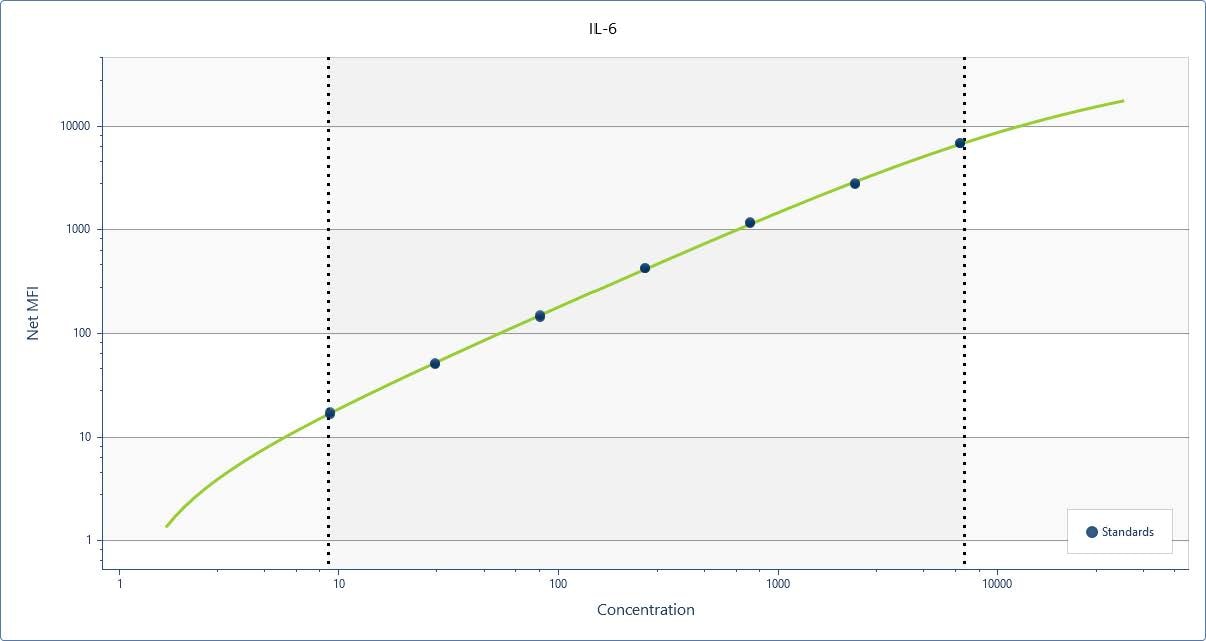
IL-6 XL Cytokine Luminex Panel Standard Curves
Preparation and Storage
Shipping
The product is shipped at ambient temperature. Upon receipt, store it immediately at the temperature recommended below.
Stability & Storage
•Store the unopened kit at 2-8 °C. Do not use past the expiration date on the label. • Avoid freezing microparticles. • Protect microparticles from light.
Background: IL-6
IL-6 (Interleukin-6) is a pleiotropic cytokine that acts in the acute phase reaction, inflammation, hematopoiesis, bone metabolism, and cancer progression. It contributes to chronic inflammation in obesity, inflammatory bowel disease, arthritis, sepsis, and atherosclerosis. IL-6 signals through a receptor complex of IL-6 R alpha and gp130. gp130 is also a component of the receptors for CLC, CNTF, CT-1, IL-11, IL-27, LIF, and OSM. Soluble forms of IL-6 R alpha are generated by both alternative splicing and proteolytic cleavage. In a mechanism known as trans-signaling, complexes of soluble IL-6 and IL-6 R alpha elicit responses from gp130-expressing cells that lack cell surface IL-6 R alpha.
R&D Systems, a Bio-Techne brand, offers a comprehensive range of IL-6 Antibody products, IL-6 Proteins and Enzymes, IL-6 ELISAs, IL-6 Luminex Assays and more. Use the filters above to drill down to the IL-6 product that best fits your needs.


 Powered by Bioz