
KDM5B (also JARID1B, RBP2-H1 and PLU-1) is a 170-200 kDa member of the JARID1 histone demethylase family of proteins. It is a transcriptional repressor that is highly expressed in Sertoli cells and mammary epithelium during pregnancy, and interacts with BF-1 and PAX9. KDM5B is reported to demethylate tri- and di-methylated Lys4 on histone H3. It has no activity on Lys9 or 27. Human KDM5B is 1544 amino acids (aa) in length. It contains a jumonji N domain (aa 32-73), an ARID DNA binding region (aa 97-187), a PHD domain (aa 309-359), a jumonji C domain (aa 486-602), one C5HC2 motif (aa 692-745), and two consecutive PHD domains (aa 1176-1538). There are three utilized phosphorylation sites at Ser1383, 1384 and 1405.There are three potential splice variants. Two show a premature truncation after Pro1433 coupled to an alternative start site at either Met396 or Met159. A third contains a 36 aa insertion after Glu237. Over aa 819-918, human KDM5B shares 96% aa identity with mouse KDM5B.
Human Lysine (K)-specific Demethylase 5B/KDM5B Antibody
R&D Systems | Catalog # AF6477


Scientific images may be resized, cropped, or adjusted for brightness or contrast for presentation purposes. These updates are limited to presentation and do not affect the underlying scientific interpretation of the data. Where available, additional source data may be provided upon request.
Key Product Details
Species Reactivity
Applications
Label
Antibody Source
Product Specifications
Immunogen
Leu819-Arg918
Accession # Q9UGL1
Specificity
Clonality
Host
Isotype
Scientific Data Images for Human Lysine (K)-specific Demethylase 5B/KDM5B Antibody
Detection of Human Lysine (K)-specific Demethylase 5B/KDM5B by Western Blot.
Western blot shows lysates of 293T human embryonic kidney cell line. PVDF Membrane was probed with 1 µg/mL of Human Lysine (K)-specific Demethylase 5B/KDM5B Antigen Affinity-purified Polyclonal Antibody (Catalog # AF6477) followed by HRP-conjugated Anti-Sheep IgG Secondary Antibody (Catalog # HAF016). A specific band was detected for Lysine (K)-specific Demethylase 5B/KDM5B at approximately 170 kDa (as indicated). This experiment was conducted under reducing conditions and using Immunoblot Buffer Group 1.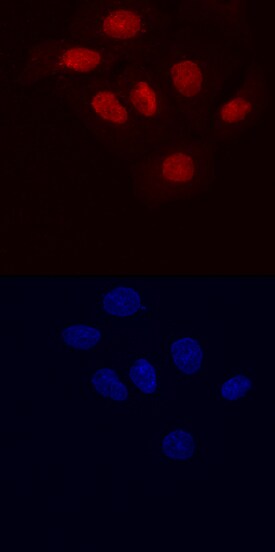
Lysine (K)-specific Demethylase 5B/KDM5B in BT‑20 Human Cell Line.
Lysine (K)-specific Demethylase 5B/KDM5B was detected in immersion fixed BT-20 human breast cancer cell line using Human Lysine (K)-specific Demethylase 5B/KDM5B Antigen Affinity-purified Polyclonal Antibody (Catalog # AF6477) at 10 µg/mL for 3 hours at room temperature. Cells were stained using the NorthernLights™ 557-conjugated Anti-Mouse IgG Secondary Antibody (red, upper panel; Catalog # NL007) and counterstained with DAPI (blue, lower panel). Specific staining was localized to nuclei. View our protocol for Fluorescent ICC Staining of Cells on Coverslips.Applications for Human Lysine (K)-specific Demethylase 5B/KDM5B Antibody
Immunocytochemistry
Sample: Immersion fixed BT‑20 human breast cancer cell line
Western Blot
Sample: 293T human embryonic kidney cell line
Formulation, Preparation, and Storage
Purification
Reconstitution
Sterile PBS to a final concentration of 0.2 mg/mL. For liquid material, refer to CoA for concentration.
Formulation
Shipping
Stability & Storage
- 12 months from date of receipt, -20 to -70 °C as supplied.
- 1 month, 2 to 8 °C under sterile conditions after reconstitution.
- 6 months, -20 to -70 °C under sterile conditions after reconstitution.
Calculators
Background: Lysine (K)-specific Demethylase 5B/KDM5B
Alternate Names
Gene Symbol
UniProt
Additional Lysine (K)-specific Demethylase 5B/KDM5B Products
Product Documents for Human Lysine (K)-specific Demethylase 5B/KDM5B Antibody
Certificate of Analysis
To download a Certificate of Analysis, please enter a lot or batch number in the search box below.
Note: Certificate of Analysis not available for kit components.
Product Specific Notices for Human Lysine (K)-specific Demethylase 5B/KDM5B Antibody
For research use only
Related Research Areas
Customer Reviews for Human Lysine (K)-specific Demethylase 5B/KDM5B Antibody
There are currently no reviews for this product. Be the first to review Human Lysine (K)-specific Demethylase 5B/KDM5B Antibody and earn rewards!
Have you used Human Lysine (K)-specific Demethylase 5B/KDM5B Antibody?
Submit a review and receive an Amazon gift card!
$25/€18/£15/$25CAN/¥2500 for a review with an image
$10/€7/£6/$10CAN/¥1110 for a review without an image
Submit a review
Protocols
Find general support by application which include: protocols, troubleshooting, illustrated assays, videos and webinars.
- Appropriate Fixation of IHC/ICC Samples
- Cellular Response to Hypoxia Protocols
- ClariTSA™ Fluorophore Kits
- Detection & Visualization of Antibody Binding
- ICC Cell Smear Protocol for Suspension Cells
- ICC Immunocytochemistry Protocol Videos
- ICC for Adherent Cells
- Immunocytochemistry (ICC) Protocol
- Immunocytochemistry Troubleshooting
- Immunofluorescence of Organoids Embedded in Cultrex Basement Membrane Extract
- Immunohistochemistry (IHC) and Immunocytochemistry (ICC) Protocols
- Preparing Samples for IHC/ICC Experiments
- Preventing Non-Specific Staining (Non-Specific Binding)
- Primary Antibody Selection & Optimization
- Protocol for VisUCyte™ HRP Polymer Detection Reagent
- Protocol for the Fluorescent ICC Staining of Cell Smears - Graphic
- Protocol for the Fluorescent ICC Staining of Cultured Cells on Coverslips - Graphic
- Protocol for the Preparation and Fluorescent ICC Staining of Cells on Coverslips
- Protocol for the Preparation and Fluorescent ICC Staining of Non-adherent Cells
- Protocol for the Preparation and Fluorescent ICC Staining of Stem Cells on Coverslips
- Protocol for the Preparation of a Cell Smear for Non-adherent Cell ICC - Graphic
- R&D Systems Quality Control Western Blot Protocol
- TUNEL and Active Caspase-3 Detection by IHC/ICC Protocol
- The Importance of IHC/ICC Controls
- Troubleshooting Guide: Western Blot Figures
- Western Blot Conditions
- Western Blot Protocol
- Western Blot Protocol for Cell Lysates
- Western Blot Troubleshooting
- Western Blot Troubleshooting Guide
- View all Protocols, Troubleshooting, Illustrated assays and Webinars