Neural cell adhesion molecule 1 (NCAM-1) is a multifunctional member of the Ig superfamily. It belongs to a family of membrane-bound glycoproteins that are involved in Ca++ independent cell matrix and homophilic or heterophilic cell-cell interactions. NCAM-1 specifically binds to heparan sulfate proteoglycans (1), the extracellular matrix protein agrin (2), and several chondroitin sulfate proteoglycans that include neurocan and phosphocan (3). There are three main forms of human NCAM-1 that arise by alternate splicing. These are designated NCAM-120/NCAM-1 (761 amino acids [aa]), NCAM‑140 (848 aa), and NCAM-180 (1120 aa). NCAM-120 is GPI-linked, while NCAM‑140 and NCAM-180 are type I transmembrane glycoproteins (4 - 6). Additional alternate splicing adds considerable diversity to all three forms, and extracellular proteolytic processing is possible for NCAM-180 (7 ‑ 8). NCAM-1 is synthesized as a 761 aa preproprecursor that contains a 19 aa signal sequence, a 722 aa GPI-linked mature region, and a 20 aa C-terminal prosegment (4). The molecule contains five C-2 type Ig-like domains and two fibronectin type-III domains. Human to mouse, NCAM-1 is 93% aa identical. NCAM-1 appears to be highly sialylated. The polysialyation of NCAM-1 reduces its adhesive property and increases its neurite outgrowth promoting features (9). NCAM-1 in the adult brain shows a decline of sialylation relative to earlier developmental periods. In regions that retain a high degree of neuronal plasticity, however, the adult brain continues to express polysialylation-NCAM-1, suggesting sialylation of NCAM-1 is involved in regenerative processes and synaptic plasticity (10 - 13).
Human NCAM-1/CD56 Antibody (2524C) [PE]
R&D Systems | Catalog # FAB24086P

Scientific images may be resized, cropped, or adjusted for brightness or contrast for presentation purposes. These updates are limited to presentation and do not affect the underlying scientific interpretation of the data. Where available, additional source data may be provided upon request.
Key Product Details
Species Reactivity
Applications
Label
Antibody Source
Product Specifications
Immunogen
Leu20-Pro603 and Glu636-Asn741
Accession # NP_001070150
Specificity
Clonality
Host
Isotype
Scientific Data Images for Human NCAM-1/CD56 Antibody (2524C) [PE]
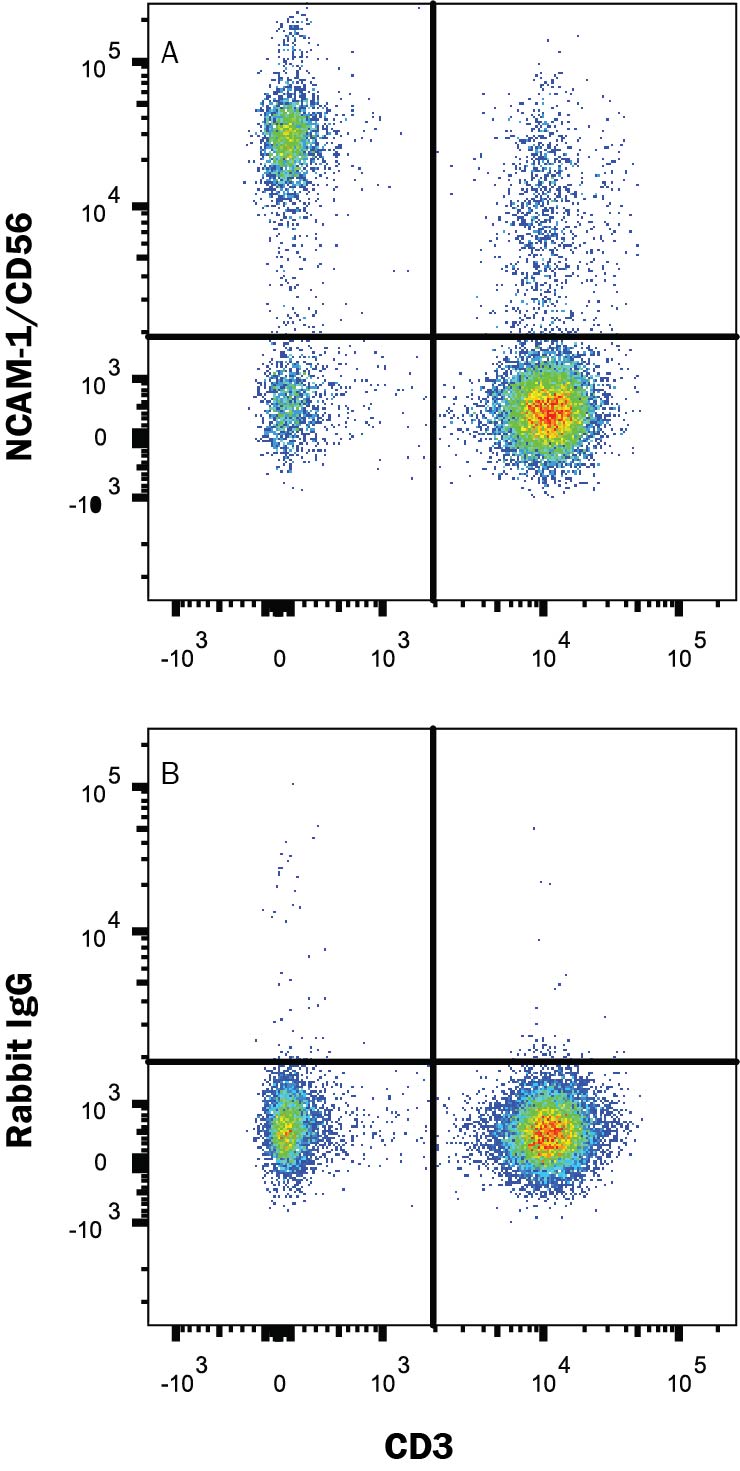
Detection of NCAM-1/CD56 in Human Peripheral Blood by Flow Cytometry.
Human peripheral blood lymphocytes were stained with Mouse Anti-Human CD3 epsilon APC-conjugated Monoclonal Antibody (Catalog # FAB100A) and either (A) Rabbit Anti-Human NCAM-1/CD56 PE-conjugated Monoclonal Antibody (Catalog # FAB24086P) or (B) Rabbit IgG Isotype Control (Catalog # IC1051P). View our protocol for Staining Membrane-associated Proteins.Applications for Human NCAM-1/CD56 Antibody (2524C) [PE]
Flow Cytometry
Sample: Human Peripheral Blood
Spectra Viewer
Plan Your Experiments
Use our spectra viewer to interactively plan your experiments, assessing multiplexing options. View the excitation and emission spectra for our fluorescent dye range and other commonly used dyes.
Spectra Viewer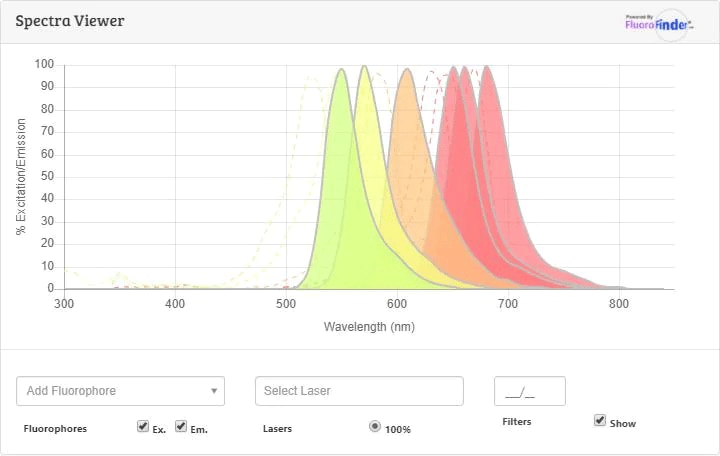
Flow Cytometry Panel Builder
Bio-Techne Knows Flow Cytometry
Save time and reduce costly mistakes by quickly finding compatible reagents using the Panel Builder Tool.
Advanced Features
- Spectra Viewer - Custom analysis of spectra from multiple fluorochromes
- Spillover Popups - Visualize the spectra of individual fluorochromes
- Antigen Density Selector - Match fluorochrome brightness with antigen density

Formulation, Preparation, and Storage
Purification
Formulation
Shipping
Stability & Storage
- 12 months from date of receipt, 2 to 8 °C as supplied.
Background: NCAM-1/CD56
References
- Burg, M.A. et al. (1995) J. Neurosci. Res. 41:49.
- Storms, S.D. and U. Rutishauser (1998) J Biol. Chem. 273:27124.
- Margolis, R.K. et al. (1996) Perspect. Dev. Neurobiol. 3:273.
- Dickson, G. et al. (1987) Cell 50:1119.
- Lanier, L.L. et al. (1991) J. Immunol. 146:4421.
- Hemperly, J.J. et al. (1990) J. Mol. Neurosci. 2:71.
- Rutishauser, U.and C. Goridis (1986) Trends Genet. 2:72.
- Vawter, M.P. et al. (2001) Exp. Neurol. 172:29.
- Rutihauser, U. (1990) Adv. Exp. Med. Biol. 265:179.
- Becker, C.G. et al. (1996) J. Neurosci. Res. 45:143.
- Doherty, P. et al. (1995) J. Neurobiol. 26:437.
- Eckardt, M. et al. (2000) J. Neurosci. 20:5234.
- Muller, D. et al. (1996) Neuron 17:413.
Long Name
Alternate Names
Gene Symbol
UniProt
Additional NCAM-1/CD56 Products
Product Documents for Human NCAM-1/CD56 Antibody (2524C) [PE]
Certificate of Analysis
To download a Certificate of Analysis, please enter a lot or batch number in the search box below.
Note: Certificate of Analysis not available for kit components.
Product Specific Notices for Human NCAM-1/CD56 Antibody (2524C) [PE]
For research use only
Related Research Areas
Customer Reviews for Human NCAM-1/CD56 Antibody (2524C) [PE]
There are currently no reviews for this product. Be the first to review Human NCAM-1/CD56 Antibody (2524C) [PE] and earn rewards!
Have you used Human NCAM-1/CD56 Antibody (2524C) [PE]?
Submit a review and receive an Amazon gift card!
$25/€18/£15/$25CAN/¥2500 for a review with an image
$10/€7/£6/$10CAN/¥1110 for a review without an image
Submit a review
Protocols
Find general support by application which include: protocols, troubleshooting, illustrated assays, videos and webinars.
- 7-Amino Actinomycin D (7-AAD) Cell Viability Flow Cytometry Protocol
- Extracellular Membrane Flow Cytometry Protocol
- Flow Cytometry Protocol for Cell Surface Markers
- Flow Cytometry Protocol for Staining Membrane Associated Proteins
- Flow Cytometry Staining Protocols
- Flow Cytometry Troubleshooting Guide
- Intracellular Flow Cytometry Protocol Using Alcohol (Methanol)
- Intracellular Flow Cytometry Protocol Using Detergents
- Intracellular Nuclear Staining Flow Cytometry Protocol Using Detergents
- Intracellular Staining Flow Cytometry Protocol Using Alcohol Permeabilization
- Intracellular Staining Flow Cytometry Protocol Using Detergents to Permeabilize Cells
- Propidium Iodide Cell Viability Flow Cytometry Protocol
- Protocol for Liperfluo
- Protocol for the Characterization of Human Th22 Cells
- Protocol for the Characterization of Human Th9 Cells
- Protocol: Annexin V and PI Staining by Flow Cytometry
- Protocol: Annexin V and PI Staining for Apoptosis by Flow Cytometry
- Troubleshooting Guide: Fluorokine Flow Cytometry Kits
- View all Protocols, Troubleshooting, Illustrated assays and Webinars
Associated Pathways