

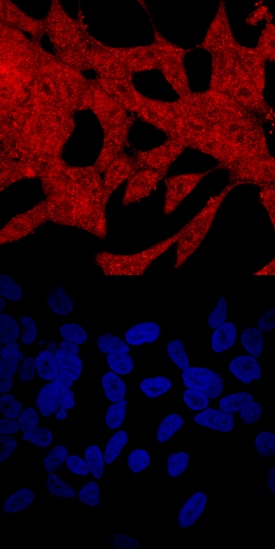
PAWR (PRKC Apoptosis WT1 Regulator protein; also PAR-4) is an intracellular, 38-42 kDa pro-apoptotic protein. It is widely expressed, and serves multiple functions. WT1 protein is both a transcriptional activator and repressor. When complexed to PAWR, WT1 activation function is repressed, while its repressor activity is enhanced. Thus, PAWR generates transcriptional repression. PAWR also binds to the atypical lambda PKC and zeta PKC isotypes. Such binding inhibits PKC avtivity, blocks cell division and MAPK activation, and promotes Fas-mediated cell apoptosis. Finally, in neurons, PAWR binds to BACE1, promoting the cleavage of APP. Human PAWR is 340 amino acids (aa) in length. It contains an Ala-rich region (aa 49-120), an NLS (aa 145-161), one coiled-coil region (aa 186-206), and a Leu-zipper domain (aa 300-340). There are at least five utilized Ser/Thr phosphorylation sites. PAWR forms noncovalent homodimers and is reported to homooligomerize. There is one potential splice form that shows a three aa substitution for aa 173-340, and a P-P-A-R substitution for A102P103. Full-length PAWR shares 78% aa identity with mouse PAWR.
