
Human PDGF-D Antibody (680018)
R&D Systems | Catalog # MAB1159

Scientific images may be resized, cropped, or adjusted for brightness or contrast for presentation purposes. These updates are limited to presentation and do not affect the underlying scientific interpretation of the data. Where available, additional source data may be provided upon request.
Key Product Details
Species Reactivity
Validated:
Cited:
Applications
Validated:
Cited:
Label
Antibody Source
Product Specifications
Immunogen
Ser250-Arg370
Accession # Q9GZP0.1
Specificity
Clonality
Host
Isotype
Endotoxin Level
Scientific Data Images for Human PDGF-D Antibody (680018)
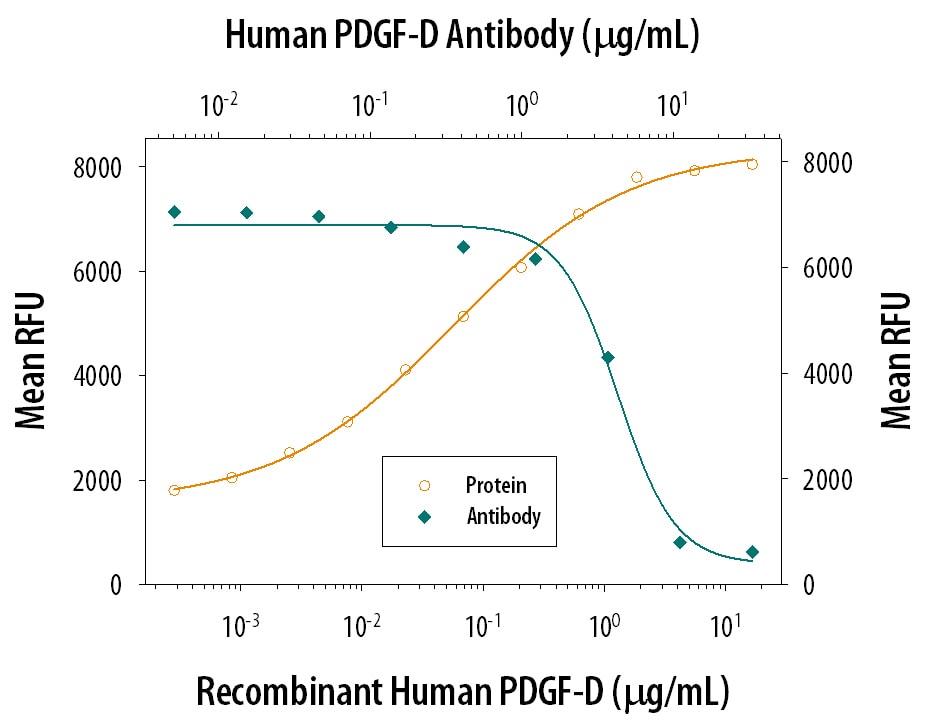
Cell Proliferation Induced by PDGF‑DD and Neutralization by Human PDGF‑D Antibody.
Recombinant Human PDGF-DD (Catalog # 1159-SB) stimulates proliferation in the NR6R-3T3 mouse fibroblast cell line in a dose-dependent manner (orange line). Proliferation elicited by Recombinant Human PDGF-DD (0.75 ug/mL) is neutralized (green line) by increasing concentrations of Mouse Anti-Human PDGF-D Monoclonal Antibody (Catalog # MAB1159). The ND50 is typically 1.5-7.5 µg/mL.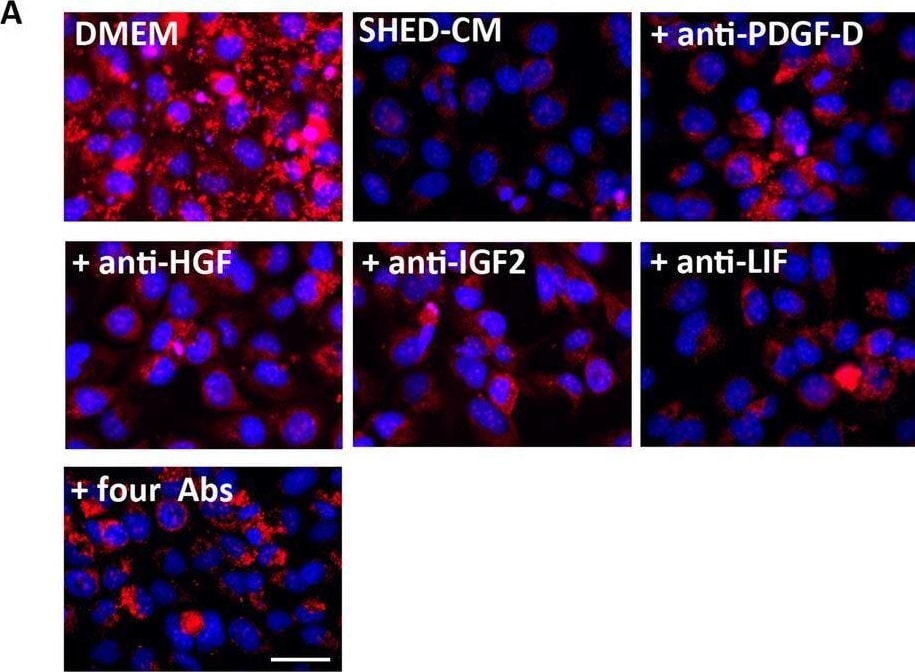
Detection of PDGF-D by Immunocytochemistry/ Immunofluorescence
Antioxidant effect of enriched proteins in SHED-CM. (A) Representative immunofluorescence images of MitoSOX analysis with nuclear DAPI staining of human acinar cell line 24 h after irradiation. Scale bar: 100 μm. (B) Quantitative analysis of the fluorescence intensities of MitoSOX analysis. The average fluorescence intensities were significantly higher in the irradiated cells treated with SHED-CM together with anti-PDGF-D antibodies or anti-HGF antibodies than those treated with SHED-CM alone. The antioxidant effect of SHED-CM was most strongly inhibited after treatment with four neutralizing antibodies together. Comparisons between groups were analyzed using an ANOVA with Tukey's multiple comparison test. Data are represented as mean ± SD (**p < 0.01, ***p < 0.001). CM, conditioned medium; HGF, hepatocyte growth factor; Fibro, fibroblast; PDGF, platelet-derived growth factor; SHED, stem cells from human exfoliated deciduous teeth. Image collected and cropped by CiteAb from the following open publication (https://pubmed.ncbi.nlm.nih.gov/36792628), licensed under a CC-BY license. Not internally tested by R&D Systems.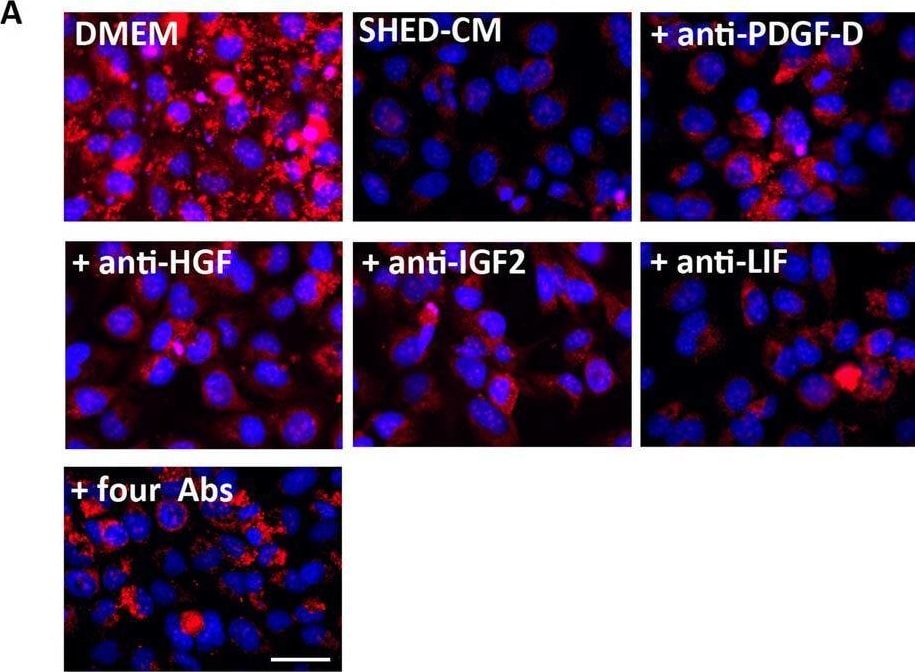
Detection of PDGF-D by Immunocytochemistry/ Immunofluorescence
Antioxidant effect of enriched proteins in SHED-CM. (A) Representative immunofluorescence images of MitoSOX analysis with nuclear DAPI staining of human acinar cell line 24 h after irradiation. Scale bar: 100 μm. (B) Quantitative analysis of the fluorescence intensities of MitoSOX analysis. The average fluorescence intensities were significantly higher in the irradiated cells treated with SHED-CM together with anti-PDGF-D antibodies or anti-HGF antibodies than those treated with SHED-CM alone. The antioxidant effect of SHED-CM was most strongly inhibited after treatment with four neutralizing antibodies together. Comparisons between groups were analyzed using an ANOVA with Tukey's multiple comparison test. Data are represented as mean ± SD (**p < 0.01, ***p < 0.001). CM, conditioned medium; HGF, hepatocyte growth factor; Fibro, fibroblast; PDGF, platelet-derived growth factor; SHED, stem cells from human exfoliated deciduous teeth. Image collected and cropped by CiteAb from the following open publication (https://pubmed.ncbi.nlm.nih.gov/36792628), licensed under a CC-BY license. Not internally tested by R&D Systems.Applications for Human PDGF-D Antibody (680018)
Neutralization
Formulation, Preparation, and Storage
Purification
Reconstitution
Sterile PBS to a final concentration of 0.5 mg/mL. For liquid material, refer to CoA for concentration.
Formulation
Shipping
Stability & Storage
- 12 months from date of receipt, -20 to -70 °C as supplied.
- 1 month, 2 to 8 °C under sterile conditions after reconstitution.
- 6 months, -20 to -70 °C under sterile conditions after reconstitution.
Calculators
Background: PDGF-D
References
- Reigstad, L.J. et al. (2005) FEBS J. 272:5723.
- Fredriksson, L. et al. (2004) Cytokine Growth Factor Rev. 15:197.
- LaRochelle, W.J. et al. (2001) Nat. Cell Biol. 3:517.
- Bergsten, E. et al. (2001) Nat. Cell Biol. 3:512.
- Uutela, M. et al. (2004) Blood 104:3198.
- Ustach, C.V. and H-R.C. Kim (2005) Mol. Cell. Biol. 25:6279.
- Ustach, C.V. et al. (2004) Canc. Res. 64:1722.
- Zhuo, Y. et al. (2003) Biochem. Biophys. Res. Commun. 308:126.
- Changsirikulchai, S. et al. (2002) Kid. Int. 62:2043.
- Ray, S. et al. (2005) J. Biol. Chem. 280:8494.
- Hudkins, K.L. et al. (2004) J. Am. Soc. Nephrol. 15:286.
- Lokker, N.A. et al. (2002) Canc. Res. 62:3729.
- Taneda, S. et al. (2003) J. Am. Soc. Nephrol. 14:2544.
- LaRochelle, W.J. et al. (2002) Canc. Res. 62:2468.
- Xu, L. et al. (2005) Canc. Res. 65:5711.
Long Name
Alternate Names
Gene Symbol
UniProt
Additional PDGF-D Products
Product Documents for Human PDGF-D Antibody (680018)
Certificate of Analysis
To download a Certificate of Analysis, please enter a lot or batch number in the search box below.
Note: Certificate of Analysis not available for kit components.
Product Specific Notices for Human PDGF-D Antibody (680018)
For research use only
Related Research Areas
Citations for Human PDGF-D Antibody (680018)
 Powered by Bioz
Customer Reviews for Human PDGF-D Antibody (680018)
There are currently no reviews for this product. Be the first to review Human PDGF-D Antibody (680018) and earn rewards!
Have you used Human PDGF-D Antibody (680018)?
Submit a review and receive an Amazon gift card!
$25/€18/£15/$25CAN/¥2500 for a review with an image
$10/€7/£6/$10CAN/¥1110 for a review without an image
Submit a review