
SPRY4 (sprouty 4) is a member of the sprouty family of proteins. It blocks tyrosine kinase growth factor activation of the MAPK signaling pathway, possibly through an interaction with either Raf1 or TESK1. Human SPRY4 is 322 amino acids (aa) in length. It contains three SH3-binding domains (aa 3‑9; 25‑31; 168‑174), an NLS (aa 87‑93), a PEST sequence (aa 118‑133), and a Cys-rich/Zn++-finger domain that binds both TESK1 and Raf1 (aa 182‑298). There are two variant isoforms. One is a short form that shows an alternate start site at Met24, while a second shows a 10 aa substitution for aa 120‑129, followed by a premature truncation. Over aa 1‑177, human SPRY4 is 89% aa identical to canine SPRY4. Mouse SPRY4 is orthologous to the human short form, and shares 90% aa identity with human SPRY4.

Key Product Details
Validated by
Biological Validation
Species Reactivity
Validated:
Human
Cited:
Human
Applications
Validated:
Western Blot, Simple Western
Cited:
Western Blot
Label
Unconjugated
Antibody Source
Polyclonal Sheep IgG
Loading...
Product Specifications
Immunogen
E. coli-derived recombinant human SPRY4
Met1-His178
Accession # NP_112226
Met1-His178
Accession # NP_112226
Specificity
Detects endogenous human SPRY4 in Western blots.
Clonality
Polyclonal
Host
Sheep
Isotype
IgG
Scientific Data Images for Human SPRY4 Antibody
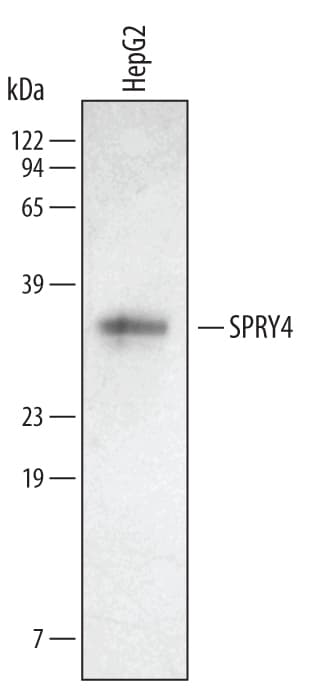
Detection of Human SPRY4 by Western Blot.
Western blot shows lysates of HepG2 human hepatocellular carcinoma cell line. PVDF membrane was probed with 1 µg/mL of Human SPRY4 Antigen Affinity-purified Polyclonal Antibody (Catalog # AF5070) followed by HRP-conjugated Anti-Sheep IgG Secondary Antibody (Catalog # HAF016). A specific band was detected for SPRY4 at approximately 35 kDa (as indicated). This experiment was conducted under reducing conditions and using Immunoblot Buffer Group 1.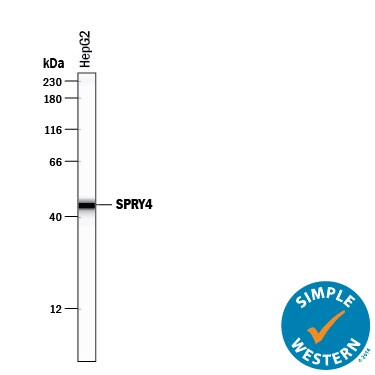
Detection of Human SPRY4 by Simple WesternTM.
Simple Western lane view shows lysates of HepG2 human hepatocellular carcinoma cell line, loaded at 0.2 mg/mL. A specific band was detected for SPRY4 at approximately 45 kDa (as indicated) using 10 µg/mL of Sheep Anti-Human SPRY4 Antigen Affinity-purified Polyclonal Antibody (Catalog # AF5070) followed by 1:50 dilution of HRP-conjugated Anti-Sheep IgG Secondary Antibody (Catalog # HAF016). This experiment was conducted under reducing conditions and using the 12-230 kDa separation system.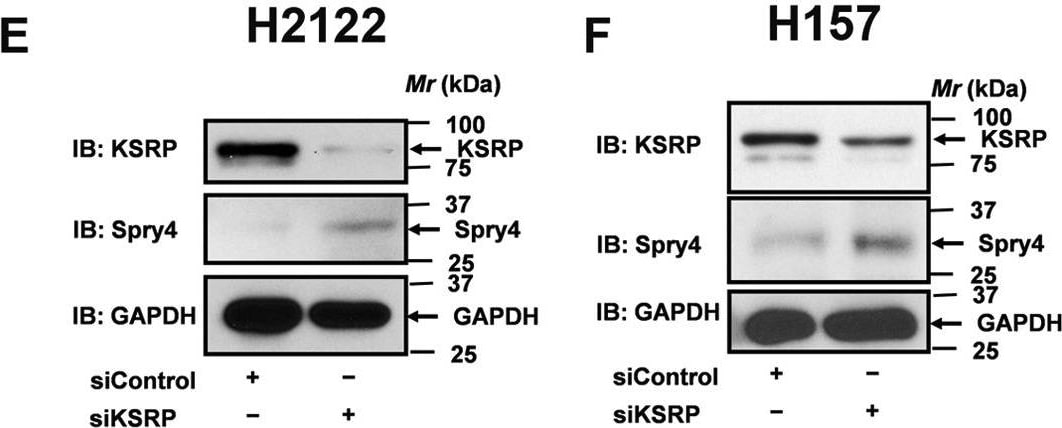
Detection of Human SPRY4 by Western Blot
KSRP is a novel regulator of Spry4.A and B, total RNA from H2122 and H157 cells treated with KSRP-specific siRNAs was isolated, and the expression of Spry4 was later determined by qPCR as described under “Experimental procedures.” **, p < 0.01, t test. C, total RNA from Beas2B cells transiently transfected with either control or FLAG-KSRP expression vectors was isolated, and the expression of Spry4 was later determined by qPCR as described under “Experimental procedures.” *, p < 0.05, t test. D, total RNA from H2122 clones with stable expression of control shRNA or KSRP shRNA was isolated, and the expression of Spry4 was later determined by qPCR as described under “Experimental procedures.” *, p < 0.05; **, p < 0.01, ANOVA. E and F, proteins from H2122 and H157 cells treated with KSRP-specific siRNAs were isolated, and the expression of Spry4 was later determined by immunoblotting. Representative data of two independent, highly reproducible experiments are displayed. Ctrl, control; IB, immunoblotting. Image collected and cropped by CiteAb from the following publication (https://linkinghub.elsevier.com/retrieve/pii/S0021925820428558), licensed under a CC-BY license. Not internally tested by R&D Systems.Applications for Human SPRY4 Antibody
Application
Recommended Usage
Simple Western
10 µg/mL
Sample: HepG2 human hepatocellular carcinoma cell line
Sample: HepG2 human hepatocellular carcinoma cell line
Western Blot
1 µg/mL
Sample: HepG2 human hepatocellular carcinoma cell line
Sample: HepG2 human hepatocellular carcinoma cell line
Formulation, Preparation, and Storage
Purification
Antigen Affinity-purified
Reconstitution
Reconstitute at 0.2 mg/mL in sterile PBS. For liquid material, refer to CoA for concentration.
Loading...
Formulation
Lyophilized from a 0.2 μm filtered solution in PBS with Trehalose. *Small pack size (SP) is supplied either lyophilized or as a 0.2 µm filtered solution in PBS.
Shipping
Lyophilized product is shipped at ambient temperature. Liquid small pack size (-SP) is shipped with polar packs. Upon receipt, store immediately at the temperature recommended below.
Stability & Storage
Use a manual defrost freezer and avoid repeated freeze-thaw cycles.
- 12 months from date of receipt, -20 to -70 °C as supplied.
- 1 month, 2 to 8 °C under sterile conditions after reconstitution.
- 6 months, -20 to -70 °C under sterile conditions after reconstitution.
Calculators
Background: SPRY4
Long Name
Sprouty Homolog 4
Alternate Names
protein sprouty homolog 4, sprouty homolog 4 (Drosophila), Spry-4
Gene Symbol
SPRY4
UniProt
Additional SPRY4 Products
Product Documents for Human SPRY4 Antibody
Certificate of Analysis
To download a Certificate of Analysis, please enter a lot or batch number in the search box below.
Note: Certificate of Analysis not available for kit components.
Product Specific Notices for Human SPRY4 Antibody
For research use only
Citations for Human SPRY4 Antibody
 Powered by Bioz
Customer Reviews for Human SPRY4 Antibody
There are currently no reviews for this product. Be the first to review Human SPRY4 Antibody and earn rewards!
Have you used Human SPRY4 Antibody?
Submit a review and receive an Amazon gift card!
$25/€18/£15/$25CAN/¥2500 for a review with an image
$10/€7/£6/$10CAN/¥1110 for a review without an image
Submit a review
Protocols
Find general support by application which include: protocols, troubleshooting, illustrated assays, videos and webinars.
- Cellular Response to Hypoxia Protocols
- R&D Systems Quality Control Western Blot Protocol
- Troubleshooting Guide: Western Blot Figures
- Western Blot Conditions
- Western Blot Protocol
- Western Blot Protocol for Cell Lysates
- Western Blot Troubleshooting
- Western Blot Troubleshooting Guide
- View all Protocols, Troubleshooting, Illustrated assays and Webinars
Loading...