Syndecan-1, designated CD138, is a dimeric type I transmembrane (TM) protein that belongs to the syndecan family of Type 1 transmembrane proteins (1, 2). The four syndecan family members are major carriers of heparan sulfate (HS) and chondroitin sulfate glycosaminoglycans (GAGs) that have different expression patterns and extracellular sequences. Syndecan-1 forms weak non-covalent homodimers, or heterodimers with Syndecan-2 or -3, through interactions of the transmembrane domain (3). It is synthesized as a 310 amino acid (aa) precursor with a 17 aa signal sequence, a 234 aa extracellular domain (ECD) that includes three closely-spaced consensus Ser-Gly HS attachment sites near the N-terminus, a 25 aa TM segment, and a 34 aa cytoplasmic region that includes a PDZ binding motif with a tyrosine phosphorylation site. The ECD is variably modified by GAGs, producing molecular weights of 120-200 kDa for native Syndecan-1. Soluble forms are shed via proteolytic cleavage. Human Syndecan-1 ECD shares 65-71% aa identity with the ECD of rat, mouse, canine, equine and bovine Syndecan-1. Syndecan-1 shows highest expression on epithelial cells such as keratinocytes, and terminally differentiated B cells such as plasma cells (4, 5). It aids wound healing in skin, cornea, and heart following myocardial infarction by promoting re-epithelialization, migration, and collagen deposition (4-8). It binds chemokines, creating chemotactic gradients when shed, but also binds and modulates integrins to control the influx of leukocytes (5, 7, 9). The net effect is to allow, but limit, inflammation. In myeloma and other cancers, shedding of Syndecan-1 can facilitate growth, angiogenesis and metastasis (10-12). Growth factors, such as FGFs and HGF, bind GAG chains and use Syndecan-1 as a coreceptor (12, 13). The GAG chains may also be used by a variety of viruses and bacteria for cell adhesion and uptake (4).
Human Syndecan-1/CD138 Antibody (359103R)
R&D Systems | Catalog # MAB2780R

Scientific images may be resized, cropped, or adjusted for brightness or contrast for presentation purposes. These updates are limited to presentation and do not affect the underlying scientific interpretation of the data. Where available, additional source data may be provided upon request.
Key Product Details
Species Reactivity
Applications
Label
Antibody Source
Product Specifications
Immunogen
Gln18-Glu251
Accession # NP_002988
Specificity
Clonality
Host
Isotype
Scientific Data Images for Human Syndecan-1/CD138 Antibody (359103R)
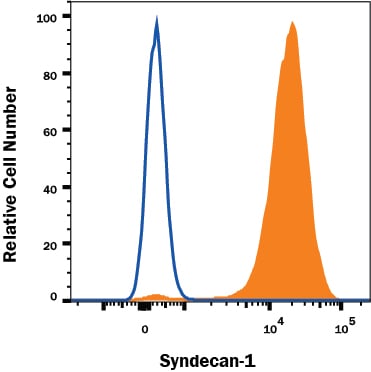
Detection of Syndecan‑1/CD138 in RPMI 8226 Human Cell Line by Flow Cytometry.
RPMI 8226 human multiple myeloma cell line was stained with Rat Anti-Human Syndecan-1/CD138 Monoclonal Antibody (Catalog # MAB2780R, filled histogram) or isotype control antibody (Catalog # MAB005, open histogram), followed by Phycoerythrin-conjugated Anti-Rat IgG Secondary Antibody (Catalog # F0105B). View our protocol for Staining Membrane-associated Proteins.Applications for Human Syndecan-1/CD138 Antibody (359103R)
CyTOF-ready
Flow Cytometry
Sample: RPMI 8226 human multiple myeloma cell line
Flow Cytometry Panel Builder
Bio-Techne Knows Flow Cytometry
Save time and reduce costly mistakes by quickly finding compatible reagents using the Panel Builder Tool.
Advanced Features
- Spectra Viewer - Custom analysis of spectra from multiple fluorochromes
- Spillover Popups - Visualize the spectra of individual fluorochromes
- Antigen Density Selector - Match fluorochrome brightness with antigen density

Formulation, Preparation, and Storage
Purification
Reconstitution
Reconstitute at 0.5 mg/mL in sterile PBS. For liquid material, refer to CoA for concentration.
Formulation
Shipping
Stability & Storage
- 12 months from date of receipt, -20 to -70 °C as supplied.
- 1 month, 2 to 8 °C under sterile conditions after reconstitution.
- 6 months, -20 to -70 °C under sterile conditions after reconstitution.
Calculators
Background: Syndecan-1/CD138
References
- Tkachenko, E. et al. (2005) Circ. Res. 96:488.
- Mali, M. et al. (1990) J. Biol. Chem. 265:6884.
- Dews, I.C. and K.R. MacKenzie (2007) Proc. Natl. Acad. Sci. USA 104:20782.
- Fears, C.Y. and A. Woods (2006) Matrix Biol. 25:443.
- Stepp, M.A. et al. (2002) J. Cell Sci. 115:4517.
- Ojeh, N. et al. (2008) J. Invest. Dermatol. 128:26.
- Stepp, M.A. et al. (2007) J. Cell Sci. 120:2851.
- Vanhoutte, D. et al. (2007) Circulation 115:475.
- Li, Q. et al. (2002) Cell 111:635.
- Beauvais, D.M. et al. (2009) J. Exp. Med. 206:691.
- Yang, Y. et al. (2007) J. Biol. Chem. 282:13326.
- Derksen, P.W.B. et al. (2002) Blood 99:1405.
- Su, G. et al. (2007) J. Biol. Chem. 282:14906.
Alternate Names
Gene Symbol
UniProt
Additional Syndecan-1/CD138 Products
Product Documents for Human Syndecan-1/CD138 Antibody (359103R)
Certificate of Analysis
To download a Certificate of Analysis, please enter a lot or batch number in the search box below.
Note: Certificate of Analysis not available for kit components.
Product Specific Notices for Human Syndecan-1/CD138 Antibody (359103R)
For research use only
Related Research Areas
Customer Reviews for Human Syndecan-1/CD138 Antibody (359103R)
There are currently no reviews for this product. Be the first to review Human Syndecan-1/CD138 Antibody (359103R) and earn rewards!
Have you used Human Syndecan-1/CD138 Antibody (359103R)?
Submit a review and receive an Amazon gift card!
$25/€18/£15/$25CAN/¥2500 for a review with an image
$10/€7/£6/$10CAN/¥1110 for a review without an image
Submit a review
Protocols
Find general support by application which include: protocols, troubleshooting, illustrated assays, videos and webinars.
- 7-Amino Actinomycin D (7-AAD) Cell Viability Flow Cytometry Protocol
- Extracellular Membrane Flow Cytometry Protocol
- Flow Cytometry Protocol for Cell Surface Markers
- Flow Cytometry Protocol for Staining Membrane Associated Proteins
- Flow Cytometry Staining Protocols
- Flow Cytometry Troubleshooting Guide
- Intracellular Flow Cytometry Protocol Using Alcohol (Methanol)
- Intracellular Flow Cytometry Protocol Using Detergents
- Intracellular Nuclear Staining Flow Cytometry Protocol Using Detergents
- Intracellular Staining Flow Cytometry Protocol Using Alcohol Permeabilization
- Intracellular Staining Flow Cytometry Protocol Using Detergents to Permeabilize Cells
- Propidium Iodide Cell Viability Flow Cytometry Protocol
- Protocol for Liperfluo
- Protocol for the Characterization of Human Th22 Cells
- Protocol for the Characterization of Human Th9 Cells
- Protocol: Annexin V and PI Staining by Flow Cytometry
- Protocol: Annexin V and PI Staining for Apoptosis by Flow Cytometry
- Troubleshooting Guide: Fluorokine Flow Cytometry Kits
- View all Protocols, Troubleshooting, Illustrated assays and Webinars