
Human TROP-2, also called tumor associated calcium signal transducer 2 (TACSTD2), GA733-1, gp50 and T16, is a type I cell surface glycoprotein that is highly expressed on human carcinomas. It was originally identified as an antigen present on human gastrointestinal tumors and is the second of two members of this family. The other family member is GA733-2, also called EpCAM, TROP-1, 17-1A, gp40 and KSA. The TROP-2 gene is unique in that it contains no introns. A study of these two genes suggested that TROP-2 was the result of a retroposition of the EpCAM gene. TROP-2 and EpCAM share approximately 49% amino acid identity and approximately 67% similarity. Human and mouse TROP-2 share 87% similarity. The human TROP-2 protein consists of a putative 26 amino acid (aa) signal sequence, a 248 aa extracellular domain, a 23 aa transmembrane region and a 26 aa cytoplasmic domain. TROP-2 is capable of transducing an intracellular calcium signal and may play a role in tumor growth. It also has adhesive functions.

Scientific images may be resized, cropped, or adjusted for brightness or contrast for presentation purposes. These updates are limited to presentation and do not affect the underlying scientific interpretation of the data. Where available, additional source data may be provided upon request.
Key Product Details
Validated by
Species Reactivity
Validated:
Cited:
Applications
Validated:
Cited:
Label
Antibody Source
Product Specifications
Immunogen
Thr88-Thr274
Accession # P09758
Specificity
Clonality
Host
Isotype
Scientific Data Images for Human TROP-2 Antibody
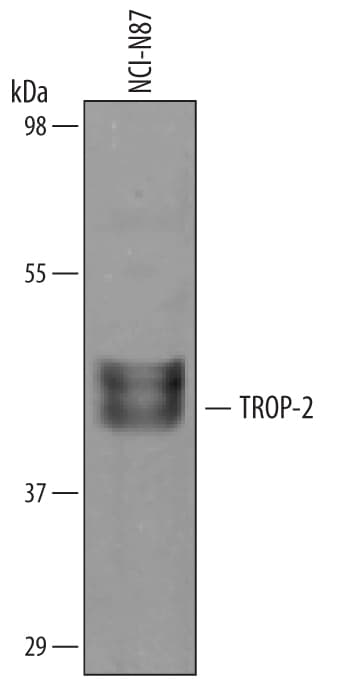
Detection of Human TROP‑2 by Western Blot.
Western blot shows lysates of NCI-N87 human gastric carcinoma cell line. PVDF membrane was probed with 1 µg/mL of Goat Anti-Human TROP-2 Antigen Affinity-purified Polyclonal Antibody (Catalog # AF650) followed by HRP-conjugated Anti-Goat IgG Secondary Antibody (Catalog # HAF019). A specific band was detected for TROP-2 at approximately 45-50 kDa (as indicated). This experiment was conducted under reducing conditions and using Immunoblot Buffer Group 8.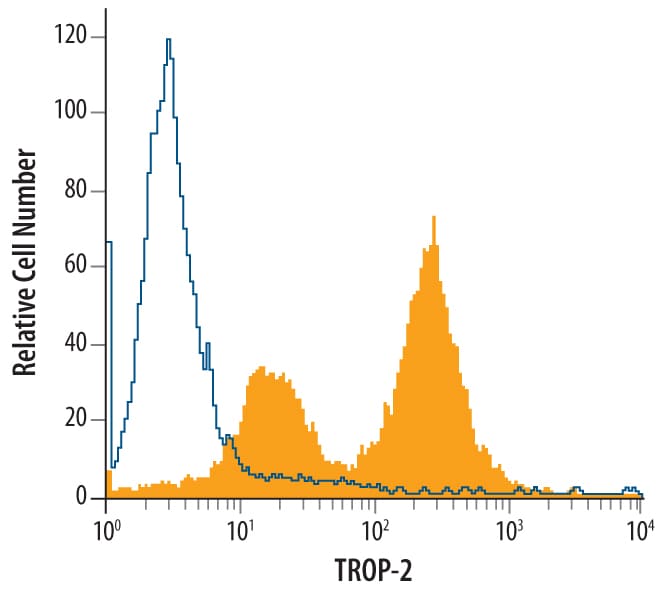
Detection of TROP‑2 in PC‑3 Human Cell Line by Flow Cytometry.
PC-3 human prostate cancer cell line was stained with Goat Anti-Human TROP-2 Antigen Affinity-purified Polyclonal Antibody (Catalog # AF650, filled histogram) or control antibody (Catalog # AB-108-C, open histogram), followed by Phycoerythrin-conjugated Anti-Goat IgG Secondary Antibody (Catalog # F0107).
TROP‑2 in Human Brain.
TROP-2 was detected in immersion fixed paraffin-embedded sections of human brain (frontal cortex) using Goat Anti-Human TROP-2 Antigen Affinity-purified Polyclonal Antibody (Catalog # AF650) at 10 µg/mL overnight at 4 °C. Before incubation with the primary antibody tissue was subjected to heat-induced epitope retrieval using Antigen Retrieval Reagent-Basic (Catalog # CTS013). Tissue was stained using the Anti-Goat HRP-DAB Cell & Tissue Staining Kit (brown; Catalog # CTS008) and counterstained with hematoxylin (blue). View our protocol for Chromogenic IHC Staining of Paraffin-embedded Tissue Sections.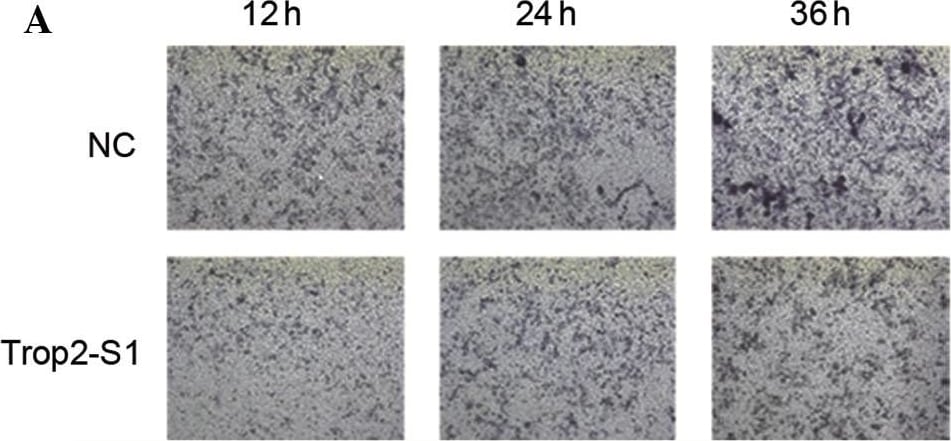
Detection of Human TROP-2 by Immunohistochemistry
Downregulation of Trop2 inhibits cell invasion. (A) The invasive capability of Hep2 cells transfected with NC or Trop2 siRNA (Trop2-S1) was measured at the indicated time points using the Transwell assay. (B) The number of cells on the underside of the chamber was counted. NC, negative control, siRNA, small interfering RNA. Image collected and cropped by CiteAb from the following publication (https://pubmed.ncbi.nlm.nih.gov/25779928), licensed under a CC-BY license. Not internally tested by R&D Systems.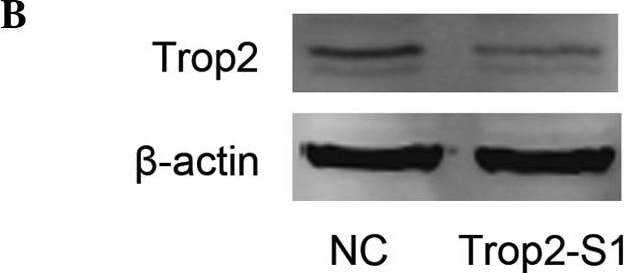
Detection of Human TROP-2 by Western Blot
Knockdown of Trop2 expression in Hep2 cells by siRNA. (A) Trop2 mRNA expression in Hep2 cells was examined by reverse transcription-quantitative polymerase chain reaction 48 h after transfection with Trop2 siRNA or NC, as indicated (*P<0.05, **P<0.001). (B) Western blot analysis of Trop2 protein expression in Hep2 cells 48 h following transfection with siRNA as indicated. siRNA, small interfering RNA; NC, negative control. Image collected and cropped by CiteAb from the following publication (https://pubmed.ncbi.nlm.nih.gov/25779928), licensed under a CC-BY license. Not internally tested by R&D Systems.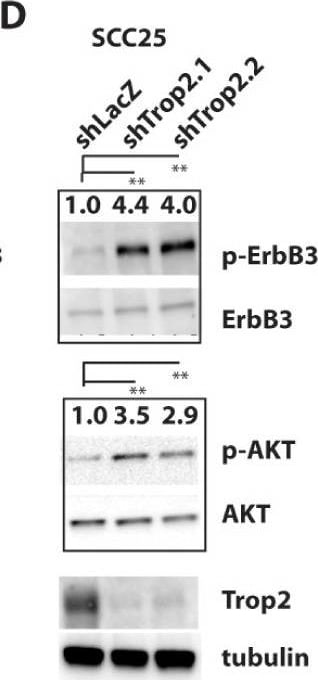
Detection of Human TROP-2 by Knockdown Validated
Trop2 Loss Promotes ErbB3 Activation in HNSCC CellsA. Immunofluorescence images of Trop2 staining (green) in SCC1 HNSCC cells after stable knockdown using short hairpins targeting the Trop2 cDNA. Nuclei are counterstained with 4′6-diamidino-2-phenylindole (DAPI). B. Results of a phosphorylated receptor tyrosine kinase antibody array demonstrating elevated p-ErbB3 in lysates from Trop2 knockdown SCC1 cells. The exposures were normalized to the control spots (four corners), which exhibit equal intensities. C&D. Representative immunoblots showing hyperactivation of ErbB3 and AKT caused by Trop2 loss in SCC1 and SCC25 HNSCC cells. Two short hairpins targeting distinct regions of the Trop2 cDNA were used. E. Reduction of ErbB3 activity after ectopic expression of an RNAi-resistant Trop2 cDNA in Trop2 knockdown SCC1 cells. Arrow points to the lower band which is the correct size for Trop2. F. Ectopic expression of a Flag-epitope tagged Trop2 cDNA in SCC1 cells suppresses basal ErbB3 and AKT activation. Control is an empty vector. Relative increases in phosphoproteins in control versus experimental groups were quantified by photodensitometry after normalization to total ErbB3 or AKT protein which served as an internal controls. Immunoblots are representative of at least three independent experiments. Significance was measured by student's t test, * (P<0.05), ** (P<0.01), *** (P<0.001). Image collected and cropped by CiteAb from the following publication (https://www.oncotarget.com/lookup/doi/10.18632/oncotarget.2423), licensed under a CC-BY license. Not internally tested by R&D Systems.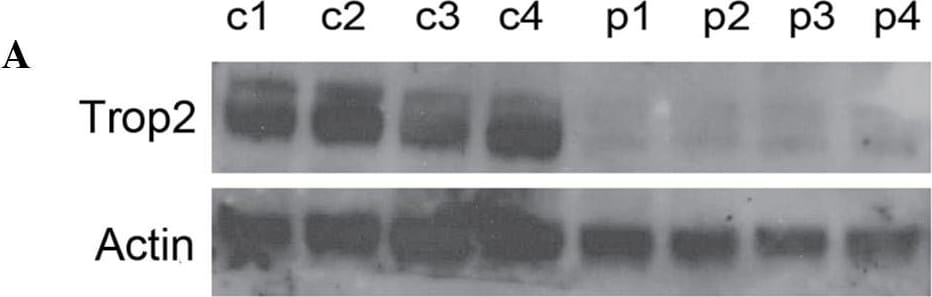
Detection of Human TROP-2 by Western Blot
Trop2 expression in laryngeal squamous cell carcinoma tissue. (A) Western blot analysis of the protein expression of Trop2 in laryngeal carcinoma tissues (c1, c2, c3 and c4) and paired paracancerous tissues (p1, p2, p3 and p4). Actin was used as a loading control. Representative (B) negative and (C) high expression of Trop2 in paraffin embedding laryngeal carcinoma and precancerous tissues, demonstrated using immunohistochemical staining. Image collected and cropped by CiteAb from the following publication (https://pubmed.ncbi.nlm.nih.gov/25779928), licensed under a CC-BY license. Not internally tested by R&D Systems.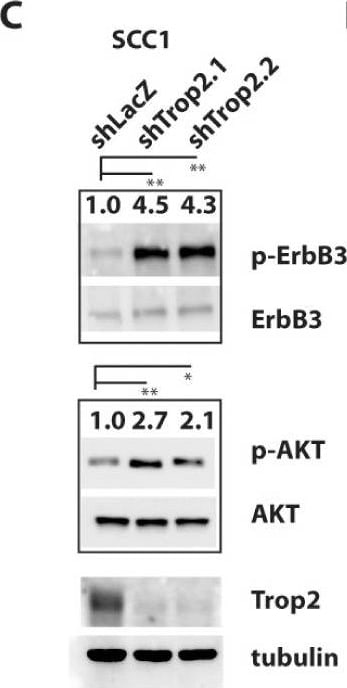
Detection of Human TROP-2 by Knockdown Validated
Trop2 Loss Promotes ErbB3 Activation in HNSCC CellsA. Immunofluorescence images of Trop2 staining (green) in SCC1 HNSCC cells after stable knockdown using short hairpins targeting the Trop2 cDNA. Nuclei are counterstained with 4′6-diamidino-2-phenylindole (DAPI). B. Results of a phosphorylated receptor tyrosine kinase antibody array demonstrating elevated p-ErbB3 in lysates from Trop2 knockdown SCC1 cells. The exposures were normalized to the control spots (four corners), which exhibit equal intensities. C&D. Representative immunoblots showing hyperactivation of ErbB3 and AKT caused by Trop2 loss in SCC1 and SCC25 HNSCC cells. Two short hairpins targeting distinct regions of the Trop2 cDNA were used. E. Reduction of ErbB3 activity after ectopic expression of an RNAi-resistant Trop2 cDNA in Trop2 knockdown SCC1 cells. Arrow points to the lower band which is the correct size for Trop2. F. Ectopic expression of a Flag-epitope tagged Trop2 cDNA in SCC1 cells suppresses basal ErbB3 and AKT activation. Control is an empty vector. Relative increases in phosphoproteins in control versus experimental groups were quantified by photodensitometry after normalization to total ErbB3 or AKT protein which served as an internal controls. Immunoblots are representative of at least three independent experiments. Significance was measured by student's t test, * (P<0.05), ** (P<0.01), *** (P<0.001). Image collected and cropped by CiteAb from the following publication (https://www.oncotarget.com/lookup/doi/10.18632/oncotarget.2423), licensed under a CC-BY license. Not internally tested by R&D Systems.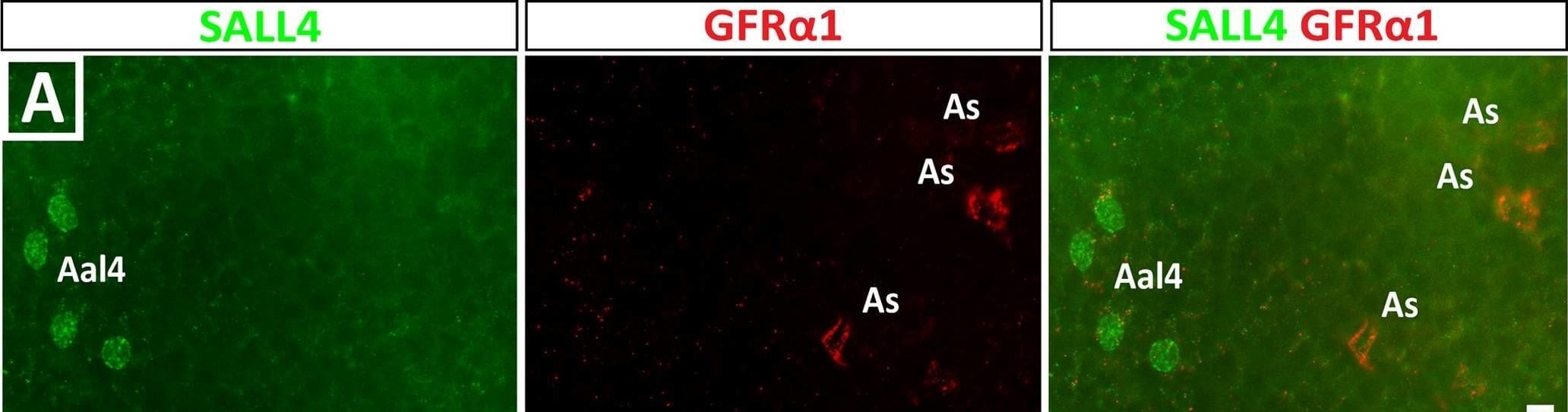
Detection of TROP-2 by Immunohistochemistry
Differential expression of GFR alpha 1 and SALL4 in As and Apr spermatogonia. Expression of GFR alpha 1 was limited to short chains of Aundiff and more restricted than expression of SALL4. (A–D) Examples of GFR alpha 1 and SALL4 expressing spermatogonial clones in whole mount seminiferous tubules. Scale bars = 10 µm. Panel D was modified from [1] with permission. (E) Quantitative evaluation of GFR alpha 1 and SALL4 expression in clones of undifferentiated spermatogonia. Among As spermatogonia, 50% of cells co-expressed both markers, but substantial populations of SALL4-only and GFR alpha 1-only cells were also observed. The number of SALL4-only cells increased in longer chains, when GFR alpha 1 expression ceased. Asym: Number of clones with molecular asymmetry. Image collected and cropped by CiteAb from the following open publication (https://pubmed.ncbi.nlm.nih.gov/23326552), licensed under a CC-BY license. Not internally tested by R&D Systems.Applications for Human TROP-2 Antibody
CyTOF-ready
Flow Cytometry
Sample: PC‑3 human prostate cancer cell line
Immunohistochemistry
Sample: Immersion fixed paraffin-embedded sections of human brain (cortex) subjected to Antigen Retrieval Reagent-Basic (Catalog # CTS013)
Western Blot
Sample: NCI‑N87 human gastric carcinoma cell line
Reviewed Applications
Read 1 review rated 4 using AF650 in the following applications:
Flow Cytometry Panel Builder
Bio-Techne Knows Flow Cytometry
Save time and reduce costly mistakes by quickly finding compatible reagents using the Panel Builder Tool.
Advanced Features
- Spectra Viewer - Custom analysis of spectra from multiple fluorochromes
- Spillover Popups - Visualize the spectra of individual fluorochromes
- Antigen Density Selector - Match fluorochrome brightness with antigen density

Formulation, Preparation, and Storage
Purification
Reconstitution
Reconstitute at 0.2 mg/mL in sterile PBS. For liquid material, refer to CoA for concentration.
Formulation
Shipping
Stability & Storage
- 12 months from date of receipt, -20 to -70 °C as supplied.
- 1 month, 2 to 8 °C under sterile conditions after reconstitution.
- 6 months, -20 to -70 °C under sterile conditions after reconstitution.
Calculators
Background: TROP-2
References
- Linnenbach, A.J. et al. (1989) Proc. Natl. Acad. Sci. USA 86:27.
- Linnenbach, A.J. et al. (1993) Mol. Cell. Biol. 13:1507.
- Fornaro, M. et al. (1995) Int. J. Cancer 62:610.
- Ripani, E. et al. (1998) Int. J. Cancer 76:671.
- El Sewedy, T. et al. (1998) Int. J. Cancer 75:324.
Long Name
Alternate Names
Gene Symbol
UniProt
Additional TROP-2 Products
Product Documents for Human TROP-2 Antibody
Certificate of Analysis
To download a Certificate of Analysis, please enter a lot or batch number in the search box below.
Note: Certificate of Analysis not available for kit components.
Product Specific Notices for Human TROP-2 Antibody
For research use only
Related Research Areas
Citations for Human TROP-2 Antibody
 Powered by Bioz
Customer Reviews for Human TROP-2 Antibody (1)
Have you used Human TROP-2 Antibody?
Submit a review and receive an Amazon gift card!
$25/€18/£15/$25CAN/¥2500 for a review with an image
$10/€7/£6/$10CAN/¥1110 for a review without an image
Submit a review
-
Application: ImmunocytochemistrySample Tested: See PMID 23151048Species: HumanVerified Customer | Posted 01/09/2015
There are no reviews that match your criteria.
Protocols
Find general support by application which include: protocols, troubleshooting, illustrated assays, videos and webinars.
- 7-Amino Actinomycin D (7-AAD) Cell Viability Flow Cytometry Protocol
- Antigen Retrieval Protocol (PIER)
- Antigen Retrieval for Frozen Sections Protocol
- Appropriate Fixation of IHC/ICC Samples
- Cellular Response to Hypoxia Protocols
- Chromogenic IHC Staining of Formalin-Fixed Paraffin-Embedded (FFPE) Tissue Protocol
- Chromogenic Immunohistochemistry Staining of Frozen Tissue
- ClariTSA™ Fluorophore Kits
- Detection & Visualization of Antibody Binding
- Extracellular Membrane Flow Cytometry Protocol
- Flow Cytometry Protocol for Cell Surface Markers
- Flow Cytometry Protocol for Staining Membrane Associated Proteins
- Flow Cytometry Staining Protocols
- Flow Cytometry Troubleshooting Guide
- Fluorescent IHC Staining of Frozen Tissue Protocol
- Graphic Protocol for Heat-induced Epitope Retrieval
- Graphic Protocol for the Preparation and Fluorescent IHC Staining of Frozen Tissue Sections
- Graphic Protocol for the Preparation and Fluorescent IHC Staining of Paraffin-embedded Tissue Sections
- Graphic Protocol for the Preparation of Gelatin-coated Slides for Histological Tissue Sections
- IHC Sample Preparation (Frozen sections vs Paraffin)
- Immunofluorescent IHC Staining of Formalin-Fixed Paraffin-Embedded (FFPE) Tissue Protocol
- Immunohistochemistry (IHC) and Immunocytochemistry (ICC) Protocols
- Immunohistochemistry Frozen Troubleshooting
- Immunohistochemistry Paraffin Troubleshooting
- Intracellular Flow Cytometry Protocol Using Alcohol (Methanol)
- Intracellular Flow Cytometry Protocol Using Detergents
- Intracellular Nuclear Staining Flow Cytometry Protocol Using Detergents
- Intracellular Staining Flow Cytometry Protocol Using Alcohol Permeabilization
- Intracellular Staining Flow Cytometry Protocol Using Detergents to Permeabilize Cells
- Preparing Samples for IHC/ICC Experiments
- Preventing Non-Specific Staining (Non-Specific Binding)
- Primary Antibody Selection & Optimization
- Propidium Iodide Cell Viability Flow Cytometry Protocol
- Protocol for Heat-Induced Epitope Retrieval (HIER)
- Protocol for Liperfluo
- Protocol for Making a 4% Formaldehyde Solution in PBS
- Protocol for VisUCyte™ HRP Polymer Detection Reagent
- Protocol for the Characterization of Human Th22 Cells
- Protocol for the Characterization of Human Th9 Cells
- Protocol for the Preparation & Fixation of Cells on Coverslips
- Protocol for the Preparation and Chromogenic IHC Staining of Frozen Tissue Sections
- Protocol for the Preparation and Chromogenic IHC Staining of Frozen Tissue Sections - Graphic
- Protocol for the Preparation and Chromogenic IHC Staining of Paraffin-embedded Tissue Sections
- Protocol for the Preparation and Chromogenic IHC Staining of Paraffin-embedded Tissue Sections - Graphic
- Protocol for the Preparation and Fluorescent IHC Staining of Frozen Tissue Sections
- Protocol for the Preparation and Fluorescent IHC Staining of Paraffin-embedded Tissue Sections
- Protocol for the Preparation of Gelatin-coated Slides for Histological Tissue Sections
- Protocol: Annexin V and PI Staining by Flow Cytometry
- Protocol: Annexin V and PI Staining for Apoptosis by Flow Cytometry
- R&D Systems Quality Control Western Blot Protocol
- TUNEL and Active Caspase-3 Detection by IHC/ICC Protocol
- The Importance of IHC/ICC Controls
- Troubleshooting Guide: Fluorokine Flow Cytometry Kits
- Troubleshooting Guide: Immunohistochemistry
- Troubleshooting Guide: Western Blot Figures
- Western Blot Conditions
- Western Blot Protocol
- Western Blot Protocol for Cell Lysates
- Western Blot Troubleshooting
- Western Blot Troubleshooting Guide
- View all Protocols, Troubleshooting, Illustrated assays and Webinars