Human TSLP R APC-conjugated Antibody
Human TSLP R APC-conjugated Antibody Summary
Gly25-Lys231
Accession # Q9HC73
Applications
Please Note: Optimal dilutions should be determined by each laboratory for each application. General Protocols are available in the Technical Information section on our website.
Scientific Data
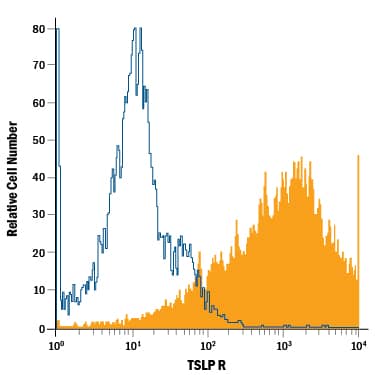 View Larger
Detection of TSLP R in NS0 Mouse Cell Line Transfected with Human TSLP R by Flow Cytometry. NS0 mouse myeloma cell line transfected with human TSLP R was stained with Mouse Anti-Human TSLP R APC-conjugated Monoclonal Antibody (Catalog # FAB981A, filled histogram) or isotype control antibody (Catalog # IC002A, open histogram). View our protocol for Staining Membrane-associated Proteins.
Reconstitution Calculator
Preparation and Storage
- 12 months from date of receipt, 2 to 8 °C as supplied.
Background: TSLPR
TSLP R, also named Delta (1) and CRLM-2 (2) (Cytokine Receptor-Like Module-2), was originally cloned as a novel type 1 cytokine receptor with similarity to the common gamma chain. It was subsequently identified to be a subunit of the cellular receptor for the IL-7-like cytokine TSLP and termed TSLP R (3). The human TSLP R cDNA encodes a 371 amino acid (aa) residue type 1 membrane protein with a 22 aa residue signal peptide, a 210 aa residue extracellular domain, a 20 aa residue transmembrane domain, and a 119 aa residue cytoplasmic domain (4, 5). The extracellular region contains two fibronectin type III-like domains and a WSXWS-like motif. The cytoplasmic domain contains a membrane-proximal box 1 motif that is known to be important for association with JAKs (4). Human TSLP R displays 39% identity to mouse TSLP R and 24% identity to the common gamma receptor (4). An alternatively spliced mRNA variant encoding a soluble TSLP R has also been reported in mouse (2). TSLP R expression is ubiquitous in the immune and hematopoietic cells, but is up-regulated in Th2-skewed cells. Cells expressing TSLP R alone bind TSLP with low affinity. Co-expression of TSLP R and IL-7 R alpha is required for high-affinity TSLP binding and signal transduction (3‑6). The TSLP R and IL-7 R alpha are co‑expressed primarily on monocytes and dendritic cells and at lower levels in lymphoid cells. TSLP has been shown to induce the release of T cell-attracting chemokines from monocytes and enhance the maturation of CD11c+ dendritic cells (5).
- Fujio, K. et al. (2000) Blood 95:2204.
- Hiroyama, T. et al. (2000) Biochem. Biophys. Res. Commun. 272:224.
- Park, L.S. et al. (2000) J. Exp. Med. 192:659.
- Tonozuka, Y. et al. (2001) Cytogenet. Cell Genet. 93:23.
- Reche, P.A. et al. (2001) J. Immunol. 167:336.
- Pandey, A. et al. (2000) Nat. Immunol. 1:59.
Product Datasheets
Citation for Human TSLP R APC-conjugated Antibody
R&D Systems personnel manually curate a database that contains references using R&D Systems products. The data collected includes not only links to publications in PubMed, but also provides information about sample types, species, and experimental conditions.
1 Citation: Showing 1 - 1
-
Combinatorial IL-17RB, ST2, and TSLPR Signaling in Dendritic Cells of Patients With Allergic Rhinitis
Authors: Rui Zheng, Yang Chen, Jianbo Shi, Kai Wang, Xuekun Huang, Yueqi Sun et al.
Frontiers in Cell and Developmental Biology
Species: Human
Sample Types: Whole Cells
Applications: Flow Cytometry
FAQs
No product specific FAQs exist for this product, however you may
View all Antibody FAQsReviews for Human TSLP R APC-conjugated Antibody
There are currently no reviews for this product. Be the first to review Human TSLP R APC-conjugated Antibody and earn rewards!
Have you used Human TSLP R APC-conjugated Antibody?
Submit a review and receive an Amazon gift card.
$25/€18/£15/$25CAN/¥75 Yuan/¥2500 Yen for a review with an image
$10/€7/£6/$10 CAD/¥70 Yuan/¥1110 Yen for a review without an image


