
KAP1 [p Ser824] Antibody
Novus Biologicals | Catalog # NB100-2350

Scientific images may be resized, cropped, or adjusted for brightness or contrast for presentation purposes. These updates are limited to presentation and do not affect the underlying scientific interpretation of the data. Where available, additional source data may be provided upon request.
Key Product Details
Validated by
Species Reactivity
Validated:
Cited:
Applications
Validated:
Cited:
Label
Antibody Source
Product Specifications
Immunogen
Reactivity Notes
Modification
Clonality
Host
Isotype
Description
Scientific Data Images for KAP1 [p Ser824] Antibody
![Immunocytochemistry/ Immunofluorescence: KAP1 [p Ser824] Antibody [NB100-2350]](https://resources.rndsystems.com/images/products/KAP1-[p-Ser824]-Antibody-Immunocytochemistry-Immunofluorescence-NB100-2350-img0015.jpg "Immunocytochemistry/ Immunofluorescence: KAP1 [p Ser824] Antibody [NB100-2350]")
Immunocytochemistry/ Immunofluorescence: KAP1 [p Ser824] Antibody [NB100-2350]
Immunocytochemistry/Immunofluorescence: KAP1 [p Ser824] Antibody [NB100-2350] - NBF-fixed asynchronous HeLa cells grown in chambered microscope slides and treated with EPE (left) or untreated (right). Antibody: Affinity purified rabbit anti-Phospho KAP-1 (S824) used at a dilution of 1:200 (1ug/ml). Detection: Red fluorescent Anti-rabbit IgG-DyLight (R) 594 conjugated used at a dilution of 1:100.![Immunohistochemistry-Paraffin: KAP1 [p Ser824] Antibody [NB100-2350]](https://resources.rndsystems.com/images/products/KAP1-[p-Ser824]-Antibody-Immunohistochemistry-Paraffin-NB100-2350-img0014.jpg "Immunohistochemistry-Paraffin: KAP1 [p Ser824] Antibody [NB100-2350]")
Immunohistochemistry-Paraffin: KAP1 [p Ser824] Antibody [NB100-2350]
Immunohistochemistry-Paraffin: KAP1 [p Ser824] Antibody [NB100-2350] - Human Phospho Kap1 (S824) by Immunohistochemistry. Sample: FFPE serial section of human lung cancer used at a dilution of 1:200 (1 ug/ml). Detection: DAB![Western Blot: KAP1 [p Ser824] Antibody [NB100-2350]](https://resources.rndsystems.com/images/products/KAP1-[p-Ser824]-Antibody-Western-Blot-NB100-2350-img0017.jpg "Western Blot: KAP1 [p Ser824] Antibody [NB100-2350]")
Western Blot: KAP1 [p Ser824] Antibody [NB100-2350]
Western Blot: KAP1 [p Ser824] Antibody [NB100-2350] - Samples: Whole cell lysate (15 ug) from NIH 3T3 cellstreated with 100 uM etoposide (+) or mock treated (-).Antibodies: Affinity purified rabbit anti-Phospho KAP-1(S824) antibody used forWB at 0.04 ug/ml. Detection: Chemiluminescence with anexposure time of 30 seconds. Lower panel shows westernblot for total KAP-1 using rabbit anti-KAP-1 recombinantmonoclonal antibody at 1:1000.![Western Blot: KAP1 [p Ser824] Antibody [NB100-2350]](https://resources.rndsystems.com/images/products/KAP1-[p-Ser824]-Antibody-Western-Blot-NB100-2350-img0018.jpg "Western Blot: KAP1 [p Ser824] Antibody [NB100-2350]")
Western Blot: KAP1 [p Ser824] Antibody [NB100-2350]
Western Blot: KAP1 [p Ser824] Antibody [NB100-2350] - Samples: Whole cell lysate (50 ug) from HEK293Tcells treated with 100 uM etoposide (+) or mock treated(-). Antibodies: Affinity purified rabbit anti-Phospho KAP-1(S824) antibody used forWB at 0.04 ug/ml. Detection: Chemiluminescence with anexposure time of 1 second. Lower panel shows westernblot for total KAP-1 using affinity purified rabbit anti KAP-1 antibody at 0.1 ug/ml.![Immunohistochemistry-Paraffin: KAP1 [p Ser824] Antibody [NB100-2350]](https://resources.rndsystems.com/images/products/KAP1-[p-Ser824]-Antibody-Immunohistochemistry-Paraffin-NB100-2350-img0013.jpg "Immunohistochemistry-Paraffin: KAP1 [p Ser824] Antibody [NB100-2350]")
Immunohistochemistry-Paraffin: KAP1 [p Ser824] Antibody [NB100-2350]
Immunohistochemistry-Paraffin: KAP1 [p Ser824] Antibody [NB100-2350] - FFPE serial sections of asynchronous HeLa cells treated with EPE (left) anduntreated HeLa cells (right). Antibody: Affinity purified rabbit anti-Phospho KAP-1 (S824) used at a dilution of 1:200 (1ug/ml). Detection: DAB![Immunoprecipitation: KAP1 [p Ser824] Antibody [NB100-2350]](https://resources.rndsystems.com/images/products/KAP1-[p-Ser824]-Antibody-Immunoprecipitation-NB100-2350-img0016.jpg "Immunoprecipitation: KAP1 [p Ser824] Antibody [NB100-2350]")
Immunoprecipitation: KAP1 [p Ser824] Antibody [NB100-2350]
Immunoprecipitation: KAP1 [p Ser824] Antibody [NB100-2350] - Samples: Whole cell lysate (1 mg for IP; 20% of IP loaded) from HEK293T cells treated with 100 uM etoposide (+) or mock treated (-). Antibodies: Rabbit anti-Phospho KAP-1 (S824) and rabbit anti-KAP-1 recombinant monoclonal antibody used for IP at 6 ug/mg lysate. For blotting immunoprecipitated Phospho KAP-1 (S824), Antibody was used at 0.04 ug/ml. To examine total KAP-1, the blot was stripped and then blotted with this antibody at 1:1000 (lower panel). Detection: Chemiluminescence with an exposure time of 1 second.Previous![KAP1 [p Ser824] Antibody](https://resources.rndsystems.com/images/products/nb100-2350_rabbit-polyclonal-kap1-p-ser824-antibody-310202415334921.jpg "Western Blot: KAP1 [p Ser824] Antibody [NB100-2350] -")
Western Blot: KAP1 [p Ser824] Antibody [NB100-2350] -
Western Blot: KAP1 [p Ser824] Antibody [NB100-2350] - MAGE I regulates KAP1 gene binding, trimethylation of histone 3 on lysine 9, & gene repression in HEK293T cells.MAGE I expression decreases binding of KAP1, H3me3K9, & repression of the ID1 tumor suppressor gene (A, B, D). In contrast, MAGE I expression increases binding of KAP1, H3me3K9, & repression of mRNA & protein levels of the Ki67 gene (E, F, H, I, J, L). Note MAGE I binds to Ki67 gene sites but not ID1 gene sites (C, G, K). “M” denotes Mock transfection control. “A3” & “C2” denote MAGE-A3 & MAGE-C2, respectively. Image collected & cropped by CiteAb from the following publication (https://pubmed.ncbi.nlm.nih.gov/21876767), licensed under a CC-BY license. Not internally tested by Novus Biologicals.![KAP1 [p Ser824] Antibody](https://resources.rndsystems.com/images/products/nb100-2350_rabbit-polyclonal-kap1-p-ser824-antibody-3102024161262.jpg "Western Blot: KAP1 [p Ser824] Antibody [NB100-2350] -")
Western Blot: KAP1 [p Ser824] Antibody [NB100-2350] -
Western Blot: KAP1 [p Ser824] Antibody [NB100-2350] - Truncated PPM1D impairs DNA damage response in mouse thymus. Expression of PPM1D mRNA analyzed by RT-qPCR in thymi of Ppm1d+/+, Ppm1dT/+ & Ppm1dT/T mice & normalized to GAPDH (n = 3) (A). Thymi from mice of indicated genotypes lysed & proteins separated by SDS-PAGE. Samples probed w/ antibody against PPM1D & importin-beta as a loading control. The empty & full arrowheads indicate the position of full-length & the C-terminally truncated PPM1D, respectively. (B). Cells from thymi from Ppm1d+/+ & Ppm1dT/+ mice analyzed by flow cytometry. Plotted are the counts of indicated populations as follows: double-negative T-cells (DN & DN1, DN2, DN3, DN4), double-positive T-cells (DP), CD8-positive T-cells (CD8+) & CD4-positive T-cells (CD4+) (n = 3) (C). The median size of thymus determined in Ppm1d +/+ (n = 11) & Ppm1dT/+ (n = 12) mice (D). A scheme of experimental setup in F-I. Mice exposed or not to a low dose of IR (3 Gy), sacrificed after 6 h & thymi & lymph nodes collected (E). Proteins isolated from thymi from mice of indicated genotypes exposed to mock or to IR probed w/ indicated antibodies by immunoblotting (F). Proteins isolated from inguinal lymph nodes from mice of indicated genotypes exposed to mock or to IR probed w/ indicated antibodies by immunoblotting (G). RNA isolated from thymi from mice in E analyzed by RT-qPCR. Expression of CDKN1Ap21 mRNA normalized to GAPDH. Statistical significance evaluated by two-tailed t-test, error bars indicate SD, n = 5 (H). RNA isolated from thymi from mice in D analyzed by RT-qPCR. Expression of PUMA mRNA normalized to GAPDH. Statistical significance evaluated by two-tailed t-test, error bars indicate SD, n = 5. * p <0.05; *** p < 0.0005; **** p < 0.0001 (I). Image collected & cropped by CiteAb from the following publication (https://pubmed.ncbi.nlm.nih.gov/32927737), licensed under a CC-BY license. Not internally tested by Novus Biologicals.![KAP1 [p Ser824] Antibody](https://resources.rndsystems.com/images/products/nb100-2350_rabbit-polyclonal-kap1-p-ser824-antibody-3102024155451.jpg "Western Blot: KAP1 [p Ser824] Antibody [NB100-2350] -")
Western Blot: KAP1 [p Ser824] Antibody [NB100-2350] -
Western Blot: KAP1 [p Ser824] Antibody [NB100-2350] - Truncated PPM1D impairs DNA damage response in mouse thymus. Expression of PPM1D mRNA analyzed by RT-qPCR in thymi of Ppm1d+/+, Ppm1dT/+ & Ppm1dT/T mice & normalized to GAPDH (n = 3) (A). Thymi from mice of indicated genotypes lysed & proteins separated by SDS-PAGE. Samples probed w/ antibody against PPM1D & importin-beta as a loading control. The empty & full arrowheads indicate the position of full-length & the C-terminally truncated PPM1D, respectively. (B). Cells from thymi from Ppm1d+/+ & Ppm1dT/+ mice analyzed by flow cytometry. Plotted are the counts of indicated populations as follows: double-negative T-cells (DN & DN1, DN2, DN3, DN4), double-positive T-cells (DP), CD8-positive T-cells (CD8+) & CD4-positive T-cells (CD4+) (n = 3) (C). The median size of thymus determined in Ppm1d +/+ (n = 11) & Ppm1dT/+ (n = 12) mice (D). A scheme of experimental setup in F-I. Mice exposed or not to a low dose of IR (3 Gy), sacrificed after 6 h & thymi & lymph nodes collected (E). Proteins isolated from thymi from mice of indicated genotypes exposed to mock or to IR probed w/ indicated antibodies by immunoblotting (F). Proteins isolated from inguinal lymph nodes from mice of indicated genotypes exposed to mock or to IR probed w/ indicated antibodies by immunoblotting (G). RNA isolated from thymi from mice in E analyzed by RT-qPCR. Expression of CDKN1Ap21 mRNA normalized to GAPDH. Statistical significance evaluated by two-tailed t-test, error bars indicate SD, n = 5 (H). RNA isolated from thymi from mice in D analyzed by RT-qPCR. Expression of PUMA mRNA normalized to GAPDH. Statistical significance evaluated by two-tailed t-test, error bars indicate SD, n = 5. * p <0.05; *** p < 0.0005; **** p < 0.0001 (I). Image collected & cropped by CiteAb from the following publication (https://pubmed.ncbi.nlm.nih.gov/32927737), licensed under a CC-BY license. Not internally tested by Novus Biologicals.Applications for KAP1 [p Ser824] Antibody
Immunocytochemistry/ Immunofluorescence
Immunohistochemistry
Immunohistochemistry-Paraffin
Immunoprecipitation
Western Blot
Reviewed Applications
Read 1 review rated 5 using NB100-2350 in the following applications:
Formulation, Preparation, and Storage
Purification
Formulation
Preservative
Concentration
Shipping
Stability & Storage
Background: KAP1
Long Name
Alternate Names
Entrez Gene IDs
Gene Symbol
UniProt
Additional KAP1 Products
Product Documents for KAP1 [p Ser824] Antibody
Certificate of Analysis
To download a Certificate of Analysis, please enter a lot or batch number in the search box below.
Product Specific Notices for KAP1 [p Ser824] Antibody
This antibody can be used as the primary antibody in a PLA assay with the following as complementing antibodies:NB100-322, NB500-158, NB100-41429
This product is for research use only and is not approved for use in humans or in clinical diagnosis. Primary Antibodies are guaranteed for 1 year from date of receipt.
Citations for KAP1 [p Ser824] Antibody
 Powered by Bioz
Customer Reviews for KAP1 [p Ser824] Antibody (1)
Have you used KAP1 [p Ser824] Antibody?
Submit a review and receive an Amazon gift card!
$25/€18/£15/$25CAN/¥2500 for a review with an image
$10/€7/£6/$10CAN/¥1110 for a review without an image
Submit a review
Customer Images
![KAP1 [p Ser824] Antibody NB100-2350](https://resources.rndsystems.com/images/reviews/review_nb100-2350_54326_0_0.jpg)
-
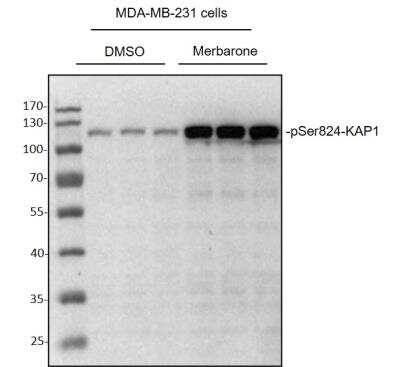
Application: Western BlotSample Tested: MDA-231 cell lysateSpecies: HumanVerified Customer | Posted 10/28/2020Western Blot: MDA-MB-231 cells were treated with DMSO or Merbarone (100 μM) for 24 hours, whole cell lysates were loaded with 50 ug/lane. 10% SDS-PAGE. KAP1 [p Ser824] Antibody (NB100-2350) primary antibody: 1:1000, 4℃, overnight.
![KAP1 [p Ser824] Antibody NB100-2350](data:image/png;base64,R0lGODlhAQABAAD/ACwAAAAAAQABAAACADs=)
There are no reviews that match your criteria.
Protocols
Find general support by application which include: protocols, troubleshooting, illustrated assays, videos and webinars.
- Antigen Retrieval Protocol (PIER)
- Antigen Retrieval for Frozen Sections Protocol
- Appropriate Fixation of IHC/ICC Samples
- Cellular Response to Hypoxia Protocols
- ChIP Protocol Video
- Chromatin Immunoprecipitation (ChIP) Protocol
- Chromatin Immunoprecipitation Protocol
- Chromogenic IHC Staining of Formalin-Fixed Paraffin-Embedded (FFPE) Tissue Protocol
- Chromogenic Immunohistochemistry Staining of Frozen Tissue
- ClariTSA™ Fluorophore Kits
- Detection & Visualization of Antibody Binding
- Fluorescent IHC Staining of Frozen Tissue Protocol
- Graphic Protocol for Heat-induced Epitope Retrieval
- Graphic Protocol for the Preparation and Fluorescent IHC Staining of Frozen Tissue Sections
- Graphic Protocol for the Preparation and Fluorescent IHC Staining of Paraffin-embedded Tissue Sections
- Graphic Protocol for the Preparation of Gelatin-coated Slides for Histological Tissue Sections
- ICC Cell Smear Protocol for Suspension Cells
- ICC Immunocytochemistry Protocol Videos
- ICC for Adherent Cells
- IHC Sample Preparation (Frozen sections vs Paraffin)
- Immunocytochemistry (ICC) Protocol
- Immunocytochemistry Troubleshooting
- Immunofluorescence of Organoids Embedded in Cultrex Basement Membrane Extract
- Immunofluorescent IHC Staining of Formalin-Fixed Paraffin-Embedded (FFPE) Tissue Protocol
- Immunohistochemistry (IHC) and Immunocytochemistry (ICC) Protocols
- Immunohistochemistry Frozen Troubleshooting
- Immunohistochemistry Paraffin Troubleshooting
- Immunoprecipitation Protocol
- Preparing Samples for IHC/ICC Experiments
- Preventing Non-Specific Staining (Non-Specific Binding)
- Primary Antibody Selection & Optimization
- Protocol for Heat-Induced Epitope Retrieval (HIER)
- Protocol for Making a 4% Formaldehyde Solution in PBS
- Protocol for VisUCyte™ HRP Polymer Detection Reagent
- Protocol for the Fluorescent ICC Staining of Cell Smears - Graphic
- Protocol for the Fluorescent ICC Staining of Cultured Cells on Coverslips - Graphic
- Protocol for the Preparation & Fixation of Cells on Coverslips
- Protocol for the Preparation and Chromogenic IHC Staining of Frozen Tissue Sections
- Protocol for the Preparation and Chromogenic IHC Staining of Frozen Tissue Sections - Graphic
- Protocol for the Preparation and Chromogenic IHC Staining of Paraffin-embedded Tissue Sections
- Protocol for the Preparation and Chromogenic IHC Staining of Paraffin-embedded Tissue Sections - Graphic
- Protocol for the Preparation and Fluorescent ICC Staining of Cells on Coverslips
- Protocol for the Preparation and Fluorescent ICC Staining of Non-adherent Cells
- Protocol for the Preparation and Fluorescent ICC Staining of Stem Cells on Coverslips
- Protocol for the Preparation and Fluorescent IHC Staining of Frozen Tissue Sections
- Protocol for the Preparation and Fluorescent IHC Staining of Paraffin-embedded Tissue Sections
- Protocol for the Preparation of Gelatin-coated Slides for Histological Tissue Sections
- Protocol for the Preparation of a Cell Smear for Non-adherent Cell ICC - Graphic
- R&D Systems Quality Control Western Blot Protocol
- TUNEL and Active Caspase-3 Detection by IHC/ICC Protocol
- The Importance of IHC/ICC Controls
- Troubleshooting Guide: Immunohistochemistry
- Troubleshooting Guide: Western Blot Figures
- Western Blot Conditions
- Western Blot Protocol
- Western Blot Protocol for Cell Lysates
- Western Blot Troubleshooting
- Western Blot Troubleshooting Guide
- View all Protocols, Troubleshooting, Illustrated assays and Webinars