
LAMP-1/CD107a Antibody (5H6) - BSA Free
Novus Biologicals | Catalog # NBP2-25154

![Immunocytochemistry/ Immunofluorescence: LAMP-1/CD107a Antibody (5H6) [NBP2-25154]](https://resources.rndsystems.com/images/products/LAMP-1-CD107a-Antibody-5H6-Immunocytochemistry-Immunofluorescence-NBP2-25154-img0007.jpg "Immunocytochemistry/ Immunofluorescence: LAMP-1/CD107a Antibody (5H6) [NBP2-25154]")
Scientific images may be resized, cropped, or adjusted for brightness or contrast for presentation purposes. These updates are limited to presentation and do not affect the underlying scientific interpretation of the data. Where available, additional source data may be provided upon request.
Key Product Details
Validated by
Biological Validation
Species Reactivity
Validated:
Human, Mouse
Cited:
Mouse, Fish - Danio rerio (Zebrafish)
Applications
Validated:
Immunohistochemistry, Western Blot, Immunocytochemistry/ Immunofluorescence
Cited:
Immunohistochemistry-Paraffin, Immunocytochemistry/ Immunofluorescence
Label
Unconjugated
Antibody Source
Monoclonal Mouse IgG1 Clone # 5H6
Format
BSA Free
Loading...
Product Specifications
Immunogen
Amino acids 32-350 of the human LAMP1 precursor sequence. [UniProt# P11279]
Reactivity Notes
Human Specific. Mouse reactivity reported in scientific literature (PMID: 29789598).
Localization
Cell membrane; Single-pass type I membrane protein. Endosome membrane; Single-pass type I membrane protein. Lysosome membrane; Single-pass type I membrane protein. Late endosome.
Marker
Late Endosome Marker
Clonality
Monoclonal
Host
Mouse
Isotype
IgG1
Theoretical MW
90-120 kDa.
Disclaimer note: The observed molecular weight of the protein may vary from the listed predicted molecular weight due to post translational modifications, post translation cleavages, relative charges, and other experimental factors.
Disclaimer note: The observed molecular weight of the protein may vary from the listed predicted molecular weight due to post translational modifications, post translation cleavages, relative charges, and other experimental factors.
Scientific Data Images for LAMP-1/CD107a Antibody (5H6) - BSA Free
Immunocytochemistry/ Immunofluorescence: LAMP-1/CD107a Antibody (5H6) [NBP2-25154]
Immunocytochemistry/Immunofluorescence: LAMP-1/CD107a Antibody (5H6) [NBP2-25154] - Analysis of HeLa cells stained with mouse LAMP-1/CD107a mAb, dilution 1:500 (Red), and costained with chicken Vimentin pAb, dilution 1:10000, (Green). DAPI staining of nuclear DNA (Blue). The cells were treated with 50uM of chloroquine, an inhibitor of autophagy, for 16hrs prior to staining. The LAMP-1/CD107a antibody reveals vesicular staining of LAMP1 protein accumulated in swollen lysosomes, while the Vimentin antibody specifically labels the intermediate filament network in these cells.![Western Blot: LAMP-1/CD107a Antibody (5H6) [NBP2-25154]](https://resources.rndsystems.com/images/products/LAMP-1-CD107a-Antibody-5H6-Western-Blot-NBP2-25154-img0006.jpg "Western Blot: LAMP-1/CD107a Antibody (5H6) [NBP2-25154]")
Western Blot: LAMP-1/CD107a Antibody (5H6) [NBP2-25154]
Western Blot: LAMP-1/CD107a Antibody (5H6) [NBP2-25154] - Analysis of different cell lysates using mouse mAb to LAMP1, NBP2-25154 dilution 1:10,000 in green. Cells were maintained under normal conditions (Ct), or treated with 50uM of chloroquine (CQ), an inhibitor of autophagy, for 24 hours: [1] protein standard (red), [2] HeLa Ct, [3] HeLa+CQ, [4] NIH-3T3 Ct, and [5] NIH-3T3+CQ. The smeared band between 75-120kDa corresponds to variably glycosylated forms of the LAMP1 protein detected only in the human cells, this antibody fails to recognize the rodent homologue. The same blot was probed with chicken pAB to HSP60, dilution 1:20,000. The HSP60 antibody reveals heat shock 60 protein with apparent molecular weight of 60kDa in all preparations.![Immunocytochemistry/ Immunofluorescence: LAMP-1/CD107a Antibody (5H6) [NBP2-25154]](https://resources.rndsystems.com/images/products/LAMP-1-CD107a-Antibody-5H6-Immunocytochemistry-Immunofluorescence-NBP2-25154-img0008.jpg "Immunocytochemistry/ Immunofluorescence: LAMP-1/CD107a Antibody (5H6) [NBP2-25154]")
Immunocytochemistry/ Immunofluorescence: LAMP-1/CD107a Antibody (5H6) [NBP2-25154]
LAMP-1-CD107a-Antibody-5H6-Immunocytochemistry-Immunofluorescence-NBP2-25154-img0008.jpg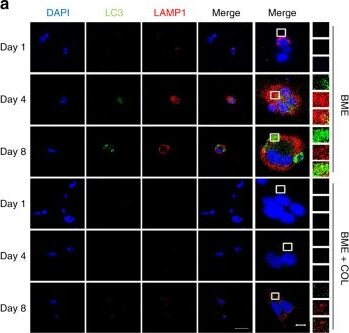
Immunocytochemistry/ Immunofluorescence: LAMP-1/CD107a Antibody (5H6) - BSA Free [NBP2-25154] -
D2.0 R cells activate autophagy upon entering a dormant state. Representative images are shown for a Immunofluorescent staining of lysosomal (LAMP1, red) and autophagic (LC3, green) markers of D2.0 R cells in BME (upper panels) and BME + COL1 (lower panels) with b Quantification of the percentage of cells exhibiting LC3 positive puncta and LAMP1 staining out of the total number of cells analysed (mean +/- s.e.m, n = 30–42 cells. Comparisons are relative to Day 1 by Kruskal–Wallis, Dunn’s post test. *P ≤ 0.05; ****P ≤ 0.0001) and the average number of LC3 puncta per cell (Comparisons by Kruskal–Wallis, Dunn’s post test. **P ≤ 0.01 and ****P ≤ 0.0001). c D2.0 R cells transfected with the mCherry-GFP-LC3 reporter show activation and completion of the autophagic cycle (red fluorescence only) when plated in BME matrices for 8 days. d The graphs represent the percentage of cells with double-positive puncta (mCherry+ and GFP+) (autophagosomes) out of the total number of cells analysed (left graph) (mean +/- s.e.m, n = 35–39 cells). Comparisons by Kruskal–Wallis, Dunn’s post test. ****P ≤ 0.0001) and the rate of conversion from cells exhibiting yellow puncta to red-only puncta expressed as fold change (right graph). Scale bars are 50 and 10 μm for a and 20 and 10 μm for b Image collected and cropped by CiteAb from the following open publication (https://pubmed.ncbi.nlm.nih.gov/29789598), licensed under a CC-BY license. Not internally tested by Novus Biologicals.Applications for LAMP-1/CD107a Antibody (5H6) - BSA Free
Application
Recommended Usage
Immunocytochemistry/ Immunofluorescence
1:2000
Immunohistochemistry
1:2000
Western Blot
1:1000-1:10000
Application Notes
This LAMP1 (5H6) antibody is useful for Immunocytochemistry/Immunofluorescence, Immunohistochemistry, and Western Blot, where a band can be seen at ~90-120 kDa.
Formulation, Preparation, and Storage
Purification
Immunogen affinity purified
Formulation
PBS, 50% glycerol
Format
BSA Free
Preservative
5mM Sodium Azide
Concentration
1 mg/ml
Shipping
The product is shipped with polar packs. Upon receipt, store it immediately at the temperature recommended below.
Stability & Storage
Store at 4C short term. Aliquot and store at -20C long term. Avoid freeze-thaw cycles.
Background: LAMP-1/CD107a
LAMP-1 plays an important role in autophagy-mediated ATP-release during apoptosis where lysosomes containing intracellular ATP migrate to the plasma membrane and, during exocytosis, LAMP-1 is exposed to the cell surface (5). Studies have found that knockdown of LAMP-1 blocks the ATP release from the cell (5). Furthermore, an absence of LAMP-1 and LAMP-2 leads to an accumulation of lysosomal cholesterol (6). Lysosomal membrane dysfunction or defects has also been associated with disease development (6,7). For example, one feature of pancreatitis is autophagy impairment which is caused by lysosomal dysfunction and a corresponding decrease in lysosomal-membrane associated proteins LAMP-1 and LAMP-2 (7).
References
1. Eskelinen E. L. (2006). Roles of LAMP-1 and LAMP-2 in lysosome biogenesis and autophagy. Molecular aspects of medicine, 27(5-6), 495-502. https://doi.org/10.1016/j.mam.2006.08.005
2. Cheng, X. T., Xie, Y. X., Zhou, B., Huang, N., Farfel-Becker, T., & Sheng, Z. H. (2018). Revisiting LAMP1 as a marker for degradative autophagy-lysosomal organelles in the nervous system. Autophagy, 14(8), 1472-1474. https://doi.org/10.1080/15548627.2018.1482147
3. Krzewski, K., & Coligan, J. E. (2012). Human NK cell lytic granules and regulation of their exocytosis. Frontiers in immunology, 3, 335. https://doi.org/10.3389/fimmu.2012.00335
4. Uniprot (P11279)
5. Wang, Y., Martins, I., Ma, Y., Kepp, O., Galluzzi, L., & Kroemer, G. (2013). Autophagy-dependent ATP release from dying cells via lysosomal exocytosis. Autophagy, 9(10), 1624-1625. https://doi.org/10.4161/auto.25873
6. Schwake, M., Schr0der, B., & Saftig, P. (2013). Lysosomal membrane proteins and their central role in physiology. Traffic (Copenhagen, Denmark), 14(7), 739-748. https://doi.org/10.1111/tra.12056
7. Gukovsky, I., Pandol, S. J., Mareninova, O. A., Shalbueva, N., Jia, W., & Gukovskaya, A. S. (2012). Impaired autophagy and organellar dysfunction in pancreatitis. Journal of gastroenterology and hepatology, 27 Suppl 2(Suppl 2), 27-32. https://doi.org/10.1111/j.1440-1746.2011.07004.x
Long Name
Lysosome-associated Membrane Glycoprotein 1
Alternate Names
CD107a, LAMP1
Entrez Gene IDs
3916 (Human)
Gene Symbol
LAMP1
OMIM
153330 (Human)
UniProt
Additional LAMP-1/CD107a Products
Product Documents for LAMP-1/CD107a Antibody (5H6) - BSA Free
Certificate of Analysis
To download a Certificate of Analysis, please enter a lot or batch number in the search box below.
Product Specific Notices for LAMP-1/CD107a Antibody (5H6) - BSA Free
This product is for research use only and is not approved for use in humans or in clinical diagnosis. Primary Antibodies are guaranteed for 1 year from date of receipt.
Citations for LAMP-1/CD107a Antibody (5H6) - BSA Free
 Powered by Bioz
Customer Reviews for LAMP-1/CD107a Antibody (5H6) - BSA Free
There are currently no reviews for this product. Be the first to review LAMP-1/CD107a Antibody (5H6) - BSA Free and earn rewards!
Have you used LAMP-1/CD107a Antibody (5H6) - BSA Free?
Submit a review and receive an Amazon gift card!
$25/€18/£15/$25CAN/¥2500 for a review with an image
$10/€7/£6/$10CAN/¥1110 for a review without an image
Submit a review
Protocols
Find general support by application which include: protocols, troubleshooting, illustrated assays, videos and webinars.
- Antigen Retrieval Protocol (PIER)
- Antigen Retrieval for Frozen Sections Protocol
- Appropriate Fixation of IHC/ICC Samples
- Cellular Response to Hypoxia Protocols
- Chromogenic IHC Staining of Formalin-Fixed Paraffin-Embedded (FFPE) Tissue Protocol
- Chromogenic Immunohistochemistry Staining of Frozen Tissue
- ClariTSA™ Fluorophore Kits
- Detection & Visualization of Antibody Binding
- Fluorescent IHC Staining of Frozen Tissue Protocol
- Graphic Protocol for Heat-induced Epitope Retrieval
- Graphic Protocol for the Preparation and Fluorescent IHC Staining of Frozen Tissue Sections
- Graphic Protocol for the Preparation and Fluorescent IHC Staining of Paraffin-embedded Tissue Sections
- Graphic Protocol for the Preparation of Gelatin-coated Slides for Histological Tissue Sections
- ICC Cell Smear Protocol for Suspension Cells
- ICC Immunocytochemistry Protocol Videos
- ICC for Adherent Cells
- IHC Sample Preparation (Frozen sections vs Paraffin)
- Immunocytochemistry (ICC) Protocol
- Immunocytochemistry Troubleshooting
- Immunofluorescence of Organoids Embedded in Cultrex Basement Membrane Extract
- Immunofluorescent IHC Staining of Formalin-Fixed Paraffin-Embedded (FFPE) Tissue Protocol
- Immunohistochemistry (IHC) and Immunocytochemistry (ICC) Protocols
- Immunohistochemistry Frozen Troubleshooting
- Immunohistochemistry Paraffin Troubleshooting
- Preparing Samples for IHC/ICC Experiments
- Preventing Non-Specific Staining (Non-Specific Binding)
- Primary Antibody Selection & Optimization
- Protocol for Heat-Induced Epitope Retrieval (HIER)
- Protocol for Making a 4% Formaldehyde Solution in PBS
- Protocol for VisUCyte™ HRP Polymer Detection Reagent
- Protocol for the Fluorescent ICC Staining of Cell Smears - Graphic
- Protocol for the Fluorescent ICC Staining of Cultured Cells on Coverslips - Graphic
- Protocol for the Preparation & Fixation of Cells on Coverslips
- Protocol for the Preparation and Chromogenic IHC Staining of Frozen Tissue Sections
- Protocol for the Preparation and Chromogenic IHC Staining of Frozen Tissue Sections - Graphic
- Protocol for the Preparation and Chromogenic IHC Staining of Paraffin-embedded Tissue Sections
- Protocol for the Preparation and Chromogenic IHC Staining of Paraffin-embedded Tissue Sections - Graphic
- Protocol for the Preparation and Fluorescent ICC Staining of Cells on Coverslips
- Protocol for the Preparation and Fluorescent ICC Staining of Non-adherent Cells
- Protocol for the Preparation and Fluorescent ICC Staining of Stem Cells on Coverslips
- Protocol for the Preparation and Fluorescent IHC Staining of Frozen Tissue Sections
- Protocol for the Preparation and Fluorescent IHC Staining of Paraffin-embedded Tissue Sections
- Protocol for the Preparation of Gelatin-coated Slides for Histological Tissue Sections
- Protocol for the Preparation of a Cell Smear for Non-adherent Cell ICC - Graphic
- R&D Systems Quality Control Western Blot Protocol
- TUNEL and Active Caspase-3 Detection by IHC/ICC Protocol
- The Importance of IHC/ICC Controls
- Troubleshooting Guide: Immunohistochemistry
- Troubleshooting Guide: Western Blot Figures
- Western Blot Conditions
- Western Blot Protocol
- Western Blot Protocol for Cell Lysates
- Western Blot Troubleshooting
- Western Blot Troubleshooting Guide
- View all Protocols, Troubleshooting, Illustrated assays and Webinars
FAQs for LAMP-1/CD107a Antibody (5H6) - BSA Free
Showing
1
-
1 of
1 FAQ
Showing All
-
Q: I am currently interested in developing a CD107a degranulation assay with sheep cells. I have been looking at your anti-CD107a antibodies that react with bovine samples (ref NBP2-25155 and NBP2-25154), as anti-bovine antibodies can cross react with sheep samples. I have seen on your webpage that both antibodies have been tested in WB and in immunofluorescence. I was wondering whether you have tested them for flow cytometry as it is the application we are intending to use in the lab. I was also wondering whether you could send us a sample of either antibody so that we can test them in sheep and for this application.
A:
Neither of these have been tested in FLOW. We do have a great progam that will allow you to try these antibodies in any species or application that has not been tested and if you share your results with us you will earn a voucher for the cost of the product for a future puchase. This is called the innovators reward. If you would like to test an antibody in an untested species and/or application and share your results with us, I can recommend our Innovator's Reward™ program. Our Innovator’s Reward™ program was created to allow researchers the opportunity to try our primary antibodies in an untested species or application, without the financial risk of failure. To participate you simply submit an online review detailing your positive or negative results. In return, you receive a discount voucher for 100% of the purchase price of the reviewed product. As such we do not provide free samples. I apologize for this.
Loading...
Associated Pathways
