
CD55 (Decay-accelarating factor/DAF) is a glycoprotein member of the RCA family of molecules. It is found on blood cells, epithelium and endothelium and serves both as a receptor for CD97 and a negative regulator of the C3 convertases, C4b2a and C3bBb. Mature mouse CD55 is the product of two genes that arose by duplication. There is a 55-60 kDa, 356 amino acid (aa), GPI-linked form that is ubiquitously expressed. This molecule contains four SUSHI domains (aa 35-285), a Ser/Thr-rich region (aa 288-362) and a GPI-anchor at Gly362. There is also a 50 kDa, 379 aa, type I transmembrane form that is testis-associated. It shows the same domain architecture and is 93% aa identical to the GPI-form. At least four GPI gene isoforms exist. They diverge after Ile285 and show deletions and substitutions. Over aa 35-359, mouse CD55 is 66% and 50% aa identical to rat and human CD55, respectively.
Mouse CD55/DAF Antibody
R&D Systems | Catalog # AF5376

Scientific images may be resized, cropped, or adjusted for brightness or contrast for presentation purposes. These updates are limited to presentation and do not affect the underlying scientific interpretation of the data. Where available, additional source data may be provided upon request.
Key Product Details
Validated by
Species Reactivity
Validated:
Cited:
Applications
Validated:
Cited:
Label
Antibody Source
Product Specifications
Immunogen
Asp35-Pro359
Accession # Q61475
Specificity
Clonality
Host
Isotype
Scientific Data Images for Mouse CD55/DAF Antibody
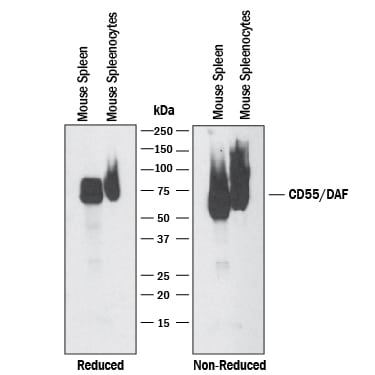
Detection of Mouse CD55/DAF by Western Blot.
Western blot shows lysates of mouse spleen tissue and mouse splenocytes. PVDF membrane was probed with 1 µg/mL of Sheep Anti-Mouse CD55/DAF Antigen Affinity-purified Polyclonal Antibody (Catalog # AF5376) followed by HRP-conjugated Anti-Sheep IgG Secondary Antibody (Catalog # HAF016). A specific band was detected for CD55/DAF at approximately 75 kDa (as indicated). This experiment was conducted under reducing and non-reducing conditions and using Immunoblot Buffer Group 1.
Detection of CD55/DAF in Mouse Splenocytes by Flow Cytometry.
Mouse splenocytes were stained with Sheep Anti-Mouse CD55/DAF Antigen Affinity-purified Polyclonal Antibody (Catalog # AF5376, filled histogram) or control antibody (Catalog # 5-001-A, open histogram), followed by NorthernLights™ 637-conjugated Anti-Sheep IgG Secondary Antibody (Catalog # NL011).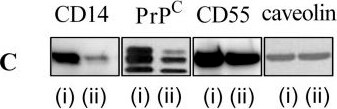
Detection of Mouse CD55/DAF by Western Blot
Glimepiride releases CD14 from RAW 264 cells. (A) The amounts of CD14 in RAW 264 cells treated for one hour with control medium (□) or glimepiride (■) as shown. Values are means ± SD, from triplicate experiments performed 4 times, n = 12. (B) The amounts of CD14 in supernatants from RAW 264 cells treated for one hour with control medium (□) or glimepiride as shown (■). Values are means ± SD, from triplicate experiments performed 4 times, n = 12. (C) Immunoblots showing the amounts of CD14, PrPC, CD55 and caveolin in extracts from RAW 264 cells treated for 1 hour with control medium (i) or 5 μM glimepiride (ii). (D) The amounts of CD14 in cells (□) or supernatants (■) from microglial cells treated for 1 hour with control medium, 5 μM glimepiride or 5 μM glipizide. Values are mean units CD14 ± SD, from triplicate experiments performed 3 times, n = 9. *Cellular CD14 significantly less than control cells. **supernatant CD14 significantly greater than control supernatants. (E) Blot showing the amounts of CD14 in supernatants from microglial cells treated with concentrations of glimepiride as shown for one hour. Image collected and cropped by CiteAb from the following publication (https://pubmed.ncbi.nlm.nih.gov/24952384), licensed under a CC-BY license. Not internally tested by R&D Systems.Applications for Mouse CD55/DAF Antibody
CyTOF-ready
Flow Cytometry
Sample: Mouse splenocytes
Western Blot
Sample: Mouse spleen tissue and Mouse splenocytes
Flow Cytometry Panel Builder
Bio-Techne Knows Flow Cytometry
Save time and reduce costly mistakes by quickly finding compatible reagents using the Panel Builder Tool.
Advanced Features
- Spectra Viewer - Custom analysis of spectra from multiple fluorochromes
- Spillover Popups - Visualize the spectra of individual fluorochromes
- Antigen Density Selector - Match fluorochrome brightness with antigen density

Formulation, Preparation, and Storage
Purification
Reconstitution
Reconstitute at 0.2 mg/mL in sterile PBS. For liquid material, refer to CoA for concentration.
Formulation
Shipping
Stability & Storage
- 12 months from date of receipt, -20 to -70 °C as supplied.
- 1 month, 2 to 8 °C under sterile conditions after reconstitution.
- 6 months, -20 to -70 °C under sterile conditions after reconstitution.
Calculators
Background: CD55/DAF
Alternate Names
Gene Symbol
UniProt
Additional CD55/DAF Products
Product Documents for Mouse CD55/DAF Antibody
Certificate of Analysis
To download a Certificate of Analysis, please enter a lot or batch number in the search box below.
Note: Certificate of Analysis not available for kit components.
Product Specific Notices for Mouse CD55/DAF Antibody
For research use only
Related Research Areas
Citations for Mouse CD55/DAF Antibody
 Powered by Bioz
Customer Reviews for Mouse CD55/DAF Antibody
There are currently no reviews for this product. Be the first to review Mouse CD55/DAF Antibody and earn rewards!
Have you used Mouse CD55/DAF Antibody?
Submit a review and receive an Amazon gift card!
$25/€18/£15/$25CAN/¥2500 for a review with an image
$10/€7/£6/$10CAN/¥1110 for a review without an image
Submit a review
Protocols
Find general support by application which include: protocols, troubleshooting, illustrated assays, videos and webinars.
- 7-Amino Actinomycin D (7-AAD) Cell Viability Flow Cytometry Protocol
- Cellular Response to Hypoxia Protocols
- Extracellular Membrane Flow Cytometry Protocol
- Flow Cytometry Protocol for Cell Surface Markers
- Flow Cytometry Protocol for Staining Membrane Associated Proteins
- Flow Cytometry Staining Protocols
- Flow Cytometry Troubleshooting Guide
- Intracellular Flow Cytometry Protocol Using Alcohol (Methanol)
- Intracellular Flow Cytometry Protocol Using Detergents
- Intracellular Nuclear Staining Flow Cytometry Protocol Using Detergents
- Intracellular Staining Flow Cytometry Protocol Using Alcohol Permeabilization
- Intracellular Staining Flow Cytometry Protocol Using Detergents to Permeabilize Cells
- Propidium Iodide Cell Viability Flow Cytometry Protocol
- Protocol for Liperfluo
- Protocol for the Characterization of Human Th22 Cells
- Protocol for the Characterization of Human Th9 Cells
- Protocol: Annexin V and PI Staining by Flow Cytometry
- Protocol: Annexin V and PI Staining for Apoptosis by Flow Cytometry
- R&D Systems Quality Control Western Blot Protocol
- Troubleshooting Guide: Fluorokine Flow Cytometry Kits
- Troubleshooting Guide: Western Blot Figures
- Western Blot Conditions
- Western Blot Protocol
- Western Blot Protocol for Cell Lysates
- Western Blot Troubleshooting
- Western Blot Troubleshooting Guide
- View all Protocols, Troubleshooting, Illustrated assays and Webinars