
An alternately spliced 50 kDa isoform of mouse Clusterin (nCLU) remains intracellular and is
neither glycosylated nor cleaved into alpha and beta chains (4). Cellular exposure to ionizing radiation
promotes the translocation of nCLU to the nucleus where it interacts with Ku70 and promotes
apoptosis (4, 10). This function contrasts with the cytoprotective effect of secreted Clusterin
(11). High µg/mL concentrations of Clusterin circulate predominantly as a component of high
density lipoprotein particles, and these are internalized and degraded through interactions
with LRP-2/Megalin (12, 13). The ability of Clusterin to bind and neutralize non-oxidatively
modified LDL reduces cytotoxicity in atherosclerotic plaques (14). The chaperone function
of Clusterin also helps to reduce the accumulation of beta -amyloid fibrils and damage due to
amyloid plaques in Alzheimer's disease (15). Clusterin levels are elevated in the cerebrospinal
fluid of patients with Alzheimer's disease, Parkinson's disease, and multiple sclerosis (9, 16, 17)
and in the urine of patients with kidney injury or bladder cancer (18-20). Clusterin is released
by activated platelets at sites of vascular injury and is found in the synovial fluid of rheumatoid
arthritis and osteoarthritis patients (21, 22). During human tumor progression, nCLU is
downregulated while the secreted form is upregulated and may be aberrantly glycosylated
(10, 23-25). Increased circulating levels of Clusterin enhance tumor aggressiveness by
inhibiting apoptosis and by promoting epithelial to mesenchymal transition (26-28).
Mouse Clusterin Quantikine ELISA Kit
R&D Systems | Catalog # MCLU00


Loading...
Key Product Details
Assay Length
4.5 hours
Sample Type & Volume Required Per Well
Cell Culture Supernates (50 µL), Cell Lysates (10 µL), Serum (10 µL), EDTA Plasma (10 µL), Heparin Plasma (10 µL), Urine (10 µL)
Sensitivity
0.094 ng/mL
Assay Range
0.781-50 ng/mL (Cell Culture Supernates, Cell Lysates, Serum, EDTA Plasma, Heparin Plasma, Urine)
Loading...
Product Summary for Mouse Clusterin Quantikine ELISA Kit
The Quantikine Mouse Clusterin Immunoassay is a 4.5 hour solid phase ELISA designed to measure mouse Clusterin levels in cell culture supernates, cell lysates, serum, plasma, and urine. It contains NS0-expressed recombinant mouse Clusterin and antibodies raised against the recombinant factor. This immunoassay has been shown to quantitate the recombinant factor accurately. Results obtained using natural mouse Clusterin showed dose-response curves that were parallel to the standard curves obtained using the recombinant kit standards. These results indicate that this kit can be used to determine relative mass values for natural mouse Clusterin.
Product Specifications
Assay Type
Solid Phase Sandwich ELISA
Format
96-well strip plate
Measurement
Quantitative ELISA
Detection Method
Colorimetric - 450nm (TMB)
Conjugate
HRP
Species
Mouse
Specificity
Natural and recombinant mouse Clusterin
Cross-reactivity
< 0.5% cross-reactivity observed with available related molecules. < 50% cross-species reactivity observed with species tested.
Interference
No significant interference observed with available related molecules.
Precision
Intra-Assay Precision (Precision within an assay) Three samples of known concentration were tested on one plate to assess intra-assay precision.
Inter-Assay Precision (Precision between assays) Three samples of known concentration were tested in separate assays to assess inter-assay precision.
Cell Culture Supernates, Cell Lysates, EDTA Plasma, Heparin Plasma, Serum, Urine
| Intra-Assay Precision | Inter-Assay Precision | |||||
|---|---|---|---|---|---|---|
| Sample | 1 | 2 | 3 | 1 | 2 | 3 |
| n | 20 | 20 | 20 | 20 | 20 | 20 |
| Mean (pg/mL) | 1.35 | 8.02 | 17.5 | 1.36 | 7.62 | 16.2 |
| Standard Deviation | 0.086 | 0.282 | 0.682 | 0.119 | 0.577 | 1.62 |
| CV% | 6.4 | 3.5 | 3.9 | 8.8 | 7.6 | 10.0 |
Recovery for Mouse Clusterin Quantikine ELISA Kit
The recovery of mouse Clusterin spiked into various matrices was evaluated.
| Sample Type | Average % Recovery | Range % |
|---|---|---|
| Cell Culture Supernates (n=4) | 101 | 90-111 |
| Cell Lysates (n=4) | 106 | 95-117 |
Linearity
To assess the linearity of the assay, samples containing high concentrations of mouse Clusterin were serially diluted with Calibrator Diluent to produce samples with values within the dynamic range of the assay.

Scientific Data Images for Mouse Clusterin Quantikine ELISA Kit
Mouse Clusterin ELISA Standard Curve
Preparation and Storage
Shipping
The product is shipped at ambient temperature. Upon receipt, store it immediately at the temperature recommended below.
Stability & Storage
Store the unopened product at 2 - 8 °C. Do not use past expiration date.
Background: Clusterin
Alternate Names
APOJ, CLI, CLU, SGP-2, SP-40, TRPM-2
Gene Symbol
CLU
Additional Clusterin Products
Product Documents for Mouse Clusterin Quantikine ELISA Kit
Certificate of Analysis
To download a Certificate of Analysis, please enter a lot or batch number in the search box below.
Note: Certificate of Analysis not available for kit components.
Product Specific Notices for Mouse Clusterin Quantikine ELISA Kit
For research use only
⚠ WARNING: This product can expose you to chemicals including N,N-Dimethylforamide, which is known to the State of California to cause cancer. For more information, go to www.P65Warnings.ca.gov.Related Research Areas
Citations for Mouse Clusterin Quantikine ELISA Kit
 Powered by Bioz
Customer Reviews for Mouse Clusterin Quantikine ELISA Kit
There are currently no reviews for this product. Be the first to review Mouse Clusterin Quantikine ELISA Kit and earn rewards!
Have you used Mouse Clusterin Quantikine ELISA Kit?
Submit a review and receive an Amazon gift card!
$25/€18/£15/$25CAN/¥2500 for a review with an image
$10/€7/£6/$10CAN/¥1110 for a review without an image
Submit a review
Protocols
View specific protocols for Mouse Clusterin Quantikine ELISA Kit (MCLU00):
Refer to the product for complete assay procedure.
Bring all reagents and samples to room temperature before use. It is recommended that all samples, standards, and controls be assayed in duplicate.
- Prepare all reagents, standard dilutions, and samples as directed in the product insert.
- Remove excess microplate strips from the plate frame, return them to the foil pouch containing the desiccant pack, and reseal.
- Add 50 µL of the appropriate Assay Diluent to each well.
- Add 50 µL of Standard, Control, or sample to each well. Cover with a plate sealer, and incubate at room temperature for 2 hours on a horizontal orbital microplate shaker.
- Aspirate each well and wash, repeating the process 4 times for a total of 5 washes.
- Add 100 µL of Conjugate to each well. Cover with a new plate sealer, and incubate at room temperature for 2 hours on the shaker.
- Aspirate and wash 5 times.
- Add 100 µL Substrate Solution to each well. Incubate at room temperature for 30 minutes on the benchtop. PROTECT FROM LIGHT.
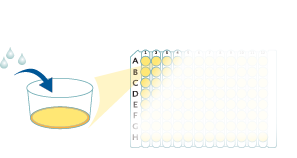
- Add 100 µL of Stop Solution to each well. Read at 450 nm within 30 minutes. Set wavelength correction to 540 nm or 570 nm.
50 µL Assay Diluent
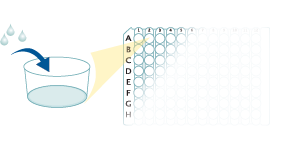
50 µL Standard, Control, or Sample
100 µL Conjugate
100 µL Substrate Solution
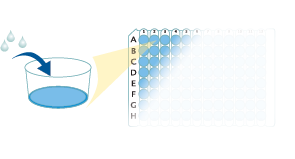
100 µL Stop Solution
Find general support by application which include: protocols, troubleshooting, illustrated assays, videos and webinars.
- ELISA Sample Preparation & Collection Guide
- ELISA Troubleshooting Guide
- How to Run an R&D Systems DuoSet ELISA
- How to Run an R&D Systems Quantikine ELISA
- How to Run an R&D Systems Quantikine™ QuicKit™ ELISA
- Quantikine HS ELISA Kit Assay Principle, Alkaline Phosphatase
- Quantikine HS ELISA Kit Principle, Streptavidin-HRP Polymer
- Sandwich ELISA (Colorimetric) – Biotin/Streptavidin Detection Protocol
- Sandwich ELISA (Colorimetric) – Direct Detection Protocol
- Troubleshooting Guide: ELISA
- View all Protocols, Troubleshooting, Illustrated assays and Webinars
Loading...