
Cripto is the founding member of the epidermal growth factor-CriptoFRL1Cryptic (EGF-CFC) family of signaling proteins that function in cancer and various developmental processes. These developmental processes include: formation of the germ layers and dorsal organizer, specification of anterior-posterior and left-right axes, and differentiation of heart muscle (1, 2). Other members of the EGF-CFC family include Cryptic, Xenopus FRL-1 and zebrafish OEP (one-eyed pinhead). Overall sequence identity between members of the family is low, but they do share several common domains: a variant EGF-like motif, a novel conserved cysteine‑rich domain (called CFC domain), and a C-terminal hydrophobic region. Most EGF-CFC members have a glycosyl-phosphatidylinositol (GPI) anchoring site at the
C-terminus and exist as extracellular membrane-anchored proteins. However, naturally-occurring soluble isoforms also exist. Mouse Cripto shares 66% and 34% amino acid identity with human Cripto and zebrafish OEP, respectively (2). Despite weak conservation in amino acid identity, EGF-CFC family members appear to function similarly in assays for phenotypic rescue of zebrafish oep mutants (2). Both secreted and membrane bound forms of Cripto demonstrate biological activity (3). Cripto, also known as CFC-2 or TDGF-1 (teratocarcinoma-derived growth factor), was originally isolated from an undifferentiated human teratocarcinoma cell line as a potential oncogene. It is overexpressed in many types of cancers and acts as a growth factor for tumors (4). Genetic evidence from mice and zebrafish points to a role for Cripto as an essential cofactor in Nodal signaling. Cripto and OEP mutants display defects in mesoderm induction and heart morphogenesis, similar to phenotypes seen in Nodal mutants (2). Cripto acts as a cofactor for Nodal by recruiting the Activin type I Receptor, ALK-4, leading to an Act RIIB‑ALK4‑Cripto‑Nodal complex for signaling (1, 3). Cripto also forms a complex with activin and Act RIIs to block activin signaling (5). Work has shown that other TGF-beta superfamily members such as Vg1 and GDF-1 also require EGF-CFC cofactors (6). Cripto can also activate mitogen-activated protein kinase (MAPK) and Akt pathways independently of Nodal by directly binding to a membrane-associated heparan sulfate proteoglycan, glypican-1 (7).
Mouse Cripto Antibody (237603)
R&D Systems | Catalog # MAB1538

Scientific images may be resized, cropped, or adjusted for brightness or contrast for presentation purposes. These updates are limited to presentation and do not affect the underlying scientific interpretation of the data. Where available, additional source data may be provided upon request.
Key Product Details
Species Reactivity
Validated:
Cited:
Applications
Validated:
Cited:
Label
Antibody Source
Product Specifications
Immunogen
Arg26-Gln150
Accession # P51865
Specificity
Clonality
Host
Isotype
Endotoxin Level
Scientific Data Images for Mouse Cripto Antibody (237603)
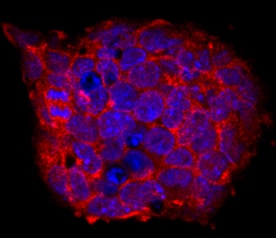
Cripto in D3 Mouse Cell Line.
Cripto was detected in immersion fixed D3 mouse embryonic stem cell line using Rat Anti-Mouse Cripto Monoclonal Antibody (Catalog # MAB1538) at 10 µg/mL for 3 hours at room temperature. Cells were stained using the NorthernLights™ 557-conjugated Anti-Rat IgG Secondary Antibody (red; Catalog # NL013) and counterstained with DAPI (blue). Specific staining was localized to cytoplasm and cell secretion. View our protocol for Fluorescent ICC Staining of Stem Cells on Coverslips.Applications for Mouse Cripto Antibody (237603)
Blockade of Receptor-ligand Interaction
CyTOF-ready
Flow Cytometry
Sample: D3 mouse embryonic stem cell line
Immunocytochemistry
Sample: Immersion fixed D3 mouse embryonic stem cell line
Flow Cytometry Panel Builder
Bio-Techne Knows Flow Cytometry
Save time and reduce costly mistakes by quickly finding compatible reagents using the Panel Builder Tool.
Advanced Features
- Spectra Viewer - Custom analysis of spectra from multiple fluorochromes
- Spillover Popups - Visualize the spectra of individual fluorochromes
- Antigen Density Selector - Match fluorochrome brightness with antigen density

Formulation, Preparation, and Storage
Purification
Reconstitution
Reconstitute at 0.5 mg/mL in sterile PBS. For liquid material, refer to CoA for concentration.
Formulation
Shipping
Stability & Storage
- 12 months from date of receipt, -20 to -70 °C as supplied.
- 1 month, 2 to 8 °C under sterile conditions after reconstitution.
- 6 months, -20 to -70 °C under sterile conditions after reconstitution.
Calculators
Background: Cripto
References
- Rosa, F.M. (2002) Science’s STKE http://stke.sciencemag.org/.
- Shen, M. and A. Schier (2000) Trends Genet. 16:303.
- Yan, Y-T. et al. (2002) Mol. Cell Biol. 22:4439.
- Salomon, D. et al. (2000) Endocrine-Rel. Cancer 7:199.
- Gray, P.C. et al. (2003) Proc. Natl. Acad. Sci. USA 100:5193.
- Cheng, S. et al. (2003) Genes & Dev. 17:31.
- Bianco, C. et al. (2003) Cancer Research 63:1192.
Long Name
Alternate Names
Gene Symbol
UniProt
Additional Cripto Products
Product Documents for Mouse Cripto Antibody (237603)
Certificate of Analysis
To download a Certificate of Analysis, please enter a lot or batch number in the search box below.
Note: Certificate of Analysis not available for kit components.
Product Specific Notices for Mouse Cripto Antibody (237603)
For research use only
Related Research Areas
Citations for Mouse Cripto Antibody (237603)
 Powered by Bioz
Customer Reviews for Mouse Cripto Antibody (237603)
There are currently no reviews for this product. Be the first to review Mouse Cripto Antibody (237603) and earn rewards!
Have you used Mouse Cripto Antibody (237603)?
Submit a review and receive an Amazon gift card!
$25/€18/£15/$25CAN/¥2500 for a review with an image
$10/€7/£6/$10CAN/¥1110 for a review without an image
Submit a review
Protocols
Find general support by application which include: protocols, troubleshooting, illustrated assays, videos and webinars.
- 7-Amino Actinomycin D (7-AAD) Cell Viability Flow Cytometry Protocol
- Appropriate Fixation of IHC/ICC Samples
- Cellular Response to Hypoxia Protocols
- ClariTSA™ Fluorophore Kits
- Detection & Visualization of Antibody Binding
- Extracellular Membrane Flow Cytometry Protocol
- Flow Cytometry Protocol for Cell Surface Markers
- Flow Cytometry Protocol for Staining Membrane Associated Proteins
- Flow Cytometry Staining Protocols
- Flow Cytometry Troubleshooting Guide
- ICC Cell Smear Protocol for Suspension Cells
- ICC Immunocytochemistry Protocol Videos
- ICC for Adherent Cells
- Immunocytochemistry (ICC) Protocol
- Immunocytochemistry Troubleshooting
- Immunofluorescence of Organoids Embedded in Cultrex Basement Membrane Extract
- Immunohistochemistry (IHC) and Immunocytochemistry (ICC) Protocols
- Intracellular Flow Cytometry Protocol Using Alcohol (Methanol)
- Intracellular Flow Cytometry Protocol Using Detergents
- Intracellular Nuclear Staining Flow Cytometry Protocol Using Detergents
- Intracellular Staining Flow Cytometry Protocol Using Alcohol Permeabilization
- Intracellular Staining Flow Cytometry Protocol Using Detergents to Permeabilize Cells
- Preparing Samples for IHC/ICC Experiments
- Preventing Non-Specific Staining (Non-Specific Binding)
- Primary Antibody Selection & Optimization
- Propidium Iodide Cell Viability Flow Cytometry Protocol
- Protocol for Liperfluo
- Protocol for VisUCyte™ HRP Polymer Detection Reagent
- Protocol for the Characterization of Human Th22 Cells
- Protocol for the Characterization of Human Th9 Cells
- Protocol for the Fluorescent ICC Staining of Cell Smears - Graphic
- Protocol for the Fluorescent ICC Staining of Cultured Cells on Coverslips - Graphic
- Protocol for the Preparation and Fluorescent ICC Staining of Cells on Coverslips
- Protocol for the Preparation and Fluorescent ICC Staining of Non-adherent Cells
- Protocol for the Preparation and Fluorescent ICC Staining of Stem Cells on Coverslips
- Protocol for the Preparation of a Cell Smear for Non-adherent Cell ICC - Graphic
- Protocol: Annexin V and PI Staining by Flow Cytometry
- Protocol: Annexin V and PI Staining for Apoptosis by Flow Cytometry
- TUNEL and Active Caspase-3 Detection by IHC/ICC Protocol
- The Importance of IHC/ICC Controls
- Troubleshooting Guide: Fluorokine Flow Cytometry Kits
- View all Protocols, Troubleshooting, Illustrated assays and Webinars
Associated Pathways
