Mouse Embryonic Fibroblast (MEF) Conditioned Media

R&D Systems | Catalog # AR005

R&D Systems
Loading...

Key Product Details

Species

Mouse

Product Summary for Mouse Embryonic Fibroblast (MEF) Conditioned Media

Kit Summary

Conditioned media to support growth and maintain the pluripotency of embryonic and induced pluripotent stem cells.

Key Benefits

  • Eliminates the need for a MEF feeder layer
  • Lot-to-lot consistency decreases experimental variability
  • Addition of FGF basic generates complete media
 

Why Culture Stem Cells Using MEF Conditioned Media?

Feeder layers of mouse embryonic fibroblasts (MEF) support stem cell growth and the maintenance of pluripotency by secreting growth factors, cytokines, and nutrients. However, the use of MEFs as a feeder layer can be laborious and MEF contamination is a significant concern.

MEF conditioned media represents an efficient alternative to MEF feeder cells and is one of the mostly widely used feeder-free systems for embryonic stem cell culture. MEF Conditioned Media includes the soluble factors required to support stem cell growth and pluripotency.

Mouse Embryonic Fibroblast (MEF) Conditioned Media:

  • Widely used feeder-free system for culturing embryonic and induced pluripotent stem cells.
  • Lot-to-lot consistency decreases experimental variability.
  • Eliminates the need for a MEF feeder layer.
  • Free of mycoplasma and microbial contamination.
  • Generate complete media by adding FGF basic (4ng/mL) (Catalog # 233-FB or 4114-TC).
Loading...

Scientific Data Images for Mouse Embryonic Fibroblast (MEF) Conditioned Media

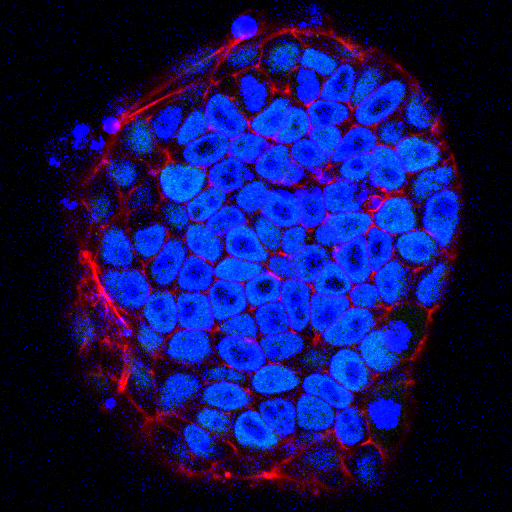
Induced Pluripotent Stem Cells Grown in MEF Conditioned Media Express Pluripotent Stem Cell Markers SSEA-4, Oct-3/4, Oct-4A, and E-Cadherin. 

Induced Pluripotent Stem Cells Grown in MEF Conditioned Media Express Pluripotent Stem Cell Markers SSEA-4, Oct-3/4, Oct-4A, and E-Cadherin. 

Induced Pluripotent Stem Cells Grown in MEF Conditioned Media Express Pluripotent Stem Cell Markers SSEA-4. Oct-3/4, Oct-4A, and E-Cadherin.Human iPS2 stem cells were cultured in MEF Conditioned Media (Catalog # AR005) supplemented with 4 ng/mL Recombinant Human FGF basic (Catalog # 233-FBor Catalog # 4114-TC).A. Expression of SSEA-4 was detected using a Mouse Anti-Human/Mouse SSEA-4 Monoclonal Antibody (Catalog # MAB1435) followed by a NorthernLights™ (NL) 493-conjugated Donkey Anti-Mouse Secondary Antibody (Catalog # NL009, green). Expression of Oct-3/4 was detected using a Goat Anti-Human Oct-3/4 Antigen Affinity Purified Polyclonal Antibody (Catalog # AF1759) followed by NL557-conjugated Donkey Anti-Goat IgG (Catalog # NL001, red). The nuclei were counterstained with DAPI.B. Expression of Oct-4A was detected using Mouse Anti-Human Oct-4A Monoclonal Antibody (Catalog # MAB17591) followed by a NorthernLights™ 493-conjugated Donkey Anti-mouse Polyclonal Antibody (Catalog # NL009, green). Expression of E-Cadherin was detected using a Goat Anti-Human E-Cadherin Antigen Affinity Purified Polyclonal Antibody (Catalog # AF648) followed by a NL557-conjugated Donkey Anti-Goat IgG Secondary Antibody (Catalog # NL001, red). The nuclei were counterstained with DAPI. View our protocol for Fluorescent ICC Staining of Stem Cells on Coverslips.

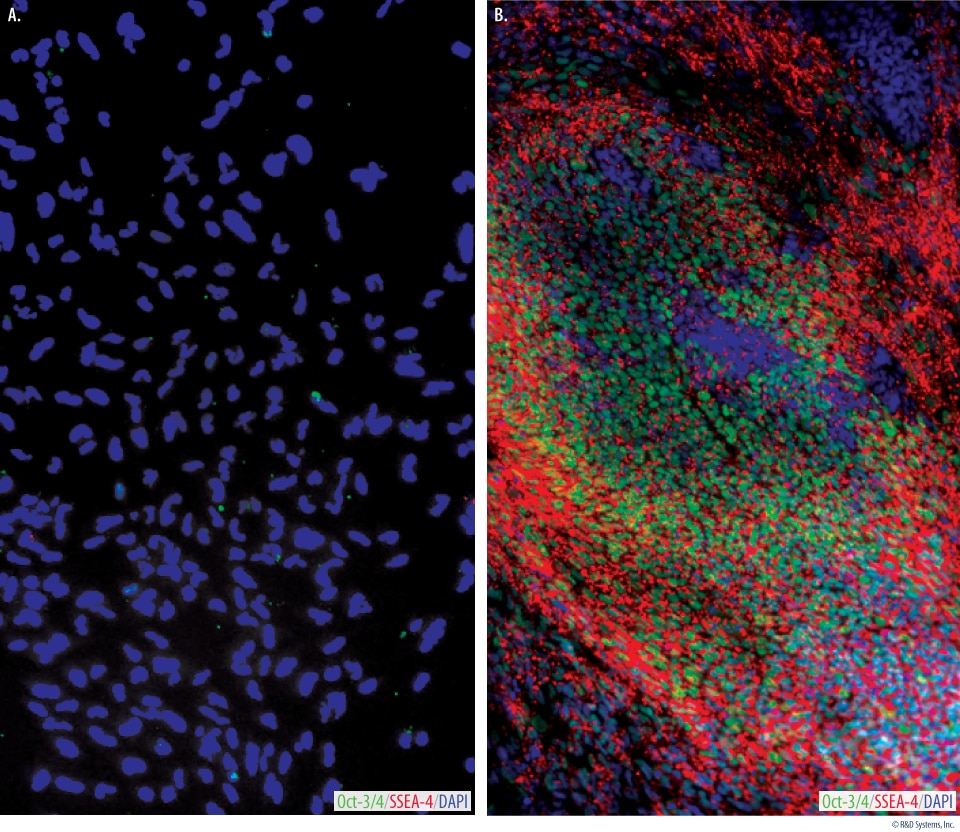
Human Emryonic Fibroblast Conditioned Media Express Pluripotent Markers SSEA-4 and Oct-3/4.

Human Emryonic Fibroblast Conditioned Media Express Pluripotent Markers SSEA-4 and Oct-3/4.

Human Emryonic Fibroblast Conditioned Media Express Pluripotent Markers SSEA-4 and Oct-3/4. A.Human embryonic stem cells were cultured in Mouse Embryonic Fibroblast (MEF) Conditioned Media (Catalog # AR005) supplemented with 4 ng/mL Recombinant Human FGF basic (Catalog # 233-FB). SSEA-4 and Oct-3/4 were detected using a Mouse Anti-Human/Mouse SSEA-4 Monoclonal Antibody (Catalog # MAB1435, red) and a Goat Anti-Human Oct-3/4 Antigen Affinity-purified Polyclonal Antibody (Catalog # AF1759, green). The nuclei were counterstained with DAPI (blue).B.Human embryonic stem cells were cultured in MEF Condition Media supplemented with 4 ng/mL Recombinant Human FGF basic. SSEA-4 and Oct-3/4 were detected as described above. The nuclei were counterstained with DAPI (blue). View our protocol for Fluorescent ICC Staining of Stem Cells on Coverslips.

Formulation, Preparation, and Storage

Shipping

The product is shipped with dry ice or equivalent. Upon receipt, store it immediately at the temperature recommended below.

Storage

Store the unopened product at -20 to -70 °C. Use a manual defrost freezer and avoid repeated freeze-thaw cycles. Do not use past expiration date.

Background: Embryonic Stem Cells

Embryonic stem (ES) cells are pluripotent stem cells derived from the inner cell mass of pre-implantation embryos. Induced pluripotent stem (iPS) cells can be generated by somatic cell reprogramming following the exogenous expression of specific transcription factors (Oct-3/4, KLF4, SOX2, and c-Myc). These cell types are capable of unlimited, undifferentiated proliferation in vitro and still maintain the capacity to differentiate into a wide variety of somatic cells. In this capacity, pluripotent stem cells have widespread clinical potential for the treatments of heart disease, diabetes, spinal cord injury, and a variety of neurodegenerative disorders.

R&D Systems offers a wide range of products to support pluripotent stem cell culture and differentiation. Mouse embryonic fibroblasts may be used to maintain and expand pluripotent stem cells in an undifferentiated state. We also offer defined culture media, which are specifically optimized for use with human or rodent pluripotent stem cells. In addition, R&D Systems offers a variety of products to assess differentiation status and identify specific stem cell types of interest, including panels of marker antibodies, primer pairs, multi-color flow cytometry kits, and specialized verification kits.

Additional Embryonic Stem Cells Products

Product Documents for Mouse Embryonic Fibroblast (MEF) Conditioned Media

Certificate of Analysis

To download a Certificate of Analysis, please enter a lot or batch number in the search box below.

Note: Certificate of Analysis not available for kit components.

Product Specific Notices for Mouse Embryonic Fibroblast (MEF) Conditioned Media

For research use only

Citations for Mouse Embryonic Fibroblast (MEF) Conditioned Media

Customer Reviews for Mouse Embryonic Fibroblast (MEF) Conditioned Media (2)

5 out of 5
2 Customer Ratings
5 Stars
100%
4 Stars
0%
3 Stars
0%
2 Stars
0%
1 Stars
0%

Have you used Mouse Embryonic Fibroblast (MEF) Conditioned Media?

Submit a review and receive an Amazon gift card!

$25/€18/£15/$25CAN/¥2500 Yen for a review with an image

$10/€7/£6/$10CAN/¥1110 Yen for a review without an image

Submit a review
Amazon Gift Card

Customer Images


Showing  1 - 2 of 2 reviews Showing All
Filter By:
  • Mouse Embryonic Fibroblast (MEF) Conditioned Media
    Name: Anonymous
    Verified Customer | Posted 09/13/2019
    We used to make are own, however the quality would often vary. This commercial media enables us to standardise the protocol and we have used a number of lots with equal results. We usually use the media for 24 hours before starting a iPSC differentiation in order to 'prime' the cells. I would recommend for those who wish to increase the efficiency of iPSC differentiation.
    Mouse Embryonic Fibroblast (MEF) Conditioned Media AR005
  • Mouse Embryonic Fibroblast (MEF) Conditioned Media
    Name: Leslie Priddy
    Verified Customer | Posted 04/04/2018

There are no reviews that match your criteria.

Showing  1 - 2 of 2 reviews Showing All

Protocols

View specific protocols for Mouse Embryonic Fibroblast (MEF) Conditioned Media (AR005):

Refer to the product datasheet for complete product details.

Briefly, MEF Conditioned Media can be used to culture human pluripotent stem cells using the following procedure:

  • Supplement MEF Conditioned Media with 4 ng/mL FGF basic
  • Culture cells in supplemented media
  • Replace media daily and passage cells as needed

Reagents Provided

Reagents Supplied in Mouse Embryonic Fibroblast (MEF) Conditioned Media (Catalog # AR005)

  • 100 mL MEF Conditioned Media


Other Supplies Required

Reagents

  • Recombinant Human FGF basic (Catalog # 233-FB) or tissue culture grade Recombinant Human FGF basic (Catalog # 4114-TC)
  • Accutase® (Innovative Cell Technologies)
  • Cultrex® Reduced Growth Factor Basement Membrane Extract (BME) (Catalog # 3433-005-01)
  • DMEM/F12

Materials

  • BG01V human embryonic stem cells or equivalent
  • 60 or 100 mm tissue culture plates
  • 15 mL centrifuge tubes
  • Pipettes and pipette tips

Equipment

  • 37 °C and 5% CO2 incubator
  • Centrifuge (low speed clinical or equivalent)
  • Hemocytometer
  • Microscope


Procedure Overview

Preparation of BME-coated Plates

  1. Thaw Cultrex BME on ice at 2 °C to 8 °C overnight.
  2. Aliquot thawed Cultrex BME into pre-cooled tubes and store at -20° C.
  3. Thaw the aliquot on ice at 2 °C to 8 °C.
  4. Dilute Cultrex BME 1:40 in DMEM/F12. This can be stored at 4 °C for up to 2 weeks.
  5. Coat the desired number of plates with diluted Cultrex BME (approximately 2.5 mL/60 mm plate) and incubate for 1-2 hours at room temperature.
  6. Remove the Cultrex BME solution immediately prior to plating the cells.
Preparation and plating of BG01V Human Embryonic Stem Cells
  1. Gently transfer thawed BG01V human embryonic stem cells to a 15 mL centrifuge tube containing pre-warmed MEF Conditioned Media.
  2. Centrifuge at 200 x g for 4 minutes.
  3. Resuspend the cell pellet in MEF Conditioned Media supplemented with 4 ng/mL FGF basic.
  4. Add the BG01V human embryonic stem cells to the Cultrex BME- or StemXVivo-Culture Matrix-coated plates.
  5. Culture the cells at 37 °C and 5% CO2 and change the media daily.
Passaging BG01V Human Embryonic Stem Cells
  1. Coat plates with Cultrex BME or StemXVivo Culture Matrix as described.
  2. Remove the media from cells and add 1 mL of Accutase solution to each 60 mm plate.
  3. Pipette gently over the plate until all of the cells have detached.
  4. Transfer the cell suspension to a 15 mL centrifuge tube containing < 5 mL of MEF Conditioned Media.
  5. Centrifuge at 200 x g for 4 minutes.
  6. Resuspend the cell pellet in MEF Conditioned Media.
  7. Perform a cell count.
  8. Plate the desired number of cells (approximately 1.0 x 10⁶ cells/60 mm plate) on Culture BME- or StemXVivo Culture Matrix-coated plates in MEF Conditioned Media containing 4 ng/mL FGF basic.
  9. Culture the cells at 37 °C and 5% CO2 and change the media daily.

BG01V cells are licensed from ViaCyte, Inc.

FAQs for Mouse Embryonic Fibroblast (MEF) Conditioned Media

Showing  1 - 1 of 1 FAQ Showing All
  • Q: Have you tried the StemXVivo® Cardiomyocyte Differentiation Kit with other human ES cell lines or human iPS cell lines?

    A: This kit has been tested both in-house and by outside groups in multiple iPS cell lines. This kit is expected to work with most cell lines as long as the starting stem cell population is of high quality and has pluripotency. For optimal performance using this kit, it is recommended that pluripotent  stem cells are grown in Mouse Embryonic Fibroblast (MEF) Conditioned Media (Catalog # AR005), however successful differentiation has been observed in cells grown with mTeSR™ medium.  We have had difficulties with cells grown in TeSR™-E8 media.  An anti-human Cardiac Troponin T antibody is provided in the kit to help determine the efficiency of differentiation.

Showing  1 - 1 of 1 FAQ Showing All
View all FAQs for Cell Culture Products