
Erythropoietin (EPO) is a 34 kDa glycoprotein hormone in the type I cytokine family and is related to thrombopoietin (1). Its three N-glycosylation sites, four alpha helices, and N- to C-terminal disulfide bond are conserved across species (2, 3). Glycosylation of EPO is required for biological activities in vivo (4). Mature mouse EPO shares 95% amino acid sequence identity with rat EPO and 73-82% with bovine, canine, equine, feline, human, ovine, and porcine EPO. EPO is primarily produced in the kidney by a population of fibroblast-like cortical interstitial cells adjacent to the proximal tubules (5). It is also produced in much lower, but functionally significant amounts by fetal hepatocytes and in adult liver and brain (6-8). EPO promotes erythrocyte formation by preventing the apoptosis of early erythroid precursors which express the EPO receptor (EPO R) (8, 9). EPO R has also been described in brain, retina, heart, skeletal muscle, kidney, endothelial cells, and a variety of tumor cells (7, 8, 10, 11). Ligand induced dimerization of EPO R triggers JAK2-mediated signaling pathways followed by receptor/ligand endocytosis and degradation (1, 12). Rapid regulation of circulating EPO allows tight control of erythrocyte production and hemoglobin concentrations. Anemia or other causes of low tissue oxygen tension induce EPO production by stabilizing the hypoxia-induceable transcription factors HIF-1 alpha and HIF-2 alpha (1, 6). EPO additionally plays a tissue-protective role in ischemia by blocking apoptosis and inducing angiogenesis (7, 8, 13).
Mouse Erythropoietin/EPO Antibody (148438)
R&D Systems | Catalog # MAB959


Scientific images may be resized, cropped, or adjusted for brightness or contrast for presentation purposes. These updates are limited to presentation and do not affect the underlying scientific interpretation of the data. Where available, additional source data may be provided upon request.
Key Product Details
Species Reactivity
Validated:
Cited:
Applications
Validated:
Cited:
Label
Antibody Source
Product Specifications
Immunogen
Ala27-Arg192
Accession # P07321
Specificity
Clonality
Host
Isotype
Endotoxin Level
Scientific Data Images for Mouse Erythropoietin/EPO Antibody (148438)
Cell Proliferation Induced by Erythropoietin/EPO and Neutralization by Mouse Erythropoietin/EPO Antibody.
Recombinant Mouse Erythropoietin/EPO (Catalog # 959-ME) stimulates proliferation in the TF-1 human erythroleukemic cell line in a dose-dependent manner (orange line). Proliferation elicited by Recombinant Mouse Erythropoietin/EPO (40 ng/mL) is neutralized (green line) by increasing concentrations of Mouse Erythropoietin/EPO Monoclonal Antibody (Catalog # MAB959). The ND50 is typically 0.2-0.8 µg/mL.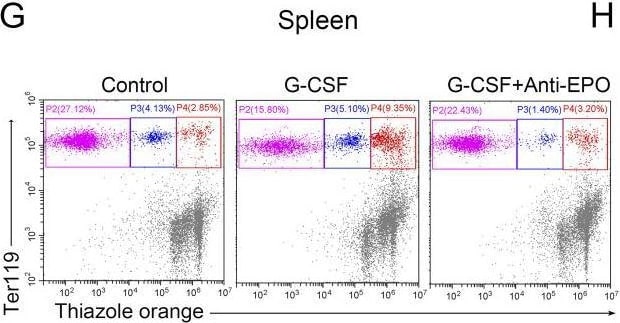
Detection of Erythropoietin/EPO by Flow Cytometry
EPO mediates G-CSF–induced splenic erythropoiesis.(G) Representative flow cytometric plots of Ter119-APC and thiazole orange-stained splenocytes from control mice, G-CSF–treated mice, and G-CSF–treated mice with anti-EPO treatment. (H) Flow cytometric quantification of reticulocytes (Ter119+ Thiazole orange+) in the spleens from different treatment groups. Image collected and cropped by CiteAb from the following open publication (https://pubmed.ncbi.nlm.nih.gov/33234677), licensed under a CC-BY license. Not internally tested by R&D Systems.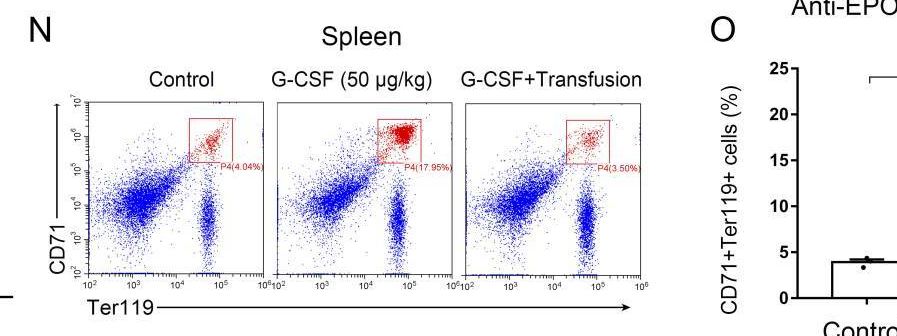
Detection of Erythropoietin/EPO by Flow Cytometry
EPO mediates G-CSF–induced splenic erythropoiesis. (N) Representative flow cytometric plots of CD71+Ter119+ cells in the spleens. Image collected and cropped by CiteAb from the following open publication (https://pubmed.ncbi.nlm.nih.gov/33234677), licensed under a CC-BY license. Not internally tested by R&D Systems.Applications for Mouse Erythropoietin/EPO Antibody (148438)
Neutralization
Formulation, Preparation, and Storage
Purification
Reconstitution
Reconstitute at 0.5 mg/mL in sterile PBS. For liquid material, refer to CoA for concentration.
Formulation
Shipping
Stability & Storage
- 12 months from date of receipt, -20 to -70 °C as supplied.
- 1 month, 2 to 8 °C under sterile conditions after reconstitution.
- 6 months, -20 to -70 °C under sterile conditions after reconstitution.
Calculators
Background: Erythropoietin/EPO
References
- Koury, M.J. (2005) Exp. Hematol. 33:1263.
- Shoemaker, C.B. and L.D. Mitsock (1986) Mol. Cell. Biol 6:849.
- Wen, D. et al. (1993) Blood 82:1507.
- Tsuda E. et al. (1990) Eur. J. Biochem. 188:405.
- Lacombe, C. et al. (1988) J. Clin. Invest. 81:620.
- Eckardt, K.U. and A. Kurtz (2005) Eur. J. Clin. Invest. 35 Suppl. 3:13.
- Sharples, E.J. et al. (2006) Curr. Opin. Pharmacol. 6:184.
- Rossert, J. and K. Eckardt (2005) Nephrol. Dial. Transplant 20:1025.
- Koury, M.J. and M.C. Bondurant (1990) Science 248:378.
- Acs, G. et al. (2001) Cancer Res. 61:3561.
- Hardee, M.E. et al. (2006) Clin. Cancer Res. 12:332.
- Verdier, F. et al. (2000) J. Biol. Chem. 275:18375.
- Kertesz, N. et al. (2004) Dev. Biol. 276:101.
Alternate Names
Gene Symbol
UniProt
Additional Erythropoietin/EPO Products
Product Documents for Mouse Erythropoietin/EPO Antibody (148438)
Certificate of Analysis
To download a Certificate of Analysis, please enter a lot or batch number in the search box below.
Note: Certificate of Analysis not available for kit components.
Product Specific Notices for Mouse Erythropoietin/EPO Antibody (148438)
For research use only
Related Research Areas
Citations for Mouse Erythropoietin/EPO Antibody (148438)
 Powered by Bioz
Customer Reviews for Mouse Erythropoietin/EPO Antibody (148438)
There are currently no reviews for this product. Be the first to review Mouse Erythropoietin/EPO Antibody (148438) and earn rewards!
Have you used Mouse Erythropoietin/EPO Antibody (148438)?
Submit a review and receive an Amazon gift card!
$25/€18/£15/$25CAN/¥2500 for a review with an image
$10/€7/£6/$10CAN/¥1110 for a review without an image
Submit a review
Associated Pathways

