
The galectins constitute a large family of carbohydrate-binding proteins with specificity for N-acetyl-lactosamine-containing glycoproteins. At least 14 mammalian galectins, which share structural similarities in their carbohydrate recognition domains (CRD), have been identified. The galectins have been classified into the prototype galectins (-1, -2, -5, -7, -10, -11, -13, -14), which contain one CRD and exist either as a monomer or a noncovalent homodimer; the chimera galectins (Galectin-3) containing one CRD linked to a nonlectin domain; and the tandem-repeat galectins (-4, -6, -8, -9, -12) consisting of two CRDs joined by a linker peptide. Galectins lack a classical signal peptide and can be localized to the cytosolic compartments where they have intracellular functions. However, via one or more as yet unidentified non-classical secretory pathways, galectins can also be secreted to function extracellularly. Individual members of the galectin family have different tissue distribution profiles and exhibit subtle differences in their carbohydrate-binding specificities. Each family member may preferentially bind to a unique subset of cell-surface glycoproteins (1-4). Galectin-3, also known as Mac-2, L29, CBP35, and epsilon BP, is a chimera galectin that has a tendency to dimerize. Besides the soluble protein, alternatively spliced forms of chicken Galectin-3 containing a transmembrane-spanning domain and a leucine zipper motif have been reported. Galectin-3 is expressed in tumor cells, macrophages, activated T cells, osteoclasts, epithelial cells, and fibroblasts. It binds various matrix glycoproteins including laminin, fibronectin, LAMPS, 90K/Mac-2BP, MP20, and CEA. Galectin-3 promotes cell growth and proliferation for many cell types. Galectin-3 acts intracellularly to prevent apoptosis. Depending on the cell types, Galectin-3 exhibits pro- or anti-adhesive properties. Galectin-3 has proinflammatory activities in vitro and in vivo. It induces pro-inflammatory and inhibits Th2 type cytokine production. Galectin-3 chemoattracts monocytes and macrophages. It activates and degranulates basophils and mast cells. Elevated circulating levels of Galectin-3 has been show to correlate with the malignant potential of several types of cancer, suggesting that Galectin-3 is also involved in tumor growth and metastasis. Human and mouse Galectin-3 shares approximately 80% amino acid sequence similarity (1-5).
Mouse Galectin-3 Antibody [Biotin]
R&D Systems | Catalog # BAF1197

Scientific images may be resized, cropped, or adjusted for brightness or contrast for presentation purposes. These updates are limited to presentation and do not affect the underlying scientific interpretation of the data. Where available, additional source data may be provided upon request.
Key Product Details
Species Reactivity
Applications
Label
Antibody Source
Product Specifications
Immunogen
Ala2-Ile264
Accession # NP_034835
Specificity
Clonality
Host
Isotype
Scientific Data Images for Mouse Galectin-3 Antibody [Biotin]
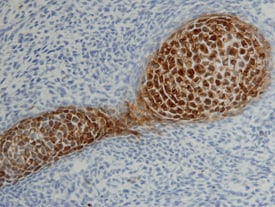
Galectin‑3 in Mouse Cartilage.
Galectin-3 was detected in immersion fixed frozen sections of mouse cartilage using 15 µg/mL Goat Anti-Mouse Galectin-3 Biotinylated Antigen Affinity-purified Polyclonal Antibody (Catalog # BAF1197) overnight at 4 °C. Tissue was stained with the Anti-Goat HRP-DAB Cell & Tissue Staining Kit (brown; Catalog # CTS008) and counterstained with hematoxylin (blue). View our protocol for Chromogenic IHC Staining of Frozen Tissue Sections.
Mouse Galectin-3 ELISA Standard Curve
Recombinant Mouse Galectin‑3 (Catalog # 1197-GA) was serially diluted and captured by Rat Anti-Human/Mouse/Rat Galectin‑3 Monoclonal Antibody (Catalog # MAB1197) coated on a Clear Polystyrene Microplate (Catalog # DY990). Goat Anti-Human/Mouse/Rat Galectin‑3 Antigen Affinity-purified Polyclonal Antibody (Catalog # AF1197) was biotinylated and incubated with the protein captured on the plate. Detection of the standard curve was achieved by incubating Streptavidin-HRP (Catalog # DY998)Applications for Mouse Galectin-3 Antibody [Biotin]
Immunohistochemistry
Sample: Immersion fixed frozen sections of mouse cartilage
Western Blot
Sample: Recombinant Mouse Galectin‑3 (Catalog # 1197-GA)
Mouse Galectin-3 Sandwich Immunoassay
Formulation, Preparation, and Storage
Purification
Reconstitution
Reconstitute at 0.2 mg/mL in sterile PBS.
Formulation
Shipping
Stability & Storage
- 12 months from date of receipt, -20 to -70 °C as supplied.
- 1 month, 2 to 8 °C under sterile conditions after reconstitution.
- 6 months, -20 to -70 °C under sterile conditions after reconstitution.
Calculators
Background: Galectin-3
References
- Rabinovich, A. et al. (2002) Trends in Immunol. 23:313.
- Rabinovich, A. et al. (2002) J. Leukocyte Biology 71:741.
- Hughes, R.C. (2001) Biochimie 83:667.
- R&D Systems Cytokine Bulletin; Summer 2002.
- Gorski, J.P. et al. (2002) J. Biol. Chem. 277:18840.
Alternate Names
Gene Symbol
UniProt
Additional Galectin-3 Products
Product Documents for Mouse Galectin-3 Antibody [Biotin]
Certificate of Analysis
To download a Certificate of Analysis, please enter a lot or batch number in the search box below.
Note: Certificate of Analysis not available for kit components.
Product Specific Notices for Mouse Galectin-3 Antibody [Biotin]
For research use only
Citations for Mouse Galectin-3 Antibody [Biotin]
 Powered by Bioz
Customer Reviews for Mouse Galectin-3 Antibody [Biotin]
There are currently no reviews for this product. Be the first to review Mouse Galectin-3 Antibody [Biotin] and earn rewards!
Have you used Mouse Galectin-3 Antibody [Biotin]?
Submit a review and receive an Amazon gift card!
$25/€18/£15/$25CAN/¥2500 for a review with an image
$10/€7/£6/$10CAN/¥1110 for a review without an image
Submit a review
Protocols
Find general support by application which include: protocols, troubleshooting, illustrated assays, videos and webinars.
- Antigen Retrieval Protocol (PIER)
- Antigen Retrieval for Frozen Sections Protocol
- Appropriate Fixation of IHC/ICC Samples
- Cellular Response to Hypoxia Protocols
- Chromogenic IHC Staining of Formalin-Fixed Paraffin-Embedded (FFPE) Tissue Protocol
- Chromogenic Immunohistochemistry Staining of Frozen Tissue
- ClariTSA™ Fluorophore Kits
- Detection & Visualization of Antibody Binding
- Fluorescent IHC Staining of Frozen Tissue Protocol
- Graphic Protocol for Heat-induced Epitope Retrieval
- Graphic Protocol for the Preparation and Fluorescent IHC Staining of Frozen Tissue Sections
- Graphic Protocol for the Preparation and Fluorescent IHC Staining of Paraffin-embedded Tissue Sections
- Graphic Protocol for the Preparation of Gelatin-coated Slides for Histological Tissue Sections
- IHC Sample Preparation (Frozen sections vs Paraffin)
- Immunofluorescent IHC Staining of Formalin-Fixed Paraffin-Embedded (FFPE) Tissue Protocol
- Immunohistochemistry (IHC) and Immunocytochemistry (ICC) Protocols
- Immunohistochemistry Frozen Troubleshooting
- Immunohistochemistry Paraffin Troubleshooting
- Preparing Samples for IHC/ICC Experiments
- Preventing Non-Specific Staining (Non-Specific Binding)
- Primary Antibody Selection & Optimization
- Protocol for Heat-Induced Epitope Retrieval (HIER)
- Protocol for Making a 4% Formaldehyde Solution in PBS
- Protocol for VisUCyte™ HRP Polymer Detection Reagent
- Protocol for the Preparation & Fixation of Cells on Coverslips
- Protocol for the Preparation and Chromogenic IHC Staining of Frozen Tissue Sections
- Protocol for the Preparation and Chromogenic IHC Staining of Frozen Tissue Sections - Graphic
- Protocol for the Preparation and Chromogenic IHC Staining of Paraffin-embedded Tissue Sections
- Protocol for the Preparation and Chromogenic IHC Staining of Paraffin-embedded Tissue Sections - Graphic
- Protocol for the Preparation and Fluorescent IHC Staining of Frozen Tissue Sections
- Protocol for the Preparation and Fluorescent IHC Staining of Paraffin-embedded Tissue Sections
- Protocol for the Preparation of Gelatin-coated Slides for Histological Tissue Sections
- R&D Systems Quality Control Western Blot Protocol
- TUNEL and Active Caspase-3 Detection by IHC/ICC Protocol
- The Importance of IHC/ICC Controls
- Troubleshooting Guide: Immunohistochemistry
- Troubleshooting Guide: Western Blot Figures
- Western Blot Conditions
- Western Blot Protocol
- Western Blot Protocol for Cell Lysates
- Western Blot Troubleshooting
- Western Blot Troubleshooting Guide
- View all Protocols, Troubleshooting, Illustrated assays and Webinars