Key Product Details

Species Reactivity

Validated:

Human, Mouse, Rat

Cited:

Human, Mouse, Rat, Transgenic Mouse, Xenograft

Applications

Validated:

Immunohistochemistry, Western Blot, Simple Western

Cited:

Immunohistochemistry, Immunohistochemistry-Paraffin, Immunohistochemistry-Frozen, Western Blot, Flow Cytometry, Immunocytochemistry, IFC

Label

Unconjugated

Antibody Source

Polyclonal Goat IgG
Loading...

Product Specifications

Immunogen

E. coli-derived recombinant mouse Galectin‑3
Ala2-Ile264
Accession # NP_034835

Specificity

Detects human, mouse, and rat Galectin-3 in Western blots. Detects mouse Galectin-3 in direct ELISAs. In direct ELISAs, approximately 20% cross-reactivity with recombinant human (rh) Galectin-3 is observed and less than 1% cross-reactivity with recombinant mouse (rm) Galectin-4 and rmGalectin-9 is observed.

Clonality

Polyclonal

Host

Goat

Isotype

IgG

Scientific Data Images for Human/Mouse/Rat Galectin‑3 Antibody

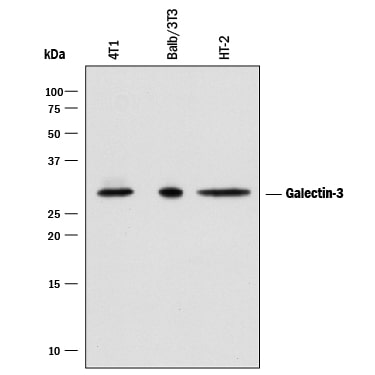
Detection of Mouse Galectin-3 antibody by Western Blot.

Detection of Mouse Galectin‑3 by Western Blot.

Western blot shows lysates of 4T1 mouse breast cancer cell line, Balb/3T3 mouse embryonic fibroblast cell line and HT-2 mouse T cell line. PVDF membrane was probed with 0.05 µg/mL of Goat Anti-Mouse Galectin-3 Antigen Affinity-purified Polyclonal Antibody (Catalog # AF1197) followed by HRP-conjugated Anti-Goat IgG Secondary Antibody (Catalog # HAF017). A specific band was detected for Galectin-3 at approximately 28 kDa (as indicated). This experiment was conducted under reducing conditions and using Immunoblot Buffer Group 1.

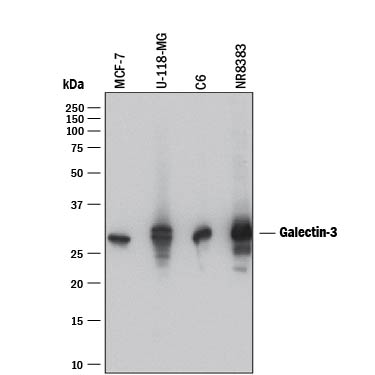
Detection of Human and Rat Galectin-3 antibody by Western Blot.

Detection of Human and Rat Galectin‑3 by Western Blot.

Western blot shows lysates of MCF-7 human breast cancer cell line, U-118-MG human glioblastoma/astrocytoma cell line, C6 rat glioma cell line, and NR8383 rat alveolar macrophage cell line. PVDF membrane was probed with 0.2 µg/mL of Goat Anti-Mouse Galectin-3 Antigen Affinity-purified Polyclonal Antibody (Catalog # AF1197) followed by HRP-conjugated Anti-Goat IgG Secondary Antibody (Catalog # HAF017). A specific band was detected for Galectin-3 at approximately 28 kDa (as indicated). This experiment was conducted under reducing conditions and using Immunoblot Buffer Group 1.

Galectin‑3 antibody in Mouse Embryo by Immunohistochemistry (IHC-Fr).

Galectin‑3 in Mouse Embryo.

Galectin-3 was detected in immersion fixed frozen sections of mouse embryo (15 d.p.c., cross-section through the eye) using Goat Anti-Human Galectin-3 Antigen Affinity-purified Polyclonal Antibody (Catalog # AF1197 ) at 15 µg/mL overnight at 4 °C. Tissue was stained using the Anti-Goat HRP-DAB Cell & Tissue Staining Kit (brown; Catalog # CTS008) and counterstained with hematoxylin (blue). View our protocol for Chromogenic IHC Staining of Frozen Tissue Sections.

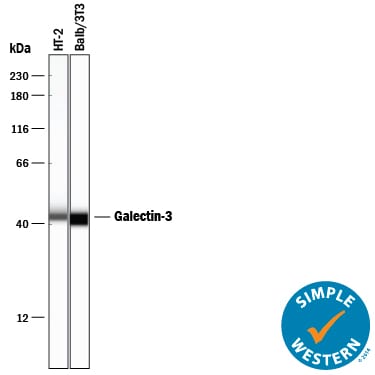
Detection of Mouse Galectin-3 antibody by Simple WesternTM.

Detection of Mouse Galectin‑3 by Simple WesternTM.

Simple Western lane view shows lysates of HT-2 mouse T cell line and Balb/3T3 mouse embryonic fibroblast cell line, loaded at 0.2 mg/mL. A specific band was detected for Galectin-3 at approximately 44 kDa (as indicated) using 10 µg/mL of Goat Anti-Mouse Galectin-3 Antigen Affinity-purified Polyclonal Antibody (Catalog # AF1197) followed by 1:50 dilution of HRP-conjugated Anti-Goat IgG Secondary Antibody (Catalog # HAF109). This experiment was conducted under reducing conditions and using the 12-230 kDa separation system.

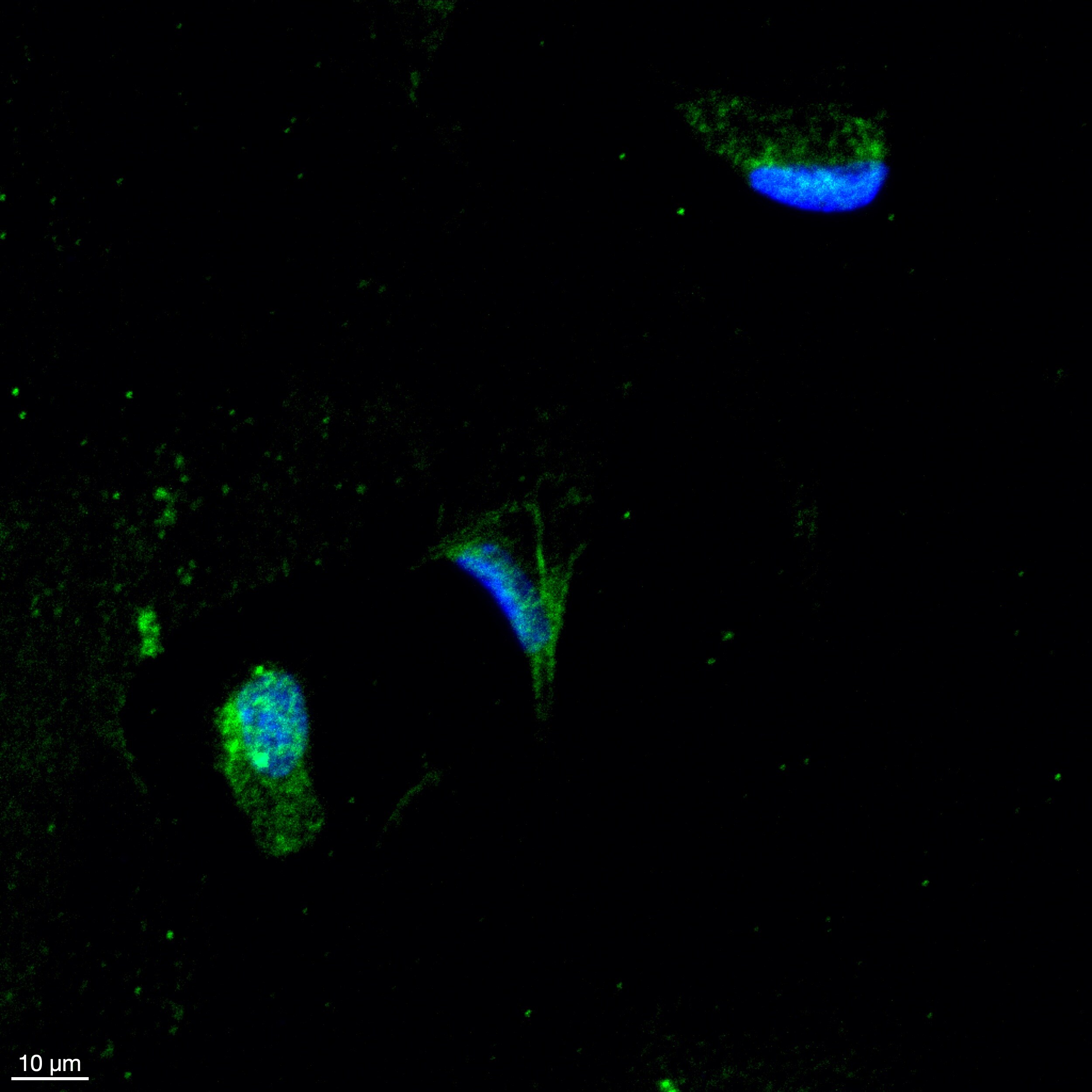
Detection of Galectin-3 by Immunocytochemistry/ Immunofluorescence

Detection of Galectin-3 by Immunocytochemistry/ Immunofluorescence

Coexpression of Iba1 and galectin-3. Human brain biopsy samples from the superior frontal gyrus after TBI were stained with the primary antibodies: rabbit anti-Iba1 (1:1000, Wako, Cat No. 019-19741) and goat anti-galectin-3 (1:500, BioLegend, Cat No. 126701) followed by rabbit anti-Alexa Fluor 488 and goat anti-Alexa Fluor 594, respectively. Limited galectin-3 expression was observed in Iba1+ microglia with a ramified morphology (A–C), but there was a strong galectin-3 expression in Iba1+ microglia in the activated state (D–L) in the non-contused brain tissue. Predominantly amoeboid microglia stained with Iba1 and galectin-3 were observed in contused brain tissue (M–O). Clotted blood from a neurosurgical (brain) operative field was used to identify peripherally-derived macrophages that strongly stained for both Iba1 and galectin-3 (P–R). Scale bars are 25 μm. Unpublished data. Image collected and cropped by CiteAb from the following open publication (https://pubmed.ncbi.nlm.nih.gov/35625531), licensed under a CC-BY license. Not internally tested by R&D Systems.
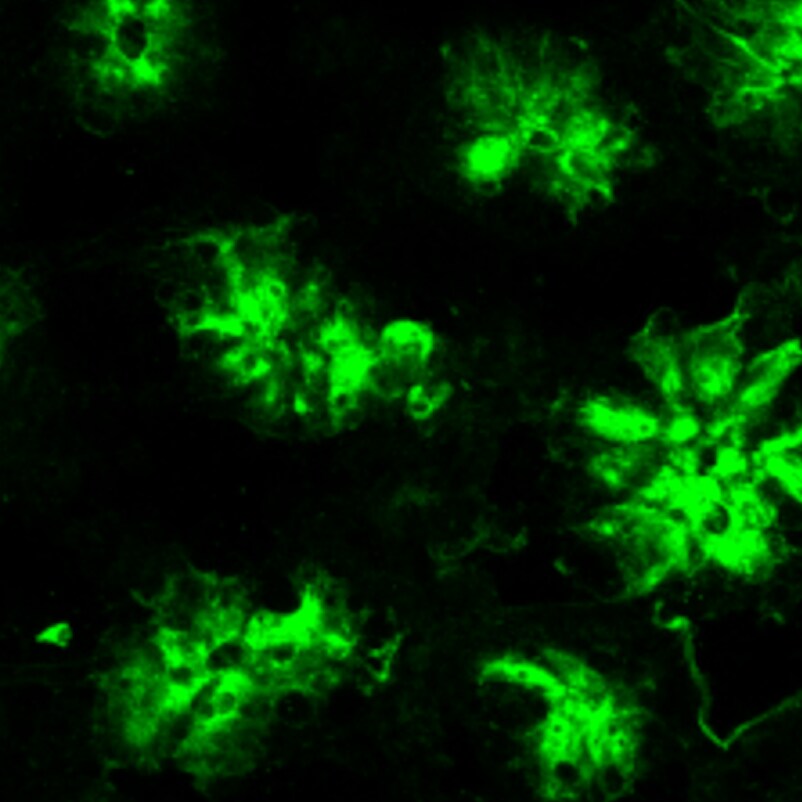
Detection of Galectin-3 by Immunocytochemistry/ Immunofluorescence

Detection of Galectin-3 by Immunocytochemistry/ Immunofluorescence

Coexpression of Iba1 and galectin-3. Human brain biopsy samples from the superior frontal gyrus after TBI were stained with the primary antibodies: rabbit anti-Iba1 (1:1000, Wako, Cat No. 019-19741) and goat anti-galectin-3 (1:500, BioLegend, Cat No. 126701) followed by rabbit anti-Alexa Fluor 488 and goat anti-Alexa Fluor 594, respectively. Limited galectin-3 expression was observed in Iba1+ microglia with a ramified morphology (A–C), but there was a strong galectin-3 expression in Iba1+ microglia in the activated state (D–L) in the non-contused brain tissue. Predominantly amoeboid microglia stained with Iba1 and galectin-3 were observed in contused brain tissue (M–O). Clotted blood from a neurosurgical (brain) operative field was used to identify peripherally-derived macrophages that strongly stained for both Iba1 and galectin-3 (P–R). Scale bars are 25 μm. Unpublished data. Image collected and cropped by CiteAb from the following open publication (https://pubmed.ncbi.nlm.nih.gov/35625531), licensed under a CC-BY license. Not internally tested by R&D Systems.

Applications for Human/Mouse/Rat Galectin‑3 Antibody

Application
Recommended Usage

Immunohistochemistry

5-15 µg/mL
Sample: Immersion fixed frozen sections of mouse embryo (E15)

Simple Western

10 µg/mL
Sample: HT‑2 mouse T cell line and Balb/3T3 mouse embryonic fibroblast cell line

Western Blot

0.05-0.2 µg/mL
Sample: 4T1 mouse breast cancer cell line, Balb/3T3 mouse embryonic fibroblast cell line, HT‑2 mouse T cell line, MCF‑7 human breast cancer cell line, U‑118‑MG human glioblastoma/astrocytoma cell line, C6 rat glioma cell line, and NR8383 rat alveolar macrophage cell line

Reviewed Applications

Read 3 reviews rated 4.3 using AF1197 in the following applications:

Formulation, Preparation, and Storage

Purification

Antigen Affinity-purified

Reconstitution

Reconstitute at 0.2 mg/mL in sterile PBS. For liquid material, refer to CoA for concentration.


Loading...

Formulation

Lyophilized from a 0.2 μm filtered solution in PBS with Trehalose. *Small pack size (SP) is supplied either lyophilized or as a 0.2 µm filtered solution in PBS.

Shipping

Lyophilized product is shipped at ambient temperature. Liquid small pack size (-SP) is shipped with polar packs. Upon receipt, store immediately at the temperature recommended below.

Stability & Storage

Use a manual defrost freezer and avoid repeated freeze-thaw cycles.
  • 12 months from date of receipt, -20 to -70 °C as supplied.
  • 1 month, 2 to 8 °C under sterile conditions after reconstitution.
  • 6 months, -20 to -70 °C under sterile conditions after reconstitution.

Calculators

The reconstitution calculator allows you to quickly calculate the volume of a reagent to reconstitute your vial. Simply enter the mass of reagent and the target concentration and the calculator will determine the rest.

=
÷

Background: Galectin-3

The galectins constitute a large family of carbohydrate-binding proteins with specificity for N-acetyl-lactosamine-containing glycoproteins. At least 14 mammalian galectins, which share structural similarities in their carbohydrate recognition domains (CRD), have been identified. The galectins have been classified into the prototype galectins (-1, -2, -5, -7, -10, -11, -13, -14), which contain one CRD and exist either as a monomer or a noncovalent homodimer; the chimera galectins (Galectin-3) containing one CRD linked to a nonlectin domain; and the tandem-repeat galectins (-4, -6, -8, -9, -12) consisting of two CRDs joined by a linker peptide. Galectins lack a classical signal peptide and can be localized to the cytosolic compartments where they have intracellular functions. However, via one or more as yet unidentified non-classical secretory pathways, galectins can also be secreted to function extracellularly. Individual members of the galectin family have different tissue distribution profiles and exhibit subtle differences in their carbohydrate-binding specificities. Each family member may preferentially bind to a unique subset of cell-surface glycoproteins (1-4).

Galectin-3, also known as Mac-2, L29, CBP35, and epsilon BP, is a chimera galectin that has a tendency to dimerize. Besides the soluble protein, alternatively spliced forms of chicken Galectin-3 containing a transmembrane-spanning domain and a leucine zipper motif have been reported. Galectin-3 is expressed in tumor cells, macrophages, activated T cells, osteoclasts, epithelial cells, and fibroblasts. It binds various matrix glycoproteins including laminin, fibronectin, LAMPS, 90K/Mac-2BP, MP20, and CEA. Galectin-3 promotes cell growth and proliferation for many cell types. Galectin-3 acts intracellularly to prevent apoptosis. Depending on the cell types, Galectin-3 exhibits pro- or anti-adhesive properties. Galectin-3 has proinflammatory activities in vitro and in vivo. It induces pro-inflammatory and inhibits Th2 type cytokine production. Galectin-3 chemoattracts monocytes and macrophages. It activates and degranulates basophils and mast cells. Elevated circulating levels of Galectin-3 has been show to correlate with the malignant potential of several types of cancer, suggesting that Galectin-3 is also involved in tumor growth and metastasis. Human and mouse Galectin-3 shares approximately 80% amino acid sequence similarity (1-5).

References

  1. Rabinovich, A. et al. (2002) Trends in Immunol. 23:313.
  2. Rabinovich, A. et al. (2002) J. Leukocyte Biology 71:741.
  3. Hughes, R.C. (2001) Biochimie 83:667.
  4. R&D Systems Cytokine Bulletin; Summer 2002.
  5. Gorski, J.P. et al. (2002) J. Biol. Chem. 277:18840.

Alternate Names

AGE-R3, CBP35, GAL3, Galectin3, L29, LGALS3, Mac-2

Entrez Gene IDs

3958 (Human); 16854 (Mouse)

Gene Symbol

LGALS3

UniProt

Additional Galectin-3 Products

Product Documents for Human/Mouse/Rat Galectin‑3 Antibody

Certificate of Analysis

To download a Certificate of Analysis, please enter a lot or batch number in the search box below.

Note: Certificate of Analysis not available for kit components.

Product Specific Notices for Human/Mouse/Rat Galectin‑3 Antibody

For research use only

Citations for Human/Mouse/Rat Galectin‑3 Antibody

Customer Reviews for Human/Mouse/Rat Galectin‑3 Antibody (3)

4.3 out of 5
3 Customer Ratings
5 Stars
33%
4 Stars
67%
3 Stars
0%
2 Stars
0%
1 Stars
0%

Have you used Human/Mouse/Rat Galectin‑3 Antibody?

Submit a review and receive an Amazon gift card!

$25/€18/£15/$25CAN/¥2500 Yen for a review with an image

$10/€7/£6/$10CAN/¥1110 Yen for a review without an image

Submit a review
Amazon Gift Card

Customer Images


Showing  1 - 3 of 3 reviews Showing All
Filter By:
  • Human/Mouse/Rat Galectin-3 Antibody
    Name: Anonymous
    Application: Immunocytochemistry/Immunofluorescence
    Verified Customer | Posted 01/24/2024
    Human/Mouse/Rat Galectin‑3 Antibody AF1197
  • Name: Anonymous
    Application: Immunocytochemistry
    Sample Tested: See PMID 22981630
    Species: Rat
    Verified Customer | Posted 01/05/2015
  • Name: Anonymous
    Application: Immunohistochemistry-Paraffin
    Sample Tested: See PMID 23175698
    Species: Mouse
    Verified Customer | Posted 01/05/2015

There are no reviews that match your criteria.

Showing  1 - 3 of 3 reviews Showing All

Protocols

Find general support by application which include: protocols, troubleshooting, illustrated assays, videos and webinars.

FAQs

No product specific FAQs exist for this product.

View all FAQs for Antibodies