
IGF-II (Insulin-like growth factor II; also multiplication-stimulating polypeptide/MSP and somatomedin-A) is a secreted 8 kDa polypeptide that belongs to the insulin family of peptide growth factors (1, 2, 3). It is part of a complex system of growth and metabolic-regulating proteins that is particularly important during development. It has been associated with nervous system proliferation and differentiation, myelination, adrenal cortical proliferation, and skeletal growth and differentiation (4). In human, IGF-II is primarily synthesized by the liver, and circulates at high levels in both fetus and adult. In rodent, however, IGF-II levels drop after the perinatal period, an effect attributed to the lack of a key gene promoter (2, 5). This may indicate that postnatally, IGF-II has either a limited, or local effect only in rodent. For example, evidence suggests IGF-II may be the intermediary for SHH induction of VEGF attendant with local neovascularization (6). Rodent cells known to express IGF-II include astrocytes (7), hepatocytes (8), osteoblasts (9), embryonic striated muscle cells (10, 11) plus Kupffer cells and Ito cells (12). Mouse IGF-II is synthesized as a 180 amino acid (aa) preproprecursor (13). It contains a 24 aa signal sequence, a 67 aa mature region, and an 89 aa C-terminal prodomain that is alternatively referred to as the E-peptide. Mature IGF-II is 91% and 97% aa identical to human and rat IGF-II, respectively. Proper processing of IGF-II requires the chaperone activity of GRP94 (14). This generates an 8 kDa mature form, an 18 kDa, 156 aa proform, and a potential 11 kDa, 88 aa “Big” form (aa 25-112). This 11 kDa ”Big” form would be equivalent to human 15-16 kDa IGF-II, with the 5 kDa difference attributable to the presence of O-linked glycosylation (15). There is an additional 34 aa proteolytic fragment that is termed preptin and contains aa 93-126 of the preproprecursor. This is distinct from IGF-II, is secreted by pancreatic B cells, and facilitates insulin secretion (16, 17). IGF-II has multiple binding partners. It binds to IGF-IR, the Insulin receptor (IR)-type A and IGF-IR:IR-A hybrids, the type 2 IGF receptor (IGF-2R), and IGF binding proteins 1-6 (18, 19). The first three receptors initiate downstream signaling events, the IGF-2R sequesters local IGF‑II, and the six IGFBPs regulate IGF-II activity in various tissues.
Mouse IGF-II/IGF2 Antibody (122404)
R&D Systems | Catalog # MAB792

Scientific images may be resized, cropped, or adjusted for brightness or contrast for presentation purposes. These updates are limited to presentation and do not affect the underlying scientific interpretation of the data. Where available, additional source data may be provided upon request.
Key Product Details
Species Reactivity
Validated:
Cited:
Applications
Validated:
Cited:
Label
Antibody Source
Product Specifications
Immunogen
Ala25-Glu91
Accession # P09535
Specificity
Clonality
Host
Isotype
Scientific Data Images for Mouse IGF-II/IGF2 Antibody (122404)
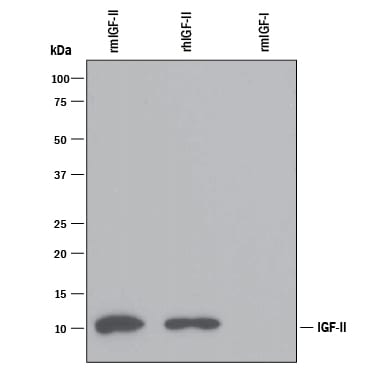
Detection of Recombinant Human and Mouse IGF-II/IGF2 by Western Blot.
Western blot shows 50 ng of Recombinant Mouse IGF-I/IGF1 (Catalog # 791-MG), Recombinant Human IGF-II/IGF2 (Catalog # 292-G2) and Recombinant Mouse IGF-I/IGF1 (Catalog # 791-MG). PVDF Membrane was probed with 1 µg/mL of Rat Anti-Mouse IGF-II/IGF2 Monoclonal Antibody (Catalog # MAB792) followed by HRP-conjugated Anti-Rat IgG Secondary Antibody (Catalog # HAF005). A specific band was detected for IGF-II/IGF2 at approximately 11 kDa (as indicated). This experiment was conducted under reducing conditions and using Immunoblot Buffer Group 3.
Mouse IGF-II ELISA Standard Curve
Recombinant Mouse IGF-II/IGF2 (Catalog # 792-MG) was serially diluted and captured by Rat Anti-Mouse IGF-II/IGF2 Monoclonal Antibody (Catalog # MAB792) coated on a Clear Polystyrene Microplate (Catalog # DY990). Goat Anti-Mouse IGF-II/IGF2 Antigen Affinity-purified Polyclonal Antibody (Catalog # AF792) was biotinylated and incubated with the protein captured on the plate. Detection of the standard curve was achieved by incubating Streptavidin-HRP (Catalog # DY998)Applications for Mouse IGF-II/IGF2 Antibody (122404)
Western Blot
Sample: Recombinant Mouse IGF-II/IGF2 (Catalog # 792-MG)
Mouse IGF-II/IGF2 Sandwich Immunoassay
Formulation, Preparation, and Storage
Purification
Reconstitution
Reconstitute at 0.5 mg/mL in sterile PBS. For liquid material, refer to CoA for concentration.
Formulation
Shipping
Stability & Storage
- 12 months from date of receipt, -20 to -70 °C as supplied.
- 1 month, 2 to 8 °C under sterile conditions after reconstitution.
- 6 months, -20 to -70 °C under sterile conditions after reconstitution.
Calculators
Background: IGF-II/IGF2
References
- LeRoith, D. & C.T. Roberts Jr. (2003) Cancer Lett. 195:127.
- Werner, H. & D. LeRoith (2000) Cell. Mol. Life Sci. 57:932.
- Pavelic, J. et al. (2007) Indian J. Med. Res. 125:511.
- Varela-Nieto, I. et al. (2007) Curr. Pharm. Des. 13:687.
- Rotwein, P. & L.J. Hall (1990) DNA Cell Biol. 10:725.
- Chao, W. & P.A. D-Amore (2008) Cytokine Growth Factor Rev. 19:111.
- Rotwein, P. et al. (1988) Proc. Natl. Acad. Sci. USA 85:265.
- Goya, L. et al. (1999) J. Biol. Chem. 274:24633.
- McCarthy, T.L. et al. (1992) Endocrinology 130:1303.
- Zindy, F. et al. (1992) J. Hepatol. 14:30.
- Holthuizen, P.E. et al. (1993) Regul. Pept. 48:77.
- Merrick, D. et al. (2007) BMC Dev. Biol. 7:65.
- Stempien, M.M. et al. (1986) DNA 5:357.
- Ostrovsky, O. et al. (2009) Mol. Biol. Cell 20:1855.
- Daughaday, W.H. et al. (1993) Proc. Natl. Acad. Sci. USA 90:5823.
- Buchanan, C.M. et al. (2001) Biochem. J. 360:431.
- Cornish, J. et al. (2007) Am. J. Physiol. Endocrinol. Metab. 292:E117.
- Denley, A. et al. (2005) Cytokine Growth Factor Rev. 16:421.
- Belfiore, A. (2007) Curr. Pharm. Des. 13:671.
Long Name
Alternate Names
Gene Symbol
UniProt
Additional IGF-II/IGF2 Products
Product Documents for Mouse IGF-II/IGF2 Antibody (122404)
Certificate of Analysis
To download a Certificate of Analysis, please enter a lot or batch number in the search box below.
Note: Certificate of Analysis not available for kit components.
Product Specific Notices for Mouse IGF-II/IGF2 Antibody (122404)
For research use only
Citations for Mouse IGF-II/IGF2 Antibody (122404)
 Powered by Bioz
Customer Reviews for Mouse IGF-II/IGF2 Antibody (122404)
There are currently no reviews for this product. Be the first to review Mouse IGF-II/IGF2 Antibody (122404) and earn rewards!
Have you used Mouse IGF-II/IGF2 Antibody (122404)?
Submit a review and receive an Amazon gift card!
$25/€18/£15/$25CAN/¥2500 for a review with an image
$10/€7/£6/$10CAN/¥1110 for a review without an image
Submit a review
Protocols
Find general support by application which include: protocols, troubleshooting, illustrated assays, videos and webinars.
- Cellular Response to Hypoxia Protocols
- R&D Systems Quality Control Western Blot Protocol
- Troubleshooting Guide: Western Blot Figures
- Western Blot Conditions
- Western Blot Protocol
- Western Blot Protocol for Cell Lysates
- Western Blot Troubleshooting
- Western Blot Troubleshooting Guide
- View all Protocols, Troubleshooting, Illustrated assays and Webinars