
Interleukin 34 (IL-34; also known as uncharacterized protein C16orf77 homolog) is a 39 kDa, secreted cytokine that belongs to no known cytokine family (1). Mouse IL-34 is synthesized as a 235 amino acid (aa) precursor with a 20 aa signal sequence and a 215 aa mature chain (SwissProt # Q8R1R4). The mature chain contains two potential sites for N-linked glycosylation. There are three isoforms for IL-34. Isoform 1 (Q8R1R4-1) is the recombinant mouse IL-34 described in this insert. Isoform 2 (Q8R1R4-2) has an 85 aa substitution for the final 101 aa’s in isoform 1, and isoform 3 (Q8R1R4-3) lacks Q81 in isoform 1. Mouse IL-34 is 71% identical to human IL-34 on the amino acid level. IL-34 is expressed in various tissues, including heart, brain, lung, liver, kidney, spleen, thymus, testes, ovary, small intestine, prostate, and colon, and it is most abundant in the spleen (1). The receptor for IL-34 is colony-stimulating factor 1 receptor (CSF‑1R) (1). IL-34 stimulates monocyte viability (1). In functional studies, IL-34, like CSF-1, the other ligand for CSF-1R, stimulated phosphorylation of extracellular signal-regulated kinase-1 and -2 (ERK1/2) in human monocytes (1). In addition, IL-34 promoted the formation of the colony-forming unit-macrophage (CFU-M), a macrophage progenitor, in human bone marrow cultures (1).
Mouse IL-34 Antibody
R&D Systems | Catalog # AF5195


Scientific images may be resized, cropped, or adjusted for brightness or contrast for presentation purposes. These updates are limited to presentation and do not affect the underlying scientific interpretation of the data. Where available, additional source data may be provided upon request.
Key Product Details
Species Reactivity
Validated:
Cited:
Applications
Validated:
Cited:
Label
Antibody Source
Product Specifications
Immunogen
Asn21-Pro235
Accession # Q8R1R4
Specificity
Clonality
Host
Isotype
Endotoxin Level
Scientific Data Images for Mouse IL-34 Antibody
Detection of Mouse IL‑34 by Western Blot.
Western blot shows lysates of mouse spleen tissue and mouse brain tissue. PVDF membrane was probed with 1 µg/mL of Sheep Anti-Mouse IL-34 Antigen Affinity-purified Polyclonal Antibody (Catalog # AF5195) followed by HRP-conjugated Anti-Sheep IgG Secondary Antibody (Catalog # HAF016). A specific band was detected for IL-34 at approximately 33 kDa (as indicated). This experiment was conducted under reducing conditions and using Immunoblot Buffer Group 8.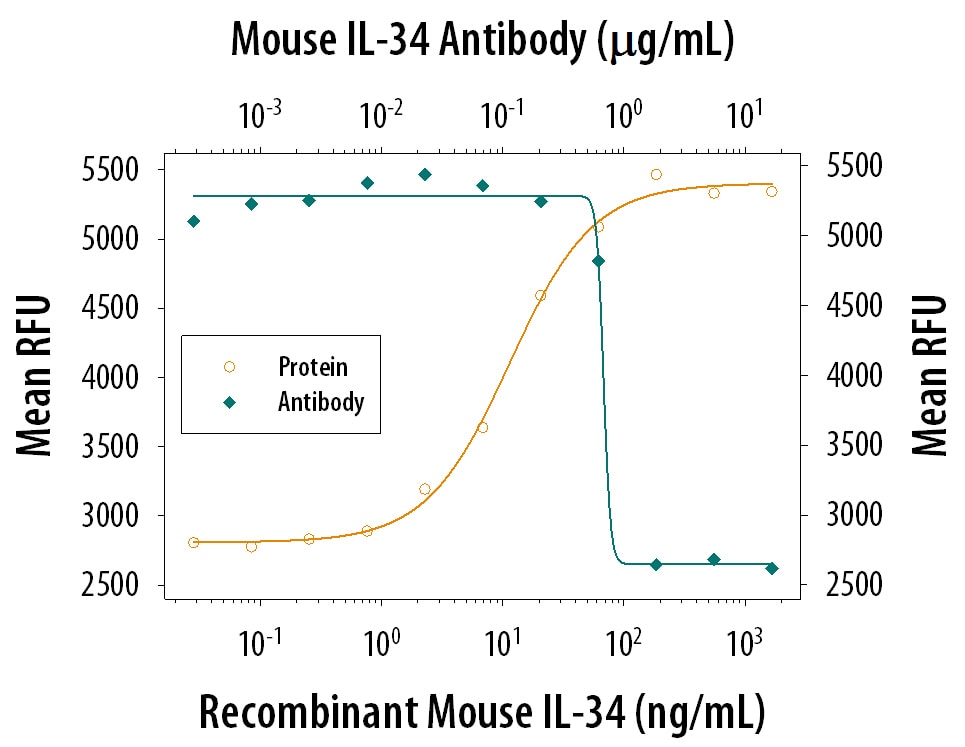
Cell Proliferation Induced by IL‑34 and Neutralization by Mouse IL‑34 Antibody.
Recombinant Mouse IL-34 (Catalog # 5195-ML) induces proliferation in the M-NFS-60 mouse myelogenous leukemia lymphoblast cell line in a dose-dependent manner (orange line). Proliferation elicited by Recombinant Mouse IL-34 (100 ng/mL) is neutralized (green line) by increasing concentrations of Sheep Anti-Mouse IL-34 Antigen Affinity-purified Polyclonal Antibody (Catalog # AF5195). The ND50 is typically 0.3-1.5 µg/mL.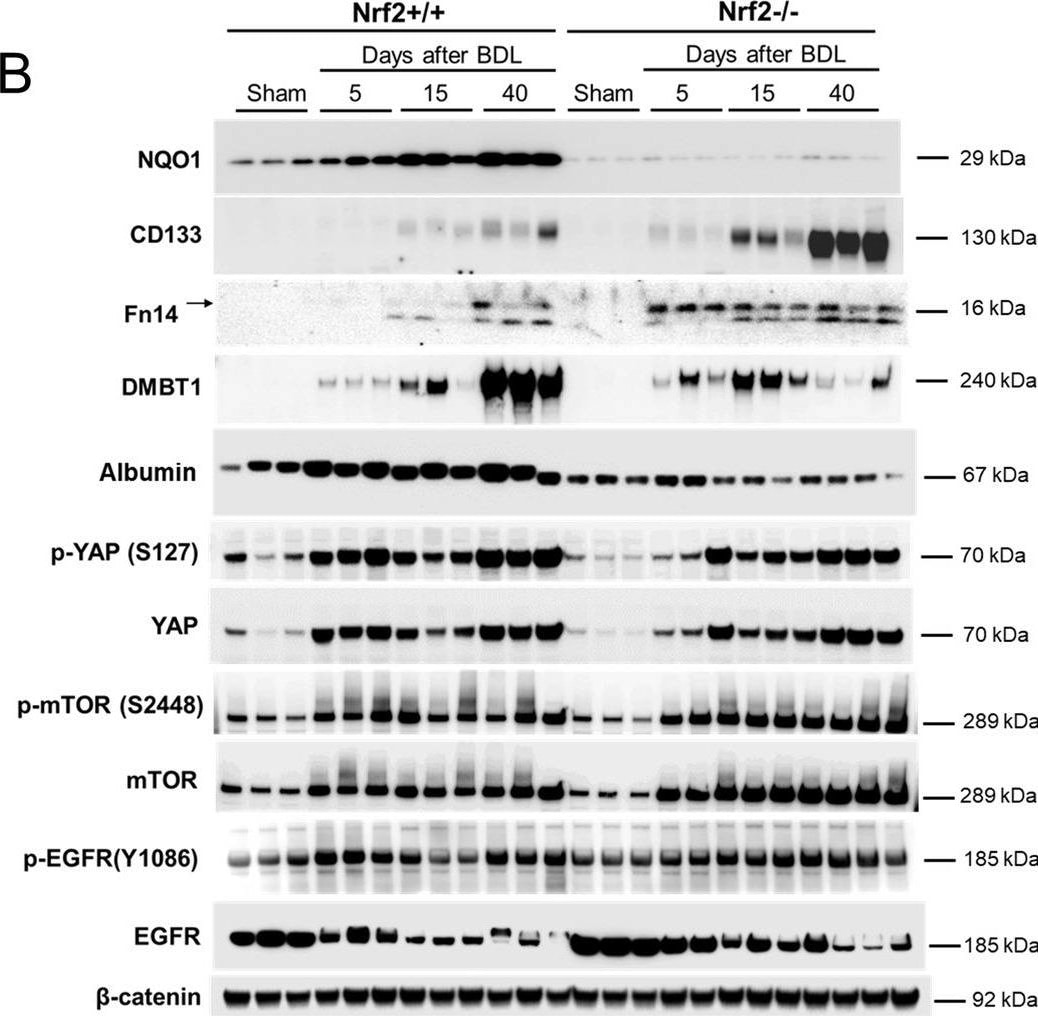
Detection of IL-34 by Western Blot
Hepatic expression of a group of genes or proteins in Nrf2+/+ and Nrf2-/- mice after bile duct ligation (BDL).(A) mRNA expression of hepatic Nrf2 and Nqo1 was quantified by qRT-PCR. (B) Western blotting was performed with antibodies against the proteins indicated. Liver lysates were prepared from the livers of mice after BDL or sham operation. beta -catenon was used as a loading control because it showed the most stable expression over the course of cholestasis relative to regular loading controls screened. Each lane represents a sample from an individual mouse. *P < 0.05; **, P < 0.01; ***, P < 0.001. Image collected and cropped by CiteAb from the following open publication (https://pubmed.ncbi.nlm.nih.gov/35696363), licensed under a CC-BY license. Not internally tested by R&D Systems.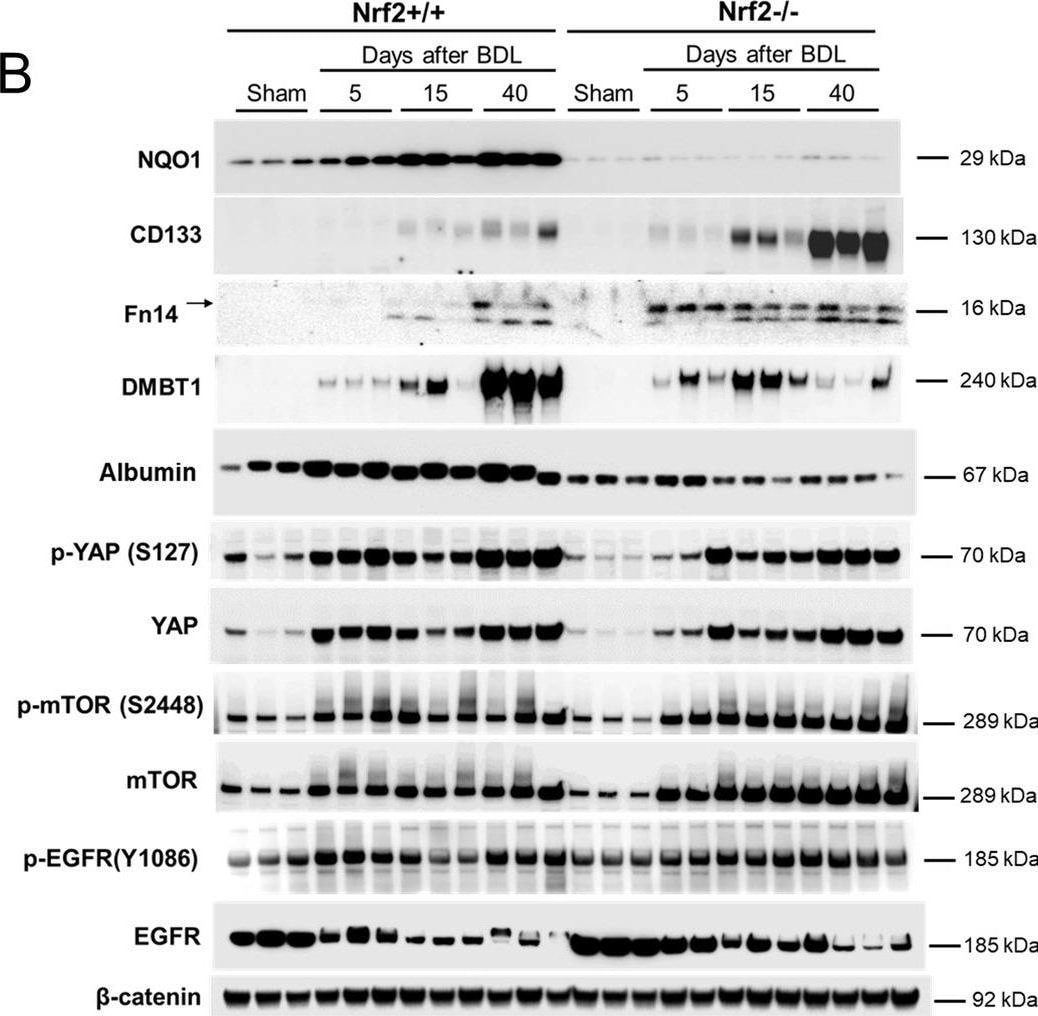
Detection of IL-34 by Western Blot
Hepatic expression of a group of genes or proteins in Nrf2+/+ and Nrf2-/- mice after bile duct ligation (BDL).(A) mRNA expression of hepatic Nrf2 and Nqo1 was quantified by qRT-PCR. (B) Western blotting was performed with antibodies against the proteins indicated. Liver lysates were prepared from the livers of mice after BDL or sham operation. beta -catenon was used as a loading control because it showed the most stable expression over the course of cholestasis relative to regular loading controls screened. Each lane represents a sample from an individual mouse. *P < 0.05; **, P < 0.01; ***, P < 0.001. Image collected and cropped by CiteAb from the following open publication (https://pubmed.ncbi.nlm.nih.gov/35696363), licensed under a CC-BY license. Not internally tested by R&D Systems.Applications for Mouse IL-34 Antibody
Western Blot
Sample: Mouse spleen tissue and mouse brain tissue
Neutralization
Formulation, Preparation, and Storage
Purification
Reconstitution
Reconstitute at 0.2 mg/mL in sterile PBS. For liquid material, refer to CoA for concentration.
Formulation
Shipping
Stability & Storage
- 12 months from date of receipt, -20 to -70 °C as supplied.
- 1 month, 2 to 8 °C under sterile conditions after reconstitution.
- 6 months, -20 to -70 °C under sterile conditions after reconstitution.
Calculators
Background: IL-34
References
- Lin, H. et al. (2008) Science 320:807.
Long Name
Alternate Names
Gene Symbol
UniProt
Additional IL-34 Products
Product Documents for Mouse IL-34 Antibody
Certificate of Analysis
To download a Certificate of Analysis, please enter a lot or batch number in the search box below.
Note: Certificate of Analysis not available for kit components.
Product Specific Notices for Mouse IL-34 Antibody
For research use only
Related Research Areas
Citations for Mouse IL-34 Antibody
 Powered by Bioz
Customer Reviews for Mouse IL-34 Antibody
There are currently no reviews for this product. Be the first to review Mouse IL-34 Antibody and earn rewards!
Have you used Mouse IL-34 Antibody?
Submit a review and receive an Amazon gift card!
$25/€18/£15/$25CAN/¥2500 for a review with an image
$10/€7/£6/$10CAN/¥1110 for a review without an image
Submit a review
Protocols
Find general support by application which include: protocols, troubleshooting, illustrated assays, videos and webinars.
- Cellular Response to Hypoxia Protocols
- R&D Systems Quality Control Western Blot Protocol
- Troubleshooting Guide: Western Blot Figures
- Western Blot Conditions
- Western Blot Protocol
- Western Blot Protocol for Cell Lysates
- Western Blot Troubleshooting
- Western Blot Troubleshooting Guide
- View all Protocols, Troubleshooting, Illustrated assays and Webinars