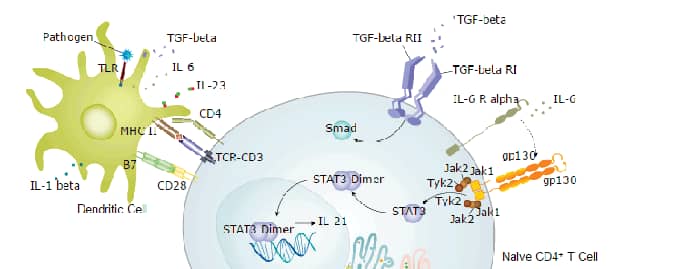
Interleukin 6 (IL-6) is a multifunctional cytokine that exerts its activities by binding to a high-affinity receptor complex consisting of two membrane glycoproteins: an 80 kDa ligand binding subunit (IL-6 R alpha /CD126) and a 130 kDa nonligand-binding signal-transducing subunit (gp130/CD130) (1‑4). The mouse IL-6 R alpha cDNA encodes a precursor type I transmembrane protein of 460 amino acids (aa) that contains a 19 aa signal sequence, a 345 aa extracellular ligand binding domain, a 21 aa transmembrane region, and a 75 aa cytoplasmic segment (2). The extracellular segment contains an Ig-like and a fibronectin-type III domain, plus a membrane proximal WSXWS motif. In their extracellular regions, mouse IL‑6 R alpha shares 89%, 51% and 50% aa identity with rat, human and porcine IL‑6 R alpha, respectively. Unlike gp130 that is expressed ubiquitously, the cellular distribution of IL-6 R alpha is predominantly limited to hepatocytes and leukocyte subpopulations such as monocytes, neutrophils, T and B cells. Soluble IL-6R alpha has been found in various body fluids (5). Two soluble receptor isoforms that arise either from proteolytic cleavage of the membrane-bound IL‑6 R alpha, or by alternative mRNA splicing (reported only in human) have been described (6, 7). Soluble IL-6 R alpha binds IL-6 with an affinity similar to that of the membrane-bound IL-6 R alpha. More importantly, the soluble IL-6 R alpha /IL-6 complex is capable of interacting with the membrane-bound gp130 to activate cells that lack an integral membrane IL-6 R alpha. It has been documented that elevated soluble IL-6 R is associated with numerous diseases including arthritic lesions, multiple myeloma and Crohn’s disease (6, 7).
Mouse IL-6R alpha Antibody (255821) [Biotin]
R&D Systems | Catalog # BAM1830

![Mouse IL-6R alpha Antibody (255821) [Biotin]](https://resources.rndsystems.com/images/icons/RnD-Default-Product-Image_Antibodies-Icon.svg "Mouse IL-6R alpha Antibody (255821) [Biotin]")
Key Product Details
Species Reactivity
Mouse
Applications
Flow Cytometry, Immunocytochemistry
Label
Biotin
Antibody Source
Monoclonal Rat IgG2A Clone # 255821
Loading...
Product Specifications
Immunogen
Mouse myeloma cell line NS0-derived recombinant mouse IL-6 R alpha
Leu20-Glu357
Accession # P22272
Leu20-Glu357
Accession # P22272
Specificity
Detects mouse IL‑6 R alpha.
Clonality
Monoclonal
Host
Rat
Isotype
IgG2A
Applications for Mouse IL-6R alpha Antibody (255821) [Biotin]
Application
Recommended Usage
Flow Cytometry
0.25 µg/106 cells
Sample: Mouse CD3+ splenocytes
Sample: Mouse CD3+ splenocytes
Immunocytochemistry
8-25 µg/mL
Sample: Immersion fixed mouse splenocytes
Sample: Immersion fixed mouse splenocytes
Flow Cytometry Panel Builder
Bio-Techne Knows Flow Cytometry
Save time and reduce costly mistakes by quickly finding compatible reagents using the Panel Builder Tool.
Advanced Features
- Spectra Viewer - Custom analysis of spectra from multiple fluorochromes
- Spillover Popups - Visualize the spectra of individual fluorochromes
- Antigen Density Selector - Match fluorochrome brightness with antigen density

Formulation, Preparation, and Storage
Purification
Protein A or G purified from hybridoma culture supernatant
Reconstitution
Reconstitute at 0.5 mg/mL in sterile PBS.
Loading...
Formulation
Lyophilized from a 0.2 μm filtered solution in PBS with BSA as a carrier protein.
Shipping
The product is shipped at ambient temperature. Upon receipt, store it immediately at the temperature recommended below.
Stability & Storage
Use a manual defrost freezer and avoid repeated freeze-thaw cycles.
- 12 months from date of receipt, -20 to -70 °C as supplied.
- 1 month, 2 to 8 °C under sterile conditions after reconstitution.
- 6 months, -20 to -70 °C under sterile conditions after reconstitution.
Calculators
Background: IL-6R alpha
References
- Yamasaki, K. et al. (1988) Science 241:825.
- Sugita, T. et al. (1990) J. Exp. Med. 171:2001.
- Hibi, M. et al. (1990) Cell 63:1149.
- Saito, M. et al. (1992) J. Immunol. 148:4066.
- Novick, D. et al. (1989) J. Exp. Med. 170:1409.
- Jones, S.A. et al. (2001) FASEB J. 15:43.
- Jones, S.A. and S. Rose-John (2002) Biochim. Biophys. Acta 1592:251.
Long Name
Interleukin 6 Receptor alpha
Alternate Names
CD126, IL-6 R alpha, IL-6Ra, IL6R, IL6R alpha
Gene Symbol
IL6R
UniProt
Additional IL-6R alpha Products
Product Documents for Mouse IL-6R alpha Antibody (255821) [Biotin]
Certificate of Analysis
To download a Certificate of Analysis, please enter a lot or batch number in the search box below.
Note: Certificate of Analysis not available for kit components.
Product Specific Notices for Mouse IL-6R alpha Antibody (255821) [Biotin]
For research use only
Citations for Mouse IL-6R alpha Antibody (255821) [Biotin]
 Powered by Bioz
Customer Reviews for Mouse IL-6R alpha Antibody (255821) [Biotin]
There are currently no reviews for this product. Be the first to review Mouse IL-6R alpha Antibody (255821) [Biotin] and earn rewards!
Have you used Mouse IL-6R alpha Antibody (255821) [Biotin]?
Submit a review and receive an Amazon gift card!
$25/€18/£15/$25CAN/¥2500 for a review with an image
$10/€7/£6/$10CAN/¥1110 for a review without an image
Submit a review
Protocols
Find general support by application which include: protocols, troubleshooting, illustrated assays, videos and webinars.
- 7-Amino Actinomycin D (7-AAD) Cell Viability Flow Cytometry Protocol
- Appropriate Fixation of IHC/ICC Samples
- Cellular Response to Hypoxia Protocols
- ClariTSA™ Fluorophore Kits
- Detection & Visualization of Antibody Binding
- Extracellular Membrane Flow Cytometry Protocol
- Flow Cytometry Protocol for Cell Surface Markers
- Flow Cytometry Protocol for Staining Membrane Associated Proteins
- Flow Cytometry Staining Protocols
- Flow Cytometry Troubleshooting Guide
- ICC Cell Smear Protocol for Suspension Cells
- ICC Immunocytochemistry Protocol Videos
- ICC for Adherent Cells
- Immunocytochemistry (ICC) Protocol
- Immunocytochemistry Troubleshooting
- Immunofluorescence of Organoids Embedded in Cultrex Basement Membrane Extract
- Immunohistochemistry (IHC) and Immunocytochemistry (ICC) Protocols
- Intracellular Flow Cytometry Protocol Using Alcohol (Methanol)
- Intracellular Flow Cytometry Protocol Using Detergents
- Intracellular Nuclear Staining Flow Cytometry Protocol Using Detergents
- Intracellular Staining Flow Cytometry Protocol Using Alcohol Permeabilization
- Intracellular Staining Flow Cytometry Protocol Using Detergents to Permeabilize Cells
- Preparing Samples for IHC/ICC Experiments
- Preventing Non-Specific Staining (Non-Specific Binding)
- Primary Antibody Selection & Optimization
- Propidium Iodide Cell Viability Flow Cytometry Protocol
- Protocol for Liperfluo
- Protocol for VisUCyte™ HRP Polymer Detection Reagent
- Protocol for the Characterization of Human Th22 Cells
- Protocol for the Characterization of Human Th9 Cells
- Protocol for the Fluorescent ICC Staining of Cell Smears - Graphic
- Protocol for the Fluorescent ICC Staining of Cultured Cells on Coverslips - Graphic
- Protocol for the Preparation and Fluorescent ICC Staining of Cells on Coverslips
- Protocol for the Preparation and Fluorescent ICC Staining of Non-adherent Cells
- Protocol for the Preparation and Fluorescent ICC Staining of Stem Cells on Coverslips
- Protocol for the Preparation of a Cell Smear for Non-adherent Cell ICC - Graphic
- Protocol: Annexin V and PI Staining by Flow Cytometry
- Protocol: Annexin V and PI Staining for Apoptosis by Flow Cytometry
- TUNEL and Active Caspase-3 Detection by IHC/ICC Protocol
- The Importance of IHC/ICC Controls
- Troubleshooting Guide: Fluorokine Flow Cytometry Kits
- View all Protocols, Troubleshooting, Illustrated assays and Webinars