
Mouse LAP (TGF-beta 1) Antibody (860206)
R&D Systems | Catalog # MAB7666

Scientific images may be resized, cropped, or adjusted for brightness or contrast for presentation purposes. These updates are limited to presentation and do not affect the underlying scientific interpretation of the data. Where available, additional source data may be provided upon request.
Key Product Details
Validated by
Species Reactivity
Validated:
Cited:
Applications
Validated:
Cited:
Label
Antibody Source
Product Specifications
Immunogen
Met1-Ser390
Accession # P04202
Specificity
Clonality
Host
Isotype
Scientific Data Images for Mouse LAP (TGF-beta 1) Antibody (860206)
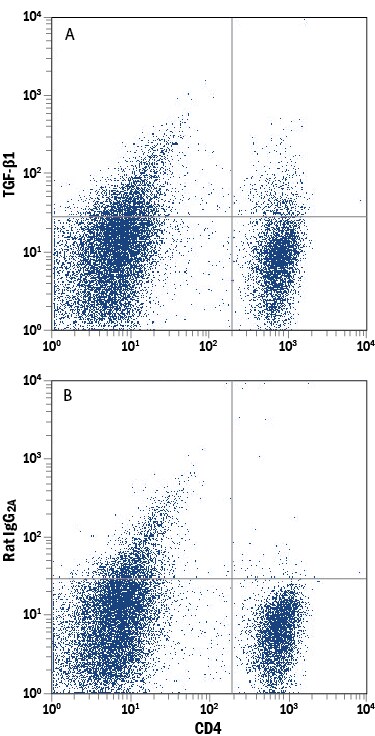
Detection of LAP (TGF‑ beta 1) in Mouse iTreg cells by Flow Cytometry.
Mouse splenocytes treated with 10 µg/mL Anti-CD3, 5 µg/mL Anti-CD28, 10 µg/mL Recombinant Human TGF-beta 1 (Catalog # 240-B), and 20 µg/mL Recombinant Mouse IL-2 (Catalog # 402-IL) for 24 hours to induce T regulatory cells (iTregs) were stained with Rat Anti-Mouse CD4 PE-conjugated Monoclonal Antibody (Catalog # FAB554P) and either (A) Rat Anti-Mouse LAP (TGF-beta 1) Monoclonal Antibody (Catalog # MAB7666) or (B) Rat IgG2AIsotype Control (Catalog # MAB006) followed by Allophycocyanin-conjugated Anti-Rat IgG Secondary Antibody (Catalog # F0113).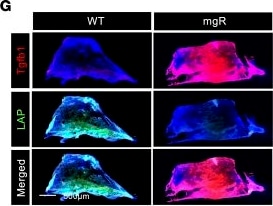
Detection of LAP (TGF-beta 1) by Immunocytochemistry/ Immunofluorescence
Fibrillin-1 deficiency associated with severe myxomatous mitral valve disease as well as TGF-beta and mTOR signaling activation in 12-week-old mgR mice.(A) H&E staining of long-axis sections of mitral valve leaflets in 12-week-old WT versus mgR mice and measurement of maximal leaflet thickness (n = 10). Scale bar: 100 μm. (B) Morphometric analysis of anterior mitral valve leaflet area (outlined by a black semicircle) (n = 9–10). Scale bar: 500 μm. Bulk RNA-Seq data from mitral valves analyzed by (C) principal component analysis, (D) volcano plot of DEGs, and (E) GO pathway analysis based on input genes with adjusted P < 0.05 (n = 3). (F) Representative IF and mean fluorescence density measurements, in AU, of mitral valve leaflets for p-Smad2 (n = 12), p-PI3K (n = 3), and p-S6 (n = 5). Scale bar: 100 μm. (G) Representative whole-mount IF of anterior mitral valve leaflet for TGF-beta 1 (Tgfb1) and LAP. Scale bar: 500 μm. (H) Representative IF of CD45 and CCR2 staining and number of CD45+/CCR2+ cells per valve section (n = 3). Scale bar: 100 μm. Data are represented as individual values with mean ± SEM; ***P < 0.001, ****P < 0.0001 by unpaired t test. Image collected and cropped by CiteAb from the following open publication (https://www.jci.org/articles/view/183558), licensed under a CC-BY license. Not internally tested by R&D Systems.Applications for Mouse LAP (TGF-beta 1) Antibody (860206)
CyTOF-ready
Flow Cytometry
Sample: Mouse splenocytes treated with Anti-CD3, Anti-CD28, Recombinant Human TGF‑ beta 1 (Catalog # 240-B), and Recombinant Mouse IL‑2 (Catalog # 402-IL) for 24 hours to induce T regulatory cells (iTregs)
Reviewed Applications
Read 1 review rated 4 using MAB7666 in the following applications:
Flow Cytometry Panel Builder
Bio-Techne Knows Flow Cytometry
Save time and reduce costly mistakes by quickly finding compatible reagents using the Panel Builder Tool.
Advanced Features
- Spectra Viewer - Custom analysis of spectra from multiple fluorochromes
- Spillover Popups - Visualize the spectra of individual fluorochromes
- Antigen Density Selector - Match fluorochrome brightness with antigen density

Formulation, Preparation, and Storage
Purification
Reconstitution
Reconstitute at 0.5 mg/mL in sterile PBS. For liquid material, refer to CoA for concentration.
Formulation
Shipping
Stability & Storage
- 12 months from date of receipt, -20 to -70 °C as supplied.
- 1 month, 2 to 8 °C under sterile conditions after reconstitution.
- 6 months, -20 to -70 °C under sterile conditions after reconstitution.
Calculators
Background: LAP (TGF-beta 1)
References
- Derynck, R. and K. Miyazono (2008) Cold Spring Harbor Laboratory Press, 29.
- Dunker, N. and K. Krieglstein (2000) Eur. J. Biochem. 267:6982.
- Wahl, S.M. (2006) Immunol. Rev. 213:213.
- Chang, H. et al. (2002) Endocr. Rev. 23:787.
- Lin, J.S. et al. (2006) Reproduction 132:179.
- Hinck, A.P. et al. (1996) Biochemistry 35:8517.
- Mittl, P.R.E. et al. (1996) Protein Sci. 5:1261.
- Derynck, R. et al. (1985) Nature 316:701.
- Miyazono, K. et al. (1988) J. Biol. Chem. 263:6407.
- Oklu, R. and R. Hesketh (2000) Biochem. J. 352:601.
- de Caestecker, M. et al. (2004) Cytokine Growth Factor Rev. 15:1.
- Zuniga, J.E. et al. (2005) J. Mol. Biol. 354:1052.
Long Name
Alternate Names
Entrez Gene IDs
Gene Symbol
UniProt
Additional LAP (TGF-beta 1) Products
Product Documents for Mouse LAP (TGF-beta 1) Antibody (860206)
Certificate of Analysis
To download a Certificate of Analysis, please enter a lot or batch number in the search box below.
Note: Certificate of Analysis not available for kit components.
Product Specific Notices for Mouse LAP (TGF-beta 1) Antibody (860206)
For research use only
Citations for Mouse LAP (TGF-beta 1) Antibody (860206)
 Powered by Bioz
Customer Reviews for Mouse LAP (TGF-beta 1) Antibody (860206) (1)
Have you used Mouse LAP (TGF-beta 1) Antibody (860206)?
Submit a review and receive an Amazon gift card!
$25/€18/£15/$25CAN/¥2500 for a review with an image
$10/€7/£6/$10CAN/¥1110 for a review without an image
Submit a review
Customer Images
-
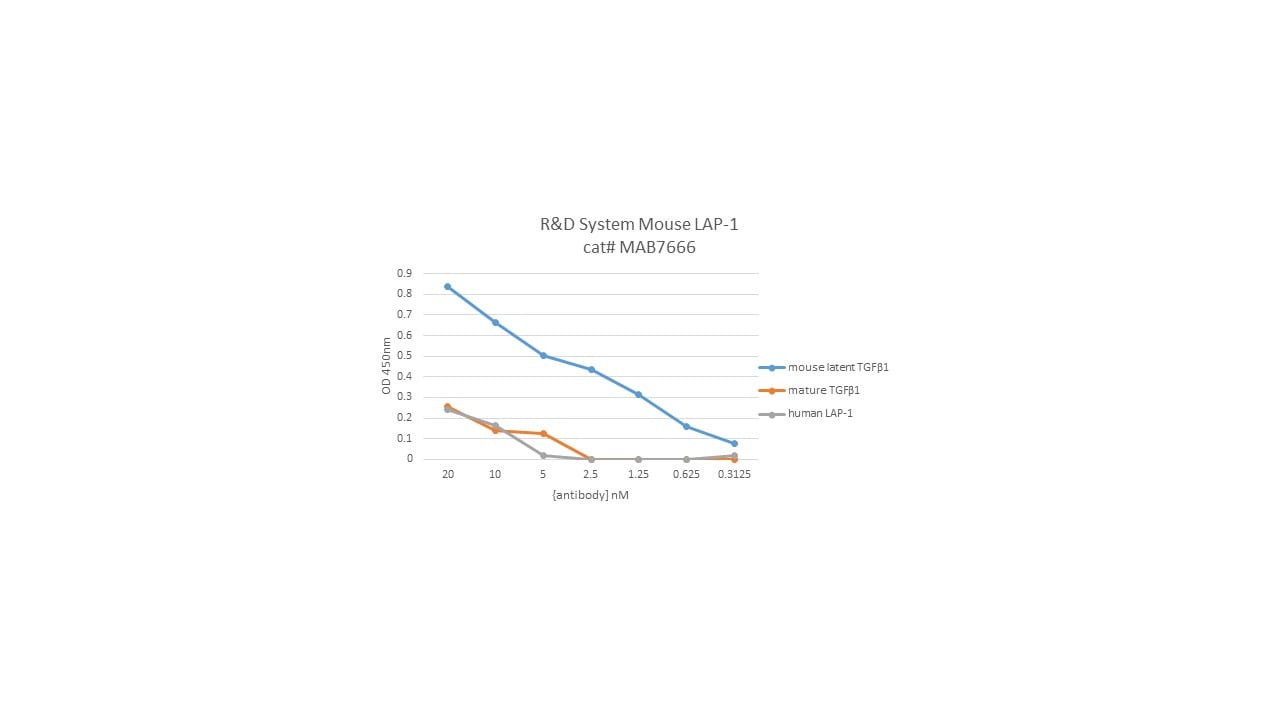
Application: ELISASample Tested: Recombinant proteinSpecies: MouseVerified Customer | Posted 03/29/2019confirmed antibody specificity using recombinant proteins in a direct ELISA

There are no reviews that match your criteria.
Protocols
Find general support by application which include: protocols, troubleshooting, illustrated assays, videos and webinars.
- 7-Amino Actinomycin D (7-AAD) Cell Viability Flow Cytometry Protocol
- Extracellular Membrane Flow Cytometry Protocol
- Flow Cytometry Protocol for Cell Surface Markers
- Flow Cytometry Protocol for Staining Membrane Associated Proteins
- Flow Cytometry Staining Protocols
- Flow Cytometry Troubleshooting Guide
- Intracellular Flow Cytometry Protocol Using Alcohol (Methanol)
- Intracellular Flow Cytometry Protocol Using Detergents
- Intracellular Nuclear Staining Flow Cytometry Protocol Using Detergents
- Intracellular Staining Flow Cytometry Protocol Using Alcohol Permeabilization
- Intracellular Staining Flow Cytometry Protocol Using Detergents to Permeabilize Cells
- Propidium Iodide Cell Viability Flow Cytometry Protocol
- Protocol for Liperfluo
- Protocol for the Characterization of Human Th22 Cells
- Protocol for the Characterization of Human Th9 Cells
- Protocol: Annexin V and PI Staining by Flow Cytometry
- Protocol: Annexin V and PI Staining for Apoptosis by Flow Cytometry
- Troubleshooting Guide: Fluorokine Flow Cytometry Kits
- View all Protocols, Troubleshooting, Illustrated assays and Webinars