
Leukemia inhibitory factor (LIF) was initially identified as a factor that inhibited the proliferation and induced the differentiation to macrophages of the murine myeloid leukemic cell line M1. Subsequent to its purification and molecular cloning, LIF was recognized to be a pleiotropic factor with multiple effects on both hematopoietic and non-hematopoietic cells. LIF has overlapping biological functions with OSM, IL-6, IL-11 and CNTF. All these cytokines utilize gp130 as a component in their signal transducing receptor complexes. Mouse LIF cDNA encodes a 203 amino acid residue polypeptide with a 23 amino acid signal peptide that is cleaved to yield a 180 amino acid mature mouse LIF. Native human and mouse LIF are highly glycosylated monomeric proteins. Both human and murine LIF protein sequences have multiple potential N- and O-linked glycosylation sites and six conserved cysteine residues that are involved in three intramolecular disulfide bridges.

Scientific images may be resized, cropped, or adjusted for brightness or contrast for presentation purposes. These updates are limited to presentation and do not affect the underlying scientific interpretation of the data. Where available, additional source data may be provided upon request.
Key Product Details
Species Reactivity
Validated:
Cited:
Applications
Validated:
Cited:
Label
Antibody Source
Product Specifications
Immunogen
Specificity
Clonality
Host
Isotype
Endotoxin Level
Scientific Data Images for Mouse LIF Antibody
IL-6 Secretion Induced by LIF and Neutralization by Mouse LIF Antibody.
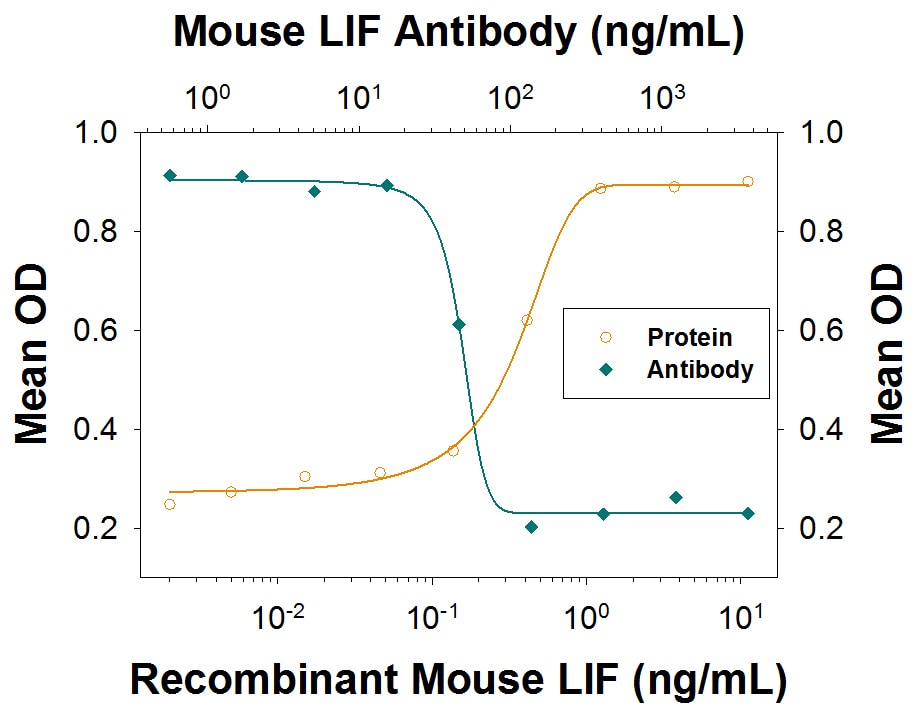
Recombinant Mouse LIF (Catalog # 8878-LF) stimulates IL-6 secretion in the M1 mouse myeloid leukemia cell line in a dose-dependent manner (orange line) as measured by the Mouse IL-6 Quantikine ELISA (Catalog # M6000B). IL-6 secretion elicited by 3 ng/mL Recombinant Mouse LIF is neutralized (green line) by increasing concentrations of Goat Anti-Mouse LIF Polyclonal Antibody (Catalog # AB-449-NA). The ND50 is typically 80-480 ng/mL.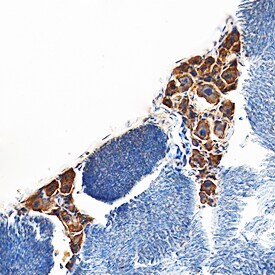
LIF in Mouse Trigeminal Ganglion.
LIF was detected in perfusion fixed frozen sections of mouse trigeminal ganglion using Goat Anti-Mouse LIF Polyclonal Antibody (Catalog # AB-449-NA) at 15 µg/mL overnight at 4 °C. Tissue was stained using the Anti-Goat HRP-DAB Cell & Tissue Staining Kit (brown; Catalog # CTS008) and counterstained with hematoxylin (blue). Specific staining was localized to sensory neurons in trigeminal ganglia. View our protocol for Chromogenic IHC Staining of Frozen Tissue Sections.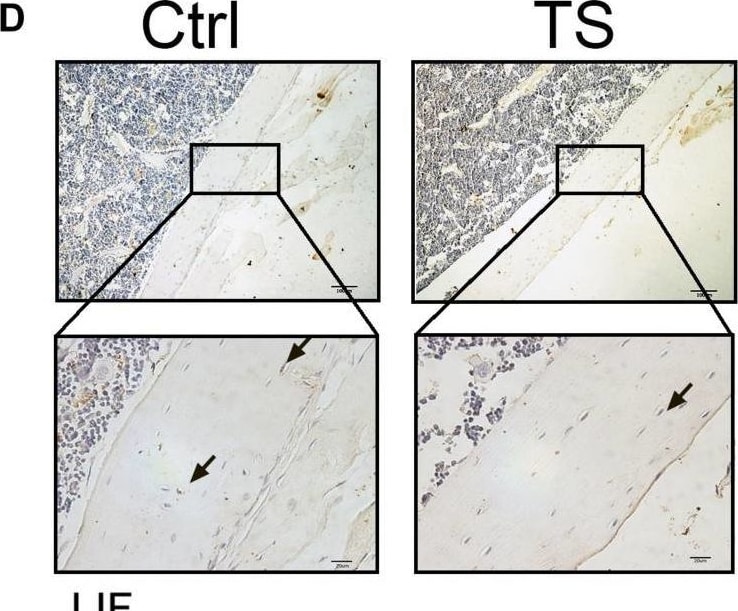
Detection of LIF by Immunohistochemistry
Micro-CT analysis of Tail-suspension mice (A) Quantitative analysis of BV/TV, Tb.N, Tb.Th, BS/BV and Tb.Sp. (B) Micro-CT 3D reconstruction pictures. (C) Osteoclasts in the sub-growth-plate bone of tibia were stained using tartrate-resistant acid phosphatase. (D) The expression of LIF in tibias was detected by immunohistochemical staining. (E) Osteoclast numbers in Figure 1C were counted. (F) LIF positive cells in Figure 1D were counted. (F) Expression level of LIF in the serum was detected by ELISA. Black arrow: LIF positive osteocyte. All data are shown as means ± standard deviations (n = 10), *p < 0.05, **p < 0.01, ***p < 0.005 and ****p < 0.001. Image collected and cropped by CiteAb from the following open publication (https://pubmed.ncbi.nlm.nih.gov/33324677), licensed under a CC-BY license. Not internally tested by R&D Systems.Applications for Mouse LIF Antibody
Immunohistochemistry
Sample: Perfusion fixed frozen sections of rat spinal cord (dorsal roots) and mouse trigeminal ganglion
Western Blot
Sample: Recombinant Mouse LIF
Neutralization
Reviewed Applications
Read 1 review rated 5 using AB-449-NA in the following applications:
Formulation, Preparation, and Storage
Purification
Reconstitution
Reconstitute at 1 mg/mL in sterile PBS.
Formulation
Shipping
Stability & Storage
- 12 months from date of receipt, -20 to -70 °C as supplied.
- 1 month, 2 to 8 °C under sterile conditions after reconstitution.
- 6 months, -20 to -70 °C under sterile conditions after reconstitution.
Calculators
Background: LIF
Long Name
Alternate Names
Gene Symbol
Additional LIF Products
Product Documents for Mouse LIF Antibody
Certificate of Analysis
To download a Certificate of Analysis, please enter a lot or batch number in the search box below.
Note: Certificate of Analysis not available for kit components.
Product Specific Notices for Mouse LIF Antibody
For research use only
Related Research Areas
Citations for Mouse LIF Antibody
 Powered by Bioz
Customer Reviews for Mouse LIF Antibody (1)
Have you used Mouse LIF Antibody?
Submit a review and receive an Amazon gift card!
$25/€18/£15/$25CAN/¥2500 for a review with an image
$10/€7/£6/$10CAN/¥1110 for a review without an image
Submit a review
Customer Images

-
Application: Block/NeutralizeSample Tested: Mouse iPSSpecies: MouseVerified Customer | Posted 05/17/2017

There are no reviews that match your criteria.
Protocols
Find general support by application which include: protocols, troubleshooting, illustrated assays, videos and webinars.
- Antigen Retrieval Protocol (PIER)
- Antigen Retrieval for Frozen Sections Protocol
- Appropriate Fixation of IHC/ICC Samples
- Cellular Response to Hypoxia Protocols
- Chromogenic IHC Staining of Formalin-Fixed Paraffin-Embedded (FFPE) Tissue Protocol
- Chromogenic Immunohistochemistry Staining of Frozen Tissue
- ClariTSA™ Fluorophore Kits
- Detection & Visualization of Antibody Binding
- Fluorescent IHC Staining of Frozen Tissue Protocol
- Graphic Protocol for Heat-induced Epitope Retrieval
- Graphic Protocol for the Preparation and Fluorescent IHC Staining of Frozen Tissue Sections
- Graphic Protocol for the Preparation and Fluorescent IHC Staining of Paraffin-embedded Tissue Sections
- Graphic Protocol for the Preparation of Gelatin-coated Slides for Histological Tissue Sections
- IHC Sample Preparation (Frozen sections vs Paraffin)
- Immunofluorescent IHC Staining of Formalin-Fixed Paraffin-Embedded (FFPE) Tissue Protocol
- Immunohistochemistry (IHC) and Immunocytochemistry (ICC) Protocols
- Immunohistochemistry Frozen Troubleshooting
- Immunohistochemistry Paraffin Troubleshooting
- Preparing Samples for IHC/ICC Experiments
- Preventing Non-Specific Staining (Non-Specific Binding)
- Primary Antibody Selection & Optimization
- Protocol for Heat-Induced Epitope Retrieval (HIER)
- Protocol for Making a 4% Formaldehyde Solution in PBS
- Protocol for VisUCyte™ HRP Polymer Detection Reagent
- Protocol for the Preparation & Fixation of Cells on Coverslips
- Protocol for the Preparation and Chromogenic IHC Staining of Frozen Tissue Sections
- Protocol for the Preparation and Chromogenic IHC Staining of Frozen Tissue Sections - Graphic
- Protocol for the Preparation and Chromogenic IHC Staining of Paraffin-embedded Tissue Sections
- Protocol for the Preparation and Chromogenic IHC Staining of Paraffin-embedded Tissue Sections - Graphic
- Protocol for the Preparation and Fluorescent IHC Staining of Frozen Tissue Sections
- Protocol for the Preparation and Fluorescent IHC Staining of Paraffin-embedded Tissue Sections
- Protocol for the Preparation of Gelatin-coated Slides for Histological Tissue Sections
- R&D Systems Quality Control Western Blot Protocol
- TUNEL and Active Caspase-3 Detection by IHC/ICC Protocol
- The Importance of IHC/ICC Controls
- Troubleshooting Guide: Immunohistochemistry
- Troubleshooting Guide: Western Blot Figures
- Western Blot Conditions
- Western Blot Protocol
- Western Blot Protocol for Cell Lysates
- Western Blot Troubleshooting
- Western Blot Troubleshooting Guide
- View all Protocols, Troubleshooting, Illustrated assays and Webinars
Associated Pathways
