
MCAM (Melanoma cell adhesion molecule; also CD146 and MUC18) is a 110‑120 kDa member of a small group of Ig‑superfamily molecules that includes CD239 and CD166. MCAM has also been reported at a molecular weight of approximately 150 kDa. In rodent, MCAM is reportedly expressed on neurons, endothelial cells, NK cells, neutrophils, mesenchymal stem cells and melanoma cells. MCAM appears to contribute to intercellular endothelial cell junctions, and possibly contributes to the migration of select cell types. Mature mouse MCAM is a 625 amino acid (aa) type I transmembrane glycoprotein. Its extracellular region is 540 aa in length (aa 24‑563). It contains two V‑type Ig‑like domains (aa 24‑244) followed by three C2‑type Ig‑like domains (aa 246‑512). One cytoplasmic region splice form shows a seven aa substitution for aa 600‑648. Unlike human, rodent MCAM does not undergo a splicing event that will generate a soluble isoform. Over aa 24‑563, mouse MCAM shares 90% and 74% aa identity with rat and human MCAM, respectively.


Scientific images may be resized, cropped, or adjusted for brightness or contrast for presentation purposes. These updates are limited to presentation and do not affect the underlying scientific interpretation of the data. Where available, additional source data may be provided upon request.
Key Product Details
Species Reactivity
Validated:
Cited:
Applications
Validated:
Cited:
Label
Antibody Source
Product Specifications
Immunogen
Val24-Tyr563
Accession # Q8R2Y2
Specificity
Clonality
Host
Isotype
Scientific Data Images for Mouse MCAM/CD146 Antibody
Detection of Human and Mouse MCAM/CD146 by Western Blot.
Western blot shows lysates of Bowes human melanoma cell line and mouse embryo tissue. PVDF Membrane was probed with 1 µg/mL of Sheep Anti-Mouse MCAM/CD146 Antigen Affinity-purified Polyclonal Antibody (Catalog # AF6106) followed by HRP-conjugated Anti-Sheep IgG Secondary Antibody (Catalog # HAF016). A specific band was detected for MCAM/CD146 at approximately 117 kDa (as indicated). This experiment was conducted under reducing conditions and using Immunoblot Buffer Group 8.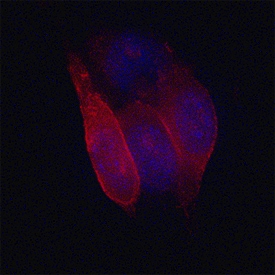
MCAM/CD146 in B16‑F1 Mouse Cell Line.
MCAM/CD146 was detected in immersion fixed B16-F1 mouse melanoma cell line using Sheep Anti-Mouse MCAM/CD146 Antigen Affinity-purified Polyclonal Antibody (Catalog # AF6106) at 1.7 µg/mL for 3 hours at room temperature. Cells were stained using the NorthernLights™ 557-conjugated Anti-Sheep IgG Secondary Antibody (red; Catalog # NL010) and counterstained with DAPI (blue). Specific staining was localized to plasma membranes. View our protocol for Fluorescent ICC Staining of Cells on Coverslips.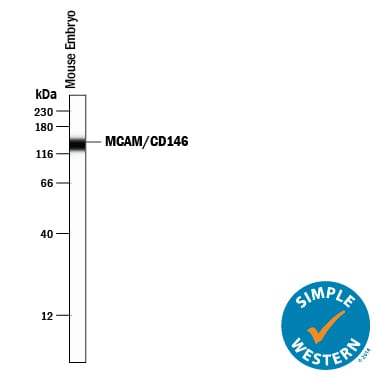
Detection of Mouse MCAM/CD146 by Simple WesternTM.
Simple Western lane view shows lysates of mouse embryo tissue (15 d.p.c.), loaded at 0.2 mg/mL. A specific band was detected for MCAM/CD146 at approximately 138 kDa (as indicated) using 10 µg/mL of Sheep Anti-Mouse MCAM/CD146 Antigen Affinity-purified Polyclonal Antibody (Catalog # AF6106) followed by 1:50 dilution of HRP-conjugated Anti-Sheep IgG Secondary Antibody (Catalog # HAF016). This experiment was conducted under reducing conditions and using the 12-230 kDa separation system.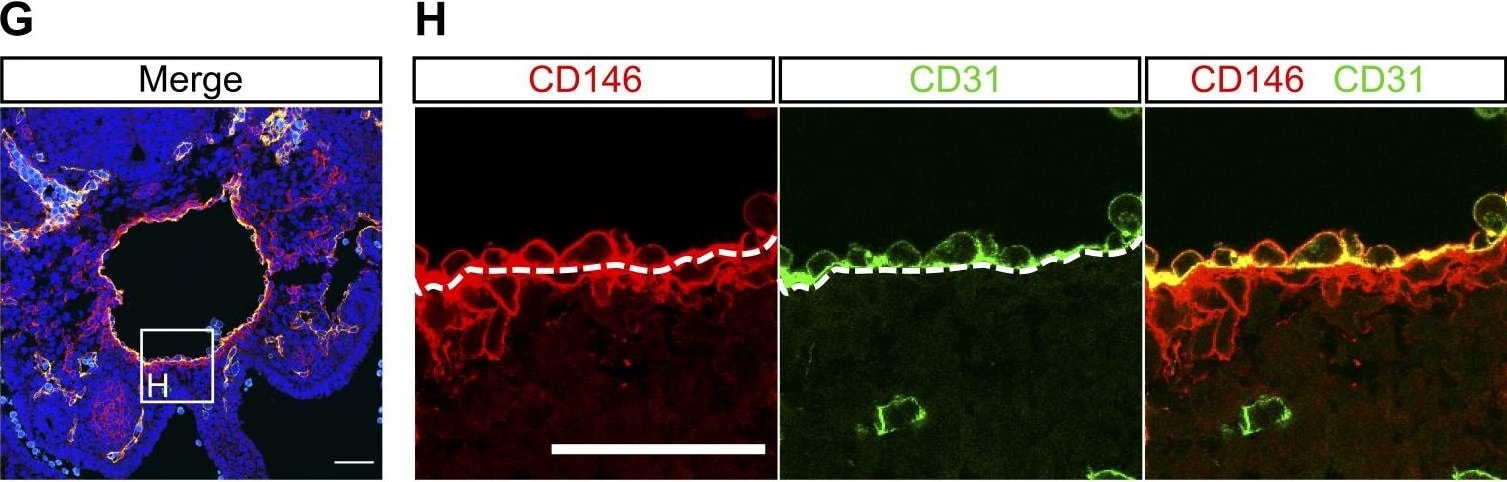
Detection of Mouse MCAM/CD146 by Immunocytochemistry/Immunofluorescence
Perivascular cells and subaortic mesenchyme are the main source of BMPER within the AGM region. (A) Distribution of BMPER protein in a transverse section of E10.5 AGM measured by immunostaining. Green, CD31; magenta, BMPER; cyan, RUNX1; blue, DAPI. gut, hindgut; nc, notochord. Bar, 50 µm. (B) Bmper mRNA in transverse section of the E10.5 AGM region by in situ hybridization. Bar, 50 µm. (C) Quantification of the mean immunostaining signal intensity (mean gray values) of DAPI (blue) and BMPER (magenta) along a box (not depicted) drawn over the dorsal-ventral axis of the AGM region from A. Distance is from the notochord (dorsal), position 0, to the intersection with the gut and the AGM region (ventral), position 500. (D) Higher magnification of the highlighted region from A showing the aortic endothelium and perivascular population. Green, CD31; magenta, BMPER; cyan, RUNX1; blue, DAPI. Bar, 50 µm. (E) Higher magnification of the region highlighted in B showing Bmper mRNA around the lining of the aorta. Bar, 50 µm. (F) Expression level of Bmper relative to Tbp in each sorted population: Lin−VC−CD45+, representing hematopoietic cells; Lin−VC+CD45−, endothelial cells; Lin−VC−CD45−CD146+, putative perivascular cells; and Lin−VC−CD45−CD146−, remaining stroma. Expression was normalized to the Lin−VC−CD45−CD146+ population. Each population as percentage of Lin− cells indicated below. Sorting was performed twice, first from one pool of embryos from four to five litters and second from two pools of embryos from four to five litters. Error bars represent SD from the mean (n = 3). Significance calculated by t test: **, P = 0.0016; ***, perivascular versus stroma, P = 0.0006; perivascular versus hematopoietic, P = 0.0002. (G) The distribution of nonendothelial, CD146-positive cells and endothelial CD146-positive cells in transverse section of the E10.5 AGM region. Green, CD31; red, CD146; blue, DAPI. Bar, 50 µm. (H) Higher magnification view of the region highlighted in G showingApplications for Mouse MCAM/CD146 Antibody
Immunocytochemistry
Sample: Immersion fixed B16‑F1 mouse melanoma cell line
Simple Western
Sample: Mouse embryo tissue (15 d.p.c.)
Western Blot
Sample: Bowes human melanoma cell line and mouse embryo tissue
Reviewed Applications
Read 1 review rated 4 using AF6106 in the following applications:
Formulation, Preparation, and Storage
Purification
Reconstitution
Reconstitute at 0.2 mg/mL in sterile PBS. For liquid material, refer to CoA for concentration.
Formulation
Shipping
Stability & Storage
- 12 months from date of receipt, -20 to -70 °C as supplied.
- 1 month, 2 to 8 °C under sterile conditions after reconstitution.
- 6 months, -20 to -70 °C under sterile conditions after reconstitution.
Calculators
Background: MCAM/CD146
Long Name
Alternate Names
Gene Symbol
UniProt
Additional MCAM/CD146 Products
Product Documents for Mouse MCAM/CD146 Antibody
Certificate of Analysis
To download a Certificate of Analysis, please enter a lot or batch number in the search box below.
Note: Certificate of Analysis not available for kit components.
Product Specific Notices for Mouse MCAM/CD146 Antibody
For research use only
Citations for Mouse MCAM/CD146 Antibody
 Powered by Bioz
Customer Reviews for Mouse MCAM/CD146 Antibody (1)
Have you used Mouse MCAM/CD146 Antibody?
Submit a review and receive an Amazon gift card!
$25/€18/£15/$25CAN/¥2500 for a review with an image
$10/€7/£6/$10CAN/¥1110 for a review without an image
Submit a review
-
Application: Immunohistochemistry-FrozenSample Tested: See PMID 22699974Species: MouseVerified Customer | Posted 01/08/2015
There are no reviews that match your criteria.
Protocols
Find general support by application which include: protocols, troubleshooting, illustrated assays, videos and webinars.
- Appropriate Fixation of IHC/ICC Samples
- Cellular Response to Hypoxia Protocols
- ClariTSA™ Fluorophore Kits
- Detection & Visualization of Antibody Binding
- ICC Cell Smear Protocol for Suspension Cells
- ICC Immunocytochemistry Protocol Videos
- ICC for Adherent Cells
- Immunocytochemistry (ICC) Protocol
- Immunocytochemistry Troubleshooting
- Immunofluorescence of Organoids Embedded in Cultrex Basement Membrane Extract
- Immunohistochemistry (IHC) and Immunocytochemistry (ICC) Protocols
- Preparing Samples for IHC/ICC Experiments
- Preventing Non-Specific Staining (Non-Specific Binding)
- Primary Antibody Selection & Optimization
- Protocol for VisUCyte™ HRP Polymer Detection Reagent
- Protocol for the Fluorescent ICC Staining of Cell Smears - Graphic
- Protocol for the Fluorescent ICC Staining of Cultured Cells on Coverslips - Graphic
- Protocol for the Preparation and Fluorescent ICC Staining of Cells on Coverslips
- Protocol for the Preparation and Fluorescent ICC Staining of Non-adherent Cells
- Protocol for the Preparation and Fluorescent ICC Staining of Stem Cells on Coverslips
- Protocol for the Preparation of a Cell Smear for Non-adherent Cell ICC - Graphic
- R&D Systems Quality Control Western Blot Protocol
- TUNEL and Active Caspase-3 Detection by IHC/ICC Protocol
- The Importance of IHC/ICC Controls
- Troubleshooting Guide: Western Blot Figures
- Western Blot Conditions
- Western Blot Protocol
- Western Blot Protocol for Cell Lysates
- Western Blot Troubleshooting
- Western Blot Troubleshooting Guide
- View all Protocols, Troubleshooting, Illustrated assays and Webinars
Associated Pathways
