
p19ARF/CDKN2A Antibody (5-C3-1) - BSA Free
Novus Biologicals | Catalog # NB200-174

Key Product Details
Validated by
Species Reactivity
Validated:
Cited:
Applications
Validated:
Cited:
Label
Antibody Source
Format
Product Specifications
Immunogen
Epitope
Reactivity Notes
Clonality
Host
Isotype
Theoretical MW
Disclaimer note: The observed molecular weight of the protein may vary from the listed predicted molecular weight due to post translational modifications, post translation cleavages, relative charges, and other experimental factors.
Scientific Data Images for p19ARF/CDKN2A Antibody (5-C3-1) - BSA Free
![Western Blot: p19ARF/CDKN2A Antibody (5-C3-1)BSA Free [NB200-174]](https://resources.rndsystems.com/images/products/p19ARF-CDKN2A-Antibody-5-C3-1-Western-Blot-NB200-174-img0011.jpg "Western Blot: p19ARF/CDKN2A Antibody (5-C3-1)BSA Free [NB200-174]")
Western Blot: p19ARF/CDKN2A Antibody (5-C3-1)BSA Free [NB200-174]
Western Blot: p19ARF/CDKN2A Antibody (5-C3-1) [NB200-174] - Whole cell protein from mouse Neuro2A and MEF cells was separated on a 4-20% gel by SDS-PAGE, transferred to 0.2 um PVDF membrane and blocked in 5% non-fat milk in TBST. The membrane was probed with 2.0 ug/mL anti-p19ARF in block buffer and detected with an anti-mouse HRP secondary antibody using chemiluminescence.![Immunohistochemistry: p19ARF/CDKN2A Antibody (5-C3-1) - BSA Free [NB200-174]](https://resources.rndsystems.com/images/products/p19ARF-CDKN2A-Antibody-5-C3-1-Immunohistochemistry-NB200-174-img0008.jpg "Immunohistochemistry: p19ARF/CDKN2A Antibody (5-C3-1) - BSA Free [NB200-174]")
Immunohistochemistry: p19ARF/CDKN2A Antibody (5-C3-1) - BSA Free [NB200-174]
Immunohistochemistry: p19ARF/CDKN2A Antibody (5-C3-1) [NB200-174] - Staining of sections from a wild type mouse testis taken at P11 were probed with NB200-174 (green). Sections were stained with DAPI to reveal the position of cell nuclei (blue).![Flow (Intracellular): p19ARF/CDKN2A Antibody (5-C3-1) - BSA Free [NB200-174]](https://resources.rndsystems.com/images/products/p19ARF-CDKN2A-Antibody-5-C3-1-Flow-Intracellular-NB200-174-img0010.jpg "Flow (Intracellular): p19ARF/CDKN2A Antibody (5-C3-1) - BSA Free [NB200-174]")
Flow (Intracellular): p19ARF/CDKN2A Antibody (5-C3-1) - BSA Free [NB200-174]
Flow (Intracellular): p19ARF/CDKN2A Antibody (5-C3-1) [NB200-174] - An intracellular stain was performed on HEK293 cells with p14ARF (5-C3-1) antibody NB200-174 (blue) and a matched isotype control MAB0061 (orange) [A]. An intracellular stain was also performed on THP-1 (known homozygous deletion of gene, PMID: 19635138) cells to ensure antibody specificity [B]. Cells were incubated in an antibody dilution of 1 ug/mL for 30 minutes at room temperature, followed by Goat Anti-Rat F(ab)2 IgG (H+L) APC-conjugated Antibody (F0113, R&D Systems). *Note: This antibody recognizes both human (p14ARF) and mouse (p19ARF) versions of the protein.![Western Blot: p19ARF/CDKN2A Antibody (5-C3-1)BSA Free [NB200-174]](https://resources.rndsystems.com/images/products/p19ARF-CDKN2A-Antibody-5-C3-1-Western-Blot-NB200-174-img0012.jpg "Western Blot: p19ARF/CDKN2A Antibody (5-C3-1)BSA Free [NB200-174]")
Western Blot: p19ARF/CDKN2A Antibody (5-C3-1)BSA Free [NB200-174]
p19ARF-CDKN2A-Antibody-5-C3-1-Western-Blot-NB200-174-img0012.jpg![Western Blot: p19ARF/CDKN2A Antibody (5-C3-1)BSA Free [NB200-174]](https://resources.rndsystems.com/images/products/p19ARF-CDKN2A-Antibody-5-C3-1-Western-Blot-NB200-174-img0005.jpg "Western Blot: p19ARF/CDKN2A Antibody (5-C3-1)BSA Free [NB200-174]")
Western Blot: p19ARF/CDKN2A Antibody (5-C3-1)BSA Free [NB200-174]
Western Blot: p19ARF/CDKN2A Antibody (5-C3-1) [NB200-174] - Analysis of endogenous p19Arf. Total cell lysates (25 ug) from NIH3T3 cells, which have deleted the Arf gene (Lanes 1) and from wild type mouse embryo fibroblasts (MEFs) at passage 6, which express p19Arf (Lanes 2), were resolved by SDS-PAGE.![Knockout Validated: p19ARF/CDKN2A Antibody (5-C3-1) - BSA Free [NB200-174]](https://resources.rndsystems.com/images/products/p19ARF-CDKN2A-Antibody-5-C3-1-Knockout-Validated-NB200-174-img0009.jpg "Immunocytochemistry/ Immunofluorescence: p19ARF/CDKN2A Antibody (5-C3-1) - BSA Free [NB200-174]")
Immunocytochemistry/ Immunofluorescence: p19ARF/CDKN2A Antibody (5-C3-1) - BSA Free [NB200-174]
Immunocytochemistry/ Immunofluorescence: p19ARF/CDKN2A Antibody (5-C3-1) [NB200-174] - Detection of p19Arf. Wild type mouse embryo fibroblasts (MEF) at passage 5 (panels 1, 2) and NIH3T3 cells, which have deleted the Arf gene (panels 3, 4) were probed with NB200-17 and nuclear stain (overlay in panels 2 and 4).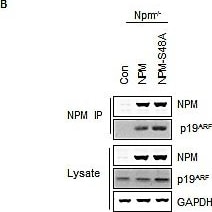
Western Blot: p19ARF/CDKN2A Antibody (5-C3-1) - BSA Free [NB200-174] -
Western Blot: p19ARF/CDKN2A Antibody (5-C3-1) - BSA Free [NB200-174] - Phosphorylation of NPM-Ser48 regulates the localization of NPM & p19A(A) Npm−/−, p53−/−double null MEF were infected with pBabe retrovirus expressing FLAG-tagged-myr-AKT1 in combination with NPM-WT or NPM-S48A as indicated. Cells were fixed & stained with DAPI & anti-NPM (left) or anti-phospho-S48-NPM (pS48-NPM). (B) NPM immunoprecipitates & whole cell lysates from Npm−/−;p53−/− MEFs expressing human NPM or NPM-S48A were probed with the indicated antibodies.(C) Graph, quantification of p19ARF staining intensity in confocal images using ImageJ. (D) Npm−/−, p53−/−double null MEF were infected with pBABE retrovirus expressing FLAG-tagged-myr-AKT1 in combination with NPM-WT, NPM-S48A or S48E as indicated. Cells were fixed & stained with DAPI, anti-NPM & anti p19ARF. Image collected & cropped by CiteAb from the following publication (https://pubmed.ncbi.nlm.nih.gov/25071014), licensed under a CC-BY license. Not internally tested by Novus Biologicals.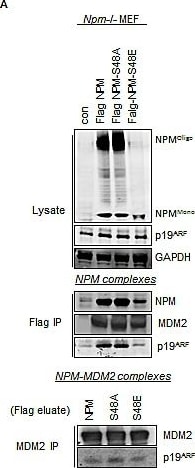
Western Blot: p19ARF/CDKN2A Antibody (5-C3-1) - BSA Free [NB200-174] -
Western Blot: p19ARF/CDKN2A Antibody (5-C3-1) - BSA Free [NB200-174] - Inhibition of AKT promotes enhanced MDM2 activity via the increased association between NPM & p14ARF(A) Npm−/−, p53−/−double null MEF were infected with pBABE retrovirus empty vector & pBABE expressing FLAG-tagged-NPM-WT, NPM-S48A or S48E as indicated. Immunopurification of NPM was done by pulling down with the Flag tag (middle panel) followed by elution of complexes by the Flag peptide & subsequent immunopurification of endogenous MDM2 (lower panel). (B) Nuclear immunoprecipitates of MDM2 from T24 cells treated with MK-2206 (5 μM, 24 hrs). Immunoprecipitates & lysates were blotted with the indicated antibodies. (C) T24 cells were treated with MK-2206 (5 μM) as indicated. p14ARF was immunoprecipitated from whole cell lysates & nuclear extracts & the association with NPM & MDM2 determined by western blot. Immunoprecipitates & lysates were blotted with the indicated antibodies. (D) MDM2 & (E) p53 ubiquinitation assay in H1299 cells transfected with wild type p53, HA-tagged ubiquitin & treated for 16 hrs with DMSO, MK-2206 (5 μM) or Nutlin3A (5 μM) as indicated. Immunoprecipitates & whole cell lysates were probed with the indicated antibodies. Image collected & cropped by CiteAb from the following publication (https://pubmed.ncbi.nlm.nih.gov/25071014), licensed under a CC-BY license. Not internally tested by Novus Biologicals.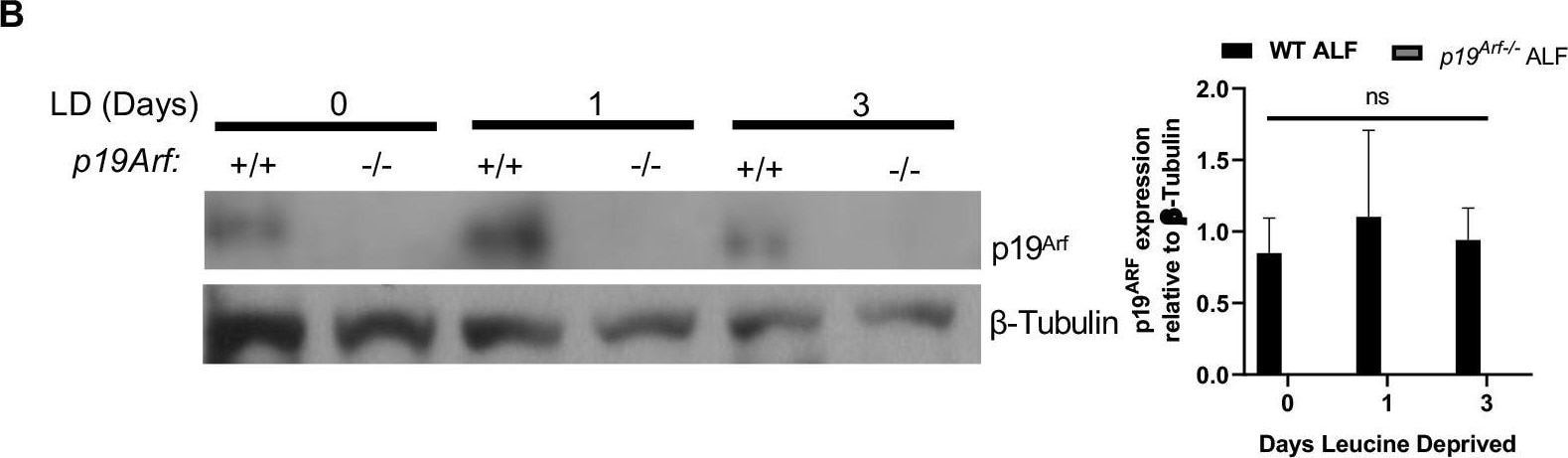
Western Blot: p19ARF/CDKN2A Antibody (5-C3-1) - BSA Free [NB200-174] -
Western Blot: p19ARF/CDKN2A Antibody (5-C3-1) - BSA Free [NB200-174] - Loss of P19Arf enhances tumor growth & primary lung fibroblasts induce p19Arf in response to leucine deprivation (LD). (A) Graph of sarcoma (SKPY) tumor volume on the indicated days. SKPY cells were injected into the flank of WT & p19Arf-null mice. Tumor volume was measured by caliper. N=7 mice/WT cohort & N=15 mice/p19Arf−/− cohort. (B) Western blot for p19Arf protein expression in WT & Arf-null fibroblasts after LD for the indicated days. Densitometric quantification of p19Arf protein expression relative to beta -tubulin is shown on right. (C) qPCR for p19Arf mRNA in WT or p19Arf−/− fibroblasts during LD for the indicated days. (D) Representative immunofluorescence images for P19Arf subcellular localization on the indicated days after LD in WT or p19Arf−/− ALFs. Quantification of nuclear p19Arf is shown in graph on right. (E) Western blot analysis of phospho-eIF2 alpha (P-eIF2 alpha ) & total eIF2 alpha expression in WT & p19Arf-null murine ALFs during LD for the indicated days. Graph quantifies intensity of P-eIF2 alpha expression relative to day 0. beta -Tubulin used as loading control. (F) Western blot analysis of P-eIF2 alpha expression in WT & p19Arf−/− ALFs upon treatment with a GCN2 inhibitor (GCN2-IN-1; A-92 1 µM in DMSO) during overnight LD. Actin used as a loading control. Quantification of P-eIF2 alpha expression relative to total eIF2 alpha. N=3; *, P<0.05; ns, not significant. Image collected & cropped by CiteAb from the following publication (https://pubmed.ncbi.nlm.nih.gov/34994382), licensed under a CC-BY license. Not internally tested by Novus Biologicals.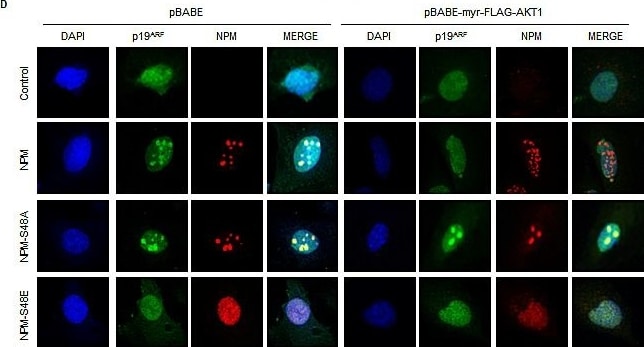
Immunocytochemistry/ Immunofluorescence: p19ARF/CDKN2A Antibody (5-C3-1) - BSA Free [NB200-174] -
Immunocytochemistry/ Immunofluorescence: p19ARF/CDKN2A Antibody (5-C3-1) - BSA Free [NB200-174] - Phosphorylation of NPM-Ser48 regulates the localization of NPM & p19A(A) Npm−/−, p53−/−double null MEF were infected with pBabe retrovirus expressing FLAG-tagged-myr-AKT1 in combination with NPM-WT or NPM-S48A as indicated. Cells were fixed & stained with DAPI & anti-NPM (left) or anti-phospho-S48-NPM (pS48-NPM). (B) NPM immunoprecipitates & whole cell lysates from Npm−/−;p53−/− MEFs expressing human NPM or NPM-S48A were probed with the indicated antibodies.(C) Graph, quantification of p19ARF staining intensity in confocal images using ImageJ. (D) Npm−/−, p53−/−double null MEF were infected with pBABE retrovirus expressing FLAG-tagged-myr-AKT1 in combination with NPM-WT, NPM-S48A or S48E as indicated. Cells were fixed & stained with DAPI, anti-NPM & anti p19ARF. Image collected & cropped by CiteAb from the following publication (https://pubmed.ncbi.nlm.nih.gov/25071014), licensed under a CC-BY license. Not internally tested by Novus Biologicals.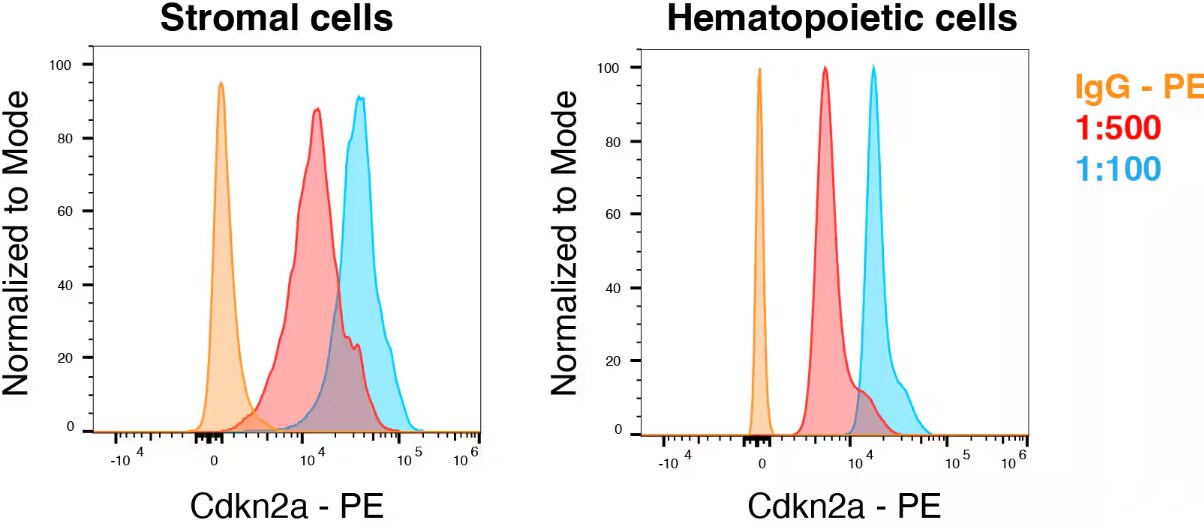
Flow Cytometry: p19ARF/CDKN2A Antibody (5-C3-1) - BSA Free
Flow Cytometry: p19ARF/CDKN2A Antibody (5-C3-1) - BSA Free - Conducted the antibody trial with two different dilutions of p19ARF/CDKN2A Antibody (5-C3-1) [PE] (Catalog # NB200-174PE) (1:500 and 1:100) and compared them to an IgG control which was also PE labelled. Image from a verified customer review.Applications for p19ARF/CDKN2A Antibody (5-C3-1) - BSA Free
Flow Cytometry
Immunocytochemistry/ Immunofluorescence
Immunohistochemistry
Immunohistochemistry-Frozen
Immunohistochemistry-Paraffin
Immunoprecipitation
Western Blot
Flow Cytometry Panel Builder
Bio-Techne Knows Flow Cytometry
Save time and reduce costly mistakes by quickly finding compatible reagents using the Panel Builder Tool.
Advanced Features
- Spectra Viewer - Custom analysis of spectra from multiple fluorochromes
- Spillover Popups - Visualize the spectra of individual fluorochromes
- Antigen Density Selector - Match fluorochrome brightness with antigen density

Formulation, Preparation, and Storage
Purification
Formulation
Format
Preservative
Concentration
Shipping
Stability & Storage
Background: p19ARF/CDKN2A
Alternate Names
Gene Symbol
Additional p19ARF/CDKN2A Products
Product Documents for p19ARF/CDKN2A Antibody (5-C3-1) - BSA Free
Certificate of Analysis
To download a Certificate of Analysis, please enter a lot or batch number in the search box below.
Product Specific Notices for p19ARF/CDKN2A Antibody (5-C3-1) - BSA Free
This product is for research use only and is not approved for use in humans or in clinical diagnosis. Primary Antibodies are guaranteed for 1 year from date of receipt.
Citations for p19ARF/CDKN2A Antibody (5-C3-1) - BSA Free
 Powered by Bioz
Customer Reviews for p19ARF/CDKN2A Antibody (5-C3-1) - BSA Free
There are currently no reviews for this product. Be the first to review p19ARF/CDKN2A Antibody (5-C3-1) - BSA Free and earn rewards!
Have you used p19ARF/CDKN2A Antibody (5-C3-1) - BSA Free?
Submit a review and receive an Amazon gift card!
$25/€18/£15/$25CAN/¥2500 for a review with an image
$10/€7/£6/$10CAN/¥1110 for a review without an image
Submit a review
Protocols
View specific protocols for p19ARF/CDKN2A Antibody (5-C3-1) - BSA Free (NB200-174):
Immunoprecipitation
1. Total cell lysates (0.25 mg) from NIH3T3 cells which have deleted the Arf gene and from NIH3T3 cells expressing an HA-tagged version of p19Arf were incubated with control rat IgG or anti-p19Arf (NB 200-174) and protein G- Sepharose.
2. Precipitated proteins were resolved by SDS-PAGE and analysed by Western blotting using an anti-HA antibody. Unprecipitated total cell lysates (25 ug, equivalent to 10% of immunoprecipitation) from Arf null NIH3T3 cells and HA- p19Arf expressing cells were also analysed by Western blotting, as input controls.
1. Perform SDS-PAGE on samples to be analyzed, loading 10-25 ug of total protein per lane.
2. Transfer proteins to PVDF membrane according to the instructions provided by the manufacturer of the membrane and transfer apparatus.
3. Stain the membrane with Ponceau S (or similar product) to assess transfer success, and mark molecular weight standards where appropriate.
4. Rinse the blot TBS -0.05% Tween 20 (TBST).
5. Block the membrane in 5% Non-fat milk in TBST (blocking buffer) for at least 1 hour.
6. Wash the membrane in TBST three times for 10 minutes each.
7. Dilute primary antibody in blocking buffer and incubate overnight at 4C with gentle rocking.
8. Wash the membrane in TBST three times for 10 minutes each.
9. Incubate the membrane in diluted HRP conjugated secondary antibody in blocking buffer (as per manufacturer's instructions) for 1 hour at room temperature.
10. Wash the blot in TBST three times for 10 minutes each (this step can be repeated as required to reduce background).
11. Apply the detection reagent of choice in accordance with the manufacturer's instructions.
Find general support by application which include: protocols, troubleshooting, illustrated assays, videos and webinars.
- 7-Amino Actinomycin D (7-AAD) Cell Viability Flow Cytometry Protocol
- Antigen Retrieval Protocol (PIER)
- Antigen Retrieval for Frozen Sections Protocol
- Appropriate Fixation of IHC/ICC Samples
- Cellular Response to Hypoxia Protocols
- Chromogenic IHC Staining of Formalin-Fixed Paraffin-Embedded (FFPE) Tissue Protocol
- Chromogenic Immunohistochemistry Staining of Frozen Tissue
- ClariTSA™ Fluorophore Kits
- Detection & Visualization of Antibody Binding
- Extracellular Membrane Flow Cytometry Protocol
- Flow Cytometry Protocol for Cell Surface Markers
- Flow Cytometry Protocol for Staining Membrane Associated Proteins
- Flow Cytometry Staining Protocols
- Flow Cytometry Troubleshooting Guide
- Fluorescent IHC Staining of Frozen Tissue Protocol
- Graphic Protocol for Heat-induced Epitope Retrieval
- Graphic Protocol for the Preparation and Fluorescent IHC Staining of Frozen Tissue Sections
- Graphic Protocol for the Preparation and Fluorescent IHC Staining of Paraffin-embedded Tissue Sections
- Graphic Protocol for the Preparation of Gelatin-coated Slides for Histological Tissue Sections
- ICC Cell Smear Protocol for Suspension Cells
- ICC Immunocytochemistry Protocol Videos
- ICC for Adherent Cells
- IHC Sample Preparation (Frozen sections vs Paraffin)
- Immunocytochemistry (ICC) Protocol
- Immunocytochemistry Troubleshooting
- Immunofluorescence of Organoids Embedded in Cultrex Basement Membrane Extract
- Immunofluorescent IHC Staining of Formalin-Fixed Paraffin-Embedded (FFPE) Tissue Protocol
- Immunohistochemistry (IHC) and Immunocytochemistry (ICC) Protocols
- Immunohistochemistry Frozen Troubleshooting
- Immunohistochemistry Paraffin Troubleshooting
- Immunoprecipitation Protocol
- Intracellular Flow Cytometry Protocol Using Alcohol (Methanol)
- Intracellular Flow Cytometry Protocol Using Detergents
- Intracellular Nuclear Staining Flow Cytometry Protocol Using Detergents
- Intracellular Staining Flow Cytometry Protocol Using Alcohol Permeabilization
- Intracellular Staining Flow Cytometry Protocol Using Detergents to Permeabilize Cells
- Preparing Samples for IHC/ICC Experiments
- Preventing Non-Specific Staining (Non-Specific Binding)
- Primary Antibody Selection & Optimization
- Propidium Iodide Cell Viability Flow Cytometry Protocol
- Protocol for Heat-Induced Epitope Retrieval (HIER)
- Protocol for Liperfluo
- Protocol for Making a 4% Formaldehyde Solution in PBS
- Protocol for VisUCyte™ HRP Polymer Detection Reagent
- Protocol for the Characterization of Human Th22 Cells
- Protocol for the Characterization of Human Th9 Cells
- Protocol for the Fluorescent ICC Staining of Cell Smears - Graphic
- Protocol for the Fluorescent ICC Staining of Cultured Cells on Coverslips - Graphic
- Protocol for the Preparation & Fixation of Cells on Coverslips
- Protocol for the Preparation and Chromogenic IHC Staining of Frozen Tissue Sections
- Protocol for the Preparation and Chromogenic IHC Staining of Frozen Tissue Sections - Graphic
- Protocol for the Preparation and Chromogenic IHC Staining of Paraffin-embedded Tissue Sections
- Protocol for the Preparation and Chromogenic IHC Staining of Paraffin-embedded Tissue Sections - Graphic
- Protocol for the Preparation and Fluorescent ICC Staining of Cells on Coverslips
- Protocol for the Preparation and Fluorescent ICC Staining of Non-adherent Cells
- Protocol for the Preparation and Fluorescent ICC Staining of Stem Cells on Coverslips
- Protocol for the Preparation and Fluorescent IHC Staining of Frozen Tissue Sections
- Protocol for the Preparation and Fluorescent IHC Staining of Paraffin-embedded Tissue Sections
- Protocol for the Preparation of Gelatin-coated Slides for Histological Tissue Sections
- Protocol for the Preparation of a Cell Smear for Non-adherent Cell ICC - Graphic
- Protocol: Annexin V and PI Staining by Flow Cytometry
- Protocol: Annexin V and PI Staining for Apoptosis by Flow Cytometry
- R&D Systems Quality Control Western Blot Protocol
- TUNEL and Active Caspase-3 Detection by IHC/ICC Protocol
- The Importance of IHC/ICC Controls
- Troubleshooting Guide: Fluorokine Flow Cytometry Kits
- Troubleshooting Guide: Immunohistochemistry
- Troubleshooting Guide: Western Blot Figures
- Western Blot Conditions
- Western Blot Protocol
- Western Blot Protocol for Cell Lysates
- Western Blot Troubleshooting
- Western Blot Troubleshooting Guide
- View all Protocols, Troubleshooting, Illustrated assays and Webinars
FAQs for p19ARF/CDKN2A Antibody (5-C3-1) - BSA Free
-
Q: We would like to confirm if the immunogen sequence is a synthetic peptide containing amino acids 54-75 (RRGPHRNPGPGDDDGQRSRSSS) of the murine p19ARF. And also, the epitope recognized is between amino acids 62-75 of murine p19ARF.
A:
I can confirm that the immunogen sequence for our product NB200-174 is aa 54-75 of the mouse Cdkn2a (also known as p19ARF) protein (Uniprot Site). The epitope recognized by this protein is aa 62-75.