
p23/PTGES3 Antibody (JJ3)
Novus Biologicals | Catalog # NB300-576

![Western Blot: p23/PTGES3 Antibody (JJ3) [NB300-576]](https://resources.rndsystems.com/images/products/p23-PTGES3-Antibody-JJ3-Western-Blot-NB300-576-img0010.jpg "Western Blot: p23/PTGES3 Antibody (JJ3) [NB300-576]")
Loading...
Key Product Details
Species Reactivity
Validated:
Human, Mouse, Rat, Chicken, Guinea Pig, Primate, Rabbit, Xenopus
Cited:
Human, Mouse
Applications
Validated:
Immunohistochemistry, Immunohistochemistry-Paraffin, Western Blot, Flow Cytometry, Immunocytochemistry/ Immunofluorescence, Immunoprecipitation
Cited:
Western Blot, Immunoprecipitation
Label
Unconjugated
Antibody Source
Monoclonal Mouse IgG1 Clone # JJ3
Loading...
Product Specifications
Immunogen
Recombinant human p23 protein.
Reactivity Notes
Rat reactivity reported in scientific literature (PMID: 16085934). Primate reactivity reported in scientific literature (PMID: 11553639). Clawed Frog reactivity reported in scientific literature (PMID: 18364744). Please note that this antibody is reactive to Mouse and derived from the same host, Mouse. Additional Mouse on Mouse blocking steps may be required for IHC and ICC experiments. Please contact Technical Support for more information.
Specificity
p23 (JJ3)
Clonality
Monoclonal
Host
Mouse
Isotype
IgG1
Scientific Data Images for p23/PTGES3 Antibody (JJ3)
Western Blot: p23/PTGES3 Antibody (JJ3) [NB300-576]
Western Blot: p23/PTGES3 Antibody (JJ3) [NB300-576] - Analysis of 25 ug of Hela (Lane 1), HepG2 (Lane 2), and mouse spleen cell lysates (Lane 3) and a molecular weight protein ladder.![Immunocytochemistry/ Immunofluorescence: p23/PTGES3 Antibody (JJ3) [NB300-576]](https://resources.rndsystems.com/images/products/p23-PTGES3-Antibody-JJ3-Immunocytochemistry-Immunofluorescence-NB300-576-img0006.jpg "Immunocytochemistry/ Immunofluorescence: p23/PTGES3 Antibody (JJ3) [NB300-576]")
Immunocytochemistry/ Immunofluorescence: p23/PTGES3 Antibody (JJ3) [NB300-576]
Immunocytochemistry/Immunofluorescence: p23/PTGES3 Antibody (JJ3) [NB300-576] - p23 staining (green), F-Actin staining with Phalloidin (red) and nuclei with DAPI (blue) is shown. Cells were grown on chamber slides and fixed with formaldehyde prior to staining. Cells were probed without (control) or with or an antibody recognizing p23 at a dilution of 1:500 over night at 4C, washed with PBS and incubated with a DyLight-488 conjugated.![Immunohistochemistry-Paraffin: p23/PTGES3 Antibody (JJ3) [NB300-576]](https://resources.rndsystems.com/images/products/p23-PTGES3-Antibody-JJ3-Immunohistochemistry-Paraffin-NB300-576-img0003.jpg "Immunohistochemistry-Paraffin: p23/PTGES3 Antibody (JJ3) [NB300-576]")
Immunohistochemistry-Paraffin: p23/PTGES3 Antibody (JJ3) [NB300-576]
Immunohistochemistry-Paraffin: p23/PTGES3 Antibody (JJ3) [NB300-576] - Normal biopsies of deparaffinized Human testis tissue.![Flow Cytometry: p23/PTGES3 Antibody (JJ3) [NB300-576]](https://resources.rndsystems.com/images/products/p23-PTGES3-Antibody-JJ3-Flow-Cytometry-NB300-576-img0009.jpg "Flow Cytometry: p23/PTGES3 Antibody (JJ3) [NB300-576]")
Flow Cytometry: p23/PTGES3 Antibody (JJ3) [NB300-576]
Flow Cytometry: p23/PTGES3 Antibody (JJ3) [NB300-576] - Analysis of 3T3 cells compared to an isotype control (blue).![Immunocytochemistry/ Immunofluorescence: p23/PTGES3 Antibody (JJ3) [NB300-576]](https://resources.rndsystems.com/images/products/p23-PTGES3-Antibody-JJ3-Immunocytochemistry-Immunofluorescence-NB300-576-img0004.jpg "Immunocytochemistry/ Immunofluorescence: p23/PTGES3 Antibody (JJ3) [NB300-576]")
Immunocytochemistry/ Immunofluorescence: p23/PTGES3 Antibody (JJ3) [NB300-576]
Immunocytochemistry/Immunofluorescence: p23/PTGES3 Antibody (JJ3) [NB300-576] - p23 staining (green), F-Actin staining with Phalloidin (red) and nuclei with DAPI (blue) is shown. Cells were grown on chamber slides and fixed with formaldehyde prior to staining. Cells were probed without (control) or with or an antibody recognizing p23 at a dilution of 1:500 over night at 4C, washed with PBS and incubated with a DyLight-488 conjugated.![Immunocytochemistry/ Immunofluorescence: p23/PTGES3 Antibody (JJ3) [NB300-576]](https://resources.rndsystems.com/images/products/p23-PTGES3-Antibody-JJ3-Immunocytochemistry-Immunofluorescence-NB300-576-img0005.jpg "Immunocytochemistry/ Immunofluorescence: p23/PTGES3 Antibody (JJ3) [NB300-576]")
Immunocytochemistry/ Immunofluorescence: p23/PTGES3 Antibody (JJ3) [NB300-576]
Immunocytochemistry/Immunofluorescence: p23/PTGES3 Antibody (JJ3) [NB300-576] - p23 staining (green), F-Actin staining with Phalloidin (red) and nuclei with DAPI (blue) is shown. Cells were grown on chamber slides and fixed with formaldehyde prior to staining. Cells were probed without (control) or with or an antibody recognizing p23 at a dilution of 1:500 over night at 4C, washed with PBS and incubated with a DyLight-488 conjugated.![Immunohistochemistry-Paraffin: p23/PTGES3 Antibody (JJ3) [NB300-576]](https://resources.rndsystems.com/images/products/p23-PTGES3-Antibody-JJ3-Immunohistochemistry-Paraffin-NB300-576-img0001.jpg "Immunohistochemistry-Paraffin: p23/PTGES3 Antibody (JJ3) [NB300-576]")
Immunohistochemistry-Paraffin: p23/PTGES3 Antibody (JJ3) [NB300-576]
Immunohistochemistry-Paraffin: p23/PTGES3 Antibody (JJ3) [NB300-576] - Cancer biopsies of deparaffinized Human breast carcinoma tissue.![Immunohistochemistry-Paraffin: p23/PTGES3 Antibody (JJ3) [NB300-576]](https://resources.rndsystems.com/images/products/p23-PTGES3-Antibody-JJ3-Immunohistochemistry-Paraffin-NB300-576-img0002.jpg "Immunohistochemistry-Paraffin: p23/PTGES3 Antibody (JJ3) [NB300-576]")
Immunohistochemistry-Paraffin: p23/PTGES3 Antibody (JJ3) [NB300-576]
Immunohistochemistry-Paraffin: p23/PTGES3 Antibody (JJ3) [NB300-576] - Normal biopsies of deparaffinized Human tonsil tissue.![Flow Cytometry: p23/PTGES3 Antibody (JJ3) [NB300-576]](https://resources.rndsystems.com/images/products/p23-PTGES3-Antibody-JJ3-Flow-Cytometry-NB300-576-img0007.jpg "Flow Cytometry: p23/PTGES3 Antibody (JJ3) [NB300-576]")
Flow Cytometry: p23/PTGES3 Antibody (JJ3) [NB300-576]
Flow Cytometry: p23/PTGES3 Antibody (JJ3) [NB300-576] - Analysis of Jurkat cells compared to an isotype control (blue).![Flow Cytometry: p23/PTGES3 Antibody (JJ3) [NB300-576]](https://resources.rndsystems.com/images/products/p23-PTGES3-Antibody-JJ3-Flow-Cytometry-NB300-576-img0008.jpg "Flow Cytometry: p23/PTGES3 Antibody (JJ3) [NB300-576]")
Flow Cytometry: p23/PTGES3 Antibody (JJ3) [NB300-576]
Flow Cytometry: p23/PTGES3 Antibody (JJ3) [NB300-576] - Analysis of Hela cells compared to an isotype control (blue).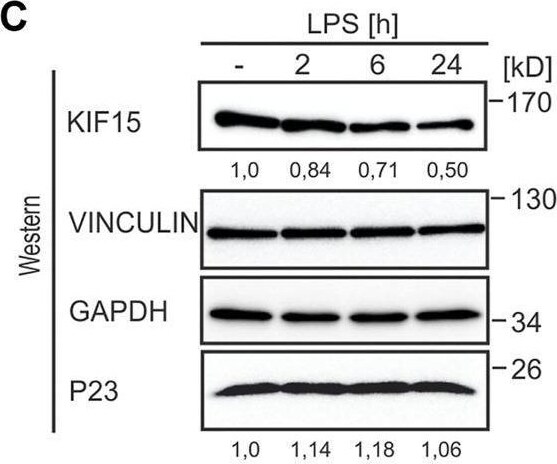
Western Blot: p23/PTGES3 Antibody (JJ3) [NB300-576] -
P23 and KIF15 expression in untreated and LPS-induced macrophages. LPS induction of RAW 264.7 macrophages (10 ng/ml, 2, 6 and 24 h) (n = 4). (A) QPCR analysis of mRNA levels as indicated, normalized to Ndufv1 mRNA (n = 4). (B) Inhibition of transcription in untreated cells and after 2 and 6 h LPS induction as indicated (n = 3). Kif15 and Actb mRNA were monitored by qPCR, normalized to exogenously added Luc mRNA. (C) Representative Western blot with specific antibodies as indicated, KIF15 was normalized to VINCULIN and P23 to GAPDH. (D) Upper panel: Schematic representation of the experimental design. Lower panel: RAW 264.7 cell migration in response to LPS (n = 3). Statistical analysis was performed with one-way ANOVA, significance levels defined as ** = p < 0.01 and *** = p < 0.001. Image collected and cropped by CiteAb from the following open publication (https://pubmed.ncbi.nlm.nih.gov/34179071), licensed under a CC-BY license. Not internally tested by Novus Biologicals.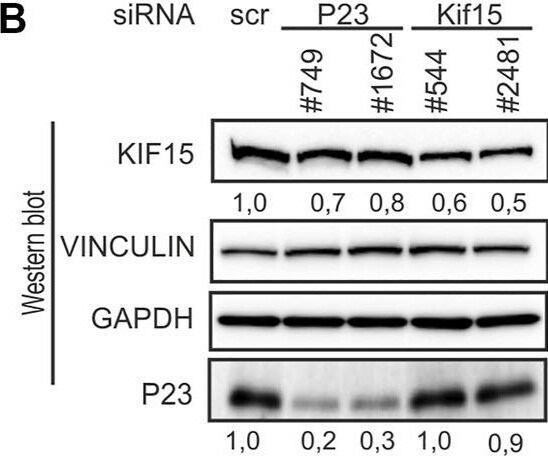
Western Blot: p23/PTGES3 Antibody (JJ3) [NB300-576] -
P23 or KIF15 depletion enhances untreated macrophage migration. (A) Schematic representation of the experimental design. RAW 264.7 cells were transfected with control (scr), P23 (#749, #1672) or Kif15 (#544, #2481) specific siRNAs and treated as depicted (n = 3). (B) Representative Western blot with antibodies as indicated. KIF15 was normalized to VINCULIN and P23 to GAPDH. (C) Left panel: Analysis of migrating cells by microscopy. Right panel: Quantification of migrating cells (n = 3). (D) Morphology of migrated cells (DAPI staining and bright-field microscopy). Statistical analysis was performed with one-way ANOVA, significance levels defined as *** = p < 0.001. Image collected and cropped by CiteAb from the following open publication (https://pubmed.ncbi.nlm.nih.gov/34179071), licensed under a CC-BY license. Not internally tested by Novus Biologicals.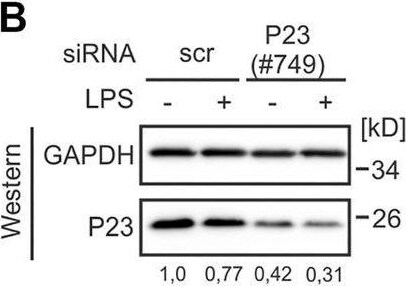
Western Blot: p23/PTGES3 Antibody (JJ3) [NB300-576] -
P23 depletion enhances phagocytosis by LPS-induced RAW 264.7 macrophages. (A) Schematic representation of the experimental design. (B) Cells were transfected with control (scr) or P23-specific siRNAs (#749) and stimulated with LPS (100 ng/ml) (n = 3). Representative Western blot of cytosolic RAW 264.7 cell extracts with antibodies as indicated, P23 was normalized to GAPDH. (C) Following siRNA transfection and LPS treatment, cells were incubated with Fluoresbrite® carboxylate labeled latex beads and analyzed by IF microscopy, as indicated. (D) The phagocytosis index was calculated as 103 beads ingested by 100 cells. Statistical analysis was performed with one-way ANOVA, significance levels defined as *** = p < 0.001. Image collected and cropped by CiteAb from the following open publication (https://pubmed.ncbi.nlm.nih.gov/34179071), licensed under a CC-BY license. Not internally tested by Novus Biologicals.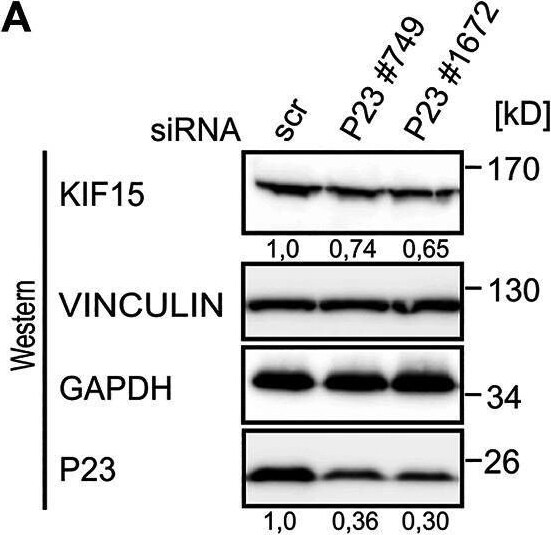
Western Blot: p23/PTGES3 Antibody (JJ3) [NB300-576] -
P23 depletion from untreated macrophages results in Kif15 mRNA and protein decline. (A) RAW 264.7 cells were transfected with control (scr) or P23 siRNAs (#749, #1672) (n = 3). Representative Western blot with antibodies as indicated. KIF15 was normalized to VINCULIN and P23 to GAPDH. (B) Analysis of mRNA levels by qPCR, normalized to Ndufv1 mRNA (n = 3). (C) Inhibition of transcription in untreated cells, as indicated (n = 3). Kif15 and Actb mRNAs were monitored by qPCR, normalized to exogenously added Luc mRNA. Statistical analysis was performed with one-way ANOVA, significance levels defined as ** = p < 0.01 and *** = p < 0.001. Image collected and cropped by CiteAb from the following open publication (https://pubmed.ncbi.nlm.nih.gov/34179071), licensed under a CC-BY license. Not internally tested by Novus Biologicals.Applications for p23/PTGES3 Antibody (JJ3)
Application
Recommended Usage
Flow Cytometry
1:100
Immunocytochemistry/ Immunofluorescence
1:200 - 1:2000
Immunohistochemistry
1:1000
Immunohistochemistry-Paraffin
1:1000
Immunoprecipitation
1:10 - 1:500
Western Blot
1:1000
Application Notes
WB: Detects an approx. 23 kDa protein representing p23 from rabbit reticulocyte lysate. May be useful in IP for both free and complexed p23.
Flow Cytometry Panel Builder
Bio-Techne Knows Flow Cytometry
Save time and reduce costly mistakes by quickly finding compatible reagents using the Panel Builder Tool.
Advanced Features
- Spectra Viewer - Custom analysis of spectra from multiple fluorochromes
- Spillover Popups - Visualize the spectra of individual fluorochromes
- Antigen Density Selector - Match fluorochrome brightness with antigen density

Formulation, Preparation, and Storage
Purification
Unpurified
Formulation
Ascites
Preservative
0.05% Sodium Azide
Concentration
This product is unpurified. The exact concentration of antibody is not quantifiable.
Shipping
The product is shipped with polar packs. Upon receipt, store it immediately at the temperature recommended below.
Stability & Storage
Store at -20C. Avoid freeze-thaw cycles.
Background: p23/PTGES3
Long Name
Prostaglandin E Synthase 3 (Cytosolic)
Alternate Names
CPGES, PTGES3, TEBP
Entrez Gene IDs
10728 (Human)
Gene Symbol
PTGES3
Additional p23/PTGES3 Products
Product Documents for p23/PTGES3 Antibody (JJ3)
Certificate of Analysis
To download a Certificate of Analysis, please enter a lot or batch number in the search box below.
Product Specific Notices for p23/PTGES3 Antibody (JJ3)
This product is for research use only and is not approved for use in humans or in clinical diagnosis. Primary Antibodies are guaranteed for 1 year from date of receipt.
Citations for p23/PTGES3 Antibody (JJ3)
 Powered by Bioz
Customer Reviews for p23/PTGES3 Antibody (JJ3)
There are currently no reviews for this product. Be the first to review p23/PTGES3 Antibody (JJ3) and earn rewards!
Have you used p23/PTGES3 Antibody (JJ3)?
Submit a review and receive an Amazon gift card!
$25/€18/£15/$25CAN/¥2500 for a review with an image
$10/€7/£6/$10CAN/¥1110 for a review without an image
Submit a review
Protocols
Find general support by application which include: protocols, troubleshooting, illustrated assays, videos and webinars.
- 7-Amino Actinomycin D (7-AAD) Cell Viability Flow Cytometry Protocol
- Antigen Retrieval Protocol (PIER)
- Antigen Retrieval for Frozen Sections Protocol
- Appropriate Fixation of IHC/ICC Samples
- Cellular Response to Hypoxia Protocols
- Chromogenic IHC Staining of Formalin-Fixed Paraffin-Embedded (FFPE) Tissue Protocol
- Chromogenic Immunohistochemistry Staining of Frozen Tissue
- ClariTSA™ Fluorophore Kits
- Detection & Visualization of Antibody Binding
- Extracellular Membrane Flow Cytometry Protocol
- Flow Cytometry Protocol for Cell Surface Markers
- Flow Cytometry Protocol for Staining Membrane Associated Proteins
- Flow Cytometry Staining Protocols
- Flow Cytometry Troubleshooting Guide
- Fluorescent IHC Staining of Frozen Tissue Protocol
- Graphic Protocol for Heat-induced Epitope Retrieval
- Graphic Protocol for the Preparation and Fluorescent IHC Staining of Frozen Tissue Sections
- Graphic Protocol for the Preparation and Fluorescent IHC Staining of Paraffin-embedded Tissue Sections
- Graphic Protocol for the Preparation of Gelatin-coated Slides for Histological Tissue Sections
- ICC Cell Smear Protocol for Suspension Cells
- ICC Immunocytochemistry Protocol Videos
- ICC for Adherent Cells
- IHC Sample Preparation (Frozen sections vs Paraffin)
- Immunocytochemistry (ICC) Protocol
- Immunocytochemistry Troubleshooting
- Immunofluorescence of Organoids Embedded in Cultrex Basement Membrane Extract
- Immunofluorescent IHC Staining of Formalin-Fixed Paraffin-Embedded (FFPE) Tissue Protocol
- Immunohistochemistry (IHC) and Immunocytochemistry (ICC) Protocols
- Immunohistochemistry Frozen Troubleshooting
- Immunohistochemistry Paraffin Troubleshooting
- Immunoprecipitation Protocol
- Intracellular Flow Cytometry Protocol Using Alcohol (Methanol)
- Intracellular Flow Cytometry Protocol Using Detergents
- Intracellular Nuclear Staining Flow Cytometry Protocol Using Detergents
- Intracellular Staining Flow Cytometry Protocol Using Alcohol Permeabilization
- Intracellular Staining Flow Cytometry Protocol Using Detergents to Permeabilize Cells
- Preparing Samples for IHC/ICC Experiments
- Preventing Non-Specific Staining (Non-Specific Binding)
- Primary Antibody Selection & Optimization
- Propidium Iodide Cell Viability Flow Cytometry Protocol
- Protocol for Heat-Induced Epitope Retrieval (HIER)
- Protocol for Liperfluo
- Protocol for Making a 4% Formaldehyde Solution in PBS
- Protocol for VisUCyte™ HRP Polymer Detection Reagent
- Protocol for the Characterization of Human Th22 Cells
- Protocol for the Characterization of Human Th9 Cells
- Protocol for the Fluorescent ICC Staining of Cell Smears - Graphic
- Protocol for the Fluorescent ICC Staining of Cultured Cells on Coverslips - Graphic
- Protocol for the Preparation & Fixation of Cells on Coverslips
- Protocol for the Preparation and Chromogenic IHC Staining of Frozen Tissue Sections
- Protocol for the Preparation and Chromogenic IHC Staining of Frozen Tissue Sections - Graphic
- Protocol for the Preparation and Chromogenic IHC Staining of Paraffin-embedded Tissue Sections
- Protocol for the Preparation and Chromogenic IHC Staining of Paraffin-embedded Tissue Sections - Graphic
- Protocol for the Preparation and Fluorescent ICC Staining of Cells on Coverslips
- Protocol for the Preparation and Fluorescent ICC Staining of Non-adherent Cells
- Protocol for the Preparation and Fluorescent ICC Staining of Stem Cells on Coverslips
- Protocol for the Preparation and Fluorescent IHC Staining of Frozen Tissue Sections
- Protocol for the Preparation and Fluorescent IHC Staining of Paraffin-embedded Tissue Sections
- Protocol for the Preparation of Gelatin-coated Slides for Histological Tissue Sections
- Protocol for the Preparation of a Cell Smear for Non-adherent Cell ICC - Graphic
- Protocol: Annexin V and PI Staining by Flow Cytometry
- Protocol: Annexin V and PI Staining for Apoptosis by Flow Cytometry
- R&D Systems Quality Control Western Blot Protocol
- TUNEL and Active Caspase-3 Detection by IHC/ICC Protocol
- The Importance of IHC/ICC Controls
- Troubleshooting Guide: Fluorokine Flow Cytometry Kits
- Troubleshooting Guide: Immunohistochemistry
- Troubleshooting Guide: Western Blot Figures
- Western Blot Conditions
- Western Blot Protocol
- Western Blot Protocol for Cell Lysates
- Western Blot Troubleshooting
- Western Blot Troubleshooting Guide
- View all Protocols, Troubleshooting, Illustrated assays and Webinars
Loading...