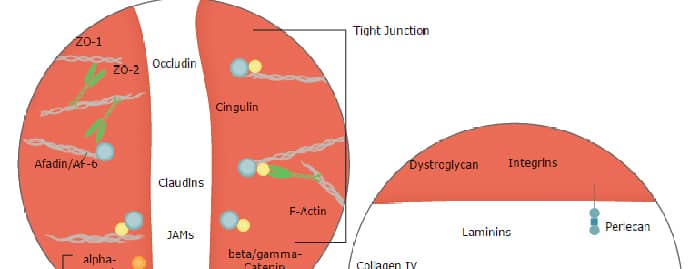
Integrin alpha 4 beta 1, also called VLA4, is an integrin family adhesion receptor that shares the beta 1 subunit with eleven other family members and the alpha 4 subunit with Integrin alpha 4 beta 7 (1-4). The non-covalent heterodimer of 150 kDa alpha 4/CD49d and 130 kDa beta 1/CD29 type I transmembrane glycoprotein subunits mediates cell adhesion to VCAM‑1/CD106 on other cells and the CS-1 fragment of fibronectin in the extracellular matrix (2-4). The alpha 4 extracellular domain (ECD) contains an N-terminal beta ‑propeller structure, followed by domains termed thigh, calf-1 and calf-2 (1). The beta 1 ECD contains a vWFA domain, which interacts with the alpha 4 beta -propeller to form a binding domain when the dimer is in active, extended and open conformation. Each subunit has a transmembrane sequence and a short cytoplasmic tail. The 944 aa mouse alpha 4 ECD shares 85% and 94% aa identity with human and rat alpha 4, respectively, while the 708 aa mouse beta 1 ECD shares 98% aa identity with rat and 93-94% aa identity with human, bovine, porcine, ovine, canine and feline beta 1. Leukocytes (except for neutrophils), erythroid precursors and some non-hematopoietic cells such as epicardial, endothelial and smooth muscle precursors, Schwann cells, and chorionic cells express alpha 4 beta 1 (5-9). Deletion is lethal in the mouse embryo due to faulty placentation and development of the epicardium and coronary vessels (6, 9). In the adult, alpha 4 beta 1 primarily regulates immune cell migration (10-12). Circulating leukocyte alpha 4 beta 1 is rapidly activated by inflamed endothelial cells that present VCAM-1 and chemokines such as SDF-1 (10). This activation facilitates rolling, firm adhesion, and extravasation. In humans, interfering with leukocyte migration via the therapeutic alpha 4 beta 1antibody Natalizumab can reduce the severity of autoimmune disorders such as multiple sclerosis (11). Natalizumab can also mobilize hematopoietic precursors from the bone marrow by impeding their interaction with stromal cell VCAM-1 (7, 11). During immune cell activation, alpha 4 beta 1 can function as a costimulatory molecule (12, 13).
Recombinant Mouse Integrin alpha 4 beta 1 Protein, CF
R&D Systems | Catalog # 6054-A4


Key Product Details
- Recombinant Integrin α4β1 Protein enables development of therapies targeting immune cell trafficking and inflammation.
- R&D Systems CHO-derived Recombinant Mouse Integrin alpha 4 beta 1 Protein (6054-A4)
- Quality control testing to verify active proteins with lot specific assays by in-house scientists
- All R&D Systems proteins are covered with a 100% guarantee
Source
Accession Number
Applications
Product Specifications
Source
| Mouse Integrin alpha 4 Tyr34-Gln970 (Arg591Leu) Accession # AAH68313 |
GGGSGGGSGGGS | Acidic Tail | 6-His tag |
| Mouse Integrin beta 1 (Gln2-Asp728) Accession # P09055 |
GGGSGGGSGGGS | Basic Tail | |
| N-terminus | C-terminus | ||
Purity
Endotoxin Level
N-terminal Sequence Analysis
Predicted Molecular Mass
SDS-PAGE
Activity
When 5 x 10⁴ cells/well are added to Recombinant Mouse Integrin alpha 4 beta 1 coated plates (10 μg/mL, 100 μL/well), approximately 55-85% will adhere after 1 hour at 37 °C.
Optimal dilutions should be determined by each laboratory for each application.
Formulation, Preparation, and Storage
6054-A4
| Formulation | Lyophilized from a 0.2 μm filtered solution in PBS. |
| Reconstitution | Reconstitute at 200 μg/mL in PBS.
Loading...
|
| Shipping | The product is shipped at ambient temperature. Upon receipt, store it immediately at the temperature recommended below. |
| Stability & Storage | Use a manual defrost freezer and avoid repeated freeze-thaw cycles.
|
Calculators
Background: Integrin alpha 4 beta 1
References
- Luo, B-H. et al. (2007) Annu. Rev. Immunol. 25:619.
- Takada, Y. et al. (1989) EMBO J. 8:1361.
- Argraves, W.S. et al. (1987) J. Cell Biol. 1025:1183.
- Takada, Y. et al. (2007) Genome Biol. 8:215.
- Eshghi, S. et al. (2007) J. Cell Biol. 177:871.
- Yang, J.T. et al. (1995) Development 121:549.
- Sheppard, A.M. et al. (1994) Cell Adhes. Commun. 2:27.
- Haack, H. and R.O. Hynes (2001) Dev. Biol. 233:38.
- Grazioli, A. et al. (2006) Dev. Biol. 293:165.
- Alon, R. and K. Ley (2008) Curr. Opin. Cell Biol. 20:525.
- Bauer, M. et al. (2009) Proc. Natl. Acad. Sci. USA 106:1920.
- Banerjee, E.R. et al. (2008) Exp. Hematol. 36:1004.
- Nguyen, K. et al. (2008) Immunity 28:810.
Alternate Names
Entrez Gene IDs
Gene Symbol
Additional Integrin alpha 4 beta 1 Products
Product Documents for Recombinant Mouse Integrin alpha 4 beta 1 Protein, CF
Certificate of Analysis
To download a Certificate of Analysis, please enter a lot or batch number in the search box below.
Note: Certificate of Analysis not available for kit components.
Product Specific Notices for Recombinant Mouse Integrin alpha 4 beta 1 Protein, CF
For research use only
Related Research Areas
Citations for Recombinant Mouse Integrin alpha 4 beta 1 Protein, CF
 Powered by Bioz
Customer Reviews for Recombinant Mouse Integrin alpha 4 beta 1 Protein, CF
There are currently no reviews for this product. Be the first to review Recombinant Mouse Integrin alpha 4 beta 1 Protein, CF and earn rewards!
Have you used Recombinant Mouse Integrin alpha 4 beta 1 Protein, CF?
Submit a review and receive an Amazon gift card!
$25/€18/£15/$25CAN/¥2500 for a review with an image
$10/€7/£6/$10CAN/¥1110 for a review without an image
Submit a review
FAQs for Recombinant Mouse Integrin alpha 4 beta 1 Protein, CF
-
Q: What is the amino acid sequence of the acidic and basic tails?
A: Acidic and basic tails are added to the protein to help facilitate optimal activity. While we generally include sequence information on the product datasheet, the sequences of these tails are considered confidential information.
Associated Pathways