
UNC13D/Munc 13-4 Antibody
Novus Biologicals | Catalog # NB100-41385

![Western Blot: UNC13D/Munc 13-4 Antibody [NB100-41385]](https://resources.rndsystems.com/images/products/UNC13D-Munc-13-4-Antibody-Western-Blot-NB100-41385-img0008.jpg "Western Blot: UNC13D/Munc 13-4 Antibody [NB100-41385]")
Scientific images may be resized, cropped, or adjusted for brightness or contrast for presentation purposes. These updates are limited to presentation and do not affect the underlying scientific interpretation of the data. Where available, additional source data may be provided upon request.
Key Product Details
Validated by
Species Reactivity
Validated:
Cited:
Predicted:
Applications
Validated:
Cited:
Label
Antibody Source
Product Specifications
Immunogen
Reactivity Notes
Clonality
Host
Isotype
Scientific Data Images for UNC13D/Munc 13-4 Antibody
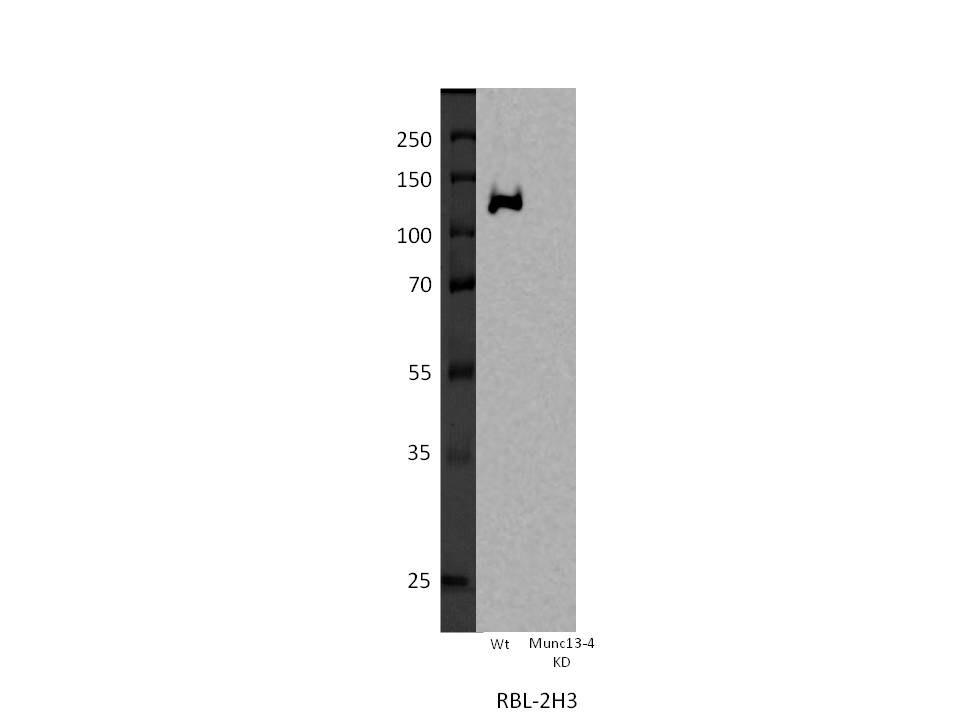
Western Blot: UNC13D/Munc 13-4 Antibody [NB100-41385]
Western Blot: UNC13D/Munc 13-4 Antibody [NB100-41385] - RBL-2H3 from Wt or shRNA Munc13-4 lentiviral stable expression whole cell lysate. 50 ug total protein. WB image submitted by a verified customer review.![Immunohistochemistry-Paraffin: UNC13D/Munc 13-4 Antibody [NB100-41385]](https://resources.rndsystems.com/images/products/UNC13D-Munc-13-4-Antibody-Immunohistochemistry-Paraffin-NB100-41385-img0006.jpg "Immunohistochemistry-Paraffin: UNC13D/Munc 13-4 Antibody [NB100-41385]")
Immunohistochemistry-Paraffin: UNC13D/Munc 13-4 Antibody [NB100-41385]
Immunohistochemistry-Paraffin: UNC13D/Munc 13-4 Antibody [NB100-41385] - Staining of paraffin embedded Mouse Lung with antibody at 0.5 ug/mL (wt in A and KO in B).![Western Blot: UNC13D/Munc 13-4 Antibody [NB100-41385]](https://resources.rndsystems.com/images/products/UNC13D-Munc-13-4-Antibody-Western-Blot-NB100-41385-img0007.jpg "Western Blot: UNC13D/Munc 13-4 Antibody [NB100-41385]")
Western Blot: UNC13D/Munc 13-4 Antibody [NB100-41385]
Western Blot: UNC13D/Munc 13-4 Antibody [NB100-41385] - Staining of Human T-lymphocyte lysate with antibody at 2 ug/mL (35 ug protein in RIPA buffer). Detected by chemiluminescence.![Immunohistochemistry-Paraffin: UNC13D/Munc 13-4 Antibody [NB100-41385]](https://resources.rndsystems.com/images/products/UNC13D-Munc-13-4-Antibody-Immunohistochemistry-Paraffin-NB100-41385-img0005.jpg "Immunohistochemistry-Paraffin: UNC13D/Munc 13-4 Antibody [NB100-41385]")
Immunohistochemistry-Paraffin: UNC13D/Munc 13-4 Antibody [NB100-41385]
Immunohistochemistry-Paraffin: UNC13D/Munc 13-4 Antibody [NB100-41385] - Staining of paraffin embedded Human Thymus. Antibody at 2.5 ug/mL. Steamed antigen retrieval with citrate buffer pH 6, AP-staining.![Knockdown Validated: UNC13D/Munc 13-4 Antibody [NB100-41385]](https://resources.rndsystems.com/images/products/UNC13D-Munc-13-4-Antibody-Knockdown-Validated-NB100-41385-img0009.jpg "Western Blot: UNC13D/Munc 13-4 Antibody [NB100-41385]")
![Knockdown Validated: UNC13D/Munc 13-4 Antibody [NB100-41385]](https://resources.rndsystems.com/images/products/UNC13D-Munc-13-4-Antibody-Knockdown-Validated-NB100-41385-img0010.jpg "Western Blot: UNC13D/Munc 13-4 Antibody [NB100-41385]")
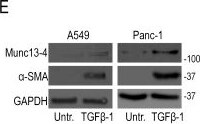
Western Blot: UNC13D/Munc 13-4 Antibody [NB100-41385] -
Western Blot: UNC13D/Munc 13-4 Antibody [NB100-41385] - Munc13-4 KD strongly impairs exosome release. (A) SDS-PAGE Western blot of indicated proteins in MDA-MB-231 cells after stable expression of shRNA for Munc13-4 or Rab27a or a scrambled control (Ctrl). (B) Culture medium from MDA-MB-231 cells either untreated or stimulated w/ 1.25 µM ionomycin for 30 min centrifuged at 1,000 g to remove cellular debris & 10,000 g to remove large extracellular vesicles. (C) The resulting 10,000-g supernatant filtered onto a nitrocellulose membrane & analyzed for CD63, CD9, ALIX, & GM130 content by antibody blotting. (D) Quantification of CD63, CD9, & ALIX blots in C are shown as exosome release as a percentage of total cellular material w/ mean values ± standard error (SE) for n ≥ 3. *, P < 0.05 for comparison w/ corresponding control samples. (E) Panc-1 or A549 cells left untreated or treated w/ TGF beta -1 for 24 h. Indicated proteins detected by SDS-PAGE Western blot. (F) Panc-1 cells left untreated or treated w/ TGF beta -1 for 24 h, & Munc13-4 levels determined by immunofluorescence. TGF beta -1–treated cells exhibited a mesenchymal morphology. Bars, 5 μm. (G) A549 cells stably expressing control shRNA (Ctrl) or Munc13-4 shRNA left untreated (Untr) or treated w/ TGF beta -1 for 24 h, & SDS-PAGE Western blotting for indicated proteins conducted. (H) Culture media supernatants (as in B) from A549 cells that either untreated or stimulated w/ 1.25 µM ionomycin for 30 min filtered onto nitrocellulose membrane & analyzed for CD63 & GM130. (I) Quantification of CD63+ exosome release shown as a percentage of total cellular material w/ mean values ± SE for n = 5. *, P < 0.05; **, P < 0.01 for comparison w/ corresponding control samples. Image collected & cropped by CiteAb from the following publication (https://pubmed.ncbi.nlm.nih.gov/29930202), licensed under a CC-BY license. Not internally tested by Novus Biologicals.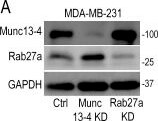
Western Blot: UNC13D/Munc 13-4 Antibody [NB100-41385] -
Western Blot: UNC13D/Munc 13-4 Antibody [NB100-41385] - Munc13-4 KD strongly impairs exosome release. (A) SDS-PAGE Western blot of indicated proteins in MDA-MB-231 cells after stable expression of shRNA for Munc13-4 or Rab27a or a scrambled control (Ctrl). (B) Culture medium from MDA-MB-231 cells either untreated or stimulated w/ 1.25 µM ionomycin for 30 min centrifuged at 1,000 g to remove cellular debris & 10,000 g to remove large extracellular vesicles. (C) The resulting 10,000-g supernatant filtered onto a nitrocellulose membrane & analyzed for CD63, CD9, ALIX, & GM130 content by antibody blotting. (D) Quantification of CD63, CD9, & ALIX blots in C are shown as exosome release as a percentage of total cellular material w/ mean values ± standard error (SE) for n ≥ 3. *, P < 0.05 for comparison w/ corresponding control samples. (E) Panc-1 or A549 cells left untreated or treated w/ TGF beta -1 for 24 h. Indicated proteins detected by SDS-PAGE Western blot. (F) Panc-1 cells left untreated or treated w/ TGF beta -1 for 24 h, & Munc13-4 levels determined by immunofluorescence. TGF beta -1–treated cells exhibited a mesenchymal morphology. Bars, 5 μm. (G) A549 cells stably expressing control shRNA (Ctrl) or Munc13-4 shRNA left untreated (Untr) or treated w/ TGF beta -1 for 24 h, & SDS-PAGE Western blotting for indicated proteins conducted. (H) Culture media supernatants (as in B) from A549 cells that either untreated or stimulated w/ 1.25 µM ionomycin for 30 min filtered onto nitrocellulose membrane & analyzed for CD63 & GM130. (I) Quantification of CD63+ exosome release shown as a percentage of total cellular material w/ mean values ± SE for n = 5. *, P < 0.05; **, P < 0.01 for comparison w/ corresponding control samples. Image collected & cropped by CiteAb from the following publication (https://pubmed.ncbi.nlm.nih.gov/29930202), licensed under a CC-BY license. Not internally tested by Novus Biologicals.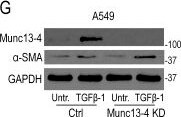
Western Blot: UNC13D/Munc 13-4 Antibody [NB100-41385] -
Western Blot: UNC13D/Munc 13-4 Antibody [NB100-41385] - Munc13-4 KD strongly impairs exosome release. (A) SDS-PAGE Western blot of indicated proteins in MDA-MB-231 cells after stable expression of shRNA for Munc13-4 or Rab27a or a scrambled control (Ctrl). (B) Culture medium from MDA-MB-231 cells either untreated or stimulated w/ 1.25 µM ionomycin for 30 min centrifuged at 1,000 g to remove cellular debris & 10,000 g to remove large extracellular vesicles. (C) The resulting 10,000-g supernatant filtered onto a nitrocellulose membrane & analyzed for CD63, CD9, ALIX, & GM130 content by antibody blotting. (D) Quantification of CD63, CD9, & ALIX blots in C are shown as exosome release as a percentage of total cellular material w/ mean values ± standard error (SE) for n ≥ 3. *, P < 0.05 for comparison w/ corresponding control samples. (E) Panc-1 or A549 cells left untreated or treated w/ TGF beta -1 for 24 h. Indicated proteins detected by SDS-PAGE Western blot. (F) Panc-1 cells left untreated or treated w/ TGF beta -1 for 24 h, & Munc13-4 levels determined by immunofluorescence. TGF beta -1–treated cells exhibited a mesenchymal morphology. Bars, 5 μm. (G) A549 cells stably expressing control shRNA (Ctrl) or Munc13-4 shRNA left untreated (Untr) or treated w/ TGF beta -1 for 24 h, & SDS-PAGE Western blotting for indicated proteins conducted. (H) Culture media supernatants (as in B) from A549 cells that either untreated or stimulated w/ 1.25 µM ionomycin for 30 min filtered onto nitrocellulose membrane & analyzed for CD63 & GM130. (I) Quantification of CD63+ exosome release shown as a percentage of total cellular material w/ mean values ± SE for n = 5. *, P < 0.05; **, P < 0.01 for comparison w/ corresponding control samples. Image collected & cropped by CiteAb from the following publication (https://pubmed.ncbi.nlm.nih.gov/29930202), licensed under a CC-BY license. Not internally tested by Novus Biologicals.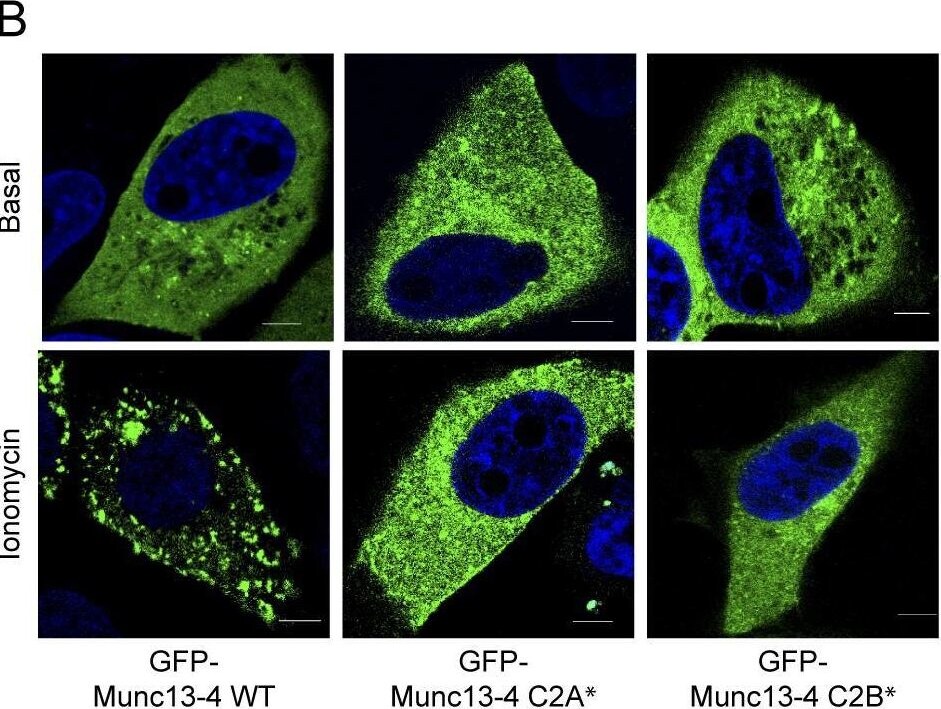
Immunocytochemistry/ Immunofluorescence: UNC13D/Munc 13-4 Antibody [NB100-41385] -
Munc13-4 translocation to membrane is Ca2+ dependent. (A) Live-cell epifluorescence imaging of GFP-Munc13-4 in MDA-MB-231 cells at indicated times after ionomycin stimulation. See Video 1. (B) MDA-MB-231 cells expressing wild-type GFP-Munc13-4, GFP-Munc13-4 C2A*, or GFP-Munc13-4 C2B* either left untreated or stimulated with 1.25 uM ionomycin for 5 min were fixed and imaged by confocal microscopy. (C) Indicated proteins were detected by SDS-PAGE and Western blotting of lysates with Munc13-4 antibody from MDA-MB-231 cells stably expressing control shRNA (Ctrl) or shRNA targeting Munc13-4 (KD), or Munc13-4 KD cells rescued with shRNA-resistant wild-type Munc13-4, Munc13-4 C2A*, or Munc13-4 C2B*. (D) Culture media supernatants (as in Fig. 1 B) from MDA-MB-231 cells as in C either untreated or stimulated with 1.25 uM ionomycin for 30 min were filtered onto membrane and analyzed for CD63 or GM130. (E) Quantification of CD63+ exosome release (from Fig 1 D) shown as mean values +/- SE for n = 3. *, P < 0.05 for comparison between ionomycin-treated and basal. Bars, 5 μm. Image collected and cropped by CiteAb from the following open publication (https://pubmed.ncbi.nlm.nih.gov/29930202), licensed under a CC-BY license. Not internally tested by Novus Biologicals.Applications for UNC13D/Munc 13-4 Antibody
Immunohistochemistry
Immunohistochemistry-Paraffin
Peptide ELISA
Western Blot
Reviewed Applications
Read 1 review rated 5 using NB100-41385 in the following applications:
Formulation, Preparation, and Storage
Purification
Formulation
Preservative
Concentration
Shipping
Stability & Storage
Background: UNC13D
Long Name
Alternate Names
Gene Symbol
UniProt
Additional UNC13D Products
Product Documents for UNC13D/Munc 13-4 Antibody
Certificate of Analysis
To download a Certificate of Analysis, please enter a lot or batch number in the search box below.
Product Specific Notices for UNC13D/Munc 13-4 Antibody
This product is for research use only and is not approved for use in humans or in clinical diagnosis. Primary Antibodies are guaranteed for 1 year from date of receipt.
Related Research Areas
Citations for UNC13D/Munc 13-4 Antibody
 Powered by Bioz
Customer Reviews for UNC13D/Munc 13-4 Antibody (1)
Have you used UNC13D/Munc 13-4 Antibody?
Submit a review and receive an Amazon gift card!
$25/€18/£15/$25CAN/¥2500 for a review with an image
$10/€7/£6/$10CAN/¥1110 for a review without an image
Submit a review
Customer Images
-
Application: Western BlotSample Tested: RBL-2H3 rat basophilic leukemia cell lineSpecies: RatVerified Customer | Posted 04/14/2017RBL-2H3 from Wt or shRNA Munc13-4 lentiviral stable expression whole cell lysate. 50ug protein

There are no reviews that match your criteria.
Protocols
Find general support by application which include: protocols, troubleshooting, illustrated assays, videos and webinars.
- Antigen Retrieval Protocol (PIER)
- Antigen Retrieval for Frozen Sections Protocol
- Appropriate Fixation of IHC/ICC Samples
- Cellular Response to Hypoxia Protocols
- Chromogenic IHC Staining of Formalin-Fixed Paraffin-Embedded (FFPE) Tissue Protocol
- Chromogenic Immunohistochemistry Staining of Frozen Tissue
- ClariTSA™ Fluorophore Kits
- Detection & Visualization of Antibody Binding
- ELISA Sample Preparation & Collection Guide
- ELISA Troubleshooting Guide
- Fluorescent IHC Staining of Frozen Tissue Protocol
- Graphic Protocol for Heat-induced Epitope Retrieval
- Graphic Protocol for the Preparation and Fluorescent IHC Staining of Frozen Tissue Sections
- Graphic Protocol for the Preparation and Fluorescent IHC Staining of Paraffin-embedded Tissue Sections
- Graphic Protocol for the Preparation of Gelatin-coated Slides for Histological Tissue Sections
- How to Run an R&D Systems DuoSet ELISA
- How to Run an R&D Systems Quantikine ELISA
- How to Run an R&D Systems Quantikine™ QuicKit™ ELISA
- ICC Cell Smear Protocol for Suspension Cells
- ICC Immunocytochemistry Protocol Videos
- ICC for Adherent Cells
- IHC Sample Preparation (Frozen sections vs Paraffin)
- Immunocytochemistry (ICC) Protocol
- Immunocytochemistry Troubleshooting
- Immunofluorescence of Organoids Embedded in Cultrex Basement Membrane Extract
- Immunofluorescent IHC Staining of Formalin-Fixed Paraffin-Embedded (FFPE) Tissue Protocol
- Immunohistochemistry (IHC) and Immunocytochemistry (ICC) Protocols
- Immunohistochemistry Frozen Troubleshooting
- Immunohistochemistry Paraffin Troubleshooting
- Preparing Samples for IHC/ICC Experiments
- Preventing Non-Specific Staining (Non-Specific Binding)
- Primary Antibody Selection & Optimization
- Protocol for Heat-Induced Epitope Retrieval (HIER)
- Protocol for Making a 4% Formaldehyde Solution in PBS
- Protocol for VisUCyte™ HRP Polymer Detection Reagent
- Protocol for the Fluorescent ICC Staining of Cell Smears - Graphic
- Protocol for the Fluorescent ICC Staining of Cultured Cells on Coverslips - Graphic
- Protocol for the Preparation & Fixation of Cells on Coverslips
- Protocol for the Preparation and Chromogenic IHC Staining of Frozen Tissue Sections
- Protocol for the Preparation and Chromogenic IHC Staining of Frozen Tissue Sections - Graphic
- Protocol for the Preparation and Chromogenic IHC Staining of Paraffin-embedded Tissue Sections
- Protocol for the Preparation and Chromogenic IHC Staining of Paraffin-embedded Tissue Sections - Graphic
- Protocol for the Preparation and Fluorescent ICC Staining of Cells on Coverslips
- Protocol for the Preparation and Fluorescent ICC Staining of Non-adherent Cells
- Protocol for the Preparation and Fluorescent ICC Staining of Stem Cells on Coverslips
- Protocol for the Preparation and Fluorescent IHC Staining of Frozen Tissue Sections
- Protocol for the Preparation and Fluorescent IHC Staining of Paraffin-embedded Tissue Sections
- Protocol for the Preparation of Gelatin-coated Slides for Histological Tissue Sections
- Protocol for the Preparation of a Cell Smear for Non-adherent Cell ICC - Graphic
- Quantikine HS ELISA Kit Assay Principle, Alkaline Phosphatase
- Quantikine HS ELISA Kit Principle, Streptavidin-HRP Polymer
- R&D Systems Quality Control Western Blot Protocol
- Sandwich ELISA (Colorimetric) – Biotin/Streptavidin Detection Protocol
- Sandwich ELISA (Colorimetric) – Direct Detection Protocol
- TUNEL and Active Caspase-3 Detection by IHC/ICC Protocol
- The Importance of IHC/ICC Controls
- Troubleshooting Guide: ELISA
- Troubleshooting Guide: Immunohistochemistry
- Troubleshooting Guide: Western Blot Figures
- Western Blot Conditions
- Western Blot Protocol
- Western Blot Protocol for Cell Lysates
- Western Blot Troubleshooting
- Western Blot Troubleshooting Guide
- View all Protocols, Troubleshooting, Illustrated assays and Webinars
FAQs for UNC13D/Munc 13-4 Antibody
-
Q: I'm looking Munc13-4 N terminal antibody with related epitope sequence.
A:
Unfortunately we do not epitope map our antibodies, but we do have a whole list of antibodies against your target depending on species reactivity and application you want to use them for. Please see this link to our MUNC 13-4 antibodies. All of the immunogen information that is not proprietary, or known should be presented on the datasheet. Often times a range will be provided where the peptide falls within, or if it was raised against a larger recombinant protein as is the case for the one you inquired about we do not know exactly where the binding occurs.