
BCMA/TNFRSF17 Antibody (Vicky-1) - BSA Free
Novus Biologicals | Catalog # NBP1-97637
Clone Vicky-1 was used by HLDA to establish CD designation.

![Immunohistochemistry: BCMA/TNFRSF17 Antibody (Vicky-1) - BSA Free [NBP1-97637]](https://resources.rndsystems.com/images/products/BCMA-TNFRSF17-Antibody-Vicky-1-Immunohistochemistry-NBP1-97637-img0007.jpg "Immunohistochemistry: BCMA/TNFRSF17 Antibody (Vicky-1) - BSA Free [NBP1-97637]")
Scientific images may be resized, cropped, or adjusted for brightness or contrast for presentation purposes. These updates are limited to presentation and do not affect the underlying scientific interpretation of the data. Where available, additional source data may be provided upon request.
Key Product Details
Species Reactivity
Validated:
Human
Cited:
Human
Applications
Validated:
Immunohistochemistry, Western Blot, ELISA, Flow Cytometry, Immunocytochemistry/ Immunofluorescence, Functional
Cited:
Flow Cytometry
Label
Unconjugated
Antibody Source
Monoclonal Rat IgG1 Clone # Vicky-1
Format
BSA Free
Loading...
Product Specifications
Immunogen
Recombinant human BCMA extracellular domain (aa 2-54).
Reactivity Notes
Does not cross-react with Mouse BCMA.
Clonality
Monoclonal
Host
Rat
Isotype
IgG1
Scientific Data Images for BCMA/TNFRSF17 Antibody (Vicky-1) - BSA Free
Immunohistochemistry: BCMA/TNFRSF17 Antibody (Vicky-1) - BSA Free [NBP1-97637]
Immunohistochemistry: BCMA/TNFRSF17 Antibody (Vicky-1) [NBP1-97637] - Immunostaining of HEK 293 cells transfected with a human BCMA expression plasmid (left panel), or mock transfected (right panel). Method: 3 days after transfection of cells with the indicated constructs, cells were fixed with acetone or 4% formaldehyde for 5 min. at room temperature. Slides were blocked with normal IgG, and incubated for 1 hour with 5ug/ml MAb to BCMA (human) (Vicky-1) in 1% BSA in 1x PBS. After washes in PBS, samples were incubated with the secondary antibody for 1 hour, washed in PBS and revealed with StreptABComplex/HRP (Vector) and AEC.![Flow Cytometry: BCMA/TNFRSF17 Antibody (Vicky-1) - BSA Free [NBP1-97637]](https://resources.rndsystems.com/images/products/BCMA-TNFRSF17-Antibody-Vicky-1-Flow-Cytometry-NBP1-97637-img0011.jpg "Flow Cytometry: BCMA/TNFRSF17 Antibody (Vicky-1) - BSA Free [NBP1-97637]")
Flow Cytometry: BCMA/TNFRSF17 Antibody (Vicky-1) - BSA Free [NBP1-97637]
Flow Cytometry: BCMA/TNFRSF17 Antibody (Vicky-1) [NBP1-97637] - Analysis using the PE conjugate of NBP1-97637. Staining of 10^6 U266 cells using BCMA (human), mAb (Vicky-1) (PE conjugate) at a concentration of 10ug/ml.![Flow Cytometry: BCMA/TNFRSF17 Antibody (Vicky-1) - BSA Free [NBP1-97637]](https://resources.rndsystems.com/images/products/BCMA-TNFRSF17-Antibody-Vicky-1-Flow-Cytometry-NBP1-97637-img0006.jpg "Flow Cytometry: BCMA/TNFRSF17 Antibody (Vicky-1) - BSA Free [NBP1-97637]")
Flow Cytometry: BCMA/TNFRSF17 Antibody (Vicky-1) - BSA Free [NBP1-97637]
Flow Cytometry: BCMA/TNFRSF17 Antibody (Vicky-1) [NBP1-97637] - Detection of endogenous human BCMA with MAb to BCMA (human) (Vicky-1). Method: U266 cells (2x10^5) were incubated on ice for 30 min. with 0.2ug of MAb to BCMA (human) (Vicky-1) or an isotype control in 25ul FACS buffer (PBS, 5% fetal calf serum, 0.02% azide). The primary antibody was revealed with PAb to Rat IgG (R-PE) and then analyzed by flow cytometry.![Flow Cytometry: BCMA/TNFRSF17 Antibody (Vicky-1) - BSA Free [NBP1-97637]](https://resources.rndsystems.com/images/products/BCMA-TNFRSF17-Antibody-Vicky-1-Flow-Cytometry-NBP1-97637-img0010.jpg "Flow Cytometry: BCMA/TNFRSF17 Antibody (Vicky-1) - BSA Free [NBP1-97637]")
Flow Cytometry: BCMA/TNFRSF17 Antibody (Vicky-1) - BSA Free [NBP1-97637]
Flow Cytometry: BCMA/TNFRSF17 Antibody (Vicky-1) [NBP1-97637] - Analysis using the FITC conjugate of NBP1-97637. Staining of 10^6 Jurkat cells using BCMA (human), mAb (Vicky-1) (FITC conjugate) at a concentration of 50ug/ml.Applications for BCMA/TNFRSF17 Antibody (Vicky-1) - BSA Free
Application
Recommended Usage
ELISA
1:100-1:2000
Flow Cytometry
1:10-1:1000
Immunocytochemistry/ Immunofluorescence
1:10-1:2000
Western Blot
1:100-1:2000
Application Notes
Use in WB was reported in the scientific literature (PMID: 20454508). Functional Application: blocks binding of BAFF to human BCMA.
Reviewed Applications
Read 1 review rated 4 using NBP1-97637 in the following applications:
Flow Cytometry Panel Builder
Bio-Techne Knows Flow Cytometry
Save time and reduce costly mistakes by quickly finding compatible reagents using the Panel Builder Tool.
Advanced Features
- Spectra Viewer - Custom analysis of spectra from multiple fluorochromes
- Spillover Popups - Visualize the spectra of individual fluorochromes
- Antigen Density Selector - Match fluorochrome brightness with antigen density

Formulation, Preparation, and Storage
Purification
Protein G purified
Formulation
PBS
Format
BSA Free
Preservative
0.02% Sodium Azide
Concentration
1.0 mg/ml
Shipping
The product is shipped with polar packs. Upon receipt, store it immediately at the temperature recommended below.
Stability & Storage
Store at -20C. Avoid freeze-thaw cycles.
Background: BCMA/TNFRSF17
BCMA has two agonistic ligands: BAFF and a proliferation-inducing ligand (APRIL) (1,2). APRIL has higher affinity for BCMA than BAFF and the binding is mediated by CD138/syndeclin-1 (2,3). Activation of BCMA promotes the growth and survival of plasma cells, or MM cells in disease, through several signaling pathways such as NFkappaB, MEK/ERK, AKT, JNK, and p38 (1,2). In MM cells the BCMA activation and downstream signaling cascade functions to upregulate antiapoptotic proteins including Bcl-2, Bcl-xL, and Mcl-1 and protect the cells against therapeutic agents like dexamethasone (2,3).
Given its specific expression on plasma cells but not memory B cells, naive B cells, or hematopoietic stem cells, BCMA has garnered much interest as a therapeutic target for the treatment of MM (1-4). Current BCMA-targeted immunotherapy strategies include antibody-drug conjugates (ADC), chimeric antigen receptor (CAR) T cells, bispecific T cell engager (BiTE), and bispecific/trispecific antibodies (1-4). CAR T cell therapy in particular has demonstrated promising clinical results (2,4). Still, more research needs to be done to improve the efficacy and risk of relapse following CAR T cell therapy and may also include targeting additional antigens in combination with BCMA or utilizing pharmacological agents to increase antigen density (4).
References
1. Yu, B., Jiang, T., & Liu, D. (2020). BCMA-targeted immunotherapy for multiple myeloma. Journal of hematology & oncology, 13(1), 125. https://doi.org/10.1186/s13045-020-00962-7
2. Cho, S. F., Anderson, K. C., & Tai, Y. T. (2018). Targeting B Cell Maturation Antigen (BCMA) in Multiple Myeloma: Potential Uses of BCMA-Based Immunotherapy. Frontiers in immunology, 9, 1821. https://doi.org/10.3389/fimmu.2018.01821
3. Dalla Palma, B., Marchica, V., Catarozzo, M. T., Giuliani, N., & Accardi, F. (2020). Monoclonal and Bispecific Anti-BCMA Antibodies in Multiple Myeloma. Journal of clinical medicine, 9(9), 3022. https://doi.org/10.3390/jcm9093022
4. Mikkilineni, L., & Kochenderfer, J. N. (2021). CAR T cell therapies for patients with multiple myeloma. Nature reviews. Clinical oncology, 18(2), 71-84. https://doi.org/10.1038/s41571-020-0427-6
Long Name
B Cell Maturation Factor
Alternate Names
CD269, TNFRSF13A, TNFRSF17
Gene Symbol
TNFRSF17
Additional BCMA/TNFRSF17 Products
Product Documents for BCMA/TNFRSF17 Antibody (Vicky-1) - BSA Free
Certificate of Analysis
To download a Certificate of Analysis, please enter a lot or batch number in the search box below.
Product Specific Notices for BCMA/TNFRSF17 Antibody (Vicky-1) - BSA Free
This product is for research use only and is not approved for use in humans or in clinical diagnosis. Primary Antibodies are guaranteed for 1 year from date of receipt.
Citations for BCMA/TNFRSF17 Antibody (Vicky-1) - BSA Free
 Powered by Bioz
Customer Reviews for BCMA/TNFRSF17 Antibody (Vicky-1) - BSA Free (1)
4 out of 5
1 Customer Rating
Have you used BCMA/TNFRSF17 Antibody (Vicky-1) - BSA Free?
Submit a review and receive an Amazon gift card!
$25/€18/£15/$25CAN/¥2500 for a review with an image
$10/€7/£6/$10CAN/¥1110 for a review without an image
Submit a review
Customer Images
Showing
1
-
1 的
1 review
Showing All
Filter By:
-
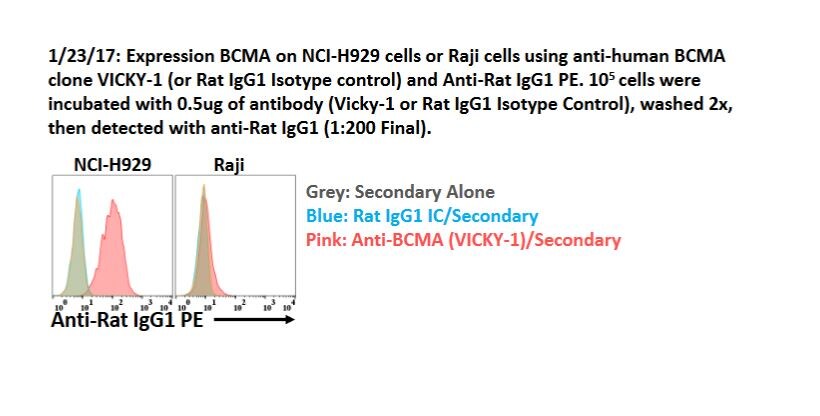
Application: Flow CytometrySample Tested: Raji human Burkitt's lymphoma cell line and H929 cellsSpecies: HumanVerified Customer | Posted 01/27/2017Expression BCMA on NCI-H929 cells or Raji cells using anti-human BCMA clone VICKY-1 (or Rat IgG1 Isotype control) and Anti-Rat IgG1 PE. 105 cells were incubated with 0.5ug of antibody (Vicky-1 or Rat IgG1 IC) and detected with a-Rat IgG1 (1:200 Final).

There are no reviews that match your criteria.
Protocols
Find general support by application which include: protocols, troubleshooting, illustrated assays, videos and webinars.
- 7-Amino Actinomycin D (7-AAD) Cell Viability Flow Cytometry Protocol
- Antigen Retrieval Protocol (PIER)
- Antigen Retrieval for Frozen Sections Protocol
- Appropriate Fixation of IHC/ICC Samples
- Cellular Response to Hypoxia Protocols
- Chromogenic IHC Staining of Formalin-Fixed Paraffin-Embedded (FFPE) Tissue Protocol
- Chromogenic Immunohistochemistry Staining of Frozen Tissue
- ClariTSA™ Fluorophore Kits
- Detection & Visualization of Antibody Binding
- ELISA Sample Preparation & Collection Guide
- ELISA Troubleshooting Guide
- Extracellular Membrane Flow Cytometry Protocol
- Flow Cytometry Protocol for Cell Surface Markers
- Flow Cytometry Protocol for Staining Membrane Associated Proteins
- Flow Cytometry Staining Protocols
- Flow Cytometry Troubleshooting Guide
- Fluorescent IHC Staining of Frozen Tissue Protocol
- Graphic Protocol for Heat-induced Epitope Retrieval
- Graphic Protocol for the Preparation and Fluorescent IHC Staining of Frozen Tissue Sections
- Graphic Protocol for the Preparation and Fluorescent IHC Staining of Paraffin-embedded Tissue Sections
- Graphic Protocol for the Preparation of Gelatin-coated Slides for Histological Tissue Sections
- How to Run an R&D Systems DuoSet ELISA
- How to Run an R&D Systems Quantikine ELISA
- How to Run an R&D Systems Quantikine™ QuicKit™ ELISA
- ICC Cell Smear Protocol for Suspension Cells
- ICC Immunocytochemistry Protocol Videos
- ICC for Adherent Cells
- IHC Sample Preparation (Frozen sections vs Paraffin)
- Immunocytochemistry (ICC) Protocol
- Immunocytochemistry Troubleshooting
- Immunofluorescence of Organoids Embedded in Cultrex Basement Membrane Extract
- Immunofluorescent IHC Staining of Formalin-Fixed Paraffin-Embedded (FFPE) Tissue Protocol
- Immunohistochemistry (IHC) and Immunocytochemistry (ICC) Protocols
- Immunohistochemistry Frozen Troubleshooting
- Immunohistochemistry Paraffin Troubleshooting
- Intracellular Flow Cytometry Protocol Using Alcohol (Methanol)
- Intracellular Flow Cytometry Protocol Using Detergents
- Intracellular Nuclear Staining Flow Cytometry Protocol Using Detergents
- Intracellular Staining Flow Cytometry Protocol Using Alcohol Permeabilization
- Intracellular Staining Flow Cytometry Protocol Using Detergents to Permeabilize Cells
- Preparing Samples for IHC/ICC Experiments
- Preventing Non-Specific Staining (Non-Specific Binding)
- Primary Antibody Selection & Optimization
- Propidium Iodide Cell Viability Flow Cytometry Protocol
- Protocol for Heat-Induced Epitope Retrieval (HIER)
- Protocol for Liperfluo
- Protocol for Making a 4% Formaldehyde Solution in PBS
- Protocol for VisUCyte™ HRP Polymer Detection Reagent
- Protocol for the Characterization of Human Th22 Cells
- Protocol for the Characterization of Human Th9 Cells
- Protocol for the Fluorescent ICC Staining of Cell Smears - Graphic
- Protocol for the Fluorescent ICC Staining of Cultured Cells on Coverslips - Graphic
- Protocol for the Preparation & Fixation of Cells on Coverslips
- Protocol for the Preparation and Chromogenic IHC Staining of Frozen Tissue Sections
- Protocol for the Preparation and Chromogenic IHC Staining of Frozen Tissue Sections - Graphic
- Protocol for the Preparation and Chromogenic IHC Staining of Paraffin-embedded Tissue Sections
- Protocol for the Preparation and Chromogenic IHC Staining of Paraffin-embedded Tissue Sections - Graphic
- Protocol for the Preparation and Fluorescent ICC Staining of Cells on Coverslips
- Protocol for the Preparation and Fluorescent ICC Staining of Non-adherent Cells
- Protocol for the Preparation and Fluorescent ICC Staining of Stem Cells on Coverslips
- Protocol for the Preparation and Fluorescent IHC Staining of Frozen Tissue Sections
- Protocol for the Preparation and Fluorescent IHC Staining of Paraffin-embedded Tissue Sections
- Protocol for the Preparation of Gelatin-coated Slides for Histological Tissue Sections
- Protocol for the Preparation of a Cell Smear for Non-adherent Cell ICC - Graphic
- Protocol: Annexin V and PI Staining by Flow Cytometry
- Protocol: Annexin V and PI Staining for Apoptosis by Flow Cytometry
- Quantikine HS ELISA Kit Assay Principle, Alkaline Phosphatase
- Quantikine HS ELISA Kit Principle, Streptavidin-HRP Polymer
- R&D Systems Quality Control Western Blot Protocol
- Sandwich ELISA (Colorimetric) – Biotin/Streptavidin Detection Protocol
- Sandwich ELISA (Colorimetric) – Direct Detection Protocol
- TUNEL and Active Caspase-3 Detection by IHC/ICC Protocol
- The Importance of IHC/ICC Controls
- Troubleshooting Guide: ELISA
- Troubleshooting Guide: Fluorokine Flow Cytometry Kits
- Troubleshooting Guide: Immunohistochemistry
- Troubleshooting Guide: Western Blot Figures
- Western Blot Conditions
- Western Blot Protocol
- Western Blot Protocol for Cell Lysates
- Western Blot Troubleshooting
- Western Blot Troubleshooting Guide
- View all Protocols, Troubleshooting, Illustrated assays and Webinars
FAQs for BCMA/TNFRSF17 Antibody (Vicky-1) - BSA Free
Showing
1
-
1 的
1 FAQ
Showing All
-
Q: What would be the appropriate negative isotype control for IHC on paraffin embedded human tissue?
A:
A rat IgG1 isotype control is what you will want to use for NBP1-97637. Rat IgG1 contains a light chain and in rat, 99% of antibodies are kappa light chain, so this is what you will want to use. Here is a link to suitable isotype controls.
Loading...
Associated Pathways
