
Rat VEGF 164 Antibody
R&D Systems | Catalog # AF564

Scientific images may be resized, cropped, or adjusted for brightness or contrast for presentation purposes. These updates are limited to presentation and do not affect the underlying scientific interpretation of the data. Where available, additional source data may be provided upon request.
Key Product Details
Validated by
Species Reactivity
Validated:
Cited:
Applications
Validated:
Cited:
Label
Antibody Source
Product Specifications
Immunogen
Ala27-Arg190
Accession # AAL07526
Specificity
Clonality
Host
Isotype
Endotoxin Level
Scientific Data Images for Rat VEGF 164 Antibody
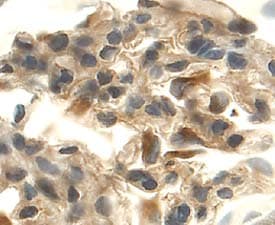
VEGF164in Rat Kidney.
VEGF164was detected in perfusion fixed frozen sections of rat kidney using 15 µg/mL Goat Anti-Rat VEGF164Antigen Affinity-purified Polyclonal Antibody (Catalog # AF564) overnight at 4 °C. Tissue was stained with the Anti-Goat HRP-DAB Cell & Tissue Staining Kit (brown; Catalog # CTS008) and counterstained with hematoxylin (blue). View our protocol for Chromogenic IHC Staining of Frozen Tissue Sections.
Cell Proliferation Induced by VEGF164and Neutralization by Rat VEGF Antibody.
Recombinant Rat VEGF164(Catalog # 564-RV) stimulates proliferation in HUVEC human umbilical vein endothelial cells in a dose-dependent manner (orange line). Proliferation elicited by Recombinant Rat VEGF164(20 ng/mL) is neutralized (green line) by increasing concentrations of Goat Anti-Rat VEGF 164 Antigen Affinity-purified Polyclonal Antibody (Catalog # AF564). The ND50 is typically 0.2-0.6 µg/mL.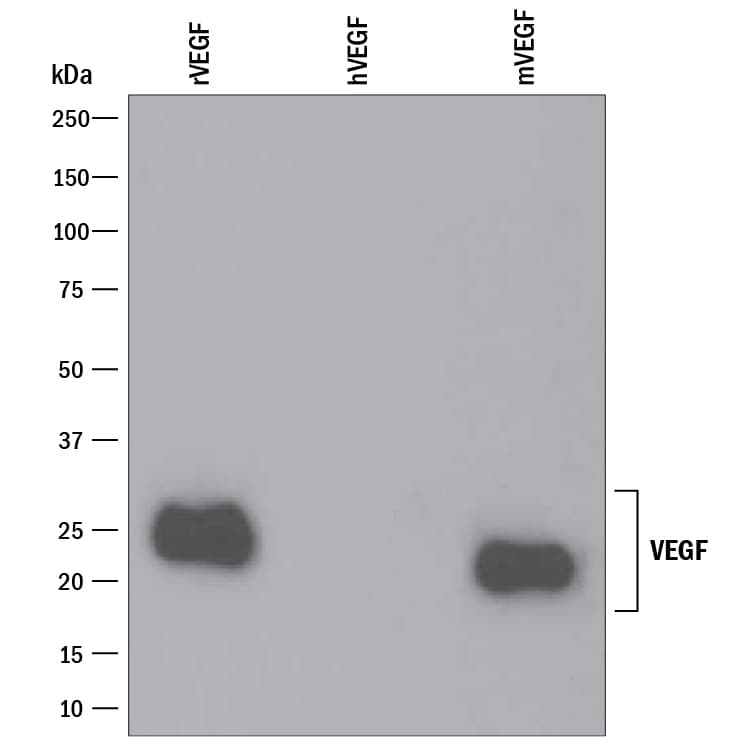
Detection of Recombinant Rat and Mouse VEGF by Western Blot.
Western blot shows 25 ng of Recombinant Rat VEGF 164 (Catalog # 564-RV), Recombinant Human VEGF 165 (Catalog # 293-VE) and Recombinant Mouse VEGF 164 (Catalog # 493-MV). PVDF Membrane was probed with 0.1 µg/mL of Goat Anti-Rat VEGF 164 Antigen Affinity-purified Polyclonal Antibody (Catalog # AF564) followed by HRP-conjugated Anti-Goat IgG Secondary Antibody (Catalog # HAF109). A specific band was detected for VEGF at approximately 20-25 kDa (as indicated). This experiment was conducted under reducing conditions and using Immunoblot Buffer Group 3.This antibody does not detect natural VEGF in lysates from cell lines or tissues.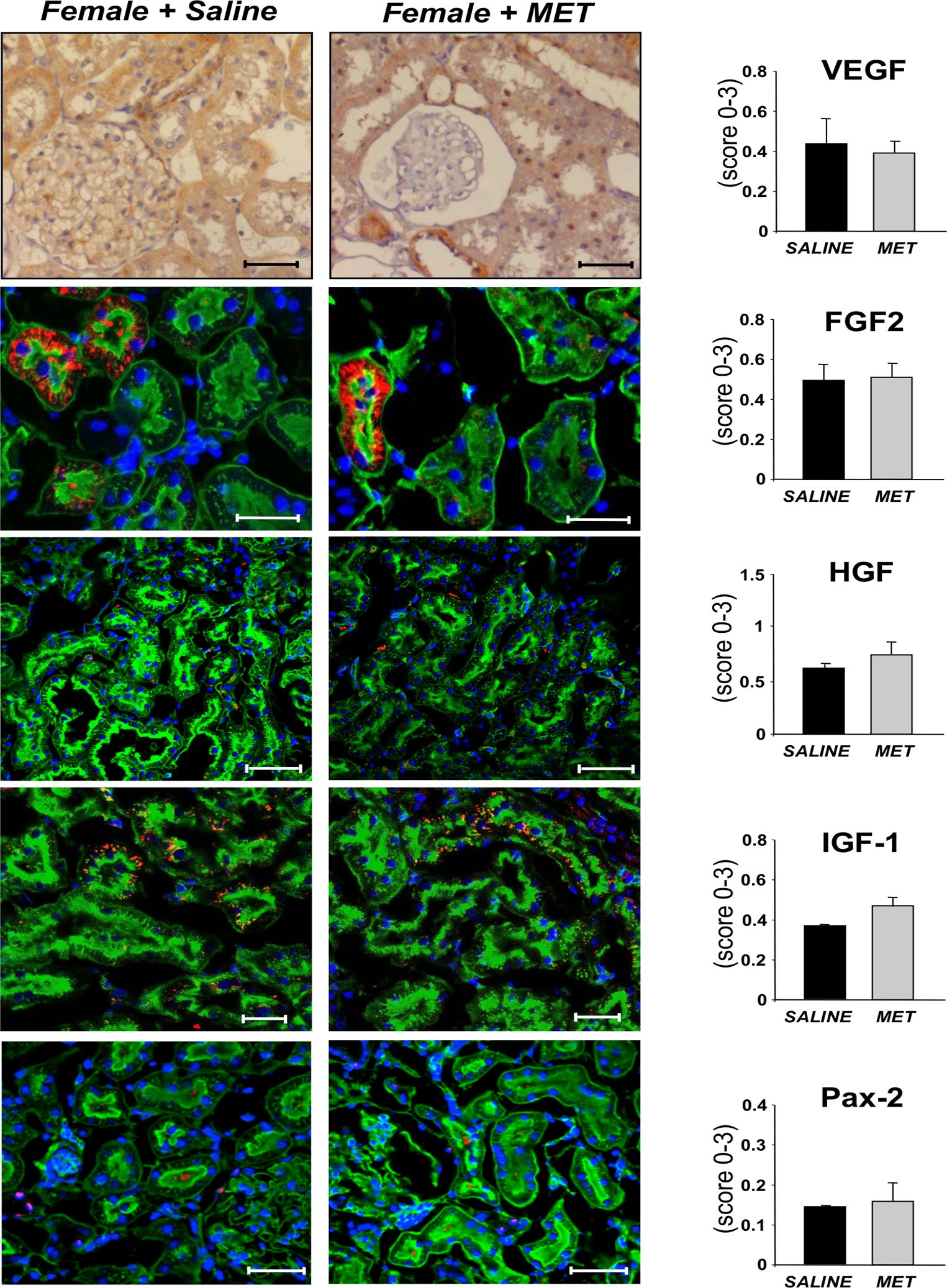
Detection of Porcine VEGF by Immunohistochemistry
Expression of proteins relevant to kidney regeneration in female MWF rats.Immunohistochemical staining of VEGF in female animals receiving saline or MET transplant, after 6 weeks. Scale bars = 50 μm. Representative immunofluorescence staining (red) of FGF2, HGF, IGF-1 and Pax-2 in female rats receiving saline or MET, on renal tissues labeled with WGA-lectin (green) and DAPI (blue). Scale bars = 50 μm, = 25 μm (for FGF2 and IGF-1). Semiquantitative analysis of immunohistochemical stainings of VEGF, FGF2, HGF, IGF-1 and Pax-2 in female MWF rats receiving saline or MET. Data are expressed as mean ± SE (n = 3/group). Image collected and cropped by CiteAb from the following open publication (https://dx.plos.org/10.1371/journal.pone.0120235), licensed under a CC-BY license. Not internally tested by R&D Systems.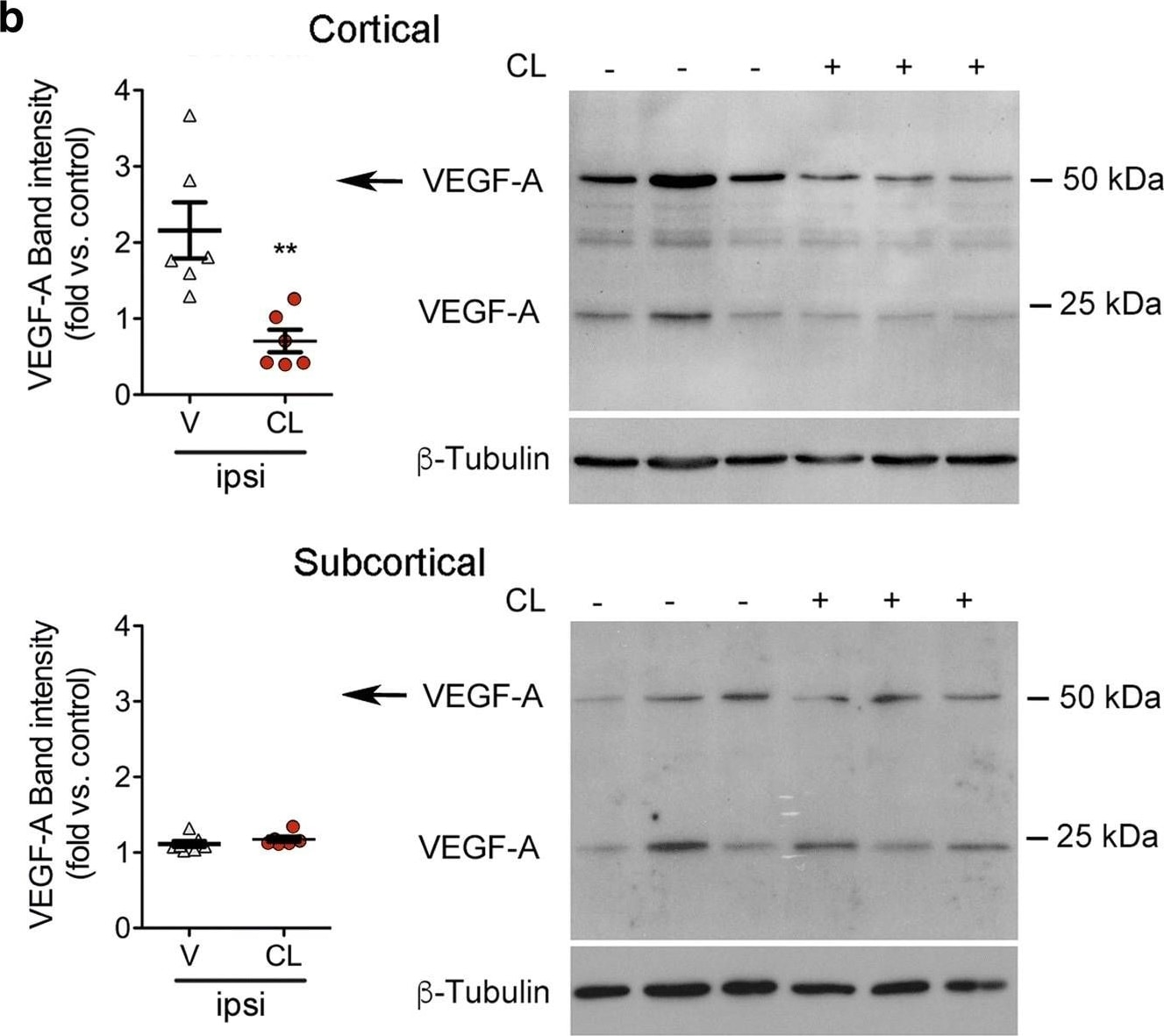
Detection of Porcine VEGF by Western Blot
Depletion of BAMs attenuates ischemia-induced pial and cortical vascular permeability. BAMs were depleted by i.c.v. administration of clodronate liposomes (CL) 4 days prior to ischemia. For treatment control, rats received vehicle liposomes (V). a) Vegfa mRNA was studied in cortical and subcortical regions of the ipsilateral (ipsi, ischemic) and the contralateral (contra) brain hemispheres. Ischemia-induced expression of Vegfa mRNA at 24 h is attenuated in the cortex of the CL rats versus the V rats (n = 6 per group) (Mann Whitney test, p = 0.041). b) Western blotting of cortical and subcortical brain tissue (ipsilateral) 24 h post-ischemia shows the VEGF164 isoform of VEGF-A detected as two bands corresponding to the homodimeric and monomeric forms at approximately 54 kDa and 24 kDa. Quantification of signal intensity of the 54-kDa band shows reduced expression in the cortex of rats receiving CL vs. rats receiving V (n = 6 per group) (Mann-Whitney test, **p = 0.002). c) Ischemia increases the permeability of pial vessels (arrows), as assessed by Evans blue extravasation 24 h post-ischemia, and BAM depletion attenuates the effect. Images of one representative coronal brain section per rat of each treatment group show Evans blue extravasation in the ipsilateral hemisphere. Rats receiving clodronate show negligible Evans blue in the cortex (arrows in the schematic representation at the right hand side). The volume of tissue showing Evans blue extravasation is reduced in the cortex, but not in subcortical zones, of the CL group (n = 8) versus the V group (n = 7) (Mann-Whitney test, *p = 0.014). Image collected and cropped by CiteAb from the following open publication (https://pubmed.ncbi.nlm.nih.gov/30092836), licensed under a CC-BY license. Not internally tested by R&D Systems.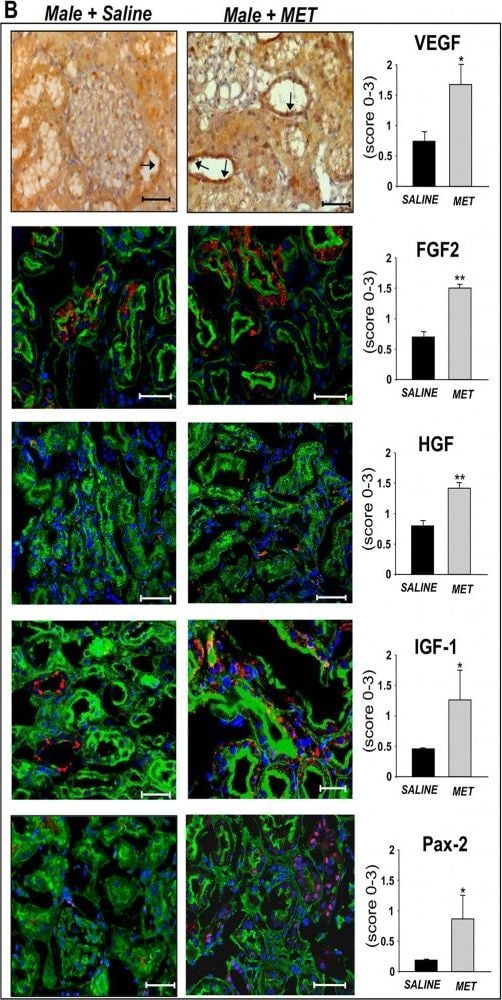
Detection of Porcine VEGF by Immunohistochemistry
Expression of mRNAs and proteins relevant to kidney regeneration in male MWF rats.(A) Real Time RT-PCR analysis of VEGF, FGF2, HGF, IGF-1 and Pax-2 in whole host renal tissues of male MWF rats receiving saline or metanephroi (MET) (in adjacent area), 6 weeks after transplantation. Data are expressed as mean ± SE; *P < 0.05, **P < 0.01 vs saline (n = 4 rats/group, VEGF n = 6 rats/group). (B) Immunohistochemical staining of VEGF (arrows) in male animals receiving saline or MET transplant, after 6 weeks. Scale bars = 50 μm. Representative immunofluorescence stainings (red) of FGF2, HGF, IGF-1 and Pax-2 in rats receiving saline or MET, on renal tissues labeled with WGA-lectin (green) and DAPI (blue). Scale bars = 50 μm, = 25 μm (for FGF2 and IGF-1). Semiquantitative analysis of immunohistochemical staining of VEGF, FGF2, HGF, IGF-1 and Pax-2 in male MWF rats receiving saline or MET. Data are expressed as mean ± SE; *P < 0.05, **P < 0.01 vs saline (n = 3/group). Image collected and cropped by CiteAb from the following open publication (https://dx.plos.org/10.1371/journal.pone.0120235), licensed under a CC-BY license. Not internally tested by R&D Systems.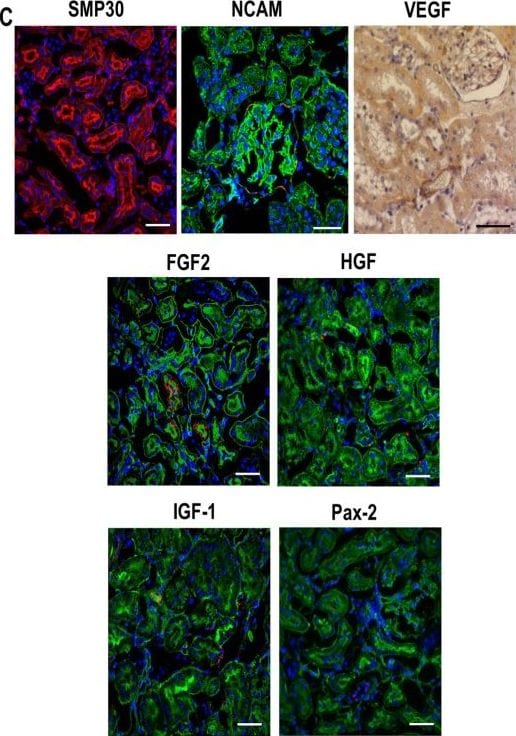
Detection of Porcine VEGF by Immunocytochemistry/ Immunofluorescence
Effect of fibroblasts transplanted under the kidney capsule of male MWF rats.(A) Histological appearance of renal tissue from male MWF rat transplanted with fibroblasts in adjacent (left, arrow) or distant (right) area. Scale bars = 200 μm. (B) Quantification of endothelium volume density (Vv), peritubular capillary length density (Jv), nitrotyrosine (NT)-positive tubuli, TUNEL-positive cells and Ki-67-positive cells, in renal tissues of MWF rats receiving fibroblasts or saline. Data are expressed as mean ± SE (n = 3 rats/group). (C) Representative immunohistochemical images of SMP30 (green), NCAM (red), VEGF (brown signal), FGF2 (red), HGF (red), IGF-1 (red) and Pax-2 (red) in male rats with fibroblast transplant. Sections are co-stained with rhodamine-LCA (in SMP30 panel, red) or with FITC-WGA lectin (in panels showing NCAM, FGF2, HGF, IGF-1, Pax2, green) and DAPI (blue). Scale bars = 50 μm. Image collected and cropped by CiteAb from the following open publication (https://dx.plos.org/10.1371/journal.pone.0120235), licensed under a CC-BY license. Not internally tested by R&D Systems.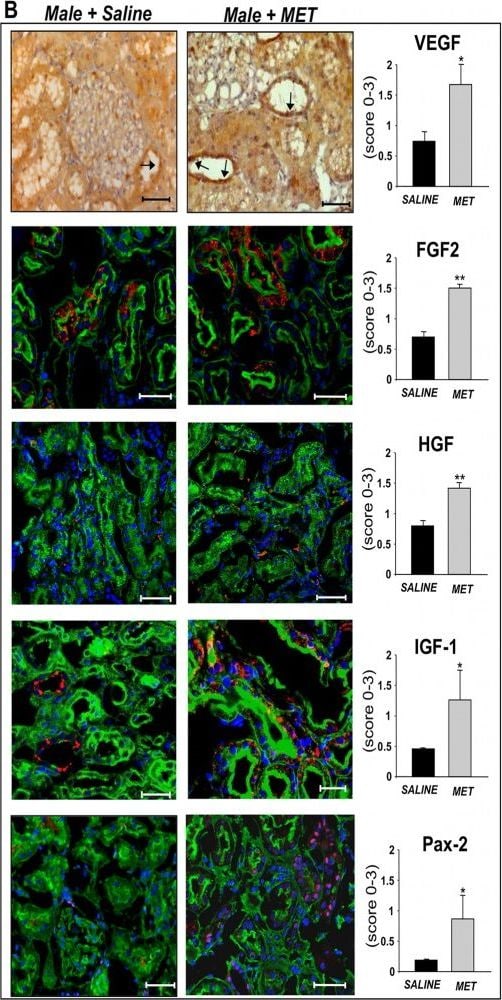
Detection of Rat VEGF by Immunohistochemistry
Expression of mRNAs and proteins relevant to kidney regeneration in male MWF rats.(A) Real Time RT-PCR analysis of VEGF, FGF2, HGF, IGF-1 and Pax-2 in whole host renal tissues of male MWF rats receiving saline or metanephroi (MET) (in adjacent area), 6 weeks after transplantation. Data are expressed as mean ± SE; *P < 0.05, **P < 0.01 vs saline (n = 4 rats/group, VEGF n = 6 rats/group). (B) Immunohistochemical staining of VEGF (arrows) in male animals receiving saline or MET transplant, after 6 weeks. Scale bars = 50 μm. Representative immunofluorescence stainings (red) of FGF2, HGF, IGF-1 and Pax-2 in rats receiving saline or MET, on renal tissues labeled with WGA-lectin (green) and DAPI (blue). Scale bars = 50 μm, = 25 μm (for FGF2 and IGF-1). Semiquantitative analysis of immunohistochemical staining of VEGF, FGF2, HGF, IGF-1 and Pax-2 in male MWF rats receiving saline or MET. Data are expressed as mean ± SE; *P < 0.05, **P < 0.01 vs saline (n = 3/group). Image collected and cropped by CiteAb from the following open publication (https://dx.plos.org/10.1371/journal.pone.0120235), licensed under a CC-BY license. Not internally tested by R&D Systems.
Rat VEGF ELISA Standard Curve
Recombinant Rat VEGF 164 (Catalog # 564-RV) was serially diluted and captured by Mouse Anti-Rat VEGF 164 Monoclonal Antibody (Catalog # MAB564) coated on a Clear Polystyrene Microplate (Catalog # DY990). Goat Anti-Rat VEGF 164 Antigen Affinity-purified Polyclonal Antibody (Catalog # AF564) was biotinylated and incubated with the protein captured on the plate. Detection of the standard curve was achieved by incubating Streptavidin-HRP (Catalog # DY998)Applications for Rat VEGF 164 Antibody
Immunohistochemistry
Sample: Perfusion fixed frozen sections of rat kidney
Western Blot
Sample: Recombinant Rat VEGF164 (Catalog # 564-RV). This antibody does not detect natural VEGF in lysates from cell lines or tissues.
Neutralization
Formulation, Preparation, and Storage
Purification
Reconstitution
Reconstitute at 0.2 mg/mL in sterile PBS. For liquid material, refer to CoA for concentration.
Formulation
Shipping
Stability & Storage
- 12 months from date of receipt, -20 to -70 °C as supplied.
- 1 month, 2 to 8 °C under sterile conditions after reconstitution.
- 6 months, -20 to -70 °C under sterile conditions after reconstitution.
Calculators
Background: VEGF
Long Name
Alternate Names
Entrez Gene IDs
Gene Symbol
UniProt
Additional VEGF Products
Product Documents for Rat VEGF 164 Antibody
Certificate of Analysis
To download a Certificate of Analysis, please enter a lot or batch number in the search box below.
Note: Certificate of Analysis not available for kit components.
Product Specific Notices for Rat VEGF 164 Antibody
For research use only
Citations for Rat VEGF 164 Antibody
 Powered by Bioz
Customer Reviews for Rat VEGF 164 Antibody
There are currently no reviews for this product. Be the first to review Rat VEGF 164 Antibody and earn rewards!
Have you used Rat VEGF 164 Antibody?
Submit a review and receive an Amazon gift card!
$25/€18/£15/$25CAN/¥2500 for a review with an image
$10/€7/£6/$10CAN/¥1110 for a review without an image
Submit a review
Protocols
Find general support by application which include: protocols, troubleshooting, illustrated assays, videos and webinars.
- Antigen Retrieval Protocol (PIER)
- Antigen Retrieval for Frozen Sections Protocol
- Appropriate Fixation of IHC/ICC Samples
- Cellular Response to Hypoxia Protocols
- Chromogenic IHC Staining of Formalin-Fixed Paraffin-Embedded (FFPE) Tissue Protocol
- Chromogenic Immunohistochemistry Staining of Frozen Tissue
- ClariTSA™ Fluorophore Kits
- Detection & Visualization of Antibody Binding
- Fluorescent IHC Staining of Frozen Tissue Protocol
- Graphic Protocol for Heat-induced Epitope Retrieval
- Graphic Protocol for the Preparation and Fluorescent IHC Staining of Frozen Tissue Sections
- Graphic Protocol for the Preparation and Fluorescent IHC Staining of Paraffin-embedded Tissue Sections
- Graphic Protocol for the Preparation of Gelatin-coated Slides for Histological Tissue Sections
- IHC Sample Preparation (Frozen sections vs Paraffin)
- Immunofluorescent IHC Staining of Formalin-Fixed Paraffin-Embedded (FFPE) Tissue Protocol
- Immunohistochemistry (IHC) and Immunocytochemistry (ICC) Protocols
- Immunohistochemistry Frozen Troubleshooting
- Immunohistochemistry Paraffin Troubleshooting
- Preparing Samples for IHC/ICC Experiments
- Preventing Non-Specific Staining (Non-Specific Binding)
- Primary Antibody Selection & Optimization
- Protocol for Heat-Induced Epitope Retrieval (HIER)
- Protocol for Making a 4% Formaldehyde Solution in PBS
- Protocol for VisUCyte™ HRP Polymer Detection Reagent
- Protocol for the Preparation & Fixation of Cells on Coverslips
- Protocol for the Preparation and Chromogenic IHC Staining of Frozen Tissue Sections
- Protocol for the Preparation and Chromogenic IHC Staining of Frozen Tissue Sections - Graphic
- Protocol for the Preparation and Chromogenic IHC Staining of Paraffin-embedded Tissue Sections
- Protocol for the Preparation and Chromogenic IHC Staining of Paraffin-embedded Tissue Sections - Graphic
- Protocol for the Preparation and Fluorescent IHC Staining of Frozen Tissue Sections
- Protocol for the Preparation and Fluorescent IHC Staining of Paraffin-embedded Tissue Sections
- Protocol for the Preparation of Gelatin-coated Slides for Histological Tissue Sections
- R&D Systems Quality Control Western Blot Protocol
- TUNEL and Active Caspase-3 Detection by IHC/ICC Protocol
- The Importance of IHC/ICC Controls
- Troubleshooting Guide: Immunohistochemistry
- Troubleshooting Guide: Western Blot Figures
- Western Blot Conditions
- Western Blot Protocol
- Western Blot Protocol for Cell Lysates
- Western Blot Troubleshooting
- Western Blot Troubleshooting Guide
- View all Protocols, Troubleshooting, Illustrated assays and Webinars
Associated Pathways


