
Aggrecan Antibody (BC-3) - BSA Free
Novus Biologicals | Catalog # NB600-504

![Western Blot: Aggrecan Antibody (BC-3)BSA Free [NB600-504]](https://resources.rndsystems.com/images/products/Aggrecan-Antibody-BC-3-Western-Blot-NB600-504-img0002.jpg "Western Blot: Aggrecan Antibody (BC-3)BSA Free [NB600-504]")
Scientific images may be resized, cropped, or adjusted for brightness or contrast for presentation purposes. These updates are limited to presentation and do not affect the underlying scientific interpretation of the data. Where available, additional source data may be provided upon request.
Key Product Details
Validated by
Species Reactivity
Validated:
Cited:
Applications
Validated:
Cited:
Label
Antibody Source
Format
Product Specifications
Immunogen
Reactivity Notes
Localization
Marker
Specificity
Clonality
Host
Isotype
Theoretical MW
Disclaimer note: The observed molecular weight of the protein may vary from the listed predicted molecular weight due to post translational modifications, post translation cleavages, relative charges, and other experimental factors.
Scientific Data Images for Aggrecan Antibody (BC-3) - BSA Free
![Immunocytochemistry/ Immunofluorescence: Aggrecan Antibody (BC-3) - BSA Free [NB600-504]](https://resources.rndsystems.com/images/products/Aggrecan-Antibody-BC-3-Immunocytochemistry-Immunofluorescence-NB600-504-img0001.jpg "Immunocytochemistry/ Immunofluorescence: Aggrecan Antibody (BC-3) - BSA Free [NB600-504]")
![Western Blot: Aggrecan Antibody (BC-3)BSA Free [NB600-504]](https://resources.rndsystems.com/images/products/Aggrecan-Antibody-BC-3-Western-Blot-NB600-504-img0003.jpg "Western Blot: Aggrecan Antibody (BC-3)BSA Free [NB600-504]")
Western Blot: Aggrecan Antibody (BC-3)BSA Free [NB600-504]
Aggrecan-Antibody-BC-3-Western-Blot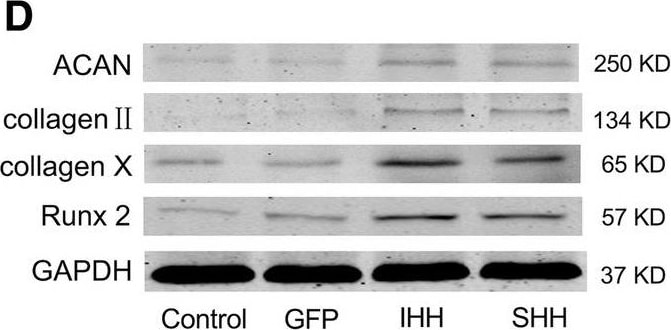
Western Blot: Aggrecan Antibody (BC-3) - BSA Free [NB600-504] -
Western Blot: Aggrecan Antibody (BC-3) - BSA Free [NB600-504] - Expression levels of related genes during differentiation induction in the 2D environment. (a) qRT-PCR analysis of Sox9, ACAN & collagen II on days 7, 14 & 21 during induction. (b) qRT-PCR analysis of collagen X, Runx2 & annexin V on days 7, 14 & 21 during induction. The results were normalized to B2M mRNA expression. Values are means ± SD (n = 3). (c) Expression of ACAN, collagen II, collagen X & Runx2 was detected by western blotting on day 10 during induction. (d) Expression of ACAN, collagen II, collagen X & Runx2 was detected by western blotting on day 21 during induction. Significant differences from the control group (non-transfection cells) are indicated by *p < 0.05 or **p < 0.01; differences between IHH & SHH transfection groups are indicated by #p < 0.05 or ##p < 0.01 Image collected & cropped by CiteAb from the following publication (https://pubmed.ncbi.nlm.nih.gov/30858866), licensed under a CC-BY license. Not internally tested by Novus Biologicals.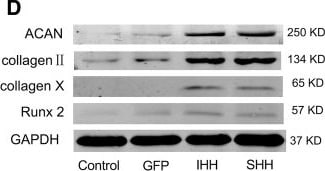
Western Blot: Aggrecan Antibody (BC-3) - BSA Free [NB600-504] -
Western Blot: Aggrecan Antibody (BC-3) - BSA Free [NB600-504] - Expression levels of related genes during differentiation induction in the RCCS environment. (a) qPCR analysis of Sox9, ACAN & collagen II on days 7, 14 & 21 during induction. (b) qRT-PCR analysis of collagen X, Runx2, & annexin V on days 7, 14 & 21 during induction. The results were normalized to B2M mRNA expression. Values are means ± SD (n = 3). (c) Expression of ACAN, collagen II, collagen X & Runx2 was detected by western blotting on day 10 during differentiation induction. (d) Expression of ACAN, collagen II, collagen X & Runx2 was detected by western blotting on day 21 during differentiation induction. Significant differences from the control group (non-transfection cells) are indicated by *p < 0.05 or ** p < 0.01; differences between IHH & SHH transfection groups are indicated by #p < 0.05 or ##p < 0.01 Image collected & cropped by CiteAb from the following publication (https://pubmed.ncbi.nlm.nih.gov/30858866), licensed under a CC-BY license. Not internally tested by Novus Biologicals.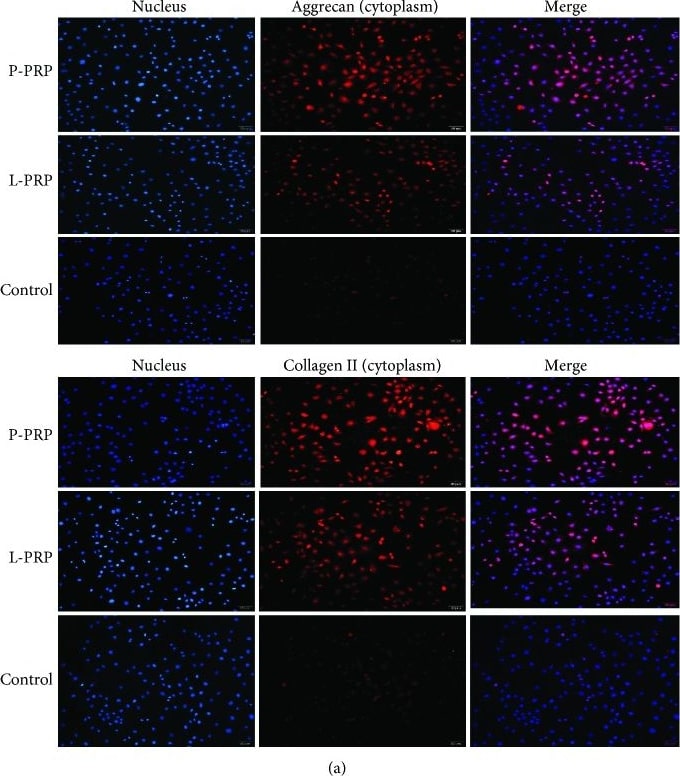
Immunocytochemistry/ Immunofluorescence: Aggrecan Antibody (BC-3) - BSA Free [NB600-504] -
P-PRP induces more extracellular matrix-related proteins. (a) Collagen II and aggrecan in the cytoplasm of the coculture cells imaged by fluorescence microscopy. (b) Production of collagen II and aggrecan, as measured by western blot. Image collected and cropped by CiteAb from the following open publication (https://pubmed.ncbi.nlm.nih.gov/30425747), licensed under a CC-BY license. Not internally tested by Novus Biologicals.Applications for Aggrecan Antibody (BC-3) - BSA Free
ELISA
Immunohistochemistry
Immunohistochemistry-Frozen
Immunohistochemistry-Paraffin
Western Blot
Formulation, Preparation, and Storage
Purification
Formulation
Format
Preservative
Concentration
Shipping
Stability & Storage
Background: Aggrecan
Alternate Names
Gene Symbol
UniProt
Additional Aggrecan Products
Product Documents for Aggrecan Antibody (BC-3) - BSA Free
Certificate of Analysis
To download a Certificate of Analysis, please enter a lot or batch number in the search box below.
Product Specific Notices for Aggrecan Antibody (BC-3) - BSA Free
This product is for research use only and is not approved for use in humans or in clinical diagnosis. Primary Antibodies are guaranteed for 1 year from date of receipt.
Citations for Aggrecan Antibody (BC-3) - BSA Free
 Powered by Bioz
Customer Reviews for Aggrecan Antibody (BC-3) - BSA Free
There are currently no reviews for this product. Be the first to review Aggrecan Antibody (BC-3) - BSA Free and earn rewards!
Have you used Aggrecan Antibody (BC-3) - BSA Free?
Submit a review and receive an Amazon gift card!
$25/€18/£15/$25CAN/¥2500 for a review with an image
$10/€7/£6/$10CAN/¥1110 for a review without an image
Submit a review
Protocols
View specific protocols for Aggrecan Antibody (BC-3) - BSA Free (NB600-504):
1. Immunostaining with enzyme-generated antibodies BC3, 13, 4, and 14 was carried out on 19 discs from patients 11-59 years of age (1 with prolapse, 2 with scoliosis, 2 with spondylolisthesis, and the remainder with degenerative disc disease).
2. Different fixation treatments were used to optimize antigen preservation and staining of the cryosections; for example, 70% ethanol, 100% ethanol, 10% formaldehyde, or no fixation was used.
3. After this treatment, sections to be stained for BC 3 and 14 were digested with keratanase I, II, and chondroitinase ABC for 3 hours, and those to be stained for BC4 and 13 were digested with chondroitinase ABC for only 90 minutes.
4. Labeling was as for paraffin sections with other antibodies.
5. Staining was done on 5 um paraffin sections that then were deparaffinized with xylene and rehydrated through a series of alcohols to phosphate buffered saline (PBS). Staining conditions were optimized for each individual antibody... no pretreatment was found necessary.
6. Sequential blocking of endogenous peroxidase activity was performed with 0.3% hydrogen peroxide in PBS and then 20% normal human and horse serum and 3% bovine serum albumin in PBS.
7. The primary antibody was incubated for 90 minutes at room temperature before labeling with peroxidase linked to a biotin-streptavidin complex using diaminobenzadine as the colorimetric substrate, then washing, dehydrating, and mounting in pertex.
Adjacent control sections were incubated with either a class-matched immunoglobulin raised to an irrelevant antigen or PBS in place of the primary antigen.
Find general support by application which include: protocols, troubleshooting, illustrated assays, videos and webinars.
- Antigen Retrieval Protocol (PIER)
- Antigen Retrieval for Frozen Sections Protocol
- Appropriate Fixation of IHC/ICC Samples
- Cellular Response to Hypoxia Protocols
- Chromogenic IHC Staining of Formalin-Fixed Paraffin-Embedded (FFPE) Tissue Protocol
- Chromogenic Immunohistochemistry Staining of Frozen Tissue
- ClariTSA™ Fluorophore Kits
- Detection & Visualization of Antibody Binding
- ELISA Sample Preparation & Collection Guide
- ELISA Troubleshooting Guide
- Fluorescent IHC Staining of Frozen Tissue Protocol
- Graphic Protocol for Heat-induced Epitope Retrieval
- Graphic Protocol for the Preparation and Fluorescent IHC Staining of Frozen Tissue Sections
- Graphic Protocol for the Preparation and Fluorescent IHC Staining of Paraffin-embedded Tissue Sections
- Graphic Protocol for the Preparation of Gelatin-coated Slides for Histological Tissue Sections
- How to Run an R&D Systems DuoSet ELISA
- How to Run an R&D Systems Quantikine ELISA
- How to Run an R&D Systems Quantikine™ QuicKit™ ELISA
- ICC Cell Smear Protocol for Suspension Cells
- ICC Immunocytochemistry Protocol Videos
- ICC for Adherent Cells
- IHC Sample Preparation (Frozen sections vs Paraffin)
- Immunocytochemistry (ICC) Protocol
- Immunocytochemistry Troubleshooting
- Immunofluorescence of Organoids Embedded in Cultrex Basement Membrane Extract
- Immunofluorescent IHC Staining of Formalin-Fixed Paraffin-Embedded (FFPE) Tissue Protocol
- Immunohistochemistry (IHC) and Immunocytochemistry (ICC) Protocols
- Immunohistochemistry Frozen Troubleshooting
- Immunohistochemistry Paraffin Troubleshooting
- Preparing Samples for IHC/ICC Experiments
- Preventing Non-Specific Staining (Non-Specific Binding)
- Primary Antibody Selection & Optimization
- Protocol for Heat-Induced Epitope Retrieval (HIER)
- Protocol for Making a 4% Formaldehyde Solution in PBS
- Protocol for VisUCyte™ HRP Polymer Detection Reagent
- Protocol for the Fluorescent ICC Staining of Cell Smears - Graphic
- Protocol for the Fluorescent ICC Staining of Cultured Cells on Coverslips - Graphic
- Protocol for the Preparation & Fixation of Cells on Coverslips
- Protocol for the Preparation and Chromogenic IHC Staining of Frozen Tissue Sections
- Protocol for the Preparation and Chromogenic IHC Staining of Frozen Tissue Sections - Graphic
- Protocol for the Preparation and Chromogenic IHC Staining of Paraffin-embedded Tissue Sections
- Protocol for the Preparation and Chromogenic IHC Staining of Paraffin-embedded Tissue Sections - Graphic
- Protocol for the Preparation and Fluorescent ICC Staining of Cells on Coverslips
- Protocol for the Preparation and Fluorescent ICC Staining of Non-adherent Cells
- Protocol for the Preparation and Fluorescent ICC Staining of Stem Cells on Coverslips
- Protocol for the Preparation and Fluorescent IHC Staining of Frozen Tissue Sections
- Protocol for the Preparation and Fluorescent IHC Staining of Paraffin-embedded Tissue Sections
- Protocol for the Preparation of Gelatin-coated Slides for Histological Tissue Sections
- Protocol for the Preparation of a Cell Smear for Non-adherent Cell ICC - Graphic
- Quantikine HS ELISA Kit Assay Principle, Alkaline Phosphatase
- Quantikine HS ELISA Kit Principle, Streptavidin-HRP Polymer
- R&D Systems Quality Control Western Blot Protocol
- Sandwich ELISA (Colorimetric) – Biotin/Streptavidin Detection Protocol
- Sandwich ELISA (Colorimetric) – Direct Detection Protocol
- TUNEL and Active Caspase-3 Detection by IHC/ICC Protocol
- The Importance of IHC/ICC Controls
- Troubleshooting Guide: ELISA
- Troubleshooting Guide: Immunohistochemistry
- Troubleshooting Guide: Western Blot Figures
- Western Blot Conditions
- Western Blot Protocol
- Western Blot Protocol for Cell Lysates
- Western Blot Troubleshooting
- Western Blot Troubleshooting Guide
- View all Protocols, Troubleshooting, Illustrated assays and Webinars
FAQs for Aggrecan Antibody (BC-3) - BSA Free
-
Q: Do you know if this antibody has been used with immunofluorescence?
A: We have not yet validated this antibody for use in immunofluorescence. In instances such as this, we recommend our Innovators Reward Program. Under the terms and conditions of this program, we would be happy to provide you with a credit of equal or lesser value, in exchange for your online review of this product including an image of either positive or negative staining for testing in a new species and/or application.
-
Q: On behalf of a customer I have a question about antibody NB600-504 anti-ACAN. The note on the datasheet says Samples must be deglycosylated using 0.01 Units Chondroitinase ABC (Sigma), 0.01 Units Keratanase (Seikagaku) and 0.0001 Units Keratanase II (Seikagaku) per 10ug S-GAG of non-deglycosylated aggrecan for optimal epitope recognition. Do you really mean to say deglycosylated? Are not those reagents actually digesting the aggrecan? Do they also deglycosylate the protein?
A: Aggrecan is a highly glycosylated protein and this can interfere with the antibody binding to and recognizing the epitope. These enzymes will deglycosylate the protein and expose the epitope for recognition by the antibody
-
Q: Our customer would like to confirm the predicted MW by using NB600-504 to detect Aggrecan. According to info from http://www.uniprot.org/uniprot/P16112, the MW of the target protein may be between 239 to 250 kDa. But this antibody can also be used with ELISA and Western blot, where it detects a variety of epitopes between 50 and 250 kDa is described. May we have the explanation?
A: There are two isoforms of aggrecan, and this antibody can detect either one or both of them. It depends on which isoforms a particular cell type/tissue/species expresses.
-
Q: Do you know if this antibody has been used with immunofluorescence?
A: We have not yet validated this antibody for use in immunofluorescence. In instances such as this, we recommend our Innovators Reward Program. Under the terms and conditions of this program, we would be happy to provide you with a credit of equal or lesser value, in exchange for your online review of this product including an image of either positive or negative staining for testing in a new species and/or application.
-
Q: On behalf of a customer I have a question about antibody NB600-504 anti-ACAN. The note on the datasheet says Samples must be deglycosylated using 0.01 Units Chondroitinase ABC (Sigma), 0.01 Units Keratanase (Seikagaku) and 0.0001 Units Keratanase II (Seikagaku) per 10ug S-GAG of non-deglycosylated aggrecan for optimal epitope recognition. Do you really mean to say deglycosylated? Are not those reagents actually digesting the aggrecan? Do they also deglycosylate the protein?
A: Aggrecan is a highly glycosylated protein and this can interfere with the antibody binding to and recognizing the epitope. These enzymes will deglycosylate the protein and expose the epitope for recognition by the antibody
-
Q: Our customer would like to confirm the predicted MW by using NB600-504 to detect Aggrecan. According to info from http://www.uniprot.org/uniprot/P16112, the MW of the target protein may be between 239 to 250 kDa. But this antibody can also be used with ELISA and Western blot, where it detects a variety of epitopes between 50 and 250 kDa is described. May we have the explanation?
A: There are two isoforms of aggrecan, and this antibody can detect either one or both of them. It depends on which isoforms a particular cell type/tissue/species expresses.
-
Q: Do you know if this antibody has been used with immunofluorescence?
A: We have not yet validated this antibody for use in immunofluorescence. In instances such as this, we recommend our Innovators Reward Program. Under the terms and conditions of this program, we would be happy to provide you with a credit of equal or lesser value, in exchange for your online review of this product including an image of either positive or negative staining for testing in a new species and/or application.
-
Q: On behalf of a customer I have a question about antibody NB600-504 anti-ACAN. The note on the datasheet says Samples must be deglycosylated using 0.01 Units Chondroitinase ABC (Sigma), 0.01 Units Keratanase (Seikagaku) and 0.0001 Units Keratanase II (Seikagaku) per 10ug S-GAG of non-deglycosylated aggrecan for optimal epitope recognition. Do you really mean to say deglycosylated? Are not those reagents actually digesting the aggrecan? Do they also deglycosylate the protein?
A: Aggrecan is a highly glycosylated protein and this can interfere with the antibody binding to and recognizing the epitope. These enzymes will deglycosylate the protein and expose the epitope for recognition by the antibody
-
Q: Our customer would like to confirm the predicted MW by using NB600-504 to detect Aggrecan. According to info from http://www.uniprot.org/uniprot/P16112, the MW of the target protein may be between 239 to 250 kDa. But this antibody can also be used with ELISA and Western blot, where it detects a variety of epitopes between 50 and 250 kDa is described. May we have the explanation?
A: There are two isoforms of aggrecan, and this antibody can detect either one or both of them. It depends on which isoforms a particular cell type/tissue/species expresses.
Associated Pathways

