
AKT1 [p Ser473] Antibody (RM251)
Novus Biologicals | Catalog # NBP2-61475
Recombinant Monoclonal Antibody

![AKT1 [p Ser473] Antibody (RM251)](https://resources.rndsystems.com/images/products/nbp2-61475_rabbit-akt1-p-ser473-mab-rm251-immunohistochemistry-paraffin-189202523512118.png "Immunohistochemistry-Paraffin: AKT1 [p Ser473] Antibody (RM251) [NBP2-61475] -")
Loading...
Key Product Details
Species Reactivity
Human
Applications
Immunohistochemistry, Immunohistochemistry-Paraffin, Western Blot
Label
Unconjugated
Antibody Source
Recombinant Monoclonal Rabbit IgG Clone # RM251 expressed in HEK293
Loading...
Product Specifications
Immunogen
This AKT1 phospho Ser473 antibody is made to a phospho-peptide corresponding to Human AKT1 phospho Ser473
Reactivity Notes
This antibody may also react to bovine, mouse or rat phospho-AKT1 [Ser473], as predicted by immunogen homology.
Modification
p Ser473
Specificity
This antibody reacts to AKT1 only when phosphorylated at Ser473. There is no cross-reactivity with AKT1 without phosphorylation at Ser473.
Clonality
Monoclonal
Host
Rabbit
Isotype
IgG
Theoretical MW
55.7 kDa.
Disclaimer note: The observed molecular weight of the protein may vary from the listed predicted molecular weight due to post translational modifications, post translation cleavages, relative charges, and other experimental factors.
Disclaimer note: The observed molecular weight of the protein may vary from the listed predicted molecular weight due to post translational modifications, post translation cleavages, relative charges, and other experimental factors.
Scientific Data Images for AKT1 [p Ser473] Antibody (RM251)
Immunohistochemistry-Paraffin: AKT1 [p Ser473] Antibody (RM251) [NBP2-61475] -
Immunohistochemistry-Paraffin: AKT1 [p Ser473] Antibody (RM251) [NBP2-61475] - IHC-P staining of FFPE human breast cancer tissue sections using NBP2-61475 at a 1:400 dilution.![AKT1 [p Ser473] Antibody (RM251)](https://resources.rndsystems.com/images/products/nbp2-61475_rabbit-akt1-p-ser473-mab-rm251-western-blot-18920252352110.png "Western Blot: AKT1 [p Ser473] Antibody (RM251) [NBP2-61475] -")
Western Blot: AKT1 [p Ser473] Antibody (RM251) [NBP2-61475] -
Western Blot: AKT1 [p Ser473] Antibody (RM251) [NBP2-61475] - WB of lysates from 293 cells either grown in medium with serum, serum starved, or insulin treated using NBP2-61475 at 1:1000 dilution.Applications for AKT1 [p Ser473] Antibody (RM251)
Application
Recommended Usage
Immunohistochemistry
1:200 - 1:500
Immunohistochemistry-Paraffin
1:200 - 1:500
Western Blot
1:1000 - 1:2000
Formulation, Preparation, and Storage
Purification
Protein A purified
Formulation
50% Glycerol/PBS, 1% BSA
Preservative
0.09% Sodium Azide
Concentration
Please see the vial label for concentration. If unlisted please contact technical services.
Shipping
The product is shipped with polar packs. Upon receipt, store it immediately at the temperature recommended below.
Stability & Storage
Store at -20C. Avoid freeze-thaw cycles.
Background: Akt1
The main function of AKT is to control inhibition of apoptosis and promote cell proliferation. Survival factors can activate AKT Ser473 and Thr308 phosphorylation sites in a transcription-independent manner, resulting in the inactivation of apoptotic signaling transduction through the tumor suppressor PTEN, an antagonist to PI3-K (5). PTEN exerts enzymatic activity as a phosphatidylinositol-3,4,5-trisphosphate (PIP3) phosphatase, opposing PI3K activity by decreasing availability of PIP3 to proliferating cells, leading to overexpression and inappropriate activation of AKT noted in many types of cancer.
AKT1 function has been linked to overall physiological growth and function (2). AKT1 has been correlated with proteus syndrome, a rare disorder characterized by overgrowth of various tissues caused by a mosaic variant in the AKT1 gene in humans.
AKT2 is strongly correlated with Type II diabetes, including phenotypes of insulin resistance, hyperglycemia and atherosclerosis (2, 6).
The function of AKT3 is specifically associated to brain development, where disruptions to AKT3 are correlated with microcephaly, hemimegalencephaly, megalencephaly and intellectual disabilities (2).
References
1. Ersahin, T., Tuncbag, N., & Cetin-Atalay, R. (2015). The PI3K/AKT/mTOR interactive pathway. Mol Biosyst, 11(7), 1946-1954. doi:10.1039/c5mb00101c
2. Cohen, M. M., Jr. (2013). The AKT genes and their roles in various disorders. Am J Med Genet A, 161a(12), 2931-2937. doi:10.1002/ajmg.a.36101
3. Georgescu, M. M. (2010). PTEN Tumor Suppressor Network in PI3K-Akt Pathway Control. Genes Cancer, 1(12), 1170-1177. doi:10.1177/1947601911407325
4. Mishra, P., Paital, B., Jena, S., Swain, S. S., Kumar, S., Yadav, M. K.,... Samanta, L. (2019). Possible activation of NRF2 by Vitamin E/Curcumin against altered thyroid hormone induced oxidative stress via NFkB/AKT/mTOR/KEAP1 signalling in rat heart. Sci Rep, 9(1), 7408. doi:10.1038/s41598-019-43320-5
5. Wedel, S., Hudak, L., Seibel, J. M., Juengel, E., Oppermann, E., Haferkamp, A., & Blaheta, R. A. (2011). Critical analysis of simultaneous blockage of histone deacetylase and multiple receptor tyrosine kinase in the treatment of prostate cancer. Prostate, 71(7), 722-735. doi:10.1002/pros.21288
6. Rotllan, N., Chamorro-Jorganes, A., Araldi, E., Wanschel, A. C., Aryal, B., Aranda, J. F.,... Fernandez-Hernando, C. (2015). Hematopoietic Akt2 deficiency attenuates the progression of atherosclerosis. Faseb j, 29(2), 597-610. doi:10.1096/fj.14-262097
Long Name
v-Akt Murine Thymoma Viral Oncogene Homolog 1
Alternate Names
PKB alpha, PRKBA, RAC-alpha
Gene Symbol
AKT1
Additional Akt1 Products
Product Documents for AKT1 [p Ser473] Antibody (RM251)
Certificate of Analysis
To download a Certificate of Analysis, please enter a lot or batch number in the search box below.
Product Specific Notices for AKT1 [p Ser473] Antibody (RM251)
This product is for research use only and is not approved for use in humans or in clinical diagnosis. Primary Antibodies are guaranteed for 1 year from date of receipt.
Customer Reviews for AKT1 [p Ser473] Antibody (RM251)
There are currently no reviews for this product. Be the first to review AKT1 [p Ser473] Antibody (RM251) and earn rewards!
Have you used AKT1 [p Ser473] Antibody (RM251)?
Submit a review and receive an Amazon gift card!
$25/€18/£15/$25CAN/¥2500 for a review with an image
$10/€7/£6/$10CAN/¥1110 for a review without an image
Submit a review
Protocols
Find general support by application which include: protocols, troubleshooting, illustrated assays, videos and webinars.
- Antigen Retrieval Protocol (PIER)
- Antigen Retrieval for Frozen Sections Protocol
- Appropriate Fixation of IHC/ICC Samples
- Cellular Response to Hypoxia Protocols
- Chromogenic IHC Staining of Formalin-Fixed Paraffin-Embedded (FFPE) Tissue Protocol
- Chromogenic Immunohistochemistry Staining of Frozen Tissue
- ClariTSA™ Fluorophore Kits
- Detection & Visualization of Antibody Binding
- Fluorescent IHC Staining of Frozen Tissue Protocol
- Graphic Protocol for Heat-induced Epitope Retrieval
- Graphic Protocol for the Preparation and Fluorescent IHC Staining of Frozen Tissue Sections
- Graphic Protocol for the Preparation and Fluorescent IHC Staining of Paraffin-embedded Tissue Sections
- Graphic Protocol for the Preparation of Gelatin-coated Slides for Histological Tissue Sections
- IHC Sample Preparation (Frozen sections vs Paraffin)
- Immunofluorescent IHC Staining of Formalin-Fixed Paraffin-Embedded (FFPE) Tissue Protocol
- Immunohistochemistry (IHC) and Immunocytochemistry (ICC) Protocols
- Immunohistochemistry Frozen Troubleshooting
- Immunohistochemistry Paraffin Troubleshooting
- Preparing Samples for IHC/ICC Experiments
- Preventing Non-Specific Staining (Non-Specific Binding)
- Primary Antibody Selection & Optimization
- Protocol for Heat-Induced Epitope Retrieval (HIER)
- Protocol for Making a 4% Formaldehyde Solution in PBS
- Protocol for VisUCyte™ HRP Polymer Detection Reagent
- Protocol for the Preparation & Fixation of Cells on Coverslips
- Protocol for the Preparation and Chromogenic IHC Staining of Frozen Tissue Sections
- Protocol for the Preparation and Chromogenic IHC Staining of Frozen Tissue Sections - Graphic
- Protocol for the Preparation and Chromogenic IHC Staining of Paraffin-embedded Tissue Sections
- Protocol for the Preparation and Chromogenic IHC Staining of Paraffin-embedded Tissue Sections - Graphic
- Protocol for the Preparation and Fluorescent IHC Staining of Frozen Tissue Sections
- Protocol for the Preparation and Fluorescent IHC Staining of Paraffin-embedded Tissue Sections
- Protocol for the Preparation of Gelatin-coated Slides for Histological Tissue Sections
- R&D Systems Quality Control Western Blot Protocol
- TUNEL and Active Caspase-3 Detection by IHC/ICC Protocol
- The Importance of IHC/ICC Controls
- Troubleshooting Guide: Immunohistochemistry
- Troubleshooting Guide: Western Blot Figures
- Western Blot Conditions
- Western Blot Protocol
- Western Blot Protocol for Cell Lysates
- Western Blot Troubleshooting
- Western Blot Troubleshooting Guide
- View all Protocols, Troubleshooting, Illustrated assays and Webinars
FAQs for AKT1 [p Ser473] Antibody (RM251)
Showing
1
-
5 of
5 FAQs
Showing All
-
Q: Do your HRP-conjugated antibodies contain sodium azide?
A: No. None of our HRP-conjugated antibodies contain sodium azide as this agent inhibits the activity of HRP.
-
Q: How do I choose secondary antibodies to label the same cells when I have two primary antibodies from the same host?
A: Use isotype-specific secondary antibodies if the primary antibodies are of different isotypes. You can also make direct conjugates of the primary antibodies by use of antibody labeling kits, dyes, or custom conjugations (please contact Technical Support for custom orders).
-
Q: I am looking for a antibody that recognizes human Akt1 but NOT Akt2 or 3, for Western blot analyses. I also want that antibody to recognize Akt1 regardless of its phosphorylated form.
A: At the moment we do not have an AKT1 antibody that definitively does not react with either AKT2 or AKT3.
-
Q: What is the molecular weight of your antibodies?
A: All IgG antibodies are approximately 150 kDa (each heavy chain is about 50 kDa and each light chain is about 25 kDa).
-
Q: Why are many of your antibodies formulated with sodium azide and BSA?
A: Sodium azide is a preservative which is added to prevent bacterial growth. BSA is added as a protein stabilizer.
-
Q: Do your HRP-conjugated antibodies contain sodium azide?
A: No. None of our HRP-conjugated antibodies contain sodium azide as this agent inhibits the activity of HRP.
-
Q: How do I choose secondary antibodies to label the same cells when I have two primary antibodies from the same host?
A: Use isotype-specific secondary antibodies if the primary antibodies are of different isotypes. You can also make direct conjugates of the primary antibodies by use of antibody labeling kits, dyes, or custom conjugations (please contact Technical Support for custom orders).
-
Q: I am looking for a antibody that recognizes human Akt1 but NOT Akt2 or 3, for Western blot analyses. I also want that antibody to recognize Akt1 regardless of its phosphorylated form.
A: At the moment we do not have an AKT1 antibody that definitively does not react with either AKT2 or AKT3.
-
Q: What is the molecular weight of your antibodies?
A: All IgG antibodies are approximately 150 kDa (each heavy chain is about 50 kDa and each light chain is about 25 kDa).
-
Q: Why are many of your antibodies formulated with sodium azide and BSA?
A: Sodium azide is a preservative which is added to prevent bacterial growth. BSA is added as a protein stabilizer.
-
Q: Do your HRP-conjugated antibodies contain sodium azide?
A: No. None of our HRP-conjugated antibodies contain sodium azide as this agent inhibits the activity of HRP.
-
Q: How do I choose secondary antibodies to label the same cells when I have two primary antibodies from the same host?
A: Use isotype-specific secondary antibodies if the primary antibodies are of different isotypes. You can also make direct conjugates of the primary antibodies by use of antibody labeling kits, dyes, or custom conjugations (please contact Technical Support for custom orders).
-
Q: I am looking for a antibody that recognizes human Akt1 but NOT Akt2 or 3, for Western blot analyses. I also want that antibody to recognize Akt1 regardless of its phosphorylated form.
A: At the moment we do not have an AKT1 antibody that definitively does not react with either AKT2 or AKT3.
-
Q: What is the molecular weight of your antibodies?
A: All IgG antibodies are approximately 150 kDa (each heavy chain is about 50 kDa and each light chain is about 25 kDa).
-
Q: Why are many of your antibodies formulated with sodium azide and BSA?
A: Sodium azide is a preservative which is added to prevent bacterial growth. BSA is added as a protein stabilizer.
-
Q: Do your HRP-conjugated antibodies contain sodium azide?
A: No. None of our HRP-conjugated antibodies contain sodium azide as this agent inhibits the activity of HRP.
-
Q: How do I choose secondary antibodies to label the same cells when I have two primary antibodies from the same host?
A: Use isotype-specific secondary antibodies if the primary antibodies are of different isotypes. You can also make direct conjugates of the primary antibodies by use of antibody labeling kits, dyes, or custom conjugations (please contact Technical Support for custom orders).
-
Q: I am looking for a antibody that recognizes human Akt1 but NOT Akt2 or 3, for Western blot analyses. I also want that antibody to recognize Akt1 regardless of its phosphorylated form.
A: At the moment we do not have an AKT1 antibody that definitively does not react with either AKT2 or AKT3.
-
Q: What is the molecular weight of your antibodies?
A: All IgG antibodies are approximately 150 kDa (each heavy chain is about 50 kDa and each light chain is about 25 kDa).
-
Q: Why are many of your antibodies formulated with sodium azide and BSA?
A: Sodium azide is a preservative which is added to prevent bacterial growth. BSA is added as a protein stabilizer.
-
Q: Do your HRP-conjugated antibodies contain sodium azide?
A: No. None of our HRP-conjugated antibodies contain sodium azide as this agent inhibits the activity of HRP.
-
Q: How do I choose secondary antibodies to label the same cells when I have two primary antibodies from the same host?
A: Use isotype-specific secondary antibodies if the primary antibodies are of different isotypes. You can also make direct conjugates of the primary antibodies by use of antibody labeling kits, dyes, or custom conjugations (please contact Technical Support for custom orders).
-
Q: I am looking for a antibody that recognizes human Akt1 but NOT Akt2 or 3, for Western blot analyses. I also want that antibody to recognize Akt1 regardless of its phosphorylated form.
A: At the moment we do not have an AKT1 antibody that definitively does not react with either AKT2 or AKT3.
-
Q: What is the molecular weight of your antibodies?
A: All IgG antibodies are approximately 150 kDa (each heavy chain is about 50 kDa and each light chain is about 25 kDa).
-
Q: Why are many of your antibodies formulated with sodium azide and BSA?
A: Sodium azide is a preservative which is added to prevent bacterial growth. BSA is added as a protein stabilizer.
Loading...
Associated Pathways


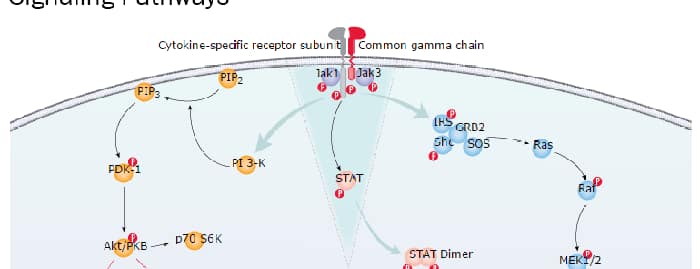
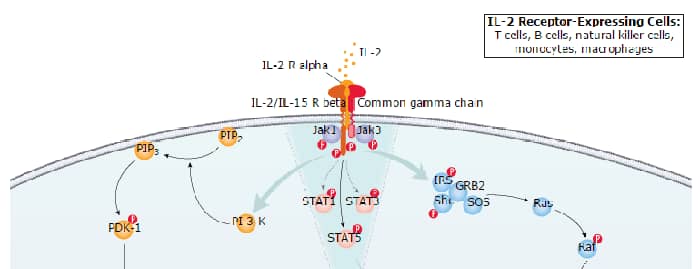
IL-2 Signaling Pathways
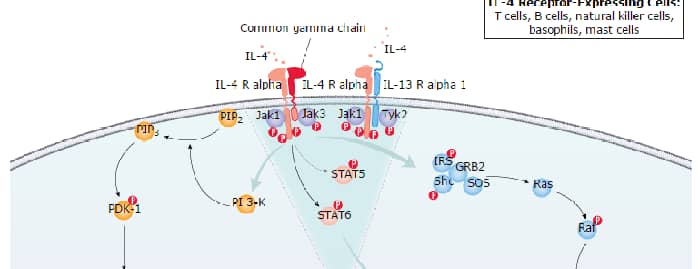
 IL-4 Signaling Pathways
 IL-7 Signaling Pathways
 IL-9 Signaling Pathways
 IL-15 Signaling Pathways
 IL-21 Signaling Pathways
 mTOR Signaling Pathway
 Notch Signaling Pathways
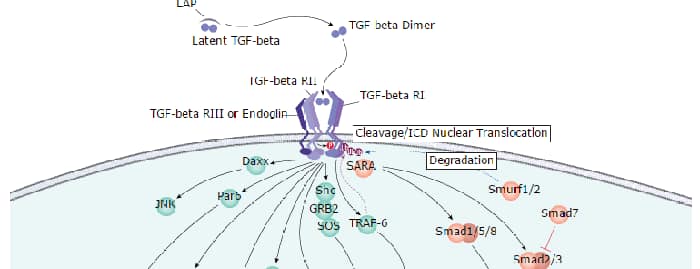
 TGF-beta Signaling Pathways
 VEGF - VEGF R2 Signaling Pathways
