
CCR7 Antibody
Novus Biologicals | Catalog # NB100-712

![Immunohistochemistry-Paraffin: CCR7 Antibody [NB100-712]](https://resources.rndsystems.com/images/products/CCR7-Antibody-Immunohistochemistry-Paraffin-NB100-712-img0006.jpg "Immunohistochemistry-Paraffin: CCR7 Antibody [NB100-712]")
Scientific images may be resized, cropped, or adjusted for brightness or contrast for presentation purposes. These updates are limited to presentation and do not affect the underlying scientific interpretation of the data. Where available, additional source data may be provided upon request.
Loading...
Key Product Details
Species Reactivity
Validated:
Human, Mouse, Rat
Cited:
Human, Mouse, Rat
Applications
Validated:
Immunohistochemistry, Immunohistochemistry-Paraffin, Immunohistochemistry-Frozen, Western Blot, ELISA, Flow Cytometry, Immunocytochemistry/ Immunofluorescence, In vivo assay
Cited:
Immunohistochemistry-Paraffin, Immunohistochemistry-Frozen, Flow Cytometry, Immunocytochemistry/ Immunofluorescence, In vivo assay, IF/IHC
Label
Unconjugated
Antibody Source
Polyclonal Goat IgG
Loading...
Product Specifications
Immunogen
Synthetic peptide: DPGKPRKNVLVVALLVIFQVC, corresponding to amino acids 2-22 of Mouse CCR7.
Reactivity Notes
Rat reactivity reported in scientific literature (PMID: 25831137), (25803728).
Localization
Integral membrane protein.
Specificity
Peptide sequence is 50 % identical to other mouse chemokine receptors in this region.
Clonality
Polyclonal
Host
Goat
Isotype
IgG
Theoretical MW
43 kDa.
Disclaimer note: The observed molecular weight of the protein may vary from the listed predicted molecular weight due to post translational modifications, post translation cleavages, relative charges, and other experimental factors.
Disclaimer note: The observed molecular weight of the protein may vary from the listed predicted molecular weight due to post translational modifications, post translation cleavages, relative charges, and other experimental factors.
Scientific Data Images for CCR7 Antibody
Immunohistochemistry-Paraffin: CCR7 Antibody [NB100-712]
CCR7-Antibody-Immunohistochemistry-Paraffin-NB100-712-img0006.jpg![Immunohistochemistry-Paraffin: CCR7 Antibody [NB100-712]](https://resources.rndsystems.com/images/products/CCR7-Antibody-Immunohistochemistry-Paraffin-NB100-712-img0001.jpg "Immunohistochemistry-Paraffin: CCR7 Antibody [NB100-712]")
Immunohistochemistry-Paraffin: CCR7 Antibody [NB100-712]
Immunohistochemistry-Paraffin: CCR7 Antibody [NB100-712] - Mouse spleen![Immunohistochemistry-Paraffin: CCR7 Antibody [NB100-712]](https://resources.rndsystems.com/images/products/CCR7-Antibody-Immunohistochemistry-Paraffin-NB100-712-img0004.jpg "Immunohistochemistry-Paraffin: CCR7 Antibody [NB100-712]")
Immunohistochemistry-Paraffin: CCR7 Antibody [NB100-712]
Immunohistochemistry-Paraffin: CCR7 Antibody [NB100-712] - Mouse spleen![Immunohistochemistry-Paraffin: CCR7 Antibody [NB100-712]](https://resources.rndsystems.com/images/products/CCR7-Antibody-Immunohistochemistry-Paraffin-NB100-712-img0005.jpg "Immunohistochemistry-Paraffin: CCR7 Antibody [NB100-712]")
Immunohistochemistry-Paraffin: CCR7 Antibody [NB100-712]
Immunohistochemistry-Paraffin: CCR7 Antibody [NB100-712] - Human spleen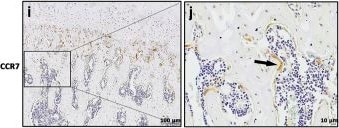
Immunohistochemistry: CCR7 Antibody [NB100-712] -
Immunohistochemistry: CCR7 Antibody [NB100-712] - M1 expression pattern changed in trabecular bone. Immunohistochemical staining was performed in sagittal serial sections of medial condyles from 6-week-old rats within the epiphyseal region. The region with the solid line indicates areas of interest to be enlarged in the following image. Representative staining with the anticluster of differentiation 68 (CD68) antibody demonstrated that CD68+ cells were either attached (black arrows) or unattached (white arrows) to the bone surfaces with a variety of sizes & shapes (a, b). TRAP+ cells showed multinucleated morphology (black arrows) which is similar to the CD68+ cells (c, d). Inducible nitric oxide synthase-positive (iNOS+) & C-C chemokine receptor type 7-positive (CCR7+) cells (black arrow) were attached to the bone surfaces with an elongated morphology (e, f, i, j). Arginase1+ & cluster of differentiation 163-positive (CD163+) cells (white arrow) represented the predominant population in the reticular connective tissue with similar expression patterns as in the cortical bone (g, h, k, l). No positive staining was found in isotype controls (data not shown). Most of the M1-labeled cells were found attached to bone surfaces instead of M2-labeled cells (m). Representative images from three independent experiments are shown. FOV, field of view. Data shown as the mean±s.d. (*P<0.05). Image collected & cropped by CiteAb from the following publication (https://pubmed.ncbi.nlm.nih.gov/29263936), licensed under a CC-BY license. Not internally tested by Novus Biologicals.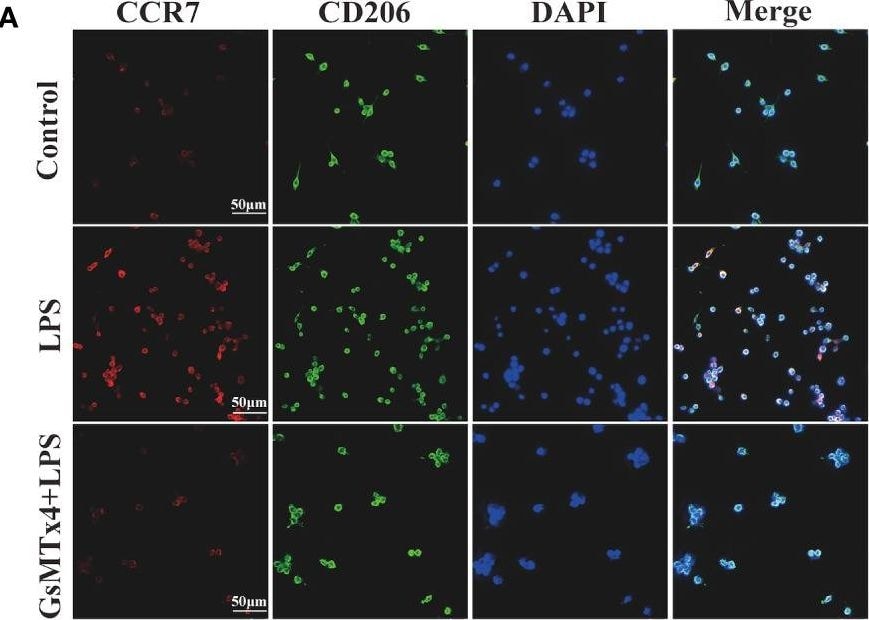
Immunocytochemistry/ Immunofluorescence: CCR7 Antibody [NB100-712] -
Immune response of macrophages after blocking Piezo1. (A) IF staining of CCR7 and CD206 in the Control, LPS and GsMTx4+LPS groups after 4-day-cultured. M1 macrophages were marked with CCR7 (red), M2 macrophages with CD206 (green), and nuclei with DAPI (blue). (B) Semi-quantitative analysis of CCR7 and CD163 in each group. (C) Flow cytometry analysis of RAW264. 7 cells in the Control, LPS and GsMTx4+LPS groups. Q6 represents M1 types (F4/80+/iNOS+) and Q10 represents M2 types (F4/80+/CD206+). (D) Expressions of Piezo1 and inflammation-related genes (Tnfa and Il1b) in macrophages cultured for 4 days. (E) Western blotting analysis of PIEZO1, IL-1B and TNF-A in RAW264. 7 cultured for 4 days. (F) Intracellular ROS levels of RAW264. 7 cultured for 4 days. (G) Concentration of inflammatory cytokines in macrophage medium detected by ELISA. *P < 0. 05; **P < 0. 01; ***P < 0. 001. Image collected and cropped by CiteAb from the following open publication (https://pubmed.ncbi.nlm.nih.gov/37261355), licensed under a CC-BY license. Not internally tested by Novus Biologicals.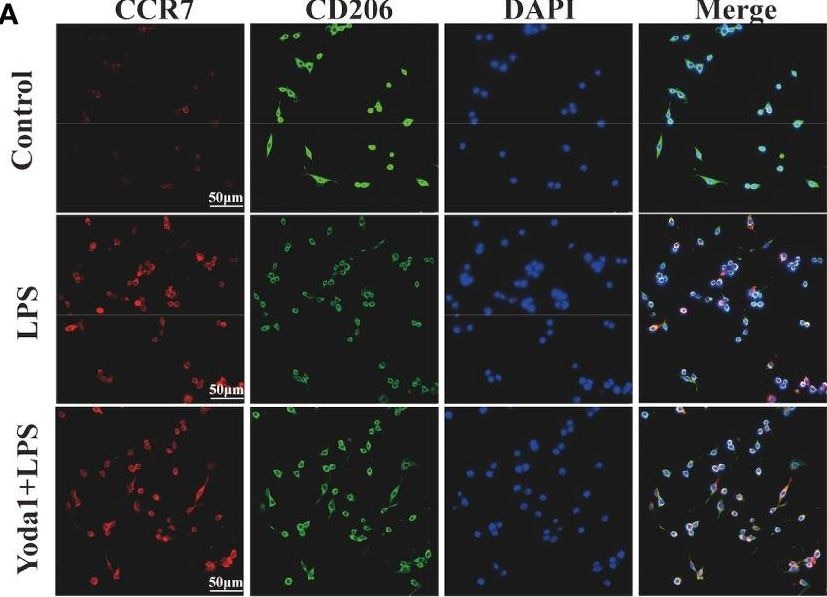
Immunocytochemistry/ Immunofluorescence: CCR7 Antibody [NB100-712] -
Immune response of macrophages after activating Piezo1. (A) IF staining of CCR7 and CD206 in the Control, LPS and Yoda1+LPS groups after 4-day-cultured. M1 macrophages were marked with CCR7 (red), M2 macrophages with CD206 (green), and nuclei with DAPI (blue). (B) Semi-quantitative analysis of CCR7 and CD206. (C) Flow cytometry analysis of RAW264. 7 cells in the Control, LPS and Yoda1+LPS groups. Q6 represents M1 types (F4/80+/iNOS+) and Q10 represents M2 types (F4/80+/CD206+). (D)Piezo1, Tnfa and Il1b genes expressions in macrophages cultured for 4 days. (E) Western blotting analysis of PIEZO1, TNF-A and IL-1B in RAW264. 7 cultured for 4 days. (F) Intracellular ROS levels of RAW264. 7 cultured for 4 days. (G) Concentration of inflammatory cytokines in macrophages medium detected by ELISA. *P < 0. 05; **P < 0. 01; ***P < 0. 001. Image collected and cropped by CiteAb from the following open publication (https://pubmed.ncbi.nlm.nih.gov/37261355), licensed under a CC-BY license. Not internally tested by Novus Biologicals.Applications for CCR7 Antibody
Application
Recommended Usage
ELISA
1:100000
Flow Cytometry
1:10
Immunocytochemistry/ Immunofluorescence
1:10-1:500
Immunohistochemistry
1:250
Immunohistochemistry-Frozen
1:250
Immunohistochemistry-Paraffin
1:250
Western Blot
1:1000
Application Notes
Use in ICC/IF reported in scintific literature (PMID: 29311580). Use in IHC-Frozen reported in scientific literature (PMID: 25803728). Use in In Vivo assays reported in scientific literature (PMID: 30541701).
Flow Cytometry Panel Builder
Bio-Techne Knows Flow Cytometry
Save time and reduce costly mistakes by quickly finding compatible reagents using the Panel Builder Tool.
Advanced Features
- Spectra Viewer - Custom analysis of spectra from multiple fluorochromes
- Spillover Popups - Visualize the spectra of individual fluorochromes
- Antigen Density Selector - Match fluorochrome brightness with antigen density

Formulation, Preparation, and Storage
Purification
Immunogen affinity purified
Formulation
10 mM KHPO4, 0.14 M NaCl, 1.0 mg/mL BSA
Preservative
0.1% Sodium Azide
Concentration
Please see the vial label for concentration. If unlisted please contact technical services.
Shipping
The product is shipped with polar packs. Upon receipt, store it immediately at the temperature recommended below.
Stability & Storage
Aliquot and store at -20C or -80C. Avoid freeze-thaw cycles.
Background: CCR7
The primary role of the CCR7/CCL19/CCL21 chemokine signaling axis is homing T cells and DCs to lymph nodes and lymphoid tissues to initiate an immune response (1,2,5,6). In the context of cancer, the CCR7 signaling axis appears to have two opposing roles (2). Downregulation of CCR7 on CD8+ T cells contributes to effector cell migration and anti-cancer activities via cytotoxic tumor-infiltrating lymphocytes (2). However, upregulation of CCR7 by cancer cells can result in cancer cell migration and metastasis (2). Overexpression of CCR7 has been implicated in a variety of cancers including breast, cervical, gastric, head and neck cell carcinoma, and prostate (1,2,7). Studies in breast cancer have found that hypoxia increases CCR7 expression, and this activation can affect cancer cell invasion, extravasation, proliferation, angiogenesis, and metastasis through induction of multiple signaling transduction pathways such as PI3K/AKT, MAPK, and JAK/STAT (5,7).
Given its important role in inflammation and immune response, several strategies have been employed to target the CCR7 signaling axis for cancer immunotherapy (2). Some cancer immunotherapies under investigation include intra-tumoral administration of CCL19 and CCL21, introduction of patient-derived cells transfected to express CCR7 or its ligands, and vaccines (2). Further interrogation of CCR7/CCL19/CCL21 signaling axis is required to develop better therapeutic strategies for cancer treatment.
References:
1. Comerford, I., Harata-Lee, Y., Bunting, M. D., Gregor, C., Kara, E. E., & McColl, S. R. (2013). A myriad of functions and complex regulation of the CCR7/CCL19/CCL21 chemokine axis in the adaptive immune system. Cytokine & growth factor reviews, 24(3), 269-283. https://doi.org/10.1016/j.cytogfr.2013.03.001
2. Salem, A., Alotaibi, M., Mroueh, R., Basheer, H. A., & Afarinkia, K. (2021). CCR7 as a therapeutic target in Cancer. Biochimica et biophysica acta. Reviews on cancer, 1875(1), 188499. https://doi.org/10.1016/j.bbcan.2020.188499
3. Yan, Y., Chen, R., Wang, X., Hu, K., Huang, L., Lu, M., & Hu, Q. (2019). CCL19 and CCR7 Expression, Signaling Pathways, and Adjuvant Functions in Viral Infection and Prevention. Frontiers in cell and developmental biology, 7, 212. https://doi.org/10.3389/fcell.2019.00212
4. Uniprot (P32248)
5. Korbecki, J., Grochans, S., Gutowska, I., Barczak, K., & Baranowska-Bosiacka, I. (2020). CC Chemokines in a Tumor: A Review of Pro-Cancer and Anti-Cancer Properties of Receptors CCR5, CCR6, CCR7, CCR8, CCR9, and CCR10 Ligands. International journal of molecular sciences, 21(20), 7619. https://doi.org/10.3390/ijms21207619
6. Sanchez-Sanchez, N., Riol-Blanco, L., & Rodriguez-Fernandez, J. L. (2006). The multiple personalities of the chemokine receptor CCR7 in dendritic cells. Journal of immunology (Baltimore, Md. : 1950), 176(9), 5153-5159. https://doi.org/10.4049/jimmunol.176.9.5153
7. Rizeq, B., & Malki, M. I. (2020). The Role of CCL21/CCR7 Chemokine Axis in Breast Cancer Progression. Cancers, 12(4), 1036. https://doi.org/10.3390/cancers12041036
Alternate Names
BLR2, CC-CKR-7, CCR7, CD197, CDw197, CMKBR7, EBI1
Gene Symbol
CCR7
UniProt
Additional CCR7 Products
Product Documents for CCR7 Antibody
Certificate of Analysis
To download a Certificate of Analysis, please enter a lot or batch number in the search box below.
Product Specific Notices for CCR7 Antibody
This product is for research use only and is not approved for use in humans or in clinical diagnosis. Primary Antibodies are guaranteed for 1 year from date of receipt.
Citations for CCR7 Antibody
 Powered by Bioz
Customer Reviews for CCR7 Antibody
There are currently no reviews for this product. Be the first to review CCR7 Antibody and earn rewards!
Have you used CCR7 Antibody?
Submit a review and receive an Amazon gift card!
$25/€18/£15/$25CAN/¥2500 for a review with an image
$10/€7/£6/$10CAN/¥1110 for a review without an image
Submit a review
Protocols
Find general support by application which include: protocols, troubleshooting, illustrated assays, videos and webinars.
- 7-Amino Actinomycin D (7-AAD) Cell Viability Flow Cytometry Protocol
- Antigen Retrieval Protocol (PIER)
- Antigen Retrieval for Frozen Sections Protocol
- Appropriate Fixation of IHC/ICC Samples
- Cellular Response to Hypoxia Protocols
- Chromogenic IHC Staining of Formalin-Fixed Paraffin-Embedded (FFPE) Tissue Protocol
- Chromogenic Immunohistochemistry Staining of Frozen Tissue
- ClariTSA™ Fluorophore Kits
- Detection & Visualization of Antibody Binding
- ELISA Sample Preparation & Collection Guide
- ELISA Troubleshooting Guide
- Extracellular Membrane Flow Cytometry Protocol
- Flow Cytometry Protocol for Cell Surface Markers
- Flow Cytometry Protocol for Staining Membrane Associated Proteins
- Flow Cytometry Staining Protocols
- Flow Cytometry Troubleshooting Guide
- Fluorescent IHC Staining of Frozen Tissue Protocol
- Graphic Protocol for Heat-induced Epitope Retrieval
- Graphic Protocol for the Preparation and Fluorescent IHC Staining of Frozen Tissue Sections
- Graphic Protocol for the Preparation and Fluorescent IHC Staining of Paraffin-embedded Tissue Sections
- Graphic Protocol for the Preparation of Gelatin-coated Slides for Histological Tissue Sections
- How to Run an R&D Systems DuoSet ELISA
- How to Run an R&D Systems Quantikine ELISA
- How to Run an R&D Systems Quantikine™ QuicKit™ ELISA
- ICC Cell Smear Protocol for Suspension Cells
- ICC Immunocytochemistry Protocol Videos
- ICC for Adherent Cells
- IHC Sample Preparation (Frozen sections vs Paraffin)
- Immunocytochemistry (ICC) Protocol
- Immunocytochemistry Troubleshooting
- Immunofluorescence of Organoids Embedded in Cultrex Basement Membrane Extract
- Immunofluorescent IHC Staining of Formalin-Fixed Paraffin-Embedded (FFPE) Tissue Protocol
- Immunohistochemistry (IHC) and Immunocytochemistry (ICC) Protocols
- Immunohistochemistry Frozen Troubleshooting
- Immunohistochemistry Paraffin Troubleshooting
- Intracellular Flow Cytometry Protocol Using Alcohol (Methanol)
- Intracellular Flow Cytometry Protocol Using Detergents
- Intracellular Nuclear Staining Flow Cytometry Protocol Using Detergents
- Intracellular Staining Flow Cytometry Protocol Using Alcohol Permeabilization
- Intracellular Staining Flow Cytometry Protocol Using Detergents to Permeabilize Cells
- Preparing Samples for IHC/ICC Experiments
- Preventing Non-Specific Staining (Non-Specific Binding)
- Primary Antibody Selection & Optimization
- Propidium Iodide Cell Viability Flow Cytometry Protocol
- Protocol for Heat-Induced Epitope Retrieval (HIER)
- Protocol for Liperfluo
- Protocol for Making a 4% Formaldehyde Solution in PBS
- Protocol for VisUCyte™ HRP Polymer Detection Reagent
- Protocol for the Characterization of Human Th22 Cells
- Protocol for the Characterization of Human Th9 Cells
- Protocol for the Fluorescent ICC Staining of Cell Smears - Graphic
- Protocol for the Fluorescent ICC Staining of Cultured Cells on Coverslips - Graphic
- Protocol for the Preparation & Fixation of Cells on Coverslips
- Protocol for the Preparation and Chromogenic IHC Staining of Frozen Tissue Sections
- Protocol for the Preparation and Chromogenic IHC Staining of Frozen Tissue Sections - Graphic
- Protocol for the Preparation and Chromogenic IHC Staining of Paraffin-embedded Tissue Sections
- Protocol for the Preparation and Chromogenic IHC Staining of Paraffin-embedded Tissue Sections - Graphic
- Protocol for the Preparation and Fluorescent ICC Staining of Cells on Coverslips
- Protocol for the Preparation and Fluorescent ICC Staining of Non-adherent Cells
- Protocol for the Preparation and Fluorescent ICC Staining of Stem Cells on Coverslips
- Protocol for the Preparation and Fluorescent IHC Staining of Frozen Tissue Sections
- Protocol for the Preparation and Fluorescent IHC Staining of Paraffin-embedded Tissue Sections
- Protocol for the Preparation of Gelatin-coated Slides for Histological Tissue Sections
- Protocol for the Preparation of a Cell Smear for Non-adherent Cell ICC - Graphic
- Protocol: Annexin V and PI Staining by Flow Cytometry
- Protocol: Annexin V and PI Staining for Apoptosis by Flow Cytometry
- Quantikine HS ELISA Kit Assay Principle, Alkaline Phosphatase
- Quantikine HS ELISA Kit Principle, Streptavidin-HRP Polymer
- R&D Systems Quality Control Western Blot Protocol
- Sandwich ELISA (Colorimetric) – Biotin/Streptavidin Detection Protocol
- Sandwich ELISA (Colorimetric) – Direct Detection Protocol
- TUNEL and Active Caspase-3 Detection by IHC/ICC Protocol
- The Importance of IHC/ICC Controls
- Troubleshooting Guide: ELISA
- Troubleshooting Guide: Fluorokine Flow Cytometry Kits
- Troubleshooting Guide: Immunohistochemistry
- Troubleshooting Guide: Western Blot Figures
- Western Blot Conditions
- Western Blot Protocol
- Western Blot Protocol for Cell Lysates
- Western Blot Troubleshooting
- Western Blot Troubleshooting Guide
- View all Protocols, Troubleshooting, Illustrated assays and Webinars
FAQs for CCR7 Antibody
Showing
1
-
3 of
3 FAQs
Showing All
-
Q: Does this product require specific antigen retrieval? I wonder if you tested the different antigen retrieval buffers and you can tell which one I should use?
A:
We recommend antigen retrieval for all of our products. We recommend citrate buffer at a pH of 6.0. Here is a link to our antigen retrieval protocol.
-
Q: I am curious about the isotype for product CCR7 Antibody (NB100-712).
A: NB100-712 is a goat polyclonal and it will be a mixture of isotypes.
-
Q: Is there a way to get this antibody without sodium azide?
A:
We unfortunately do not offer our NB100-712 without sodium azide. We do offer antibody clarification kits that will remove sodium azide.
-
Q: Does this product require specific antigen retrieval? I wonder if you tested the different antigen retrieval buffers and you can tell which one I should use?
A:
We recommend antigen retrieval for all of our products. We recommend citrate buffer at a pH of 6.0. Here is a link to our antigen retrieval protocol.
-
Q: I am curious about the isotype for product CCR7 Antibody (NB100-712).
A: NB100-712 is a goat polyclonal and it will be a mixture of isotypes.
-
Q: Is there a way to get this antibody without sodium azide?
A:
We unfortunately do not offer our NB100-712 without sodium azide. We do offer antibody clarification kits that will remove sodium azide.
-
Q: Does this product require specific antigen retrieval? I wonder if you tested the different antigen retrieval buffers and you can tell which one I should use?
A:
We recommend antigen retrieval for all of our products. We recommend citrate buffer at a pH of 6.0. Here is a link to our antigen retrieval protocol.
-
Q: I am curious about the isotype for product CCR7 Antibody (NB100-712).
A: NB100-712 is a goat polyclonal and it will be a mixture of isotypes.
-
Q: Is there a way to get this antibody without sodium azide?
A:
We unfortunately do not offer our NB100-712 without sodium azide. We do offer antibody clarification kits that will remove sodium azide.


