

Key Product Details

Species Reactivity

Validated:

Human

Cited:

Human

Applications

Validated:

Immunohistochemistry, Western Blot

Cited:

Bioassay

Label

Biotin

Antibody Source

Polyclonal Sheep IgG
Loading...

Product Specifications

Immunogen

Mouse myeloma cell line NS0-derived recombinant human C‑Reactive Protein/CRP
Phe17-Pro224
Accession # P02741

Specificity

Detects C‑Reactive Protein/CRP in Western blots. In Western blots, approximately 20% cross-reactivity with recombinant mouse CRP is observed and 1% cross-reactivity with recombinant rat CRP is observed.

Clonality

Polyclonal

Host

Sheep

Isotype

IgG

Scientific Data Images for Human C‑Reactive Protein/CRP Biotinylated Antibody

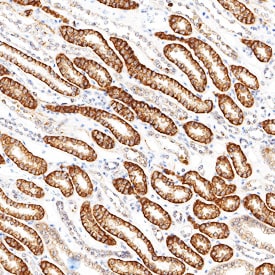
C‑Reactive Protein/CRP in Human Kidney.

C‑Reactive Protein/CRP was detected in immersion fixed paraffin-embedded sections of human kidney using Sheep Anti-Human C‑Reactive Protein/CRP Biotinylated Antigen Affinity-purified Polyclonal Antibody (Catalog # BAF1707) at 5 µg/mL for 1 hour at room temperature followed by incubation with the Anti-Sheep IgG VisUCyte™ HRP Polymer Antibody (VC006). Before incubation with the primary antibody, tissue was subjected to heat-induced epitope retrieval using Antigen Retrieval Reagent-Basic (CTS013). Tissue was stained using DAB (brown) and counterstained with hematoxylin (blue). Specific staining was localized to cytoplasm in convoluted tubules. Staining was performed using our protocol for IHC Staining with VisUCyte HRP Polymer Detection Reagents.

Applications for Human C‑Reactive Protein/CRP Biotinylated Antibody

Application
Recommended Usage

Immunohistochemistry

5-15 µg/mL
Sample: Immersion fixed paraffin-embedded sections of human kidney

Western Blot

0.1 µg/mL
Sample: Recombinant Human C-Reactive Protein/CRP (Catalog # 1707-CR)

Formulation, Preparation, and Storage

Purification

Antigen Affinity-purified

Reconstitution

Reconstitute at 0.2 mg/mL in sterile PBS.


Loading...

Formulation

Lyophilized from a 0.2 μm filtered solution in PBS with BSA as a carrier protein.

Shipping

The product is shipped at ambient temperature. Upon receipt, store it immediately at the temperature recommended below.

Stability & Storage

Use a manual defrost freezer and avoid repeated freeze-thaw cycles.
  • 12 months from date of receipt, -20 to -70 °C as supplied.
  • 1 month, 2 to 8 °C under sterile conditions after reconstitution.
  • 6 months, -20 to -70 °C under sterile conditions after reconstitution.

Calculators

The reconstitution calculator allows you to quickly calculate the volume of a reagent to reconstitute your vial. Simply enter the mass of reagent and the target concentration and the calculator will determine the rest.

=
÷

Background: C-Reactive Protein/CRP

CRP is a member of the pentraxin family of proteins that are characterized by a cyclic pentameric structure. Human CRP gene encodes a 224 amino acids precursor. The mature human CRP protein has 206 amino acids that are non-covalently linked to form the pentameter. Human CRP shares 71% and 64% amino acid sequence homology with mouse and rat respectively.

CRP, synthesized by hepatocytes, is a major acute phase serum protein in human. IL-6, IL-1 and glucocorticoids are the major inducer of the CRP gene. In response to infection, inflammation or tissue damage, the level of CRP in human serum can increase 1,000-fold within 24‑48 hours. It will come back to base level of less than 1 μg/mL very fast. Human CRP is an acute-phase serum protein that plays a role in the first line in host innate host defense. Like other pentraxins, CRP exhibits Ca++ - dependent binding to ligands. Phosphocholine (PCh), a constituent of many bacterial and fungal walls, is a principal ligand of CRP. CRP also binds to the membrane of injured cells, membrane and nuclear components of necrotic and apoptotic cells. Upon binding with the ligands, CRP is recognized by C1q and initiates the activation of complement cascade. Ligand bound CRP also binds to Fc gamma RI and Fc gamma RIIa on phagocytes and activates phogocytotic responses. In addition to phogocytosis, CRP also can induce production of hydrogen peroxide and inflammatory cytokines, such as IL-1, IL-6 and TNF‑ alpha  by monocytes. With these functions, human CRP is an important serum protein for anti-bacterial pathogen and clearance of damaged and apoptotic cells. However, in mouse, CRP is expressed at very low level and is not an acute phase reactant. Serum amyloid P component (SAP), another pentraxin, is the major acute phase serum protein in mice. It has been shown that high levels of CRP in humans is associated with an increased risk of cardiovascular diseases.

References

  1. Gotschlich, E.C. and G.M. Edelman (1965) Proc. Natl. Acad. Sci. USA 54:558.
  2. Volanakis, J.E. (2001) Molecular Immunology 38:189.
  3. Bharadwaj, D. et al. (1999) J. Experimental Medicine 190:585.
  4. Ballou S.P. and G. Lozanski (1992) Cytokine 4:361.
  5. Danesh, J. et al. (2004) N. Engl. J. Med. 350:1387.

Alternate Names

CRP

Entrez Gene IDs

1401 (Human); 12944 (Mouse); 25419 (Rat)

Gene Symbol

CRP

UniProt

Additional C-Reactive Protein/CRP Products

Product Documents for Human C‑Reactive Protein/CRP Biotinylated Antibody

Certificate of Analysis

To download a Certificate of Analysis, please enter a lot or batch number in the search box below.

Note: Certificate of Analysis not available for kit components.

Product Specific Notices for Human C‑Reactive Protein/CRP Biotinylated Antibody

For research use only

Citations for Human C‑Reactive Protein/CRP Biotinylated Antibody

Customer Reviews for Human C‑Reactive Protein/CRP Biotinylated Antibody

There are currently no reviews for this product. Be the first to review Human C‑Reactive Protein/CRP Biotinylated Antibody and earn rewards!

Have you used Human C‑Reactive Protein/CRP Biotinylated Antibody?

Submit a review and receive an Amazon gift card!

$25/€18/£15/$25CAN/¥2500 Yen for a review with an image

$10/€7/£6/$10CAN/¥1110 Yen for a review without an image

Submit a review
Amazon Gift Card

Protocols

Find general support by application which include: protocols, troubleshooting, illustrated assays, videos and webinars.

FAQs

No product specific FAQs exist for this product.

View all FAQs for Antibodies
Loading...
