
CCL22, also named stimulated T cell chemotactic protein (STCP-1), is a CC chemokine initially isolated from clones of monocyte-derived macrophages. Human CCL22 cDNA encodes a precursor protein of 93 amino acid residues with a 24 amino acid residue predicted signal peptide that is cleaved to yield a 69 amino acid residue mature 8 kDa protein. At the amino acid sequence level, CCL22 shows less than 35% identity to other CC chemokine family members. Human CCL22 is expressed in dendritic cells, macrophages and activated monocytes. In addition, CCL22 expression is also detected in the tissues of thymus, lymph node and appendix. The gene for human CCL22 has been mapped to chromosome 16 rather than chromosome 17 where the genes for many human CC chemokines are clustered. Recombinant or chemically synthesized mature CCL22 has been shown to induce chemotaxis or Ca2+ mobilization in dendritic cells, IL-2 activated NK cells, and activated T lymphocytes. A CD8+ T lymphocyte-derived secreted soluble activity that suppresses infection by primary non-syncytium-inducing and syncytium-inducing HIV-1 isolates and the T cell line-adapted isolate HIV-1IIIB, has been identified as CCL22. Based on amino-terminal sequence analysis, the major CD8+ T lymphocyte-derived CCL22 protein yielded an amino-terminal sequence of YGANM, which is two amino acid residues shorter than the predicted mature CCL22. The difference in potency between the two mature CCL22 isoforms has not been determined.


Scientific images may be resized, cropped, or adjusted for brightness or contrast for presentation purposes. These updates are limited to presentation and do not affect the underlying scientific interpretation of the data. Where available, additional source data may be provided upon request.
Key Product Details
Species Reactivity
Validated:
Cited:
Applications
Validated:
Cited:
Label
Antibody Source
Product Specifications
Immunogen
Gly25-Gln93
Accession # O00626
Specificity
Clonality
Host
Isotype
Endotoxin Level
Scientific Data Images for Human CCL22/MDC Antibody
Chemotaxis Induced by CCL22/MDC and Neutralization by Human CCL22/MDC Antibody.
Recombinant Human CCL22/MDC (Catalog # 336-MD) chemoattracts the BaF3 mouse pro-B cell line transfected with human CCR4 in a dose-dependent manner (orange line). The amount of cells that migrated through to the lower chemotaxis chamber was measured by Resazurin (Catalog # AR002). Chemotaxis elicited by Recombinant Human CCL22/MDC (0.03 µg/mL) is neutralized (green line) by increasing concentrations of Chicken Anti-Human CCL22/MDC Antigen Affinity-purified Polyclonal Antibody (Catalog # AF336). The ND50 is typically 0.4-2.0 µg/mL.
Human CCL22 / MDC ELISA Standard Curve
Recombinant Human CCL22/MDC (Catalog # 336-MD) was serially diluted and captured by Mouse Anti-Human CCL22/MDC Monoclonal Antibody (Catalog # MAB336) coated on a Clear Polystyrene Microplate (Catalog # DY990). Chicken Anti-Human CCL22/MDC Antigen Affinity-purified Polyclonal Antibody (Catalog # AF336) was biotinylated and incubated with the protein captured on the plate. Detection of the standard curve was achieved by incubating Streptavidin-HRP (Catalog # DY998)Applications for Human CCL22/MDC Antibody
Western Blot
Sample: Recombinant Human CCL22/MDC (Catalog # 336-MD)
Neutralization
Reviewed Applications
Read 1 review rated 3 using AF336 in the following applications:
Formulation, Preparation, and Storage
Purification
Reconstitution
Reconstitute at 0.2 mg/mL in sterile PBS. For liquid material, refer to CoA for concentration.
Formulation
Shipping
Stability & Storage
- 12 months from date of receipt, -20 to -70 °C as supplied.
- 1 month, 2 to 8 °C under sterile conditions after reconstitution.
- 6 months, -20 to -70 °C under sterile conditions after reconstitution.
Calculators
Background: CCL22/MDC
Alternate Names
Gene Symbol
UniProt
Additional CCL22/MDC Products
Product Documents for Human CCL22/MDC Antibody
Certificate of Analysis
To download a Certificate of Analysis, please enter a lot or batch number in the search box below.
Note: Certificate of Analysis not available for kit components.
Product Specific Notices for Human CCL22/MDC Antibody
For research use only
Citations for Human CCL22/MDC Antibody
 Powered by Bioz
Customer Reviews for Human CCL22/MDC Antibody (1)
Have you used Human CCL22/MDC Antibody?
Submit a review and receive an Amazon gift card!
$25/€18/£15/$25CAN/¥2500 for a review with an image
$10/€7/£6/$10CAN/¥1110 for a review without an image
Submit a review
Customer Images
-
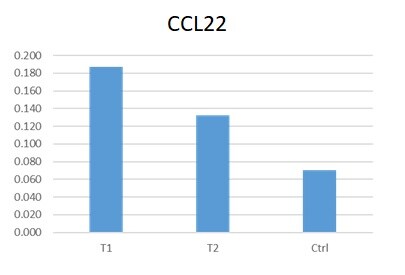
Application: ELISASample Tested: Serum and PlasmaSpecies: HumanVerified Customer | Posted 06/09/2020We used this antibody in an in-house ELISA along with mAb (336) and protein standard (336-MD) to quantify CCL22 in human serum and plasma. This combination could not detect CCL22 in our samples but generated a good standard curve.

There are no reviews that match your criteria.
Protocols
Find general support by application which include: protocols, troubleshooting, illustrated assays, videos and webinars.
- Cellular Response to Hypoxia Protocols
- R&D Systems Quality Control Western Blot Protocol
- Troubleshooting Guide: Western Blot Figures
- Western Blot Conditions
- Western Blot Protocol
- Western Blot Protocol for Cell Lysates
- Western Blot Troubleshooting
- Western Blot Troubleshooting Guide
- View all Protocols, Troubleshooting, Illustrated assays and Webinars
Associated Pathways

