
Human Contactin-1 Antibody (2332B)
R&D Systems | Catalog # MAB9041
Recombinant Monoclonal Antibody.

Key Product Details
Species Reactivity
Validated:
Human
Cited:
Human
Applications
Validated:
Western Blot
Cited:
Western Blot
Label
Unconjugated
Antibody Source
Recombinant Monoclonal Rabbit IgG Clone # 2332B
Loading...
Product Specifications
Immunogen
Human embryonic kidney cell, HEK293-derived human Contactin-1
Met1-Ser993
Accession # Q12860
Met1-Ser993
Accession # Q12860
Specificity
Detects human Contactin-1 in direct ELISAs.
Clonality
Monoclonal
Host
Rabbit
Isotype
IgG
Scientific Data Images for Human Contactin-1 Antibody (2332B)
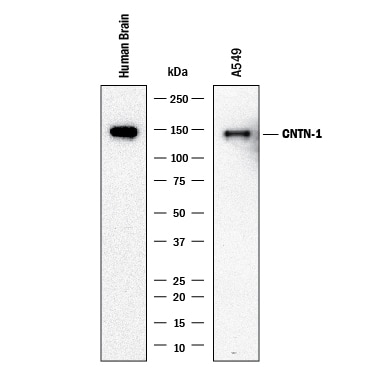
Detection of Human Contactin‑1 by Western Blot.
Western blot shows lysates of human brain tissue and A549 human lung carcinoma cell line. PVDF membrane was probed with 2 µg/mL of Rabbit Anti-Human Contactin-1 Monoclonal Antibody (Catalog # MAB9041) followed by HRP-conjugated Anti-Rabbit IgG Secondary Antibody (Catalog # HAF008). A specific band was detected for Contactin-1 at approximately 135 kDa (as indicated). This experiment was conducted under reducing conditions and using Immunoblot Buffer Group 1.Applications for Human Contactin-1 Antibody (2332B)
Application
Recommended Usage
Western Blot
2 µg/mL
Sample: Human brain tissue and A549 human lung carcinoma cell line
Sample: Human brain tissue and A549 human lung carcinoma cell line
Reviewed Applications
Read 1 review rated 5 using MAB9041 in the following applications:
Formulation, Preparation, and Storage
Purification
Protein A or G purified from hybridoma culture supernatant
Reconstitution
Reconstitute at 0.5 mg/mL in sterile PBS. For liquid material, refer to CoA for concentration.
Loading...
Formulation
Lyophilized from a 0.2 μm filtered solution in PBS with Trehalose. *Small pack size (SP) is supplied either lyophilized or as a 0.2 µm filtered solution in PBS.
Shipping
Lyophilized product is shipped at ambient temperature. Liquid small pack size (-SP) is shipped with polar packs. Upon receipt, store immediately at the temperature recommended below.
Stability & Storage
Use a manual defrost freezer and avoid repeated freeze-thaw cycles.
- 12 months from date of receipt, -20 to -70 °C as supplied.
- 1 month, 2 to 8 °C under sterile conditions after reconstitution.
- 6 months, -20 to -70 °C under sterile conditions after reconstitution.
Calculators
Background: Contactin-1
Alternate Names
CNTN1, Contactin1, F11, F3cam
Gene Symbol
CNTN1
UniProt
Additional Contactin-1 Products
Product Documents for Human Contactin-1 Antibody (2332B)
Certificate of Analysis
To download a Certificate of Analysis, please enter a lot or batch number in the search box below.
Note: Certificate of Analysis not available for kit components.
Product Specific Notices for Human Contactin-1 Antibody (2332B)
For research use only
Related Research Areas
Citations for Human Contactin-1 Antibody (2332B)
 Powered by Bioz
Customer Reviews for Human Contactin-1 Antibody (2332B) (1)
5 out of 5
1 Customer Rating
Have you used Human Contactin-1 Antibody (2332B)?
Submit a review and receive an Amazon gift card!
$25/€18/£15/$25CAN/¥2500 for a review with an image
$10/€7/£6/$10CAN/¥1110 for a review without an image
Submit a review
Customer Images

Showing
1
-
1 of
1 review
Showing All
Filter By:
-
Application: ELISASample Tested: Serum and PlasmaSpecies: HumanVerified Customer | Posted 07/05/2022works well for ELISA

There are no reviews that match your criteria.
Protocols
Find general support by application which include: protocols, troubleshooting, illustrated assays, videos and webinars.
- Cellular Response to Hypoxia Protocols
- R&D Systems Quality Control Western Blot Protocol
- Troubleshooting Guide: Western Blot Figures
- Western Blot Conditions
- Western Blot Protocol
- Western Blot Protocol for Cell Lysates
- Western Blot Troubleshooting
- Western Blot Troubleshooting Guide
- View all Protocols, Troubleshooting, Illustrated assays and Webinars
Loading...
Associated Pathways
