
CXCR6, also known as Bonzo and STRL33, is a G protein coupled chemokine receptor expressed on activated T cells and tumor-infiltrating lymphocytes. It binds soluble CXCL16 and membrane-anchored CXCL16 expressed on dendritic cells and macrophages.
Human CXCR6 Antibody (56811) [APC]
R&D Systems | Catalog # FAB699A
Clone 56811 was used by HLDA to establish CD designation

Scientific images may be resized, cropped, or adjusted for brightness or contrast for presentation purposes. These updates are limited to presentation and do not affect the underlying scientific interpretation of the data. Where available, additional source data may be provided upon request.
Key Product Details
Validated by
Biological Validation
Species Reactivity
Validated:
Human
Cited:
Human
Applications
Validated:
Flow Cytometry
Cited:
Immunohistochemistry-Paraffin, Flow Cytometry
Label
Allophycocyanin (Excitation = 620-650 nm, Emission = 660-670 nm)
Antibody Source
Monoclonal Mouse IgG2B Clone # 56811
Loading...
Product Specifications
Immunogen
NS0 mouse myeloma cell line transfected with human CXCR6
Met1-Leu342
Accession # O00574
Met1-Leu342
Accession # O00574
Specificity
Stains human CXCR6 transfectants but not irrelevant transfectants.
Clonality
Monoclonal
Host
Mouse
Isotype
IgG2B
Scientific Data Images for Human CXCR6 Antibody (56811) [APC]
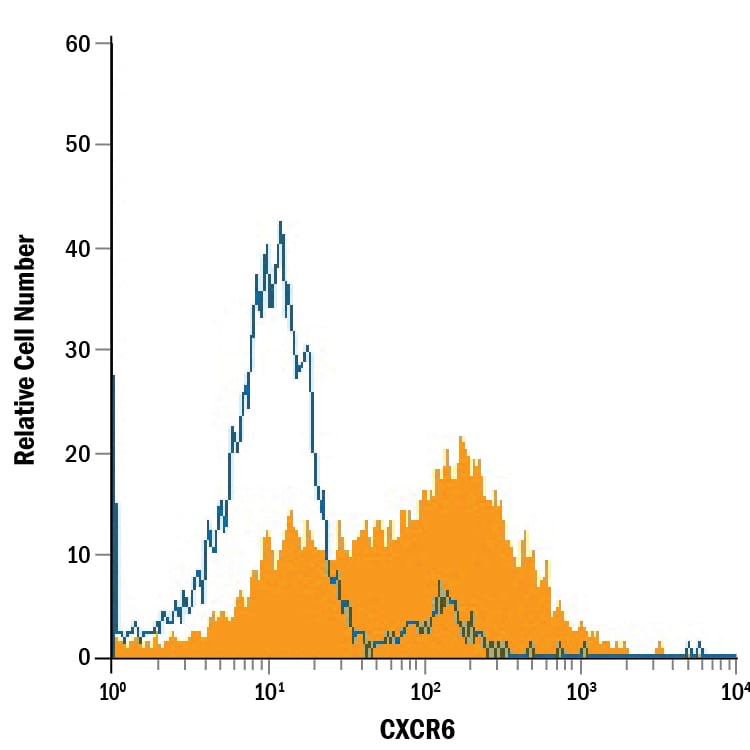
Detection of CXCR6 in HEK293 Human Cell Line Transfected with Human CXCR6 by Flow Cytometry.
HEK293 human embryonic kidney cell line transfected with human CXCR6 was stained with Mouse Anti-Human CXCR6 APC-conjugated Monoclonal Antibody (Catalog # FAB699A, filled histogram) or isotype control antibody (Catalog # IC0041A, open histogram). View our protocol for Staining Membrane-associated Proteins.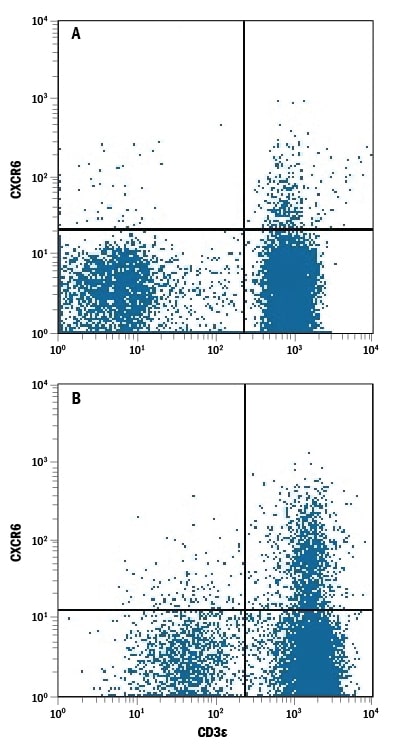
Detection of CXCR6 in Human PBMCs by Flow Cytometry.
Human peripheral blood mononuclear cells (PBMCs) either (A) untreated or (B) treated with 20 ng/mL Recombinant Human IL-2 (Catalog # 202-IL) for 9 days were stained with Mouse Anti-Human CXCR6 APC-conjugated Monoclonal Antibody (Catalog # FAB699A) and Mouse Anti-Human CD3e PE-conjugated Monoclonal Antibody (Catalog # FAB100P). Quadrant markers were set based on control antibody staining (Catalog # IC0041A). View our protocol for Staining Membrane-associated Proteins.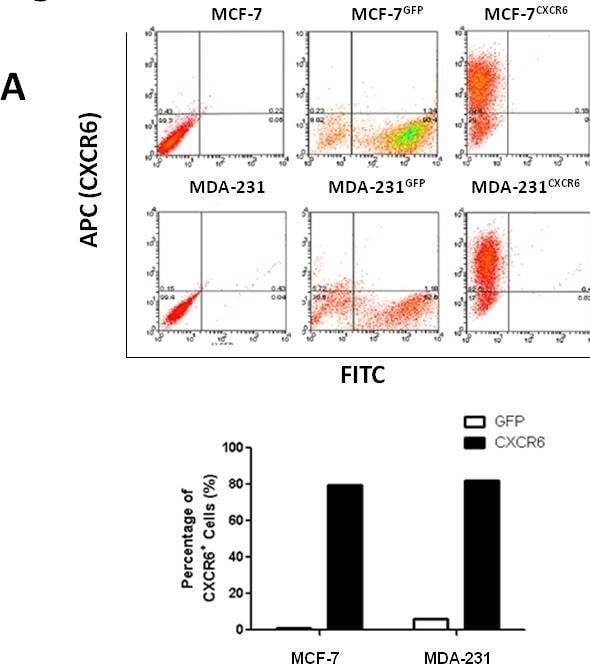
Detection of CXCR6 by Flow Cytometry
CXCR6 promotes BC cells migration and invasionA) CXCR6 was overexpressed in MCF-7 and MDA-231 BC cells by lentiviral system. CXCR6 -positive cells were then sorted by flow cytometry. Histogram displays the ratio of CXCR6 positive expression of MCF-7CXCR6, MDA-231CXCR6 and their respective control cells. B) Scratch wound healing assay shows that overexpression of CXCR6 enhanced cell migration in MDA-231 cells, but not very significant in MCF-7 cells. C) Matrigel invasion assay showed that overexpression of CXCR6 significantly enhanced cell invasion in both MCF-7 and MDA-231 cells (***P < 0.001). Experiments were performed 3 times; representative images of invaded cells are shown. Mean ± SD. D) Cytometry analysis showed CXCR6 had no effect on cell cycle. Image collected and cropped by CiteAb from the following open publication (https://pubmed.ncbi.nlm.nih.gov/25909173), licensed under a CC-BY license. Not internally tested by R&D Systems.Applications for Human CXCR6 Antibody (56811) [APC]
Application
Recommended Usage
Flow Cytometry
10 µL/106 cells
Sample: HEK293 human embryonic kidney cell line transfected with human CXCR6 and human peripheral blood mononuclear cells (PBMCs) treated with Recombinant Human IL‑2 (Catalog # 202-IL)
Sample: HEK293 human embryonic kidney cell line transfected with human CXCR6 and human peripheral blood mononuclear cells (PBMCs) treated with Recombinant Human IL‑2 (Catalog # 202-IL)
Reviewed Applications
Read 4 reviews rated 4.5 using FAB699A in the following applications:
Spectra Viewer
Plan Your Experiments
Use our spectra viewer to interactively plan your experiments, assessing multiplexing options. View the excitation and emission spectra for our fluorescent dye range and other commonly used dyes.
Spectra Viewer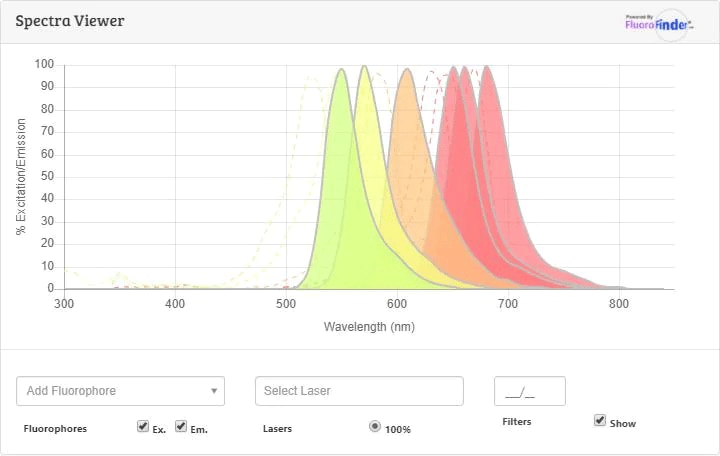
Flow Cytometry Panel Builder
Bio-Techne Knows Flow Cytometry
Save time and reduce costly mistakes by quickly finding compatible reagents using the Panel Builder Tool.
Advanced Features
- Spectra Viewer - Custom analysis of spectra from multiple fluorochromes
- Spillover Popups - Visualize the spectra of individual fluorochromes
- Antigen Density Selector - Match fluorochrome brightness with antigen density

Formulation, Preparation, and Storage
Purification
Protein A or G purified from ascites
Formulation
Supplied in a saline solution containing BSA and Sodium Azide.
Shipping
The product is shipped with polar packs. Upon receipt, store it immediately at the temperature recommended below.
Stability & Storage
Protect from light. Do not freeze.
- 12 months from date of receipt, 2 to 8 °C as supplied.
Background: CXCR6
Alternate Names
Bonzo, CD186, CXCR6, STRL33
Gene Symbol
CXCR6
UniProt
Additional CXCR6 Products
Product Documents for Human CXCR6 Antibody (56811) [APC]
Certificate of Analysis
To download a Certificate of Analysis, please enter a lot or batch number in the search box below.
Note: Certificate of Analysis not available for kit components.
Product Specific Notices for Human CXCR6 Antibody (56811) [APC]
For research use only
Citations for Human CXCR6 Antibody (56811) [APC]
 Powered by Bioz
Customer Reviews for Human CXCR6 Antibody (56811) [APC] (4)
4.5 out of 5
4 Customer Ratings
Have you used Human CXCR6 Antibody (56811) [APC]?
Submit a review and receive an Amazon gift card!
$25/€18/£15/$25CAN/¥2500 for a review with an image
$10/€7/£6/$10CAN/¥1110 for a review without an image
Submit a review
Customer Images
![Human CXCR6 Antibody (56811) [APC] FAB699A](https://resources.rndsystems.com/images/reviews/review_fab699a_38.jpg)
![Human CXCR6 Antibody (56811) [APC] FAB699A](https://resources.rndsystems.com/images/reviews/review_fab699a_42.jpg)
Showing
1
-
4 of
4 reviews
Showing All
Filter By:
-
Application: Flow CytometrySample Tested: Peripheral blood mononuclear cells (PBMCs)Species: HumanVerified Customer | Posted 10/26/2015Cells were stained for 10 minutes in room temperature followed by three washes. <br />Specificity: Specific<br />Sensitivity: Reasonably sensitive<br />Buffer: PBS 2.5% FBS<br />Dilution: 1/10
![Human CXCR6 Antibody (56811) [APC] FAB699A](data:image/png;base64,R0lGODlhAQABAAD/ACwAAAAAAQABAAACADs=)
-
Application: Flow CytometrySample Tested: Peripheral blood cellsSpecies: HumanVerified Customer | Posted 10/26/2015Gated on lymphocyte FSC-A and SSC-A populations. Singlets were further gated on by FSC-A/FSC-H doublet exclusion. <br />Buffer: 2% Human Serum, 0.5 mM EDTA in PBS<br />Dilution: 1/100
-
Application: Flow CytometrySample Tested: See PMID: 21203549Species: HumanVerified Customer | Posted 01/27/2015
-
Application: Flow CytometrySample Tested: See PMID: 21203549Species: HumanVerified Customer | Posted 01/27/2015
There are no reviews that match your criteria.
Protocols
Find general support by application which include: protocols, troubleshooting, illustrated assays, videos and webinars.
- 7-Amino Actinomycin D (7-AAD) Cell Viability Flow Cytometry Protocol
- Extracellular Membrane Flow Cytometry Protocol
- Flow Cytometry Protocol for Cell Surface Markers
- Flow Cytometry Protocol for Staining Membrane Associated Proteins
- Flow Cytometry Staining Protocols
- Flow Cytometry Troubleshooting Guide
- Intracellular Flow Cytometry Protocol Using Alcohol (Methanol)
- Intracellular Flow Cytometry Protocol Using Detergents
- Intracellular Nuclear Staining Flow Cytometry Protocol Using Detergents
- Intracellular Staining Flow Cytometry Protocol Using Alcohol Permeabilization
- Intracellular Staining Flow Cytometry Protocol Using Detergents to Permeabilize Cells
- Propidium Iodide Cell Viability Flow Cytometry Protocol
- Protocol for Liperfluo
- Protocol for the Characterization of Human Th22 Cells
- Protocol for the Characterization of Human Th9 Cells
- Protocol: Annexin V and PI Staining by Flow Cytometry
- Protocol: Annexin V and PI Staining for Apoptosis by Flow Cytometry
- Troubleshooting Guide: Fluorokine Flow Cytometry Kits
- View all Protocols, Troubleshooting, Illustrated assays and Webinars
Loading...
Associated Pathways

