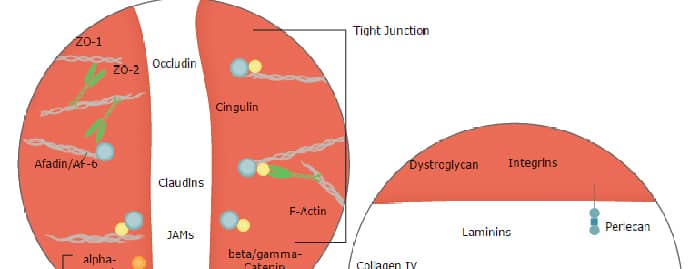
Integrin alpha V beta 3 together with alpha IIb beta 3, constitutes the only known beta 3 Integrins (1‑3). The non‑covalent heterodimer of 170 kDa alpha V/CD51 and 93 kDa beta 3/CD61 subunits shows wide expression, notably by endothelial cells and osteoclasts (2‑4). Each subunit has a transmembrane sequence and a short cytoplasmic tail connected to the cytoskeleton. Active cell surface alpha V beta 3 adheres to matrix proteins including vitronectin, fibronectin, fibrinogen and thrombospondin (2, 3). The ligand binding site of alpha V beta 3 is in the N‑terminal head region, formed by interaction of the beta 3 vWFA domain with the alpha V beta‑propeller structure (4). The alpha V subunit contributes a thigh and a calf region, while the beta 3 subunit contains a PSI domain and four cysteine‑rich I‑EGF folds. The alpha V subunit domains termed thigh, calf‑1 and calf‑2 generate a “knee” region that is bent when the alpha V beta 3 is in its constitutively inactive state. Activation, either by “inside out” signaling or by Mg2+ or Mn2+ binding, extends the Integrin to expose its ligand binding site (1, 4). The 962 aa human alpha V ECD(11) shares 92‑95% aa sequence identity with mouse, rat and bovine alpha V while the 685 aa human beta 3 ECD(12) shares 95% aa identity with equine and canine, and 89‑92% aa identity with mouse, rat and porcine beta 3. Two splice variants of beta 3 (b and c) diverge over the last 21 amino acids (aa) and lack cytoplasmic phosphorylation sites (5, 6). Another beta 3 splice variant diverges after the vWFA domain, producing a soluble 60 kDa form in platelets and endothelial cells (7). alpha V beta 3 is essential for the maturation of osteoclasts and their binding and resorption of bone; it also, however, promotes their apoptosis (8, 9). M‑CSF R and alpha V beta 3 share signaling pathways during osteoclastogenesis, and deletion of either molecule causes osteopetrosis (8, 9). alpha V beta 3 is involved in several other signaling pathways by direct interaction with receptor tyrosine kinases and ligands. For example, it cooperates with endothelial cell VEGF R2 in angiogenesis, and with IGF‑1 to promote cancer cell proliferation and invasiveness (13, 14). Also, cell entry of several viruses is mediated by alpha V beta 3 (4, 10).
Human Integrin alpha V beta 3 /CD51 Antibody (2549B)
R&D Systems | Catalog # MAB12192

Scientific images may be resized, cropped, or adjusted for brightness or contrast for presentation purposes. These updates are limited to presentation and do not affect the underlying scientific interpretation of the data. Where available, additional source data may be provided upon request.
Key Product Details
Species Reactivity
Applications
Label
Antibody Source
Product Specifications
Immunogen
Human Integrin alpha V (Phe31-Val992) and Human Integrin beta 3 (Gly27-Asp718)
Accession # NP_002201 and AAA52589
Specificity
Clonality
Host
Isotype
Scientific Data Images for Human Integrin alpha V beta 3 /CD51 Antibody (2549B)
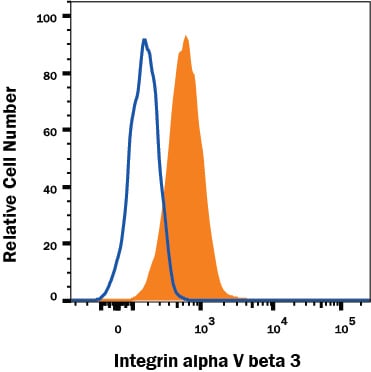
Detection of Integrin alpha V beta 3/CD51 in HUVEC Human Cells by Flow Cytometry.
HUVEC human umbilical vein endothelial cells were stained with Rabbit Anti-Human Integrin alpha V beta 3/CD51 Monoclonal Antibody (Catalog # MAB12192, filled histogram) or isotype control antibody (Catalog # MAB1050) followed by APC-conjugated anti-Rabbit IgG Secondary Antibody (Catalog # F0111). View our protocol for Staining Membrane-associated Proteins.Applications for Human Integrin alpha V beta 3 /CD51 Antibody (2549B)
CyTOF-ready
Flow Cytometry
Sample: HUVEC human unbilical vein endothelial cells
Flow Cytometry Panel Builder
Bio-Techne Knows Flow Cytometry
Save time and reduce costly mistakes by quickly finding compatible reagents using the Panel Builder Tool.
Advanced Features
- Spectra Viewer - Custom analysis of spectra from multiple fluorochromes
- Spillover Popups - Visualize the spectra of individual fluorochromes
- Antigen Density Selector - Match fluorochrome brightness with antigen density

Formulation, Preparation, and Storage
Purification
Reconstitution
Reconstitute at 0.5 mg/mL in sterile PBS. For liquid material, refer to CoA for concentration.
Formulation
Shipping
Stability & Storage
- 12 months from date of receipt, -20 to -70 °C as supplied.
- 1 month, 2 to 8 °C under sterile conditions after reconstitution.
- 6 months, -20 to -70 °C under sterile conditions after reconstitution.
Calculators
Background: Integrin alpha V beta 3
References
- Hynes, R. O. (2002) Cell 110:673.
- Serini, G. et al. (2006) Exp. Cell Res. 312:651.
- Ross, F. P. and S. L. Teitelbaum (2005) Immunol. Rev. 208:88.
- Xiong, J. et al. (2001) Science 294:339.
- Kumar, C. S. et al. (1987) J. Biol. Chem. 272:16390.
- vanKuppevelt, H. et al. (1989) Proc. Natl. Acad. Sci. USA 86:5415.
- Djaffar, I. et al. (1994) Biochem. J. 300:69.
- McHugh, K. P. et al. (2000) J. Clin. Invest. 105:433.
- Faccio, R. et al. (2003) J. Clin. Invest. 111:749.
- Chu, J. J. and M. Ng (2004) J. Biol. Chem. 279:54533.
- Suzuki, S. et al. (1987) J. Biol. Chem. 262:14060.
- Fitzgerald, L. A. et al. (1987) J. Biol. Chem. 262:3936.
- Somanath, P.R. et al. (2009) Angiogenesis 12:177.
- Saegusa, J. et al. (2009) J. Biol. Chem. 284:24106.
Alternate Names
Entrez Gene IDs
Gene Symbol
UniProt
Additional Integrin alpha V beta 3 Products
Product Documents for Human Integrin alpha V beta 3 /CD51 Antibody (2549B)
Certificate of Analysis
To download a Certificate of Analysis, please enter a lot or batch number in the search box below.
Note: Certificate of Analysis not available for kit components.
Product Specific Notices for Human Integrin alpha V beta 3 /CD51 Antibody (2549B)
For research use only
Customer Reviews for Human Integrin alpha V beta 3 /CD51 Antibody (2549B)
There are currently no reviews for this product. Be the first to review Human Integrin alpha V beta 3 /CD51 Antibody (2549B) and earn rewards!
Have you used Human Integrin alpha V beta 3 /CD51 Antibody (2549B)?
Submit a review and receive an Amazon gift card!
$25/€18/£15/$25CAN/¥2500 for a review with an image
$10/€7/£6/$10CAN/¥1110 for a review without an image
Submit a review
Protocols
Find general support by application which include: protocols, troubleshooting, illustrated assays, videos and webinars.
- 7-Amino Actinomycin D (7-AAD) Cell Viability Flow Cytometry Protocol
- Extracellular Membrane Flow Cytometry Protocol
- Flow Cytometry Protocol for Cell Surface Markers
- Flow Cytometry Protocol for Staining Membrane Associated Proteins
- Flow Cytometry Staining Protocols
- Flow Cytometry Troubleshooting Guide
- Intracellular Flow Cytometry Protocol Using Alcohol (Methanol)
- Intracellular Flow Cytometry Protocol Using Detergents
- Intracellular Nuclear Staining Flow Cytometry Protocol Using Detergents
- Intracellular Staining Flow Cytometry Protocol Using Alcohol Permeabilization
- Intracellular Staining Flow Cytometry Protocol Using Detergents to Permeabilize Cells
- Propidium Iodide Cell Viability Flow Cytometry Protocol
- Protocol for Liperfluo
- Protocol for the Characterization of Human Th22 Cells
- Protocol for the Characterization of Human Th9 Cells
- Protocol: Annexin V and PI Staining by Flow Cytometry
- Protocol: Annexin V and PI Staining for Apoptosis by Flow Cytometry
- Troubleshooting Guide: Fluorokine Flow Cytometry Kits
- View all Protocols, Troubleshooting, Illustrated assays and Webinars