

Scientific images may be resized, cropped, or adjusted for brightness or contrast for presentation purposes. These updates are limited to presentation and do not affect the underlying scientific interpretation of the data. Where available, additional source data may be provided upon request.
Key Product Details
Species Reactivity
Validated:
Cited:
Applications
Validated:
Cited:
Label
Antibody Source
Product Specifications
Immunogen
Phe254-Cys725
Accession # P97857
Specificity
Clonality
Host
Isotype
Scientific Data Images for ADAMTS1 Antibody
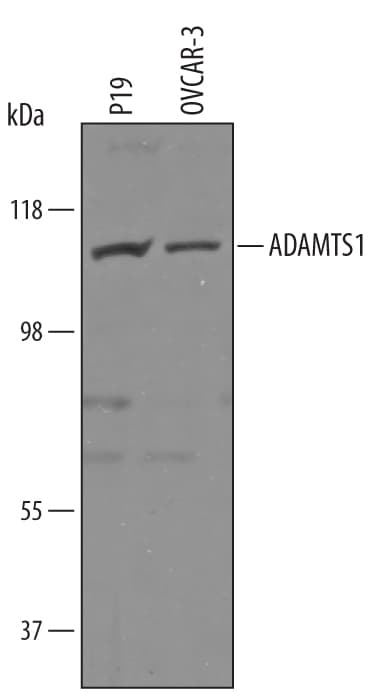
Detection of Human and Mouse ADAMTS1 by Western Blot.
Western blot shows lysates of P19 mouse embryonal carcinoma cell line and OVCAR-3 human ovarian carcinoma cell line. PVDF Membrane was probed with 1 µg/mL of Sheep Anti-Human/Mouse ADAMTS1 Antigen Affinity-purified Polyclonal Antibody (Catalog # AF5867) followed by HRP-conjugated Anti-Sheep IgG Secondary Antibody (Catalog # HAF016). A specific band was detected for ADAMTS1 at approximately 110 kDa (as indicated). This experiment was conducted under reducing conditions and using Immunoblot Buffer Group 8.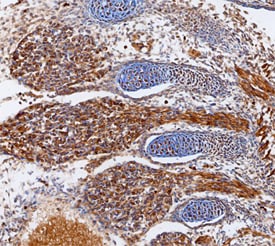
ADAMTS1 in Mouse Embryo.
ADAMTS1 was detected in immersion fixed frozen sections of mouse embryo (13 d.p.c.) using Sheep Anti-Human/Mouse ADAMTS1 Antigen Affinity-purified Polyclonal Antibody (Catalog # AF5867) at 15 µg/mL overnight at 4 °C. Tissue was stained using the Anti-Sheep HRP-DAB Cell & Tissue Staining Kit (brown; Catalog # CTS019) and counterstained with hematoxylin (blue). Specific staining was localized to cartilage primordium; dorsal ganglia cell bodies and processes. View our protocol for Chromogenic IHC Staining of Frozen Tissue Sections.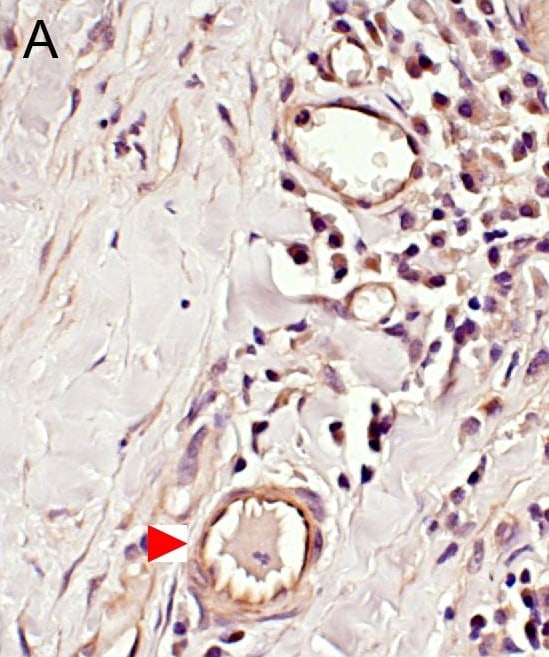
Detection of Human ADAMTS1 by Immunocytochemistry/Immunofluorescence
Immunohistochemical staining.(A) ADAMTS-1, (B) SMC marker alpha -actin, (C) macrophage marker in adventitial layer of human AAA aortas and (D) ADAMTS-1 in human non-aneurysmal control aortas. Staining of positive cells are seen in brown. The images are taken with 40X magnification and scale bar represent 50 μm. Red arrow indicates the same area. Image collected and cropped by CiteAb from the following publication (https://pubmed.ncbi.nlm.nih.gov/28570682), licensed under a CC-BY license. Not internally tested by R&D Systems.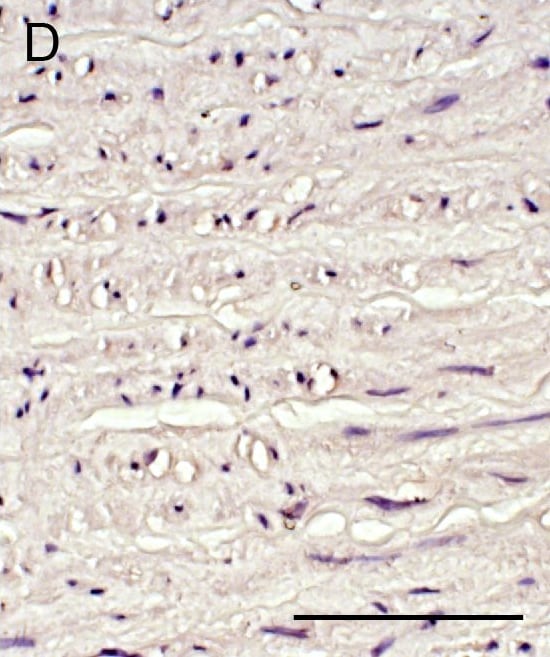
Detection of Human ADAMTS1 by Immunocytochemistry/Immunofluorescence
Immunohistochemical staining.(A) ADAMTS-1, (B) SMC marker alpha -actin, (C) macrophage marker in adventitial layer of human AAA aortas and (D) ADAMTS-1 in human non-aneurysmal control aortas. Staining of positive cells are seen in brown. The images are taken with 40X magnification and scale bar represent 50 μm. Red arrow indicates the same area. Image collected and cropped by CiteAb from the following publication (https://pubmed.ncbi.nlm.nih.gov/28570682), licensed under a CC-BY license. Not internally tested by R&D Systems.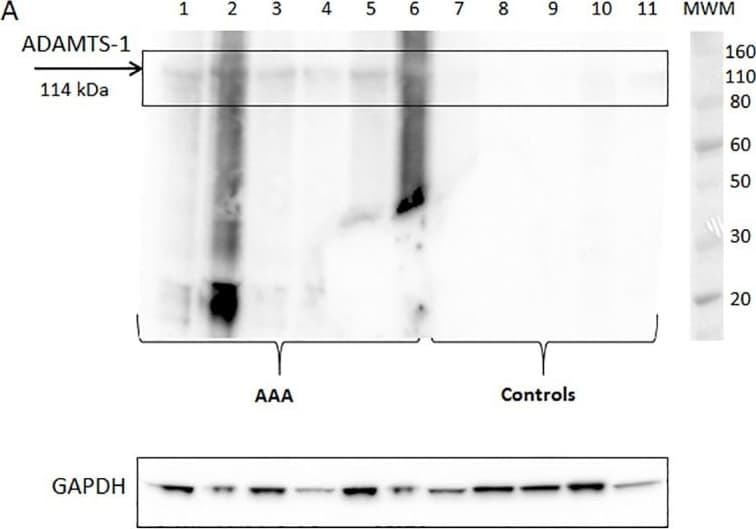
Detection of Human ADAMTS1 by Western Blot
Western blot analysis.(A) Expression of ADAMTS-1 and GAPDH in human AAA aortas (sample 1–6) and human non-aneurysmal control aortas (sample 7–11) and (B) quantification of ADAMTS-1 in relative values normalized to GAPDH. MWM: molecular weight marker indicating size in kDa. Image collected and cropped by CiteAb from the following publication (https://pubmed.ncbi.nlm.nih.gov/28570682), licensed under a CC-BY license. Not internally tested by R&D Systems.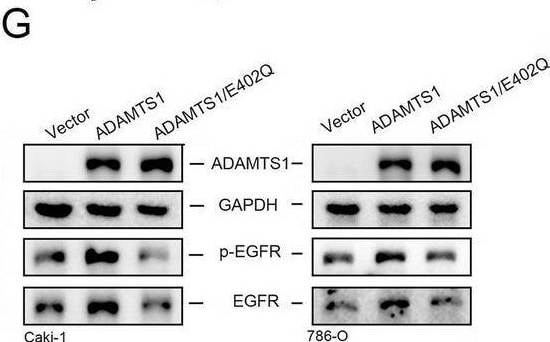
Detection of ADAMTS1 by Western Blot
The metalloproteinase activity of ADAMTS1 is pivotal in stimulating the secretion of cleaved versican, activating the epidermal growth factor receptor (EGFR), promoting invasion, and conferring anoikis resistance in renal cell carcinoma (RCC) cells. A A schematic representation depicting two variants of the recombinant ADAMTS1 protein: one containing the metalloproteinase domain (ZnMc) and the other lacking it (TSP), along with a mutant ADAMTS1 expression construct (E402Q). B–E Treatment of Caki-1 cells with or without the recombinant ZnMc or TSP protein (40 nM) for 24 or 48 h. Subsequently, secretion of cleaved versican, activation of EGFR signal cascades, invasive abilities, and anoikis were respectively assessed using dot blot (B), western blotting (C), Matrigel invasion (D), and CCK8 assays. F–I Cleaved versican secretion (F), EGFR activation (G), invasive abilities (H), and anoikis (I) were evaluated in Caki-1 and 786-O cells after transducing wild-type (WT) ADAMTS1, ADAMTS1/E402Q, or a control vector. In D, E, H, and I, values are presented as the mean ± SD of three independent experiments. *p < 0.05, **p < 0.01, ***p < 0.001, compared with the control group; #p < 0.05, ###p < 0.001, compared with the WT ADAMTS1-overexpressing group Image collected and cropped by CiteAb from the following open publication (https://pubmed.ncbi.nlm.nih.gov/39333870), licensed under a CC-BY license. Not internally tested by R&D Systems.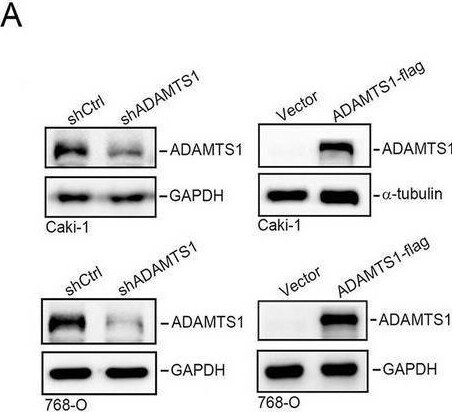
Detection of ADAMTS1 by Western Blot
ADAMTS1 expression promotes anoikis resistance of renal cell carcinoma (RCC) via inhibiting Bid, Bim, and Bak. A A western blot analysis was conducted to assess ADAMTS1 expression in Caki-1 and 786-O cells following transduction with either ADAMTS1 short hairpin (sh)RNA (left) or an ADAMTS1-expressing vector (right). B Cell viability of suspended Caki-1 and 786-O cells was evaluated using a CCK8 assay at 24 and 48 h post-stable overexpression (right) or knockdown (left) of ADAMTS1. Data are presented as the mean ± SD of three independent experiments. * p < 0.05, compared with the control group. C Dot plot demonstrated the correlation between the single sample gene set enrichment analysis (ssGSEA) score of “negative regulation of anoikis” and ADAMTS1 expression in TCGA-KIRC patients. A Pearson correlation was performed to evaluate their association and significance. D Western blot analysis of intrinsic apoptosis-related proteins (Bad, Bcl-2, Bak, Bid, Bim, and PARP) in suspended Caki-1 cells manipulated with ADAMTS1. GAPDH served as a loading control. E and F Dissemination of RCC cells in zebrafish embryos. Caki-1 cells with ADAMTS1-knockdown were implanted into zebrafish embryos at 48 h post fertilization. Tumor cell dissemination was observed at 2 days post injection (dpi), with disseminated tumor foci indicated by white arrowheads on the trunk and end-tail (E). Integrated densities of Caki-1 metastatic tumor cells in the zebrafish trunk and end-tail at 2 dpi were quantified, with the mean value of the integrated density in the shCtl group set to onefold (F) Image collected and cropped by CiteAb from the following open publication (https://pubmed.ncbi.nlm.nih.gov/39333870), licensed under a CC-BY license. Not internally tested by R&D Systems.Applications for ADAMTS1 Antibody
Immunohistochemistry
Sample: Immersion fixed frozen sections of mouse embryo (13 d.p.c.)
Immunoprecipitation
Sample: Conditioned cell culture medium spiked with Recombinant Mouse ADAMTS1 (Catalog # 5867-AD), see our available Western blot detection antibodies
Western Blot
Sample: P19 mouse embryonal carcinoma cell line and OVCAR‑3 human ovarian carcinoma cell line
Formulation, Preparation, and Storage
Purification
Reconstitution
Reconstitute at 0.2 mg/mL in sterile PBS. For liquid material, refer to CoA for concentration.
Formulation
Shipping
Stability & Storage
- 12 months from date of receipt, -20 to -70 °C as supplied.
- 1 month, 2 to 8 °C under sterile conditions after reconstitution.
- 6 months, -20 to -70 °C under sterile conditions after reconstitution.
Calculators
Background: ADAMTS1
References
- Vazquez, F. et al. (1999) J. Biol. Chem. 274:23349.
- Kuno, K. et al. (1997) J. Biol. Chem. 272:556.
- Porter, S. et al. (2005) Biochem. J. 386:15.
- Nagase, H. and M. Kashiwagi (2003) Arthritis Res. Ther. 5:94.
- Kuno, K. et al. (1999) J. Biol. Chem. 274:18821.
- Kuno, K. et al. (2000) FEBS Lett. 478:241.
- Russel, D. L. et al. (2003) J. Biol. Chem. 278:42330.
- Lee, N. et al. (2005) J. Biol. Chem. 280:34796.
- Shindo, T. et al. (2000) J. Clin. Invest. 105:1345.
- Wight, T.N. (2005) Arterioscler Thromb. Vasc. Biol. 25:12.
- Luque, A. et al. (2003) J. Biol. Chem. 278:23656.
- Krampert, M. et al. (2005) J. Biol. Chem. 280:23844.
Long Name
Alternate Names
Entrez Gene IDs
Gene Symbol
UniProt
Additional ADAMTS1 Products
Product Documents for ADAMTS1 Antibody
Certificate of Analysis
To download a Certificate of Analysis, please enter a lot or batch number in the search box below.
Note: Certificate of Analysis not available for kit components.
Product Specific Notices for ADAMTS1 Antibody
For research use only
Related Research Areas
Citations for ADAMTS1 Antibody
 Powered by Bioz
Customer Reviews for ADAMTS1 Antibody
There are currently no reviews for this product. Be the first to review ADAMTS1 Antibody and earn rewards!
Have you used ADAMTS1 Antibody?
Submit a review and receive an Amazon gift card!
$25/€18/£15/$25CAN/¥2500 for a review with an image
$10/€7/£6/$10CAN/¥1110 for a review without an image
Submit a review
Protocols
Find general support by application which include: protocols, troubleshooting, illustrated assays, videos and webinars.
- Antigen Retrieval Protocol (PIER)
- Antigen Retrieval for Frozen Sections Protocol
- Appropriate Fixation of IHC/ICC Samples
- Cellular Response to Hypoxia Protocols
- Chromogenic IHC Staining of Formalin-Fixed Paraffin-Embedded (FFPE) Tissue Protocol
- Chromogenic Immunohistochemistry Staining of Frozen Tissue
- ClariTSA™ Fluorophore Kits
- Detection & Visualization of Antibody Binding
- Fluorescent IHC Staining of Frozen Tissue Protocol
- Graphic Protocol for Heat-induced Epitope Retrieval
- Graphic Protocol for the Preparation and Fluorescent IHC Staining of Frozen Tissue Sections
- Graphic Protocol for the Preparation and Fluorescent IHC Staining of Paraffin-embedded Tissue Sections
- Graphic Protocol for the Preparation of Gelatin-coated Slides for Histological Tissue Sections
- IHC Sample Preparation (Frozen sections vs Paraffin)
- Immunofluorescent IHC Staining of Formalin-Fixed Paraffin-Embedded (FFPE) Tissue Protocol
- Immunohistochemistry (IHC) and Immunocytochemistry (ICC) Protocols
- Immunohistochemistry Frozen Troubleshooting
- Immunohistochemistry Paraffin Troubleshooting
- Immunoprecipitation Protocol
- Preparing Samples for IHC/ICC Experiments
- Preventing Non-Specific Staining (Non-Specific Binding)
- Primary Antibody Selection & Optimization
- Protocol for Heat-Induced Epitope Retrieval (HIER)
- Protocol for Making a 4% Formaldehyde Solution in PBS
- Protocol for VisUCyte™ HRP Polymer Detection Reagent
- Protocol for the Preparation & Fixation of Cells on Coverslips
- Protocol for the Preparation and Chromogenic IHC Staining of Frozen Tissue Sections
- Protocol for the Preparation and Chromogenic IHC Staining of Frozen Tissue Sections - Graphic
- Protocol for the Preparation and Chromogenic IHC Staining of Paraffin-embedded Tissue Sections
- Protocol for the Preparation and Chromogenic IHC Staining of Paraffin-embedded Tissue Sections - Graphic
- Protocol for the Preparation and Fluorescent IHC Staining of Frozen Tissue Sections
- Protocol for the Preparation and Fluorescent IHC Staining of Paraffin-embedded Tissue Sections
- Protocol for the Preparation of Gelatin-coated Slides for Histological Tissue Sections
- R&D Systems Quality Control Western Blot Protocol
- TUNEL and Active Caspase-3 Detection by IHC/ICC Protocol
- The Importance of IHC/ICC Controls
- Troubleshooting Guide: Immunohistochemistry
- Troubleshooting Guide: Western Blot Figures
- Western Blot Conditions
- Western Blot Protocol
- Western Blot Protocol for Cell Lysates
- Western Blot Troubleshooting
- Western Blot Troubleshooting Guide
- View all Protocols, Troubleshooting, Illustrated assays and Webinars