
Meprins are multimeric proteases composed of alpha and beta subunits, which are members of the astacin family of zinc endopeptidases (1, 2). Both subunits form disulfide-linked homo- or heterooligomers, which are also referred to as Meprin A (composed of alpha subunits with or without beta subunits) and Merpin B (composed of beta subunits only) (3). Although the two subunits share 42% amino acid (aa) sequence identity, they differ significantly in their oligomeric structure, post-translational processing and subsequently cellular location, and substrate and peptide bond specificity (4). The 701 aa sequence of human Merpin beta subunit precursor consists of a signal peptide (aa 1 to 21), a pro region (aa 22 to 61), and a mature chain (aa 62 to 701) containing catalytic (aa 62 to 259), MAM (aa 260 to 429), MATH (aa 430 to 585), EGF-like (aa 604 to 644), transmembrane (aa 653 to 673), and cytoplasmic (aa 674 to 701) domains.
Meprin beta Subunit/MEP1B Antibody (289731)
R&D Systems | Catalog # MAB28951

Scientific images may be resized, cropped, or adjusted for brightness or contrast for presentation purposes. These updates are limited to presentation and do not affect the underlying scientific interpretation of the data. Where available, additional source data may be provided upon request.
Key Product Details
Species Reactivity
Validated:
Cited:
Applications
Validated:
Cited:
Label
Antibody Source
Product Specifications
Immunogen
Thr23-Ser293
Accession # Q16820
Specificity
Clonality
Host
Isotype
Scientific Data Images for Meprin beta Subunit/MEP1B Antibody (289731)
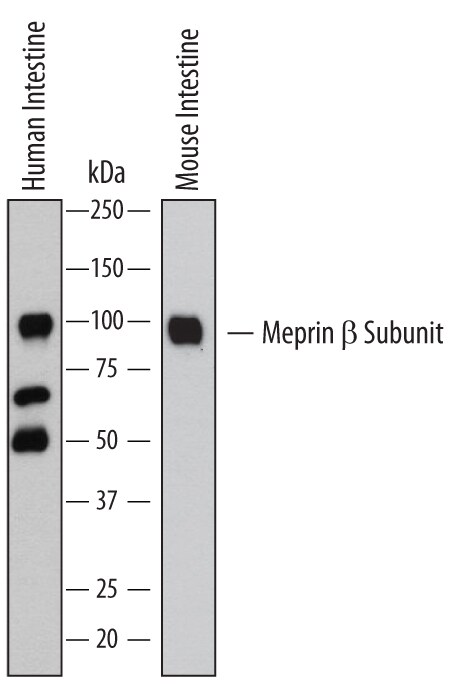
Detection of Human and Mouse Meprin beta Subunit/ MEP1B by Western Blot.
Western blot shows lysates of human intestine tissue and mouse intestine tissue. PVDF membrane was probed with 1 µg/mL of Rat Anti-Human/Mouse Meprin beta Subunit/MEP1B Monoclonal Antibody (Catalog # MAB28951) followed by HRP-conjugated Anti-Rat IgG Secondary Antibody (Catalog # HAF005). A specific band was detected for Meprin beta Subunit/MEP1B at approximately 97 kDa (as indicated). This experiment was conducted under reducing conditions and using Immunoblot Buffer Group 1.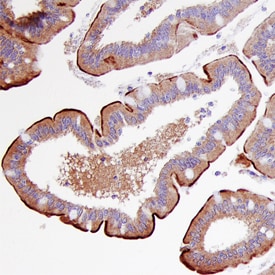
Meprin beta Subunit/MEP1B in Human Intestine.
Meprin beta Subunit/MEP1B was detected in immersion fixed paraffin-embedded sections of human intestine using Human/Mouse Meprin beta Subunit/MEP1B Monoclonal Antibody (Catalog # MAB28951) at 1 µg/mL overnight at 4 °C. Before incubation with the primary antibody, tissue was subjected to heat-induced epitope retrieval using Antigen Retrieval Reagent-Basic (Catalog # CTS013). Tissue was stained using the Anti-Rat HRP-DAB Cell & Tissue Staining Kit (brown; Catalog # CTS017) and counterstained with hemotoxylin (blue). Specific staining was localized to the Brush border of epithelial cells. View our protocol for Chromogenic IHC Staining of Paraffin-embedded Tissue Sections. This application has not been tested in mouse samples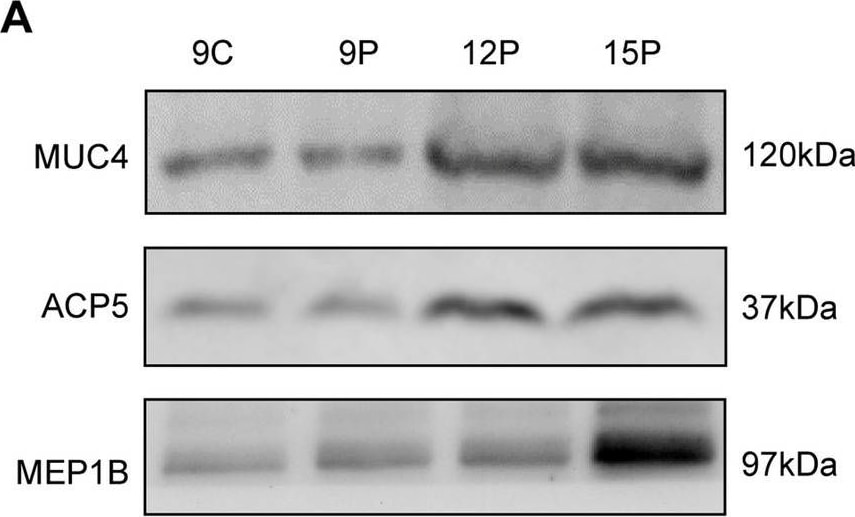
Detection of Meprin beta Subunit/MEP1B by Western Blot
Representative proteins in ULF-EVs whose abundance increased with pregnancy development also significantly increased after ULF-EVs treatment of pTr2 cells. A Western blot analysis of MUC4, ACP5 and MEP1B in ULF-EVs. B Relative abundance of MUC4, ACP5 and MEP1B in pTr2 cells treated with ULF-EVs. C Images of the embryo-maternal interface stained with MEP1B antibodies. MEP1B was obviously expressed in the endometrium and trophoblast. The scale bar indicates 100 nm. D Quantitative analysis of MEP1B by assessing the average integrated optical density (IOD) in the endometrium. The data are displayed as mean ± SD and different lowercase letters correspond to significant differences at the p < 0.05 threshold. E Quantitative analysis of MEP1B by assessing IOD in the trophoblast. Asterisks indicate significant differences (mean ± SD) between 12 and 15P (**p < 0.01). F The relative expression level of MEP1B mRNA was determined by qRT-PCR. The data are displayed as mean ± SD and asterisk indicate significant differences (*p < 0.05) Image collected and cropped by CiteAb from the following open publication (https://pubmed.ncbi.nlm.nih.gov/36882792), licensed under a CC-BY license. Not internally tested by R&D Systems.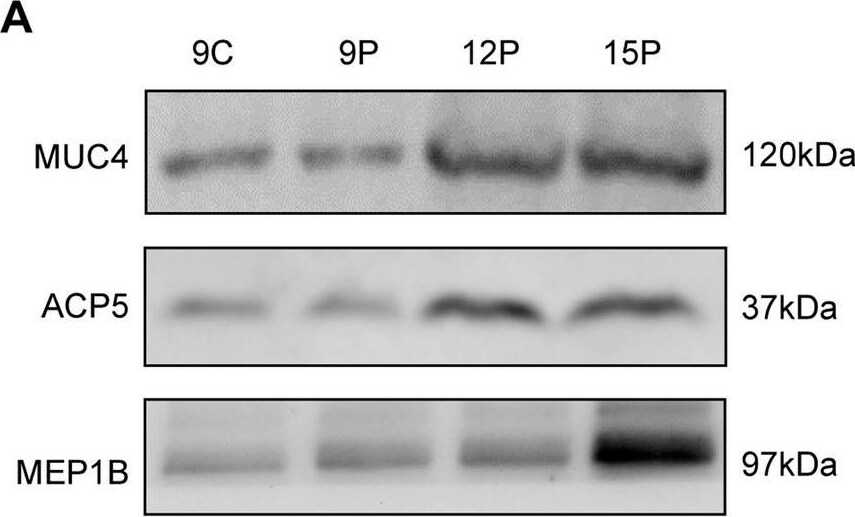
Detection of Meprin beta Subunit/MEP1B by Western Blot
Representative proteins in ULF-EVs whose abundance increased with pregnancy development also significantly increased after ULF-EVs treatment of pTr2 cells. A Western blot analysis of MUC4, ACP5 and MEP1B in ULF-EVs. B Relative abundance of MUC4, ACP5 and MEP1B in pTr2 cells treated with ULF-EVs. C Images of the embryo-maternal interface stained with MEP1B antibodies. MEP1B was obviously expressed in the endometrium and trophoblast. The scale bar indicates 100 nm. D Quantitative analysis of MEP1B by assessing the average integrated optical density (IOD) in the endometrium. The data are displayed as mean ± SD and different lowercase letters correspond to significant differences at the p < 0.05 threshold. E Quantitative analysis of MEP1B by assessing IOD in the trophoblast. Asterisks indicate significant differences (mean ± SD) between 12 and 15P (**p < 0.01). F The relative expression level of MEP1B mRNA was determined by qRT-PCR. The data are displayed as mean ± SD and asterisk indicate significant differences (*p < 0.05) Image collected and cropped by CiteAb from the following open publication (https://pubmed.ncbi.nlm.nih.gov/36882792), licensed under a CC-BY license. Not internally tested by R&D Systems.Applications for Meprin beta Subunit/MEP1B Antibody (289731)
Immunohistochemistry
Sample: Immersion fixed paraffin-embedded sections of human intestine
Western Blot
Sample: Human intestine tissue and mouse intestine tissue
Formulation, Preparation, and Storage
Purification
Reconstitution
Reconstitute at 0.5 mg/mL in sterile PBS. For liquid material, refer to CoA for concentration.
Formulation
Shipping
Stability & Storage
- 12 months from date of receipt, -20 to -70 °C as supplied.
- 1 month, 2 to 8 °C under sterile conditions after reconstitution.
- 6 months, -20 to -70 °C under sterile conditions after reconstitution.
Calculators
Background: Meprin beta Subunit/MEP1B
References
- Bond, J.S. and R.J. Beynon (1995) Protein Sci. 4:1247.
- Stocker, W. et al. (1995) Protein Sci. 4:823.
- Bertenshaw, G.P. et al. (2001) J. Biol. Chem. 276:13248.
- Ishmael, F.T. et al. (2005) J. Biol. Chem. 280:13895.
Alternate Names
Gene Symbol
UniProt
Additional Meprin beta Subunit/MEP1B Products
Product Documents for Meprin beta Subunit/MEP1B Antibody (289731)
Certificate of Analysis
To download a Certificate of Analysis, please enter a lot or batch number in the search box below.
Note: Certificate of Analysis not available for kit components.
Product Specific Notices for Meprin beta Subunit/MEP1B Antibody (289731)
For research use only
Related Research Areas
Citations for Meprin beta Subunit/MEP1B Antibody (289731)
 Powered by Bioz
Customer Reviews for Meprin beta Subunit/MEP1B Antibody (289731)
There are currently no reviews for this product. Be the first to review Meprin beta Subunit/MEP1B Antibody (289731) and earn rewards!
Have you used Meprin beta Subunit/MEP1B Antibody (289731)?
Submit a review and receive an Amazon gift card!
$25/€18/£15/$25CAN/¥2500 for a review with an image
$10/€7/£6/$10CAN/¥1110 for a review without an image
Submit a review
Protocols
Find general support by application which include: protocols, troubleshooting, illustrated assays, videos and webinars.
- Antigen Retrieval Protocol (PIER)
- Antigen Retrieval for Frozen Sections Protocol
- Appropriate Fixation of IHC/ICC Samples
- Cellular Response to Hypoxia Protocols
- Chromogenic IHC Staining of Formalin-Fixed Paraffin-Embedded (FFPE) Tissue Protocol
- Chromogenic Immunohistochemistry Staining of Frozen Tissue
- ClariTSA™ Fluorophore Kits
- Detection & Visualization of Antibody Binding
- Fluorescent IHC Staining of Frozen Tissue Protocol
- Graphic Protocol for Heat-induced Epitope Retrieval
- Graphic Protocol for the Preparation and Fluorescent IHC Staining of Frozen Tissue Sections
- Graphic Protocol for the Preparation and Fluorescent IHC Staining of Paraffin-embedded Tissue Sections
- Graphic Protocol for the Preparation of Gelatin-coated Slides for Histological Tissue Sections
- IHC Sample Preparation (Frozen sections vs Paraffin)
- Immunofluorescent IHC Staining of Formalin-Fixed Paraffin-Embedded (FFPE) Tissue Protocol
- Immunohistochemistry (IHC) and Immunocytochemistry (ICC) Protocols
- Immunohistochemistry Frozen Troubleshooting
- Immunohistochemistry Paraffin Troubleshooting
- Preparing Samples for IHC/ICC Experiments
- Preventing Non-Specific Staining (Non-Specific Binding)
- Primary Antibody Selection & Optimization
- Protocol for Heat-Induced Epitope Retrieval (HIER)
- Protocol for Making a 4% Formaldehyde Solution in PBS
- Protocol for VisUCyte™ HRP Polymer Detection Reagent
- Protocol for the Preparation & Fixation of Cells on Coverslips
- Protocol for the Preparation and Chromogenic IHC Staining of Frozen Tissue Sections
- Protocol for the Preparation and Chromogenic IHC Staining of Frozen Tissue Sections - Graphic
- Protocol for the Preparation and Chromogenic IHC Staining of Paraffin-embedded Tissue Sections
- Protocol for the Preparation and Chromogenic IHC Staining of Paraffin-embedded Tissue Sections - Graphic
- Protocol for the Preparation and Fluorescent IHC Staining of Frozen Tissue Sections
- Protocol for the Preparation and Fluorescent IHC Staining of Paraffin-embedded Tissue Sections
- Protocol for the Preparation of Gelatin-coated Slides for Histological Tissue Sections
- R&D Systems Quality Control Western Blot Protocol
- TUNEL and Active Caspase-3 Detection by IHC/ICC Protocol
- The Importance of IHC/ICC Controls
- Troubleshooting Guide: Immunohistochemistry
- Troubleshooting Guide: Western Blot Figures
- Western Blot Conditions
- Western Blot Protocol
- Western Blot Protocol for Cell Lysates
- Western Blot Troubleshooting
- Western Blot Troubleshooting Guide
- View all Protocols, Troubleshooting, Illustrated assays and Webinars