
BAT3 (HLA-B-associated transcript 3; also BAG6, BAG family molecular chaperone regulator 6, Protein G3 and Scythe) is a multifunctional molecule that is not easily placed into known protein families. Although its predicted MW is 119 kDa, it runs anomalously in SDS-PAGE at 150-170 kDa. BAT3 is found in diverse cell types such as dendritic cells, hepatocytes, renal epithelial cells and tumor cells. It is found extracellularly where it is complexed to Hsp70, and activates the NKp30 receptor expressed on NK cells. Intracellularly, it binds to TGF-beta receptors I and II where, upon receptor ligation, it translocates to the nucleus and activates TGF-beta target genes. Human BAT3 is 1132 amino acids (aa) in length. It contains one Ub-like domain (aa 17-77), two Pro-rich regions (aa 195-273 and 394-681), an NLS (aa 1030-1052) plus a BAG domain (aa 1053-1101). BAT3 is phosphorylated on multiple Ser/Thr residues. Caspase 3 will cleave BAT3 after Asp1001, generating a 20 kDa C-terminal fragment. There are also multiple splice variants. Two of them share an absence of aa 185-190 that may be accompanied by a 36 aa insertion after Gly489. Over aa 1-190, human BAT3 shares 93% aa identity with mouse BAT3.

Scientific images may be resized, cropped, or adjusted for brightness or contrast for presentation purposes. These updates are limited to presentation and do not affect the underlying scientific interpretation of the data. Where available, additional source data may be provided upon request.
Key Product Details
Species Reactivity
Validated:
Cited:
Applications
Validated:
Cited:
Label
Antibody Source
Product Specifications
Immunogen
Met1-Gln190
Accession # P46379
Specificity
Clonality
Host
Isotype
Scientific Data Images for BAT3/BAG6 Antibody
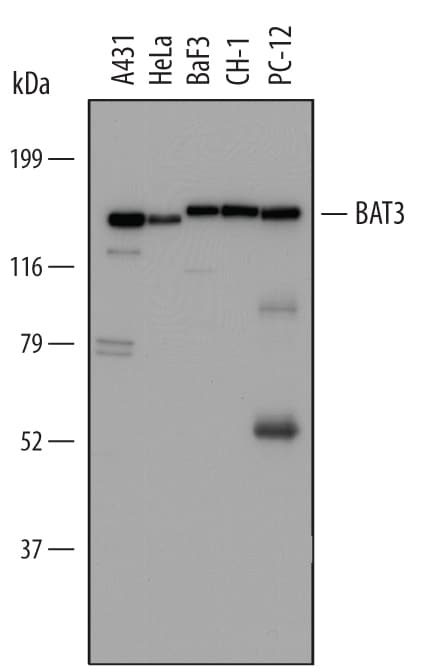
Detection of Human, Mouse, and Rat BAT3/BAG6 by Western Blot.
Western blot shows lysates of A431 human epithelial carcinoma cell line, HeLa human cervical epithelial carcinoma cell line, BaF3 mouse pro-B cell line, CH-1 mouse B cell lymphoma cell line, and PC-12 rat adrenal pheochromocytoma cell line. PVDF Membrane was probed with 1 µg/mL of Sheep Anti-Human/Mouse/Rat BAT3/BAG6 Antigen Affinity-purified Polyclonal Antibody (Catalog # AF6438) followed by HRP-conjugated Anti-Sheep IgG Secondary Antibody (Catalog # HAF016). A specific band was detected for BAT3/BAG6 at approximately 150 kDa (as indicated). This experiment was conducted under reducing conditions and using Immunoblot Buffer Group 1.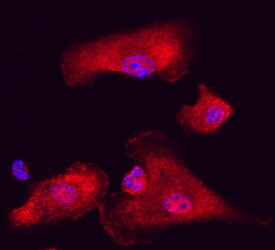
BAT3/BAG6 in Human Dendritic Cells.
BAT3/BAG6 was detected in immersion fixed immature human dendritic cells using Sheep Anti-Human/Mouse/Rat BAT3/BAG6 Affinity-purified Polyclonal Antibody (Catalog # AF6438) at 10 µg/mL for 3 hours at room temperature. Cells were stained using the NorthernLights™ 557-conjugated Anti-Sheep IgG Secondary Antibody (red; Catalog # NL010) and counter-stained with DAPI (blue). Specific staining was localized to nuclei and cytoplasm. View our protocol for Fluorescent ICC Staining of Cells on Coverslips.
Detection of BAT3/BAG6 by Western Blot
H2O2 induces BAG3 reduction.A Immunoblot results indicated H2O2 treatment caused time and dosage-dependent decreases in neuronal BAG3. B qPCR demonstrated H2O2 treatment causes significant decreases in neuronal BAG3 RNA. C In addition to validating H2O2-induced reductions in BAG3 protein, immunocytochemistry suggested neurons exposed to H2O2 treatment may develop minor dystrophies in their branching processes. D Immunoblotting revealed H2O2 reduced other BAG family members (BAG2, BAG5, BAG6), and exacerbated the reduction in BAG3 observed in response to Tat or Nef. ***p < 0.001. Scale bar equals 50 μM; ×40 magnification. Scale bar equals 20 μM; ×63 magnification. Image collected and cropped by CiteAb from the following open publication (https://pubmed.ncbi.nlm.nih.gov/33771978), licensed under a CC-BY license. Not internally tested by R&D Systems.Applications for BAT3/BAG6 Antibody
Immunocytochemistry
Sample: Immersion fixed immature human dendritic cells
Western Blot
Sample: A431 human epithelial carcinoma cell line, HeLa human cervical epithelial carcinoma cell line, BaF3 mouse pro-B cell line, CH‑1 mouse B cell lymphoma cell line, and PC‑12 rat adrenal pheochromocytoma cell line
Formulation, Preparation, and Storage
Purification
Reconstitution
Reconstitute at 0.2 mg/mL in sterile PBS. For liquid material, refer to CoA for concentration.
Formulation
Shipping
Stability & Storage
- 12 months from date of receipt, -20 to -70 °C as supplied.
- 1 month, 2 to 8 °C under sterile conditions after reconstitution.
- 6 months, -20 to -70 °C under sterile conditions after reconstitution.
Calculators
Background: BAT3/BAG6
Long Name
Alternate Names
Gene Symbol
UniProt
Additional BAT3/BAG6 Products
Product Documents for BAT3/BAG6 Antibody
Certificate of Analysis
To download a Certificate of Analysis, please enter a lot or batch number in the search box below.
Note: Certificate of Analysis not available for kit components.
Product Specific Notices for BAT3/BAG6 Antibody
For research use only
Related Research Areas
Citations for BAT3/BAG6 Antibody
 Powered by Bioz
Customer Reviews for BAT3/BAG6 Antibody
There are currently no reviews for this product. Be the first to review BAT3/BAG6 Antibody and earn rewards!
Have you used BAT3/BAG6 Antibody?
Submit a review and receive an Amazon gift card!
$25/€18/£15/$25CAN/¥2500 for a review with an image
$10/€7/£6/$10CAN/¥1110 for a review without an image
Submit a review
Protocols
Find general support by application which include: protocols, troubleshooting, illustrated assays, videos and webinars.
- Appropriate Fixation of IHC/ICC Samples
- Cellular Response to Hypoxia Protocols
- ClariTSA™ Fluorophore Kits
- Detection & Visualization of Antibody Binding
- ICC Cell Smear Protocol for Suspension Cells
- ICC Immunocytochemistry Protocol Videos
- ICC for Adherent Cells
- Immunocytochemistry (ICC) Protocol
- Immunocytochemistry Troubleshooting
- Immunofluorescence of Organoids Embedded in Cultrex Basement Membrane Extract
- Immunohistochemistry (IHC) and Immunocytochemistry (ICC) Protocols
- Preparing Samples for IHC/ICC Experiments
- Preventing Non-Specific Staining (Non-Specific Binding)
- Primary Antibody Selection & Optimization
- Protocol for VisUCyte™ HRP Polymer Detection Reagent
- Protocol for the Fluorescent ICC Staining of Cell Smears - Graphic
- Protocol for the Fluorescent ICC Staining of Cultured Cells on Coverslips - Graphic
- Protocol for the Preparation and Fluorescent ICC Staining of Cells on Coverslips
- Protocol for the Preparation and Fluorescent ICC Staining of Non-adherent Cells
- Protocol for the Preparation and Fluorescent ICC Staining of Stem Cells on Coverslips
- Protocol for the Preparation of a Cell Smear for Non-adherent Cell ICC - Graphic
- R&D Systems Quality Control Western Blot Protocol
- TUNEL and Active Caspase-3 Detection by IHC/ICC Protocol
- The Importance of IHC/ICC Controls
- Troubleshooting Guide: Western Blot Figures
- Western Blot Conditions
- Western Blot Protocol
- Western Blot Protocol for Cell Lysates
- Western Blot Troubleshooting
- Western Blot Troubleshooting Guide
- View all Protocols, Troubleshooting, Illustrated assays and Webinars