
S100A4 (also named metastasin, Mtsl and calvasculin) is an 11 kDa member of the S100 (soluble in 100% saturated ammonium sulfate) family of proteins (1‑5). The S100 family is a further classified as a member of the EF-hand superfamily of Ca++-binding proteins. These participate in both calcium‑dependent and calcium‑independent protein-protein interactions. The hallmark of this superfamily is the EF-hand motif that consists of a Ca++-binding site flanked by two alpha -helices (helix E and helix F) that were originally identified in a right-handed model of carp muscle calcium‑binding protein (6). Mouse S100A4 is 101 amino acids (aa) in length (1, 2). It contains two EF hand domains, one between aa 12‑47, and a second between aa 50‑85. The first domain has a 14 aa cation-binding motif and binds Ca++ with low affinity. The second Ca++-binding motif is 12 aa in length and binds Ca++ with high affinity. S100A4 has no classical signal sequence but is secreted from cells (3, 7). Mouse S100A4 shares 93%, 96% and 89% aa identity with human, rat and canine S100A4, respectively. S100A4 exists as dimer (8, 9, 10). Extracellular S100A4 is reported to induce MMP production, activate MMPs, promote neurite outgrowth and stimulate cardiomyocyte proliferation (4, 10, 11, 12, 13). Within the cell, dimers are likely the functional unit. Here, they are constitutive homo- or heterodimers (with S100A1) that interact with Ca++, undergo a conformational change, and subsequently bind to cytoplasmic targets. Known targets include p53, myosin heavy chain II, F-actin and liprin beta 1 (4, 14). In general, it can be said that S100A4 blocks target phosphorylation and multimerization (4, 7, 14). S100A4 activity has been associated with cell transformation. It seems likely this is either coincidental, or a consequence, rather than a cause of transformation (3).

Scientific images may be resized, cropped, or adjusted for brightness or contrast for presentation purposes. These updates are limited to presentation and do not affect the underlying scientific interpretation of the data. Where available, additional source data may be provided upon request.
Key Product Details
Validated by
Species Reactivity
Validated:
Cited:
Applications
Validated:
Cited:
Label
Antibody Source
Product Specifications
Immunogen
Ala2-Lys101
Accession # P07091
Specificity
Clonality
Host
Isotype
Scientific Data Images for S100A4 Antibody
Detection of Mouse S100A4 by Western Blot.
Western blot shows lysates of 3T3-L1 mouse embryonic fibroblast adipose-like cell line. PVDF membrane was probed with 1 µg/mL of Sheep Anti-Human/Mouse S100A4 Antigen Affinity-purified Polyclonal Antibody (Catalog # AF4138) followed by HRP-conjugated Anti-Sheep IgG Secondary Antibody (Catalog # HAF016). A specific band was detected for S100A4 at approximately 11 kDa (as indicated). This experiment was conducted under reducing conditions and using Immunoblot Buffer Group 2.
Detection of Mouse S100A4 by Simple WesternTM.
Simple Western lane view shows lysates of 3T3-L1 mouse embryonic fibroblast adipose-like cell line, loaded at 0.2 mg/mL. A specific band was detected for S100A4 at approximately 12 kDa (as indicated) using 10 µg/mL of Sheep Anti-Human/Mouse S100A4 Antigen Affinity-purified Polyclonal Antibody (Catalog # AF4138) followed by 1:50 dilution of HRP-conjugated Anti-Sheep IgG Secondary Antibody (Catalog # HAF016). This experiment was conducted under reducing conditions and using the 12-230 kDa separation system.
Western Blot Shows Sheep Anti-Human/Mouse S100A4 Antigen Affinity-purified Polyclonal Antibody Specificity by Using Knockout Cell Line.
Western blot shows lysates of HeLa human cervical epithelial carcinoma parental cell line and S100A4 knockout HeLa cell line (KO). PVDF membrane was probed with 1 µg/mL of Sheep Anti-Human/Mouse S100A4 Antigen Affinity-purified Polyclonal Antibody (Catalog # AF4138) followed by HRP-conjugated Anti-Sheep IgG Secondary Antibody (Catalog # HAF016). A specific band was detected for S100A4 at approximately 12 kDa (as indicated) in the parental HeLa cell line, but is not detectable in knockout HeLa cell line. GAPDH (Catalog # AF5718) is shown as a loading control. This experiment was conducted under reducing conditions and using Immunoblot Buffer Group 1.
Detection of S100A4 by Western Blot
Combined effects of PD407824 and gamma -irradiation on the expression and activities of S100A4 and MMP-2 on MDA-MB-231 cells. Non-IR = no irradiation, PD = PD407824. *P < 0.05 vs Non-IR †P < 0.01; error bar means standard deviation. All experiments conducted three times independently. (A) Effects of PD407824 on S100A4 and MMP-2 mRNA levels. (B) Effects of PD407824 combined with gamma -irradiation on S100A4 and phosphorylation of Chk1. (C) Effect of PD407824 on MMP-2 activity. (D) Effects of a Chk1-specific siRNA (siChk1) on S100A4 and p-Chk1 expression. (E) Effect of siChk1 on MMP-2 activity. Image collected and cropped by CiteAb from the following open publication (https://pubmed.ncbi.nlm.nih.gov/34124754), licensed under a CC-BY license. Not internally tested by R&D Systems.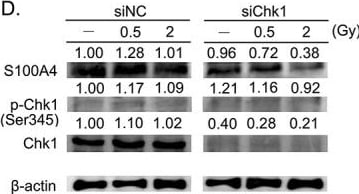
Detection of S100A4 by Western Blot
Combined effects of PD407824 and gamma -irradiation on the expression and activities of S100A4 and MMP-2 on MDA-MB-231 cells. Non-IR = no irradiation, PD = PD407824. *P < 0.05 vs Non-IR †P < 0.01; error bar means standard deviation. All experiments conducted three times independently. (A) Effects of PD407824 on S100A4 and MMP-2 mRNA levels. (B) Effects of PD407824 combined with gamma -irradiation on S100A4 and phosphorylation of Chk1. (C) Effect of PD407824 on MMP-2 activity. (D) Effects of a Chk1-specific siRNA (siChk1) on S100A4 and p-Chk1 expression. (E) Effect of siChk1 on MMP-2 activity. Image collected and cropped by CiteAb from the following open publication (https://pubmed.ncbi.nlm.nih.gov/34124754), licensed under a CC-BY license. Not internally tested by R&D Systems.Applications for S100A4 Antibody
Knockout Validated
Simple Western
Sample: 3T3‑L1 mouse embryonic fibroblast adipose-like cell line
Western Blot
Sample: 3T3‑L1 mouse embryonic fibroblast adipose‑like cell line
Reviewed Applications
Read 1 review rated 5 using AF4138 in the following applications:
Formulation, Preparation, and Storage
Purification
Reconstitution
Reconstitute at 0.2 mg/mL in sterile PBS. For liquid material, refer to CoA for concentration.
Formulation
Shipping
Stability & Storage
- 12 months from date of receipt, -20 to -70 °C as supplied.
- 1 month, 2 to 8 °C under sterile conditions after reconstitution.
- 6 months, -20 to -70 °C under sterile conditions after reconstitution.
Calculators
Background: S100A4
References
- Jackson-Grusby, L.L. et al. (1987) Nucleic Acids Res. 15:6677.
- Goto, K. et al. (1988) J. Biochem. 103:48.
- Garrett, S.C. et al. (2006) J. Biol. Chem. 281:677.
- Santamaria-Kisiel, L. et al. (2006) Biochem. J. 396:201.
- Donato, R. (2001) Int. J. Biochem. Mol. Biol. 33:637.
- Kretsinger, R.H. and C.E. Nockolds (1973) J. Biol. Chem. 248:3313.
- Helfman, D.M. et al. (2005) Br. J. Cancer 92:1955.
- Burkitt, W.I. et al. (2003) Biochem. Soc. Trans. 31:985.
- Vallaly, K.M. et al. (2002) Biochemistry 41:12670.
- Novitskaya, V. et al. (2000) J. Biol. Chem. 275:41278.
- Stary, M. et al. (2006) Biochem. Biophys. Res. Commun. 343:555.
- Semov, A. et al. (2005) J. Biol. Chem. 280:20833.
- Saleem, M. et al. (2006) Proc. Natl. Acad. Sci. USA 103:14825.
- Kriajevska, M. et al. (2002) J. Biol. Chem. 277:5229.
Long Name
Alternate Names
Gene Symbol
UniProt
Additional S100A4 Products
Product Documents for S100A4 Antibody
Certificate of Analysis
To download a Certificate of Analysis, please enter a lot or batch number in the search box below.
Note: Certificate of Analysis not available for kit components.
Product Specific Notices for S100A4 Antibody
For research use only
Related Research Areas
Citations for S100A4 Antibody
 Powered by Bioz
Customer Reviews for S100A4 Antibody (1)
Have you used S100A4 Antibody?
Submit a review and receive an Amazon gift card!
$25/€18/£15/$25CAN/¥2500 for a review with an image
$10/€7/£6/$10CAN/¥1110 for a review without an image
Submit a review
-
Application: ELISASample Tested: Purified StandardSpecies: HumanVerified Customer | Posted 11/30/2018
There are no reviews that match your criteria.
Protocols
Find general support by application which include: protocols, troubleshooting, illustrated assays, videos and webinars.
- Cellular Response to Hypoxia Protocols
- R&D Systems Quality Control Western Blot Protocol
- Troubleshooting Guide: Western Blot Figures
- Western Blot Conditions
- Western Blot Protocol
- Western Blot Protocol for Cell Lysates
- Western Blot Troubleshooting
- Western Blot Troubleshooting Guide
- View all Protocols, Troubleshooting, Illustrated assays and Webinars