
NKp30, along with NKp44 and NKp46, constitute a group of receptors termed “Natural Cytotoxicity Receptors” (1). These receptors play a major role in triggering NK‑mediated killing of most tumor cells lines. NKp30 is a type I transmembrane protein having a single extracellular V-like immunoglobulin domain (2). A physical association with the ITAM-bearing accessory protein, CD3 zeta, occurs via a charged residue in the NKp30 transmembrane domain. Ligation of NKp30 with a specific antibody results in phosphorylation of CD3 zeta (3). NKp30 is expressed on both resting and activated NK cells of the CD56dim, CD16+ subset that account for more that 85% of NK cells found in peripheral blood and spleen (4). NKp30 is absent from the CD56bright, CD16- subset that constitutes the majority of NK cells in lymph node and tonsil, however, its expression is up-regulated in these cells upon IL-2 activation (4). Studies with neutralizing antibodies reveal that NKp30 is partially responsible for triggering lytic activity against several tumor cell types and that it is the main receptor responsible for NK‑mediated lysis of immature dendritic cells (2, 5). The ligand(s) recognized by NKp30 has not been described.
Human NKp30/NCR3 Antibody (210845)
R&D Systems | Catalog # MAB1849

Scientific images may be resized, cropped, or adjusted for brightness or contrast for presentation purposes. These updates are limited to presentation and do not affect the underlying scientific interpretation of the data. Where available, additional source data may be provided upon request.
Key Product Details
Species Reactivity
Validated:
Cited:
Applications
Validated:
Cited:
Label
Antibody Source
Product Specifications
Immunogen
Specificity
Clonality
Host
Isotype
Endotoxin Level
Scientific Data Images for Human NKp30/NCR3 Antibody (210845)
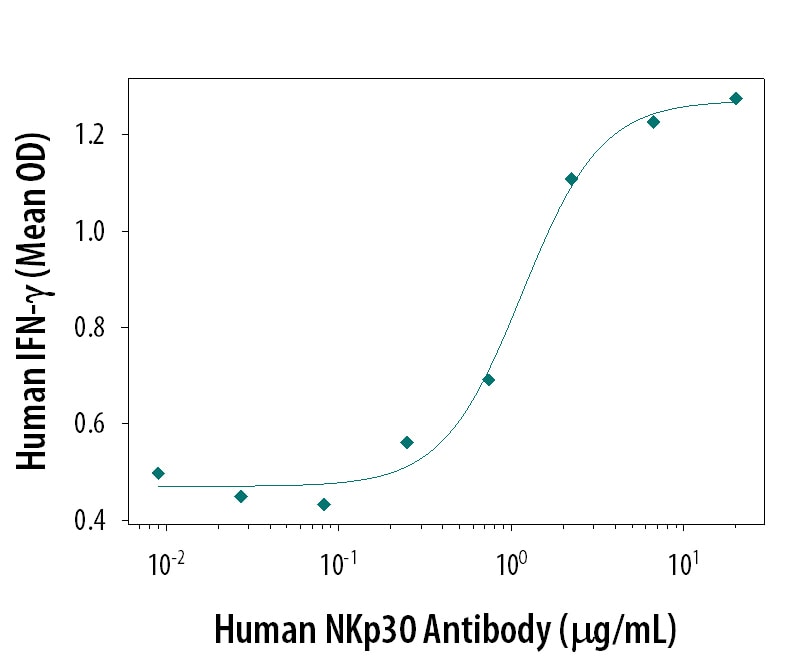
Human NKp30 Antibody Induces IFN‑ gamma Secretion in NK‑92 Cells.
Human NKp30 Monoclonal Antibody induces IFN-gamma secretion in the NK-92 human natural killer lymphoma cell line in a dose-dependent manner, as measured using the Human IFN-gamma DuoSet ELISA Kit (Catalog # DY285B). The ED50 for this effect is typically 0.2-1.2 µg/mL.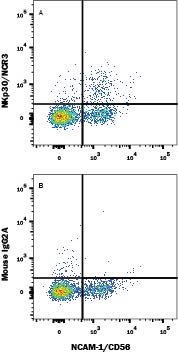
Detection of NKp30/NCR3 in Human Blood Lymphocytes by Flow Cytometry.
Human peripheral blood lymphocytes were stained with either (A) Mouse Anti-Human NKp30/NCR3 Monoclonal Antibody (Catalog # MAB1849) or (B) Mouse IgG2A Isotype Control (MAB003) followed by anti-Mouse IgG APC-conjugated secondary antibody (F0101B) and Mouse Anti-Human NCAM-1/CD56 PE-conjugated Monoclonal Antibody (FAB2408P). Staining was performed using our Staining Membrane-associated Proteins protocol.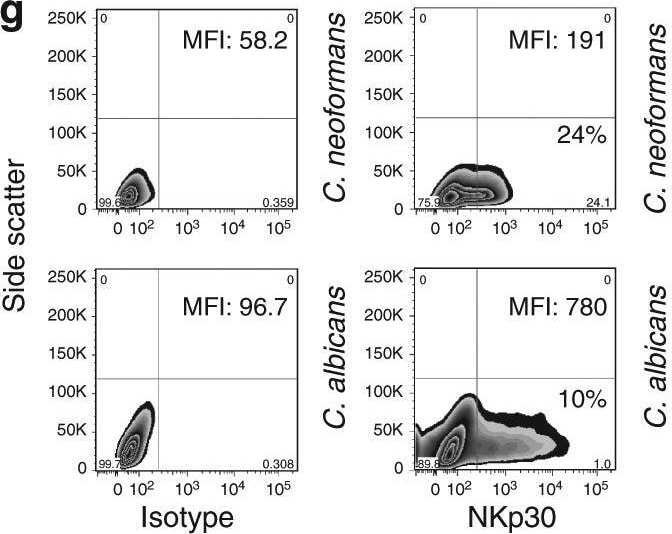
Detection of NKp30/NCR3 by Flow Cytometry
beta -1,3-glucan is required for NKp30-mediated killing of Cryptococcus. g NKp30 binding to C. neoformans vs. C. albicans analyzed using flow cytometry. The experiment was performed twice. Image collected and cropped by CiteAb from the following open publication (https://pubmed.ncbi.nlm.nih.gov/29467448), licensed under a CC-BY license. Not internally tested by R&D Systems.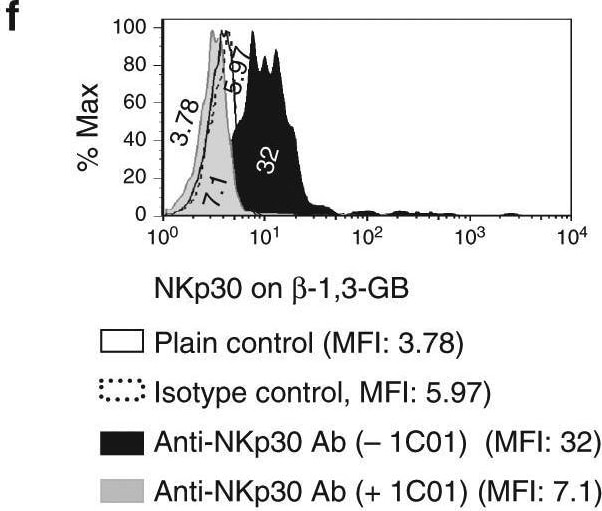
Detection of NKp30/NCR3 by Flow Cytometry
beta -1,3-glucan is required for NKp30-mediated killing of Cryptococcus. f Anti-NKp30 mAb (1C01) blocked NKp30 binding to beta -1,3-GB. Recombinant NKp30 was incubated with 1C01 before being applied to beads conjugated with beta -1,3-glucan. The presence of NKp30 on beta -1,3-GB was detected using the polyclonal anti-NKp30 antibody. Image collected and cropped by CiteAb from the following open publication (https://pubmed.ncbi.nlm.nih.gov/29467448), licensed under a CC-BY license. Not internally tested by R&D Systems.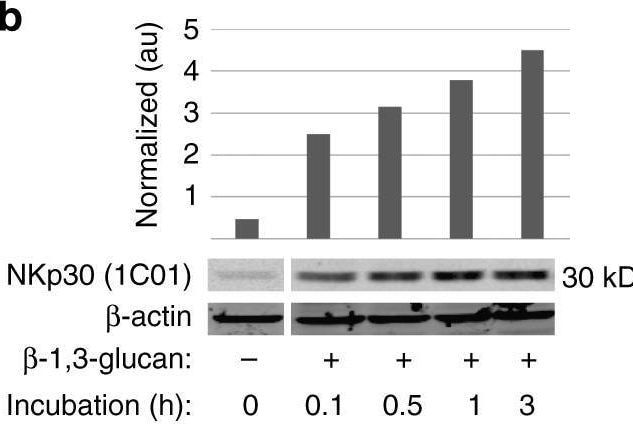
Detection of NKp30/NCR3 by Western Blot
beta -1,3-glucan increases expression & clustering of NKp30 in NK. a NKp30 expression in YT in response to beta -1,3-glucan. YT treated with beta -1,3-glucan (III & IV) & expression of NKp30 using 1C01 was compared to untreated (I), or untreated labeled with isotype control (II). b WB analysis of NKp30 expression in YT in response to beta -1,3-glucan. YT incubated with or without beta -1,3-glucan for various times. The experiment was repeated three times with similar results. c NKp30 labeling at the synapse between a representative single YT cell & a single beta -1,3-glucan-conjugated bead. 1C01 was used to label NKp30. The location of the bead is shown with a white arrow. Bar = 5 µm. d Proximity of NKp30 expression in relation to the radius defined by the center of the IS (n = 21 ) in panel c. The method for determining the angle is illustrated in Supplementary Fig. 6C. Clustering was defined when the peak of fluorescence was at an angle <45° (blue bars in the left). e Frequency of NKp30 clustering of all YT cell conjugates with beta -1,3-glucan-conjugated or unconjugated beads as analyzed in panel c, as defined in panel d. f TIRF microscopic analysis of NKp30 expression at the interface between YT & beta -1,3-glucan or control. YT loaded into a glass chamber that had been coated with beta -1,3-glucan or mannan incubated at 37 °C for 30 min, fixed & stained for NKp30 using 1C01. Bar = 10 µm. g Fluorescent intensity of NKp30 from panel f in arbitrary units. Distance is defined in Supplementary Fig. 6A-B. All experiments repeated three times with similar results. TIRF total internal reflection fluorescence, poly-l-lysine coating alone or mannan coating served as control, Au arbitrary unit, Arrow bead, SD spinning disc microscopy, DIC differential interference contrast digital image, IS immunological synapse Image collected & cropped by CiteAb from the following open publication (https://pubmed.ncbi.nlm.nih.gov/29467448), licensed under a CC-BY license. Not internally tested by R&D Systems.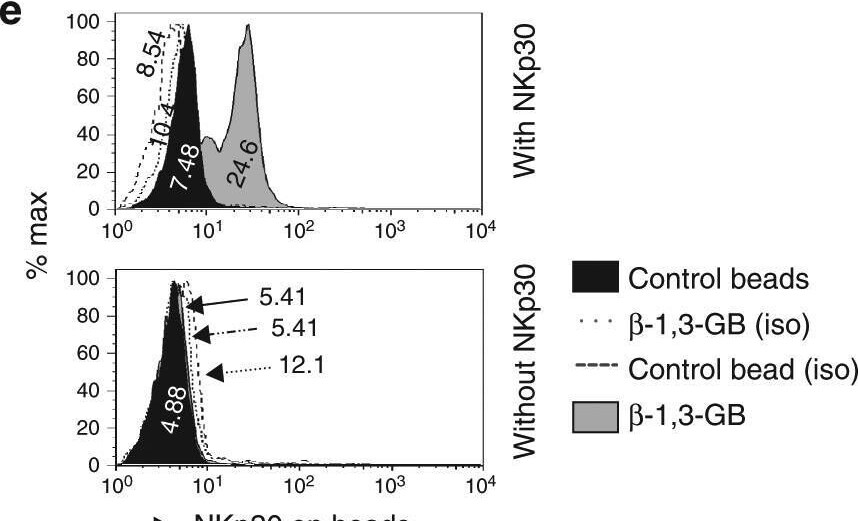
Detection of NKp30/NCR3 by Flow Cytometry
beta -1,3-glucan is required for NKp30-mediated killing of Cryptococcus. e Flow cytometric analysis of a recombinant NKp30-Fc fusion protein binding to beta -glucan-conjugated beads ( beta -1,3-GB) compared to unconjugated polystyrene beads as control. NKp30-Fc on the beads was detected with anti-NKp30 antibody (1C01). Image collected and cropped by CiteAb from the following open publication (https://pubmed.ncbi.nlm.nih.gov/29467448), licensed under a CC-BY license. Not internally tested by R&D Systems.Applications for Human NKp30/NCR3 Antibody (210845)
Agonist Activity
Sample: NK-92 human natural killer lymphoma cell line
CyTOF-ready
Flow Cytometry
Sample: Human whole blood lymphocytes
Flow Cytometry Panel Builder
Bio-Techne Knows Flow Cytometry
Save time and reduce costly mistakes by quickly finding compatible reagents using the Panel Builder Tool.
Advanced Features
- Spectra Viewer - Custom analysis of spectra from multiple fluorochromes
- Spillover Popups - Visualize the spectra of individual fluorochromes
- Antigen Density Selector - Match fluorochrome brightness with antigen density

Formulation, Preparation, and Storage
Purification
Reconstitution
Reconstitute at 0.5 mg/mL in sterile PBS. For liquid material, refer to CoA for concentration.
Formulation
Shipping
Stability & Storage
- 12 months from date of receipt, -20 to -70 °C as supplied.
- 1 month, 2 to 8 °C under sterile conditions after reconstitution.
- 6 months, -20 to -70 °C under sterile conditions after reconstitution.
Calculators
Background: NKp30/NCR3
References
- Moretta, L. and A. Moretta (2004) EMBO J. 23:255.
- Pende, D. et al. (1999) J. Exp. Med. 190:1505.
- Augugliaro, R. et al. (2003) Eur. J. Immunol. 33:1235.
- Ferlazzo, G. et al. (2004) J. Immunol. 172:1455.
- Ferlazzo, G. et al. (2002) J. Exp. Med. 195:343.
Alternate Names
Gene Symbol
Additional NKp30/NCR3 Products
Product Documents for Human NKp30/NCR3 Antibody (210845)
Certificate of Analysis
To download a Certificate of Analysis, please enter a lot or batch number in the search box below.
Note: Certificate of Analysis not available for kit components.
Product Specific Notices for Human NKp30/NCR3 Antibody (210845)
For research use only
Citations for Human NKp30/NCR3 Antibody (210845)
 Powered by Bioz
Customer Reviews for Human NKp30/NCR3 Antibody (210845)
There are currently no reviews for this product. Be the first to review Human NKp30/NCR3 Antibody (210845) and earn rewards!
Have you used Human NKp30/NCR3 Antibody (210845)?
Submit a review and receive an Amazon gift card!
$25/€18/£15/$25CAN/¥2500 for a review with an image
$10/€7/£6/$10CAN/¥1110 for a review without an image
Submit a review
Protocols
Find general support by application which include: protocols, troubleshooting, illustrated assays, videos and webinars.
- 7-Amino Actinomycin D (7-AAD) Cell Viability Flow Cytometry Protocol
- Extracellular Membrane Flow Cytometry Protocol
- Flow Cytometry Protocol for Cell Surface Markers
- Flow Cytometry Protocol for Staining Membrane Associated Proteins
- Flow Cytometry Staining Protocols
- Flow Cytometry Troubleshooting Guide
- Intracellular Flow Cytometry Protocol Using Alcohol (Methanol)
- Intracellular Flow Cytometry Protocol Using Detergents
- Intracellular Nuclear Staining Flow Cytometry Protocol Using Detergents
- Intracellular Staining Flow Cytometry Protocol Using Alcohol Permeabilization
- Intracellular Staining Flow Cytometry Protocol Using Detergents to Permeabilize Cells
- Propidium Iodide Cell Viability Flow Cytometry Protocol
- Protocol for Liperfluo
- Protocol for the Characterization of Human Th22 Cells
- Protocol for the Characterization of Human Th9 Cells
- Protocol: Annexin V and PI Staining by Flow Cytometry
- Protocol: Annexin V and PI Staining for Apoptosis by Flow Cytometry
- Troubleshooting Guide: Fluorokine Flow Cytometry Kits
- View all Protocols, Troubleshooting, Illustrated assays and Webinars
Associated Pathways
