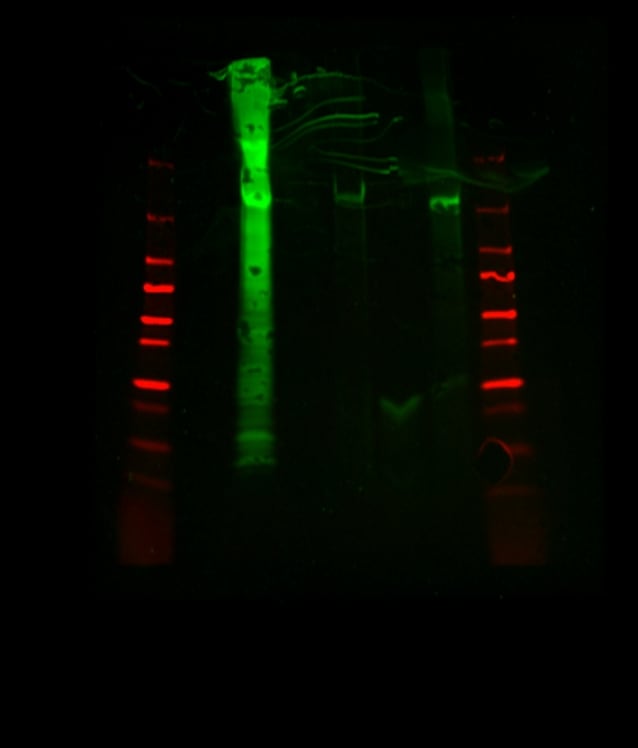
Key Product Details

Species Reactivity

Validated:

Human

Cited:

Human, Xenograft

Applications

Validated:

Western Blot, Blockade of Receptor-ligand Interaction

Cited:

Western Blot, Neutralization, Immunocytochemistry

Label

Unconjugated

Antibody Source

Polyclonal Sheep IgG
Loading...

Product Specifications

Immunogen

Mouse myeloma cell line NS0-derived recombinant human Notch-3
Ala40-Glu467
Accession # Q9UM47

Specificity

Detects human Notch-3 in direct ELISAs and Western blots. In direct ELISAs, approximately 50% cross-reactivity with recombinant mouse Notch-3 is observed and less than 5% cross-reactivity with recombinant human (rh) Notch-1 and rhNotch-2 is observed.

Clonality

Polyclonal

Host

Sheep

Isotype

IgG

Applications for Human Notch‑3 Antibody

Application
Recommended Usage

Blockade of Receptor-ligand Interaction

In a functional ELISA, 1-3 µg/mL of this antibody will block 50% of the binding of 250 ng/mL of Recombinant Rat Jagged 1 Fc Chimera (Catalog # 599-JG) to immobilized Recombinant Human Notch-3 Fc Chimera (Catalog # 1559-NT) coated at 5 µg/mL (100 µL/well). At 10 μg/mL, this antibody will block >90% of the binding.

Western Blot

0.1 µg/mL
Sample: Recombinant Human Notch‑3 Fc Chimera, aa 40-467 (Catalog # 1559-NT)

Reviewed Applications

Read 3 reviews rated 4 using AF1559 in the following applications:

Formulation, Preparation, and Storage

Purification

Antigen Affinity-purified

Reconstitution

Reconstitute at 0.2 mg/mL in sterile PBS. For liquid material, refer to CoA for concentration.


Loading...

Formulation

Lyophilized from a 0.2 μm filtered solution in PBS with Trehalose. *Small pack size (SP) is supplied either lyophilized or as a 0.2 µm filtered solution in PBS.

Shipping

Lyophilized product is shipped at ambient temperature. Liquid small pack size (-SP) is shipped with polar packs. Upon receipt, store immediately at the temperature recommended below.

Stability & Storage

Use a manual defrost freezer and avoid repeated freeze-thaw cycles.
  • 12 months from date of receipt, -20 to -70 °C as supplied.
  • 1 month, 2 to 8 °C under sterile conditions after reconstitution.
  • 6 months, -20 to -70 °C under sterile conditions after reconstitution.

Calculators

The reconstitution calculator allows you to quickly calculate the volume of a reagent to reconstitute your vial. Simply enter the mass of reagent and the target concentration and the calculator will determine the rest.

=
÷

Background: Notch-3

Human Notch-3 is part of the Notch family of type I transmembrane glycoproteins involved in a number of early-event developmental processes (1). The extracellular domain of Notch receptors interact with the extracellular domain of transmembrane ligands Jagged, Delta, and Serrate expressed on the surface of a neighboring cell. In both vertebrates and invertebrates, Notch signaling is important for specifying cell fates and for defining boundaries between different cell types. The Notch molecule is synthesized as a 2321amino acid (aa) precursor that contains an 39 aa signal sequence, a 1603 aa extracellular region, a 21aa transmembrane (TM) segment and a 658 aa cytoplasmic domain. The large Notch extracellular domain has 34 EGF-like repeats followed by three notch/Lin-12 repeats (LNR) (2). The 11th and 12th EGF-like repeats of Notch have been shown to be both necessary and sufficient for binding the ligands Serrate and Delta, in Drosophila (3). Notch-3 has the same biochemical mechanism of signal tranduction as Notch-1, where a series of cleavage events result in the release of the Notch intracellular domain (NICD). NICD translocates into the nucleus and initiates transcription of Notch-responsive genes (4). Thus, Notch acts as both a ligand-binding receptor and a nuclear factor that regulates transcription.

Mutations in Notch-3 in humans cause an autosomal dominant condition called CADASIL (cerebral autosomal dominant arteriopathy with subcortical infarcts and leukoencephalopathy). This disorder is characterized by recurrent ischemic strokes at an early age without any underlying vascular risk and progressive dementia. Nearly all mutations leading to this disorder are clustered in the first 5 EGF repeats of the Notch-3 gene (5). Human Notch-3 shows 90% aa identity to mouse Notch-3 over the entire protein.

References

  1. Weinmaster, G. (2000) Curr. Opin. Genet. Dev. 10:363.
  2. Joutel, A. et al. (1996) Nature 383:707.
  3. Rebay, I. et al. (1991) Cell 67:687.
  4. Mizutani, T. et al. (2001) Proc. Natl. Acad. Sci. USA 98:9026.
  5. Joutel, A. and E. Tounier-Lasserve (1998) Sem Cell & Dev Biol. 9:619.

Alternate Names

Notch3

Entrez Gene IDs

4854 (Human); 18131 (Mouse)

Gene Symbol

NOTCH3

UniProt

Additional Notch-3 Products

Product Documents for Human Notch‑3 Antibody

Certificate of Analysis

To download a Certificate of Analysis, please enter a lot or batch number in the search box below.

Note: Certificate of Analysis not available for kit components.

Product Specific Notices for Human Notch‑3 Antibody

For research use only

Related Research Areas

Citations for Human Notch‑3 Antibody

Customer Reviews for Human Notch‑3 Antibody (3)

4 out of 5
3 Customer Ratings
5 Stars
0%
4 Stars
100%
3 Stars
0%
2 Stars
0%
1 Stars
0%

Have you used Human Notch‑3 Antibody?

Submit a review and receive an Amazon gift card!

$25/€18/£15/$25CAN/¥2500 Yen for a review with an image

$10/€7/£6/$10CAN/¥1110 Yen for a review without an image

Submit a review
Amazon Gift Card

Customer Images


Showing  1 - 3 of 3 reviews Showing All
Filter By:
  • Human Notch-3 Antibody
    Name: Anonymous
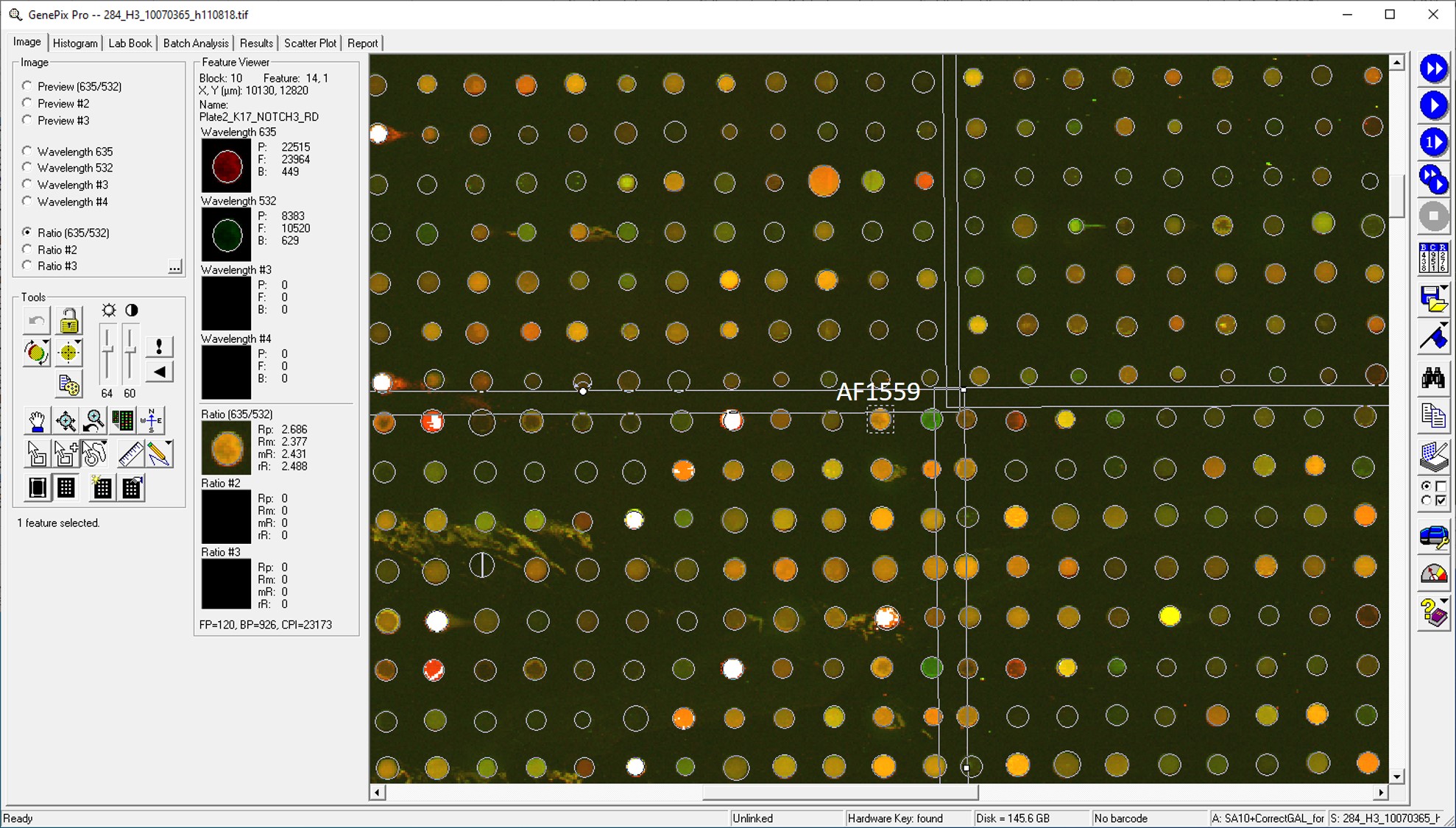
    Application: Microarrays
    Sample Tested: EDTA Plasma
    Species: Human
    Verified Customer | Posted 01/14/2021
    Human Notch‑3 Antibody AF1559
  • Human Notch-3 Antibody
    Name: Anonymous
    Application: Microarrays
    Sample Tested: EDTA Plasma
    Species: Human
    Verified Customer | Posted 11/14/2018
  • Human Notch-3 Antibody
    Name: Anonymous
    Application: Microarray
    Sample Tested: EDTA Plasma
    Species: Human
    Verified Customer | Posted 10/31/2018

There are no reviews that match your criteria.

Showing  1 - 3 of 3 reviews Showing All

FAQs

No product specific FAQs exist for this product.

View all FAQs for Antibodies