


Scientific images may be resized, cropped, or adjusted for brightness or contrast for presentation purposes. These updates are limited to presentation and do not affect the underlying scientific interpretation of the data. Where available, additional source data may be provided upon request.
Key Product Details
Species Reactivity
Validated:
Cited:
Applications
Validated:
Cited:
Label
Antibody Source
Product Specifications
Immunogen
Met1-Gln254
Accession # Q05516
Specificity
Clonality
Host
Isotype
Scientific Data Images for Human PLZF Antibody
Detection of Human PLZF by Western Blot.
Western blot shows lysates of HUVEC human umbilical vein endothelial cells, HEL 92.1.7 human erythroleukemic cell line, LNCaP human prostate cancer cell line, and 293T human embryonic kidney cell line. PVDF membrane was probed with 1 µg/mL of Goat Anti-Human PLZF Antigen Affinity-purified Polyclonal Antibody (Catalog # AF2944) followed by HRP-conjugated Anti-Goat IgG Secondary Antibody (Catalog # HAF019). A specific band was detected for PLZF at approximately 85 kDa (as indicated). This experiment was conducted under reducing conditions and using Immunoblot Buffer Group 1.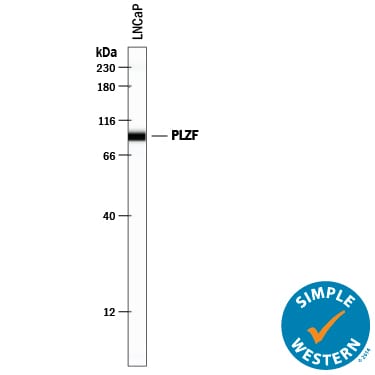
Detection of Human PLZF by Simple WesternTM.
Simple Western lane view shows lysates of LNCaP human prostate cancer cell line, loaded at 0.2 mg/mL. A specific band was detected for PLZF at approximately 94 kDa (as indicated) using 10 µg/mL of Goat Anti-Human PLZF Antigen Affinity-purified Polyclonal Antibody (Catalog # AF2944) followed by 1:50 dilution of HRP-conjugated Anti-Goat IgG Secondary Antibody (Catalog # HAF109). This experiment was conducted under reducing conditions and using the 12-230 kDa separation system.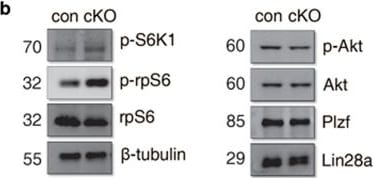
Detection of Mouse PLZF by Western Blot
Increased mTORC1 activity in germ cells from Lkb1 newborn cKO testis. (a) Western blot of testis proteins at different postnatal ages using specific antibodies against p-S6K1 (T389), p-rpS6 (S235/6), rpS6 and beta -tubulin. rpS6, and beta -tubulin were used as internal controls. (b) Expression of PI3K-, mTOR- and SPC-related markers by western blot in P8 testes from control and Lkb1 cKO mice. (c) Immunohistochemistry for VASA, GATA4, p-rpS6 in P8 control testis. (d) Immunohistochemistry for Lin28a and p-rpS6 in P8 control testis. Serial sections were used in order to compare cellular localizations of these markers in the same tubule. Asterisks, different distribution of Lin28a and p-rpS6 in the same tubule resulting in strong positive for Lin28a and weak staining for p-rpS6. Arrows, cells expressing both Lin28a and p-rpS6. (e) Immunohistochemistry for Plzf and p-rpS6 in control and cKO mice. (f) Mean number of Plzf- or p-rpS6-positive cells in each tubule (positive cells/total tubules). The data were shown as mean±S.E.M. of at least three replicates. *P<0.05. Scale bars=50 μm Image collected and cropped by CiteAb from the following publication (https://pubmed.ncbi.nlm.nih.gov/29022902), licensed under a CC-BY license. Not internally tested by R&D Systems.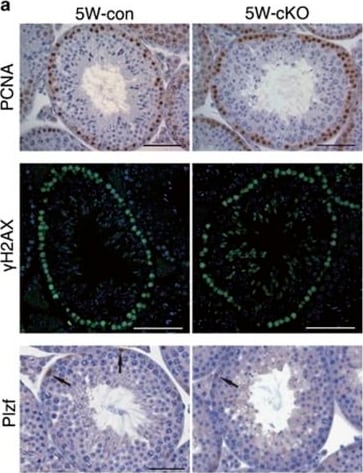
Detection of Mouse PLZF by Immunohistochemistry
Depletion of SPCs in Lkb1 cKO mice. Seminiferous tubules from 5- (a) and 13- (b) week-old control and Lkb1 cKO mice (n=3) were used for immunostaining using specific antibodies against PCNA, gamma H2AX and Plzf. Scale bars=50 μm. Arrows, representative Plzf-positive cells in tubules. (c) Quantification of Plzf-positive germ cells in each tubule. Data are presented as mean±S.E.M. **P < 0. 01 Image collected and cropped by CiteAb from the following publication (https://pubmed.ncbi.nlm.nih.gov/29022902), licensed under a CC-BY license. Not internally tested by R&D Systems.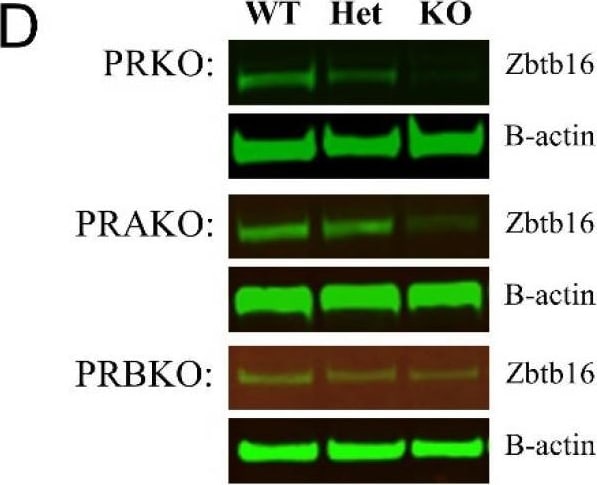
Detection of PLZF by Western Blot
PGR regulates a network of transcription factors in granulosa cells including Pparg and Zbtb16. (A) Heatmap showing expression level of PGR-regulated transcription factors, including DNA-binding transcription factors (bold) and transcription cofactors (not bold). Shown are PRKO (left) and PRWT (right) RNA-seq reads (LCPM) with blue representing low expression levels and red increased expression levels. (B) Expression of Pparg and Zbtb16 in wildtype granulosa cells over a preovulatory time course from 0–12 h post-hCG using CBA-F1 mice. (C) Expression of Pparg and Zbtb16 in granulosa cells of PRKO (left) PRAKO (center) and PRBKO (right) mice at 8 h post-hCG qPCR data normalized to reference gene Rpl19 and expressed as fold change relative to 0 h or WT control. N = 4 biological replicates of cells pooled from ovaries of 3 females. (D) Western blot for ZBTB16 protein in granulosa cells of PRKO, PRAKO and PRBKO mice at 10 h post-hCG. (E) Quantification of Western blot ZBTB16 expression relative to B-actin loading control. N = 3 pools of cells from 3 females. Mean ± SEM, statistical significance determined by one-way ANOVA. * p < 0.05, ** p < 0.01, *** p < 0.001, **** p < 0.0001. Image collected and cropped by CiteAb from the following open publication (https://pubmed.ncbi.nlm.nih.gov/35563869), licensed under a CC-BY license. Not internally tested by R&D Systems.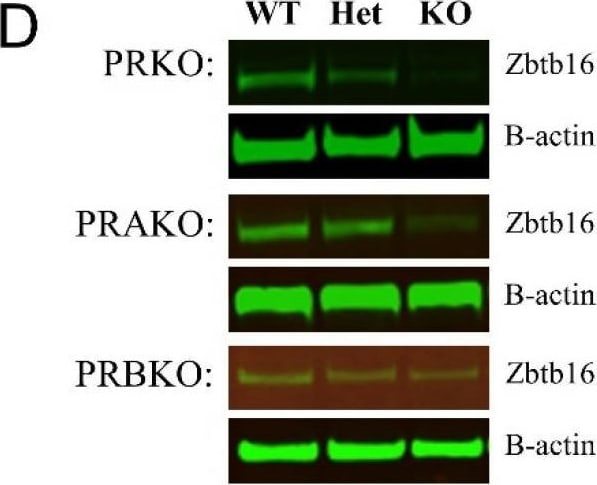
Detection of PLZF by Western Blot
PGR regulates a network of transcription factors in granulosa cells including Pparg and Zbtb16. (A) Heatmap showing expression level of PGR-regulated transcription factors, including DNA-binding transcription factors (bold) and transcription cofactors (not bold). Shown are PRKO (left) and PRWT (right) RNA-seq reads (LCPM) with blue representing low expression levels and red increased expression levels. (B) Expression of Pparg and Zbtb16 in wildtype granulosa cells over a preovulatory time course from 0–12 h post-hCG using CBA-F1 mice. (C) Expression of Pparg and Zbtb16 in granulosa cells of PRKO (left) PRAKO (center) and PRBKO (right) mice at 8 h post-hCG qPCR data normalized to reference gene Rpl19 and expressed as fold change relative to 0 h or WT control. N = 4 biological replicates of cells pooled from ovaries of 3 females. (D) Western blot for ZBTB16 protein in granulosa cells of PRKO, PRAKO and PRBKO mice at 10 h post-hCG. (E) Quantification of Western blot ZBTB16 expression relative to B-actin loading control. N = 3 pools of cells from 3 females. Mean ± SEM, statistical significance determined by one-way ANOVA. * p < 0.05, ** p < 0.01, *** p < 0.001, **** p < 0.0001. Image collected and cropped by CiteAb from the following open publication (https://pubmed.ncbi.nlm.nih.gov/35563869), licensed under a CC-BY license. Not internally tested by R&D Systems.Applications for Human PLZF Antibody
Simple Western
Sample: LNCaP human prostate cancer cell line
Western Blot
Sample: HUVEC human umbilical vein endothelial cells, HEL 92.1.7 human erythroleukemic cell line, LNCaP human prostate cancer cell line, and 293T human embryonic kidney cell line
Formulation, Preparation, and Storage
Purification
Reconstitution
Reconstitute at 0.2 mg/mL in sterile PBS. For liquid material, refer to CoA for concentration.
Formulation
Shipping
Stability & Storage
- 12 months from date of receipt, -20 to -70 °C as supplied.
- 1 month, 2 to 8 °C under sterile conditions after reconstitution.
- 6 months, -20 to -70 °C under sterile conditions after reconstitution.
Calculators
Background: PLZF
Long Name
Alternate Names
Gene Symbol
UniProt
Additional PLZF Products
Product Documents for Human PLZF Antibody
Certificate of Analysis
To download a Certificate of Analysis, please enter a lot or batch number in the search box below.
Note: Certificate of Analysis not available for kit components.
Product Specific Notices for Human PLZF Antibody
For research use only
Citations for Human PLZF Antibody
 Powered by Bioz
Customer Reviews for Human PLZF Antibody
There are currently no reviews for this product. Be the first to review Human PLZF Antibody and earn rewards!
Have you used Human PLZF Antibody?
Submit a review and receive an Amazon gift card!
$25/€18/£15/$25CAN/¥2500 for a review with an image
$10/€7/£6/$10CAN/¥1110 for a review without an image
Submit a review
Protocols
Find general support by application which include: protocols, troubleshooting, illustrated assays, videos and webinars.
- Cellular Response to Hypoxia Protocols
- R&D Systems Quality Control Western Blot Protocol
- Troubleshooting Guide: Western Blot Figures
- Western Blot Conditions
- Western Blot Protocol
- Western Blot Protocol for Cell Lysates
- Western Blot Troubleshooting
- Western Blot Troubleshooting Guide
- View all Protocols, Troubleshooting, Illustrated assays and Webinars
Associated Pathways
