
Semaphorin 4G (Sema4G) is the least characterized of the seven known Class 4 transmembrane semaphorin glycoproteins (1). Class 4 semaphorins have multiple roles in cell attraction or repulsion. These include development of nerve pathways in the brain, promoting or inhibiting proliferation, and in some cases organizing immune cell interactions. Receptors include transmembrane plexins, but alternate receptors, such as CD72 for Sema4D and TIM-2 for Sema4A, have been identified (2, 3). The 838 amino acid (aa) human Sema4G precursor contains a 17 aa signal sequence, a 658 aa extracellular domain (ECD) containing sema and C2-type immunoglobulin domains, a 21 aa transmembrane domain, and a 142 aa cytoplasmic domain with one Ser/Thr phosphorylation site (4). The human Sema4G ECD shares 90%, 92%, 93%, 93% and 92% aa identity with mouse, rat, equine, bovine and canine Sema4G, respectively. It also shares 42% aa identity with Sema4C, the most closely related semaphorin. Two additional isoforms have been reported: an 843 aa form contains a 5 aa insert at aa 542, while a 458 aa form diverges at aa 450 near the end of the Sema domain (5). Sema4G mRNA is expressed early in development in the central and peripheral nervous systems and in sensory organs such as retina, cochlea, vomeronasal organ and olfactory epithelium. In adults, Sema4G mRNA is found in predominantly in the liver, but is also detected in the kidneys and brain. Elevated Sema4G mRNA expression was found in mouse kidney during Plasmodium yoelii infection (6). Sema4G was also identified in a screen for genes that are downregulated in human colorectal cancer (7).

Scientific images may be resized, cropped, or adjusted for brightness or contrast for presentation purposes. These updates are limited to presentation and do not affect the underlying scientific interpretation of the data. Where available, additional source data may be provided upon request.
Key Product Details
Species Reactivity
Applications
Label
Antibody Source
Product Specifications
Immunogen
Val18-Leu675
Accession # Q9NTN9
Specificity
Clonality
Host
Isotype
Scientific Data Images for Human Semaphorin 4G Antibody
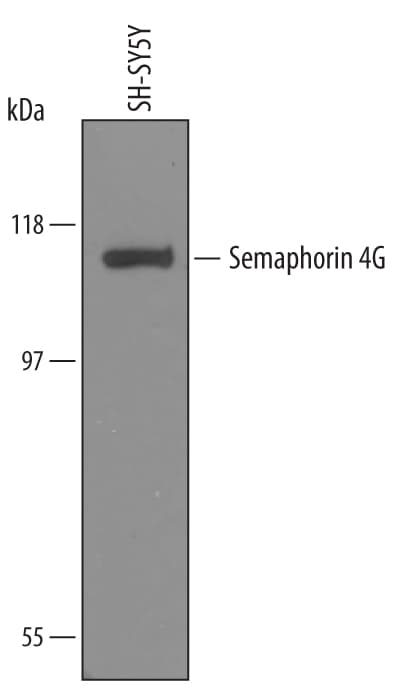
Detection of Human Semaphorin 4G by Western Blot.
Western blot shows lysates of SH-SY5Y human neuroblastoma cell line. PVDF Membrane was probed with 1 µg/mL of Sheep Anti-Human Semaphorin 4G Antigen Affinity-purified Polyclonal Antibody (Catalog # AF5840) followed by HRP-conjugated Anti-Sheep IgG Secondary Antibody (Catalog # HAF016). A specific band was detected for Semaphorin 4G at approximately 115 kDa (as indicated). This experiment was conducted under reducing conditions and using Immunoblot Buffer Group 8.Applications for Human Semaphorin 4G Antibody
Immunohistochemistry
Sample: Perfusion-fixed frozen sections of mouse neural tube
Western Blot
Sample: SH‑SY5Y human neuroblastoma cell line
Formulation, Preparation, and Storage
Purification
Reconstitution
Reconstitute at 0.2 mg/mL in sterile PBS. For liquid material, refer to CoA for concentration.
Formulation
Shipping
Stability & Storage
- 12 months from date of receipt, -20 to -70 °C as supplied.
- 1 month, 2 to 8 °C under sterile conditions after reconstitution.
- 6 months, -20 to -70 °C under sterile conditions after reconstitution.
Calculators
Background: Semaphorin 4G
References
- Li, H. et al. (1999) Mech. Dev. 87:169.
- Halloran, M.C. and M.A. Wolman (2006) Curr. Opin. Cell Biol. 18:533.
- Suzuki, K. et al. (2008) Nat. Immunol. 9:17.
- Swissprot Accession # Q9NTN9.
- Entrez Accession # EAW49803, EAW49802.
- Lao, A.O.T. et al. (2001) J. Immunol. 166:1945.
- Wang, X. et al. (2008) Hepatogastroenterology 55:2039.
Alternate Names
Gene Symbol
UniProt
Additional Semaphorin 4G Products
Product Documents for Human Semaphorin 4G Antibody
Certificate of Analysis
To download a Certificate of Analysis, please enter a lot or batch number in the search box below.
Note: Certificate of Analysis not available for kit components.
Product Specific Notices for Human Semaphorin 4G Antibody
For research use only
Related Research Areas
Customer Reviews for Human Semaphorin 4G Antibody
There are currently no reviews for this product. Be the first to review Human Semaphorin 4G Antibody and earn rewards!
Have you used Human Semaphorin 4G Antibody?
Submit a review and receive an Amazon gift card!
$25/€18/£15/$25CAN/¥2500 for a review with an image
$10/€7/£6/$10CAN/¥1110 for a review without an image
Submit a review
Protocols
Find general support by application which include: protocols, troubleshooting, illustrated assays, videos and webinars.
- Antigen Retrieval Protocol (PIER)
- Antigen Retrieval for Frozen Sections Protocol
- Appropriate Fixation of IHC/ICC Samples
- Cellular Response to Hypoxia Protocols
- Chromogenic IHC Staining of Formalin-Fixed Paraffin-Embedded (FFPE) Tissue Protocol
- Chromogenic Immunohistochemistry Staining of Frozen Tissue
- ClariTSA™ Fluorophore Kits
- Detection & Visualization of Antibody Binding
- Fluorescent IHC Staining of Frozen Tissue Protocol
- Graphic Protocol for Heat-induced Epitope Retrieval
- Graphic Protocol for the Preparation and Fluorescent IHC Staining of Frozen Tissue Sections
- Graphic Protocol for the Preparation and Fluorescent IHC Staining of Paraffin-embedded Tissue Sections
- Graphic Protocol for the Preparation of Gelatin-coated Slides for Histological Tissue Sections
- IHC Sample Preparation (Frozen sections vs Paraffin)
- Immunofluorescent IHC Staining of Formalin-Fixed Paraffin-Embedded (FFPE) Tissue Protocol
- Immunohistochemistry (IHC) and Immunocytochemistry (ICC) Protocols
- Immunohistochemistry Frozen Troubleshooting
- Immunohistochemistry Paraffin Troubleshooting
- Preparing Samples for IHC/ICC Experiments
- Preventing Non-Specific Staining (Non-Specific Binding)
- Primary Antibody Selection & Optimization
- Protocol for Heat-Induced Epitope Retrieval (HIER)
- Protocol for Making a 4% Formaldehyde Solution in PBS
- Protocol for VisUCyte™ HRP Polymer Detection Reagent
- Protocol for the Preparation & Fixation of Cells on Coverslips
- Protocol for the Preparation and Chromogenic IHC Staining of Frozen Tissue Sections
- Protocol for the Preparation and Chromogenic IHC Staining of Frozen Tissue Sections - Graphic
- Protocol for the Preparation and Chromogenic IHC Staining of Paraffin-embedded Tissue Sections
- Protocol for the Preparation and Chromogenic IHC Staining of Paraffin-embedded Tissue Sections - Graphic
- Protocol for the Preparation and Fluorescent IHC Staining of Frozen Tissue Sections
- Protocol for the Preparation and Fluorescent IHC Staining of Paraffin-embedded Tissue Sections
- Protocol for the Preparation of Gelatin-coated Slides for Histological Tissue Sections
- R&D Systems Quality Control Western Blot Protocol
- TUNEL and Active Caspase-3 Detection by IHC/ICC Protocol
- The Importance of IHC/ICC Controls
- Troubleshooting Guide: Immunohistochemistry
- Troubleshooting Guide: Western Blot Figures
- Western Blot Conditions
- Western Blot Protocol
- Western Blot Protocol for Cell Lysates
- Western Blot Troubleshooting
- Western Blot Troubleshooting Guide
- View all Protocols, Troubleshooting, Illustrated assays and Webinars