


Key Product Details

Species Reactivity

Validated:

Human

Cited:

Human

Applications

Validated:

Western Blot, ELISA Detection (Matched Antibody Pair), Flow Cytometry, Immunocytochemistry

Cited:

Western Blot, Neutralization, Flow Cytometry, Immunoprecipitation, Depletion

Label

Biotin

Antibody Source

Polyclonal Goat IgG
Loading...

Product Specifications

Immunogen

Mouse myeloma cell line NS0-derived recombinant human Siglec-9
Gln18-Gly348
Accession # Q9Y336

Specificity

Detects human Siglec‑9 in direct ELISAs and Western blots. In direct ELISAs, less than 0.2% cross-reactivity with recombinant human (rh) Siglec-2, rhSiglec-3, rhSiglec-5, rhSiglec-7, and rhSiglec-10 is observed. In Western blots, approximately 25% cross‑reactivity with rhSiglec-7 is observed, approximately 5% cross‑reactivity with rhSiglec-3 and rhSiglec-5 is observed, and less than 1% cross‑reactivity with rhSiglec-2 is observed.

Clonality

Polyclonal

Host

Goat

Isotype

IgG

Scientific Data Images for Human Siglec‑9 Biotinylated Antibody

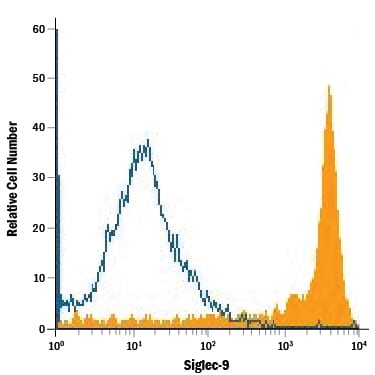
Detection of Siglec‑9 antibody in Human Monocytes antibody by Flow Cytometry.

Detection of Siglec‑9 in Human Monocytes by Flow Cytometry.

Human peripheral blood monocytes were stained with Goat Anti-Human Siglec-9 Biotinylated Antigen Affinity-purified Polyclonal Antibody (Catalog # BAF1139, filled histogram) or isotype control antibody (Catalog # BAF108, open histogram), followed by Streptavidin-Phycoerythrin (Catalog # F0040).
Siglec-9 antibody in Human PBMCs by Immunocytochemistry (ICC).

Siglec‑9 in Human PBMCs.

Siglec-9 was detected in immersion fixed human peripheral blood mononuclear cells (PBMCs) using Goat Anti-Human Siglec-9 Biotinylated Antigen Affinity-purified Polyclonal Antibody (Catalog # BAF1139) at 10 µg/mL for 3 hours at room temperature. Cells were stained using the NorthernLights™ 557-conjugated Streptavidin (yellow; Catalog # NL999) and counterstained with DAPI (blue). View our protocol for Fluorescent ICC Staining of Non-adherent Cells.

Applications for Human Siglec‑9 Biotinylated Antibody

Application
Recommended Usage

Flow Cytometry

0.25 µg/106 cells
Sample: Human peripheral blood monocytes

Immunocytochemistry

5-15 µg/mL
Sample: Immersion fixed human peripheral blood mononuclear cells

Western Blot

0.1 µg/mL
Sample: Recombinant Human Siglec‑9 Fc Chimera (Catalog # 1139-SL)

Human Siglec-9 Sandwich Immunoassay

ELISA Detection (Matched Antibody Pair)
Recommended Concentration: 0.1-0.4 µg/mL
Use in combination with these reagents:
  • Capture Reagent: Human Siglec‑9 Antibody (Catalog # MAB1139)
  • Standard: Recombinant Human Siglec-9 Fc Chimera Protein, CF (Catalog # 1139-SL)
Please Note: Optimal dilutions of this antibody should be experimentally determined.

Flow Cytometry Panel Builder

Bio-Techne Knows Flow Cytometry

Save time and reduce costly mistakes by quickly finding compatible reagents using the Panel Builder Tool.

Advanced Features

  • Spectra Viewer - Custom analysis of spectra from multiple fluorochromes
  • Spillover Popups - Visualize the spectra of individual fluorochromes
  • Antigen Density Selector - Match fluorochrome brightness with antigen density
Build Your Panel Now

Formulation, Preparation, and Storage

Purification

Antigen Affinity-purified

Reconstitution

Reconstitute at 0.2 mg/mL in sterile PBS.


Loading...

Formulation

Lyophilized from a 0.2 μm filtered solution in PBS with BSA as a carrier protein.

Shipping

The product is shipped at ambient temperature. Upon receipt, store it immediately at the temperature recommended below.

Stability & Storage

Use a manual defrost freezer and avoid repeated freeze-thaw cycles.
  • 12 months from date of receipt, -20 to -70 °C as supplied.
  • 1 month, 2 to 8 °C under sterile conditions after reconstitution.
  • 6 months, -20 to -70 °C under sterile conditions after reconstitution.

Calculators

The reconstitution calculator allows you to quickly calculate the volume of a reagent to reconstitute your vial. Simply enter the mass of reagent and the target concentration and the calculator will determine the rest.

=
÷

Background: Siglec-9

Siglecs(1) (sialic acid binding Ig-like lectins) are I-type (Ig-type) lectins belonging to the Ig superfamily. They are characterized by an N-terminal Ig-like V-type domain which mediates sialic acid binding, followed by varying numbers of Ig-like C2-type domains (1, 2). Eleven human Siglecs have been cloned and characterized. They are sialoadhesin/CD169/Siglec-1, CD22/Siglec-2, CD33/Siglec-3, Myelin-Associated Glycoprotein (MAG/Siglec-4a) and Siglec-5 to -11 (1‑4). To date, no Siglec has been shown to recognized any cell surface ligand other than sialic acids, suggesting that interactions with glycans containing this carbohydrate are important in mediating the biological functions of Siglecs. Siglecs 5 to 11 share a high degree of sequence similarity with CD33/Siglec-3 both in their extracellular and intracellular regions. They are collectively referred to as CD33-related Siglecs. One remarkable feature of the CD33-related Siglecs is their differential expression pattern within the hematopoietic system (2, 3). This fact, together with the presence of two conserved immunoreceptor tyrosine-based inhibition motifs (ITIMs) in their cytoplasmic tails, suggests that CD33-related Siglecs are involved in the regulation of cellular activation within the immune system.

The cDNA of human Siglec-9 encodes a 463 amino acid (aa) polypeptide with a hydrophobic signal peptide, an N-terminal Ig-likeV-type domain, two Ig-like C2-type domains, a transmembrane region and a cytoplasmic tail (5, 6). In peripheral blood leukocytes, Siglec-9 is expressed on neutrophils, monocytes, a fraction of NK cells, B cells, and a minor subset of CD8+ T cells (5). It binds equally well to both 2,3- and 2,6-linked sialic acid (5, 6). Siglec-9 is closely related to Siglec-7, and they share ~80% amino acid sequence identity. The gene encoding siglec-9 was mapped to chromosome 19q13.4.

References

  1. Crocker, P.R. et al. (1998) Glycobiology 8:v.
  2. Crocker, P.R. and A. Varki (2001) Trends Immunol. 22:337.
  3. Crocker, P.R. and A. Varki (2001) Immunology 103:137.
  4. Angata, T. et al. (2002) J. Biol. Chem. 277:24466.
  5. Zhang, J.Q. et al. (2000) J. Biol. Chem. 275:22121.
  6. Angata, T. et al. (2000) J. Biol. Chem. 275:22127.

Long Name

Sialic Acid Binding Ig-like Lectin 9

Alternate Names

CD329, OBBP-Like, Siglec9

Entrez Gene IDs

27180 (Human); 102118310 (Cynomolgus Monkey)

Gene Symbol

SIGLEC9

UniProt

Additional Siglec-9 Products

Product Documents for Human Siglec‑9 Biotinylated Antibody

Certificate of Analysis

To download a Certificate of Analysis, please enter a lot or batch number in the search box below.

Note: Certificate of Analysis not available for kit components.

Product Specific Notices for Human Siglec‑9 Biotinylated Antibody

For research use only

Citations for Human Siglec‑9 Biotinylated Antibody

Customer Reviews for Human Siglec‑9 Biotinylated Antibody

There are currently no reviews for this product. Be the first to review Human Siglec‑9 Biotinylated Antibody and earn rewards!

Have you used Human Siglec‑9 Biotinylated Antibody?

Submit a review and receive an Amazon gift card!

$25/€18/£15/$25CAN/¥2500 Yen for a review with an image

$10/€7/£6/$10CAN/¥1110 Yen for a review without an image

Submit a review
Amazon Gift Card

Protocols

Find general support by application which include: protocols, troubleshooting, illustrated assays, videos and webinars.

FAQs

No product specific FAQs exist for this product.

View all FAQs for Antibodies
Loading...
