
TAFA2 (also FAM19A2) is a secreted, 11 kDa member of the FAM19/TAFA family of chemokine-like proteins (1). It is synthesized as a 131 amino acid (aa) precursor that contains a 30 aa signal sequence and a 101 aa mature chain. Like other members of the FAM19/TAFA family, with the exception of TAFA5, mature TAFA1 contains 10 regularly spaced cysteine residues that follow the pattern CX7CCX13CXCX14CX11CX4CX5CX10C, where C represents a conserved cysteine residue and X represents any noncysteine amino acid (1). Human TAFA2 is 97% aa identical to mouse TAFA2 (1). TAFA2 expression can be detected in the central nervous system (CNS), colon, heart, lung, spleen, kidney, and thymus, but its expression in the CNS is 50- to 1000-fold higher than in other tissues (1). Within the CNS, TAFA2 expression is highest in the occipital and frontal cortex (3- to 10-fold more abundantly expressed than in other cortical regions) and medulla (1). The biological functions of TAFA family members remain to be determined, but there are a few tentative hypotheses. First, TAFAs may modulate immune responses in the CNS by functioning as brain-specific chemokines, and may act with other chemokines to optimize the recruitment and activity of immune cells in the CNS (1). Second, TAFAs may represent a novel class of neurokines that act as regulators of immune nervous cells (1 - 2). Finally, TAFAs may control axonal sprouting following brain injury (1).
Human TAFA2/FAM19A2 Antibody
R&D Systems | Catalog # AF4179

Scientific images may be resized, cropped, or adjusted for brightness or contrast for presentation purposes. These updates are limited to presentation and do not affect the underlying scientific interpretation of the data. Where available, additional source data may be provided upon request.
Key Product Details
Species Reactivity
Applications
Label
Antibody Source
Product Specifications
Immunogen
Ala31-His131
Accession # Q8N3H0
Specificity
Clonality
Host
Isotype
Endotoxin Level
Scientific Data Images for Human TAFA2/FAM19A2 Antibody
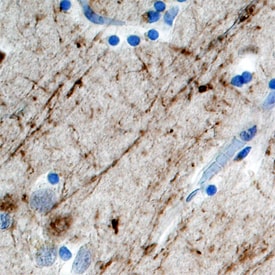
TAFA2/FAM19A2 in Human Brain.
TAFA2/FAM19A2 was detected in immersion fixed paraffin-embedded sections of human brain (cortex) using Human TAFA2/FAM19A2 Antigen Affinity-purified Polyclonal Antibody (Catalog # AF4179) at 10 µg/mL overnight at 4 °C. Before incubation with the primary antibody, tissue was subjected to heat-induced epitope retrieval using Antigen Retrieval Reagent-Basic (Catalog # CTS013). Tissue was stained using the Anti-Sheep HRP-DAB Cell & Tissue Staining Kit (brown; Catalog # CTS019) and counterstained with hematoxylin (blue). Specific staining was localized to neuronal processes. View our protocol for Chromogenic IHC Staining of Paraffin-embedded Tissue Sections.Applications for Human TAFA2/FAM19A2 Antibody
Immunohistochemistry
Sample: Immersion fixed paraffin-embedded sections of human brain (cortex)
Neutralization
Formulation, Preparation, and Storage
Purification
Reconstitution
Reconstitute at 0.2 mg/mL in sterile PBS. For liquid material, refer to CoA for concentration.
Formulation
Shipping
Stability & Storage
- 12 months from date of receipt, -20 to -70 °C as supplied.
- 1 month, 2 to 8 °C under sterile conditions after reconstitution.
- 6 months, -20 to -70 °C under sterile conditions after reconstitution.
Calculators
Background: TAFA2/FAM19A2
References
- Tang, Y.T. et al. (2004) Genomics 83:727.
- Benveniste, E. (1998) Cytokine Growth Factor Rev. 9:259.
Long Name
Alternate Names
Gene Symbol
UniProt
Additional TAFA2/FAM19A2 Products
Product Documents for Human TAFA2/FAM19A2 Antibody
Certificate of Analysis
To download a Certificate of Analysis, please enter a lot or batch number in the search box below.
Note: Certificate of Analysis not available for kit components.
Product Specific Notices for Human TAFA2/FAM19A2 Antibody
For research use only
Citations for Human TAFA2/FAM19A2 Antibody
 Powered by Bioz
Customer Reviews for Human TAFA2/FAM19A2 Antibody
There are currently no reviews for this product. Be the first to review Human TAFA2/FAM19A2 Antibody and earn rewards!
Have you used Human TAFA2/FAM19A2 Antibody?
Submit a review and receive an Amazon gift card!
$25/€18/£15/$25CAN/¥2500 for a review with an image
$10/€7/£6/$10CAN/¥1110 for a review without an image
Submit a review
Protocols
Find general support by application which include: protocols, troubleshooting, illustrated assays, videos and webinars.
- Antigen Retrieval Protocol (PIER)
- Antigen Retrieval for Frozen Sections Protocol
- Appropriate Fixation of IHC/ICC Samples
- Cellular Response to Hypoxia Protocols
- Chromogenic IHC Staining of Formalin-Fixed Paraffin-Embedded (FFPE) Tissue Protocol
- Chromogenic Immunohistochemistry Staining of Frozen Tissue
- ClariTSA™ Fluorophore Kits
- Detection & Visualization of Antibody Binding
- Fluorescent IHC Staining of Frozen Tissue Protocol
- Graphic Protocol for Heat-induced Epitope Retrieval
- Graphic Protocol for the Preparation and Fluorescent IHC Staining of Frozen Tissue Sections
- Graphic Protocol for the Preparation and Fluorescent IHC Staining of Paraffin-embedded Tissue Sections
- Graphic Protocol for the Preparation of Gelatin-coated Slides for Histological Tissue Sections
- IHC Sample Preparation (Frozen sections vs Paraffin)
- Immunofluorescent IHC Staining of Formalin-Fixed Paraffin-Embedded (FFPE) Tissue Protocol
- Immunohistochemistry (IHC) and Immunocytochemistry (ICC) Protocols
- Immunohistochemistry Frozen Troubleshooting
- Immunohistochemistry Paraffin Troubleshooting
- Preparing Samples for IHC/ICC Experiments
- Preventing Non-Specific Staining (Non-Specific Binding)
- Primary Antibody Selection & Optimization
- Protocol for Heat-Induced Epitope Retrieval (HIER)
- Protocol for Making a 4% Formaldehyde Solution in PBS
- Protocol for VisUCyte™ HRP Polymer Detection Reagent
- Protocol for the Preparation & Fixation of Cells on Coverslips
- Protocol for the Preparation and Chromogenic IHC Staining of Frozen Tissue Sections
- Protocol for the Preparation and Chromogenic IHC Staining of Frozen Tissue Sections - Graphic
- Protocol for the Preparation and Chromogenic IHC Staining of Paraffin-embedded Tissue Sections
- Protocol for the Preparation and Chromogenic IHC Staining of Paraffin-embedded Tissue Sections - Graphic
- Protocol for the Preparation and Fluorescent IHC Staining of Frozen Tissue Sections
- Protocol for the Preparation and Fluorescent IHC Staining of Paraffin-embedded Tissue Sections
- Protocol for the Preparation of Gelatin-coated Slides for Histological Tissue Sections
- TUNEL and Active Caspase-3 Detection by IHC/ICC Protocol
- The Importance of IHC/ICC Controls
- Troubleshooting Guide: Immunohistochemistry
- View all Protocols, Troubleshooting, Illustrated assays and Webinars