
Beta IG-H3, also known as TGFBI and RGD-CAP, is a matricellular adaptor protein that is induced in most cell types in response to TGF-beta stimulation (1‑4). The mouse beta IG-H3 cDNA encodes a 683 amino acid (aa) precursor that includes a 23 aa signal sequence, one EMI domain, four FAS1 domains, and one RGD motif (2). Mouse beta IG-H3 shares 91% aa sequence identity with human and porcine beta IG-H3. beta IG-H3 is expressed as a 75 kDa protein with no post-translational additions (5). Following secretion, cleavages at multiple positions near the C-terminal end liberate peptides with pro-apoptotic activity (5, 6). Peptides that encompass the RGD motif contribute to the pro-apoptotic effects of TGF-beta (6). FAS1 domains contain YH motifs that are characterized by conserved Tyr and His residues (7). The YH motifs in each of the FAS1 domains enable beta IG-H3 to bind to matrix fibronectin, collagen I, collagen VI, biglycan, and decorin (3, 8‑11), in addition to cell expressed integrins alpha V/ beta 3, alpha V beta 5, and alpha 3 beta 1 (7, 8, 12, 13). The expression of beta IG-H3 is modulated at particular developmental stages in some cell types. It is upregulated in keratinocytes and immature dendritic cells but downregulated in osteoblasts (8, 12, 14). It promotes keratinocyte differentiation but blocks osteoblast differentiation (8, 12). beta IG-H3 stimulates macrophage endocytosis and vascular endothelial cell proliferation and migration (13, 14). High glucose levels induce beta IG-H3 in renal proximal tubule cells which is predictive of diabetic nephropathy (3). Several point mutations (clustered in the fourth FAS1 domain) of beta IG-H3 are linked to different corneal dystrophies (15). beta IG-H3 is downregulated in many cancers (4, 16) and functions as a suppressor of tumorigenicity when overexpressed (2, 4, 16).

Scientific images may be resized, cropped, or adjusted for brightness or contrast for presentation purposes. These updates are limited to presentation and do not affect the underlying scientific interpretation of the data. Where available, additional source data may be provided upon request.
Key Product Details
Species Reactivity
Applications
Label
Antibody Source
Product Specifications
Immunogen
Gly24-His683
Accession # P82198
Specificity
Clonality
Host
Isotype
Scientific Data Images for Mouse beta IG-H3 Antibody
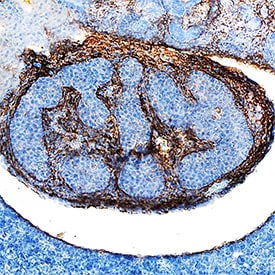
beta IG‑H3 in Mouse Embryo.
beta IG-H3 was detected in immersion fixed frozen sections of mouse embryo (13 d.p.c.) using Sheep Anti-Mouse beta IG-H3 Antigen Affinity-purified Polyclonal Antibody (Catalog # AF2559) at 5 µg/mL overnight at 4 °C. Tissue was stained using the Anti-Goat HRP-DAB Cell & Tissue Staining Kit (brown; Catalog # CTS008) and counterstained with hematoxylin (blue). Specific staining was localized to developing duodenum. View our protocol for Chromogenic IHC Staining of Frozen Tissue Sections.
Mouse beta IG-H3 ELISA Standard Curve
Recombinant Mouse beta IG‑H3 (Catalog # 2559-BG) was serially diluted and captured by Sheep Anti-Mouse beta IG‑H3 Antigen Affinity-purified Polyclonal Antibody (Catalog # AF2559) coated on a Clear Polystyrene Microplate (Catalog # DY990). Sheep Anti-Mouse beta IG‑H3 Antigen Affinity-purified Polyclonal Antibody (Catalog # AF2559) was biotinylated and incubated with the protein captured on the plate. Detection of the standard curve was achieved by incubating Streptavidin-HRP (Catalog # DY998)
Mouse beta IG-H3 ELISA Standard Curve
Recombinant Mouse beta IG‑H3 (Catalog # 2559-BG) was serially diluted and captured by Sheep Anti-Mouse beta IG‑H3 Antigen Affinity-purified Polyclonal Antibody (Catalog # AF2559) coated on a Clear Polystyrene Microplate (Catalog # DY990). Sheep Anti-Mouse beta IG‑H3 Antigen Affinity-purified Polyclonal Antibody (Catalog # AF2559) was biotinylated and incubated with the protein captured on the plate. Detection of the standard curve was achieved by incubating Streptavidin-HRP (Catalog # DY998)Applications for Mouse beta IG-H3 Antibody
Immunohistochemistry
Sample: Immersion fixed frozen sections of mouse embryo (13 d.p.c.)
Western Blot
Sample: Recombinant Mouse beta IG-H3 (Catalog # 2559-BG)
Mouse beta IG-H3 Sandwich Immunoassay
Formulation, Preparation, and Storage
Purification
Reconstitution
Reconstitute at 0.2 mg/mL in sterile PBS. For liquid material, refer to CoA for concentration.
Formulation
Shipping
Stability & Storage
- 12 months from date of receipt, -20 to -70 °C as supplied.
- 1 month, 2 to 8 °C under sterile conditions after reconstitution.
- 6 months, -20 to -70 °C under sterile conditions after reconstitution.
Calculators
Background: beta IG-H3
References
- Skonier, J. et al. (1992) DNA Cell Biol. 11:511.
- Skonier, J. et al. (1994) DNA Cell Biol. 13:571.
- Lee, S-H. et al. (2003) Kidney Int. 64:1012.
- Zhao, Y.L. et al. (2002) Oncogene 21:7471.
- Andersen, R.B. et al. (2004) Biochemistry 43:16374.
- Kim, J-E. et al. (2003) Oncogene 22:2045.
- Kim, J-E. et al. (2002) J. Biol. Chem. 277:46159.
- Thapa, N. et al. (2005) Bone 36:232.
- Hanssen, E. et al. (2003) J. Biol. Chem. 278:24334.
- Billings, P.C. et al. (2002) J. Biol. Chem. 277:28003.
- Reinboth, B. et al. (2006) J. Biol. Chem. 281:7816.
- Oh, J-E. et al. (2005) J. Biol. Chem. 280:21629.
- Nam, J-O. et al. (2003) J. Biol. Chem. 278:25902.
- Cao, W. et al. (2006) Blood 107:2777.
- Stewart, H.S. et al. (1999) Hum. Mutat. 14:126.
- Zhao, Y. et al. (2006) Mol. Carcinog. 45:84.
Long Name
Alternate Names
Gene Symbol
UniProt
Additional beta IG-H3 Products
Product Documents for Mouse beta IG-H3 Antibody
Certificate of Analysis
To download a Certificate of Analysis, please enter a lot or batch number in the search box below.
Note: Certificate of Analysis not available for kit components.
Product Specific Notices for Mouse beta IG-H3 Antibody
For research use only
Related Research Areas
Customer Reviews for Mouse beta IG-H3 Antibody
There are currently no reviews for this product. Be the first to review Mouse beta IG-H3 Antibody and earn rewards!
Have you used Mouse beta IG-H3 Antibody?
Submit a review and receive an Amazon gift card!
$25/€18/£15/$25CAN/¥2500 for a review with an image
$10/€7/£6/$10CAN/¥1110 for a review without an image
Submit a review
Protocols
Find general support by application which include: protocols, troubleshooting, illustrated assays, videos and webinars.
- Antigen Retrieval Protocol (PIER)
- Antigen Retrieval for Frozen Sections Protocol
- Appropriate Fixation of IHC/ICC Samples
- Cellular Response to Hypoxia Protocols
- Chromogenic IHC Staining of Formalin-Fixed Paraffin-Embedded (FFPE) Tissue Protocol
- Chromogenic Immunohistochemistry Staining of Frozen Tissue
- ClariTSA™ Fluorophore Kits
- Detection & Visualization of Antibody Binding
- Fluorescent IHC Staining of Frozen Tissue Protocol
- Graphic Protocol for Heat-induced Epitope Retrieval
- Graphic Protocol for the Preparation and Fluorescent IHC Staining of Frozen Tissue Sections
- Graphic Protocol for the Preparation and Fluorescent IHC Staining of Paraffin-embedded Tissue Sections
- Graphic Protocol for the Preparation of Gelatin-coated Slides for Histological Tissue Sections
- IHC Sample Preparation (Frozen sections vs Paraffin)
- Immunofluorescent IHC Staining of Formalin-Fixed Paraffin-Embedded (FFPE) Tissue Protocol
- Immunohistochemistry (IHC) and Immunocytochemistry (ICC) Protocols
- Immunohistochemistry Frozen Troubleshooting
- Immunohistochemistry Paraffin Troubleshooting
- Preparing Samples for IHC/ICC Experiments
- Preventing Non-Specific Staining (Non-Specific Binding)
- Primary Antibody Selection & Optimization
- Protocol for Heat-Induced Epitope Retrieval (HIER)
- Protocol for Making a 4% Formaldehyde Solution in PBS
- Protocol for VisUCyte™ HRP Polymer Detection Reagent
- Protocol for the Preparation & Fixation of Cells on Coverslips
- Protocol for the Preparation and Chromogenic IHC Staining of Frozen Tissue Sections
- Protocol for the Preparation and Chromogenic IHC Staining of Frozen Tissue Sections - Graphic
- Protocol for the Preparation and Chromogenic IHC Staining of Paraffin-embedded Tissue Sections
- Protocol for the Preparation and Chromogenic IHC Staining of Paraffin-embedded Tissue Sections - Graphic
- Protocol for the Preparation and Fluorescent IHC Staining of Frozen Tissue Sections
- Protocol for the Preparation and Fluorescent IHC Staining of Paraffin-embedded Tissue Sections
- Protocol for the Preparation of Gelatin-coated Slides for Histological Tissue Sections
- R&D Systems Quality Control Western Blot Protocol
- TUNEL and Active Caspase-3 Detection by IHC/ICC Protocol
- The Importance of IHC/ICC Controls
- Troubleshooting Guide: Immunohistochemistry
- Troubleshooting Guide: Western Blot Figures
- Western Blot Conditions
- Western Blot Protocol
- Western Blot Protocol for Cell Lysates
- Western Blot Troubleshooting
- Western Blot Troubleshooting Guide
- View all Protocols, Troubleshooting, Illustrated assays and Webinars