

Key Product Details

Validated by

Biological Validation

Species Reactivity

Mouse

Applications

Immunohistochemistry, Western Blot

Label

Unconjugated

Antibody Source

Polyclonal Sheep IgG
Loading...

Product Specifications

Immunogen

Chinese hamster ovary cell line CHO-derived recombinant mouse MSP/MST1
Gly19-Gly716 (Cys677Ala)
Accession # NP_032269

Specificity

Detects mouse MSP/MST1 in direct ELISAs and Western blots. In direct ELISAs, approximately 15% cross-reactivity with recombinant human MSP is observed.

Clonality

Polyclonal

Host

Sheep

Isotype

IgG

Scientific Data Images for Mouse MSP/MST1 Antibody

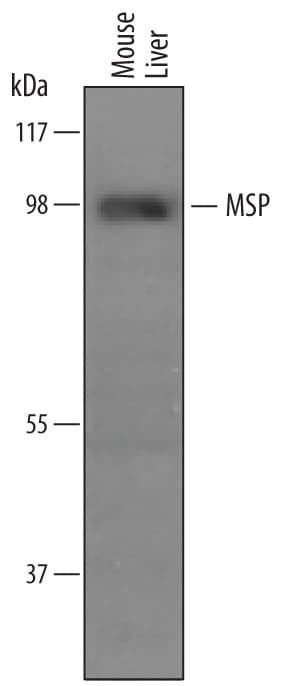
Detection of Mouse MSP/MST1 antibody by Western Blot.

Detection of Mouse MSP/MST1 by Western Blot.

Western blot shows lysates of mouse liver tissue. PVDF membrane was probed with 1 µg/mL of Sheep Anti-Mouse MSP/MST1 Antigen Affinity-purified Polyclonal Antibody (Catalog # AF6244) followed by HRP-conjugated Anti-Sheep IgG Secondary Antibody (Catalog # HAF016). A specific band was detected for MSP/MST1 at approximately 96 kDa (as indicated). This experiment was conducted under reducing conditions and using Immunoblot Buffer Group 8.

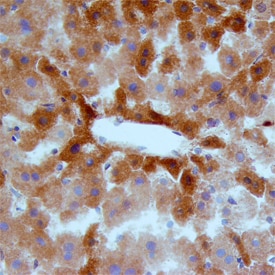
MSP/MST1 antibody in Mouse Liver by Immunohistochemistry (IHC-Fr).

MSP/MST1 in Mouse Liver.

MSP/MST1 was detected in perfusion fixed frozen sections of mouse liver using Sheep Anti-Mouse MSP/MST1 Antigen Affinity-purified Polyclonal Antibody (Catalog # AF6244) at 15 µg/mL overnight at 4 °C. Tissue was stained using the Anti-Sheep HRP-DAB Cell & Tissue Staining Kit (brown; Catalog # CTS019) and counterstained with hematoxylin (blue). Specific staining was localized to hepatocytes. View our protocol for Chromogenic IHC Staining of Frozen Tissue Sections.

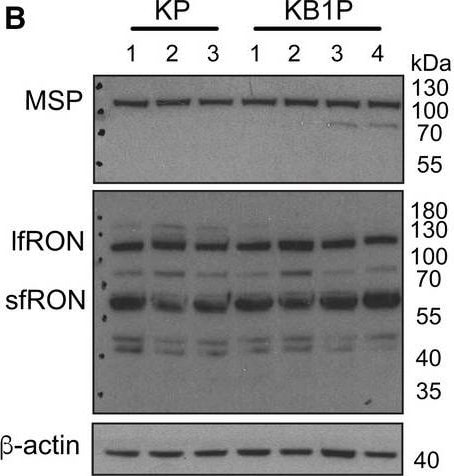
Detection of Mouse MSP/MST1 by Western Blot

Detection of Mouse MSP/MST1 by Western Blot

MSP stimulates AKT and MAPK signaling pathways through the RON receptor. (A) Mst1r mRNA expression assessed by qRT–PCR in cell lines derived from three KP tumors and four KB1P tumors, respectively. (B) Western blot analysis of RON protein expression in the same cell lines used in A. beta ‐Actin was used as sample integrity control (same sample, different blot). (C) Western blot analysis of indicated proteins in the same KP and KB1P cell lines used in A, B. Cells were pretreated with 1 μm BMS‐777607 for 1 h prior to 100 ng·mL−1 recombinant MSP for 1 h where denoted. Images are representative of three replicate experiments. Total AKT and ERK were probed on the same blot as sample integrity controls. (D) Two KB1P cell lines were transduced with lentiviral shRNA vectors against Mst1r mRNA (shRON‐1 or shRON‐2) or control pLKO.1 vector. Confirmation of Mst1r mRNA knockdown quantified by qRT–PCR is expressed as relative to two housekeeping genes, Hprt and beta ‐actin (each dot represents one technical replicate in a given experiment, the experiment was repeated three times for each cell line). (E) Two independent KB1P cell lines transduced with control or shRNA vectors against Mst1r mRNA were treated with 100 ng·mL−1 recombinant MSP for 1 h. Activation of AKT and ERK1/2 was assessed by western blot. Images are representative of three replicate transduction experiments. Data are represented as mean ± SD. **P < 0.01 as determined by one‐way ANOVA followed by Dunn’s post hoc test. n.s., not significant. Image collected and cropped by CiteAb from the following publication (https://pubmed.ncbi.nlm.nih.gov/32484599), licensed under a CC-BY license. Not internally tested by R&D Systems.
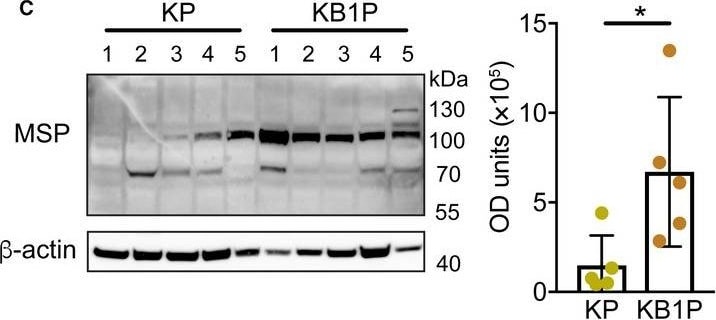
Detection of Mouse MSP/MST1 by Western Blot

Detection of Mouse MSP/MST1 by Western Blot

MSP and RON are upregulated in tumors from KB1P mice. (A) Mst1 and Mst1r mRNA expression in normal MG (from three individual mice), KP tumors (n = 44) and KB1P tumors (n = 41) analyzed by RNA sequencing. Boxplots represent the median, and 25th and 75th percentiles. (B) Mst1 and Mst1r mRNA expression in KP and KB1P tumors assessed by qRT–PCR (n = 7/group). (C) Western blot analysis of MSP expression in KP and KB1P tumors with densitometric quantification. Numbers above the blot represent individual tumors. Each dot represents one donor tumor from one mouse. (D) MSP serum levels in tumor‐free, WT (n = 5) mice, tumor‐bearing KP (n = 6) mice, and tumor‐bearing KB1P (n = 6) mice assessed by ELISA. (E) Western blot analysis of RON protein expression in KP and KB1P tumors (same samples as in C) with densitometric quantification. Numbers above the blot represent individual tumors. Each dot represents one donor tumor from one mouse. For C and E, beta ‐actin was used as sample integrity control (same sample, different blot). Data are represented as mean ± SD. *P < 0.05, **P < 0.01, ***P < 0.001 as determined by Mann–Whitney U‐test (A, B, C, E) or one‐way ANOVA followed by Dunn’s post hoc test (D). n.s., not significant. Image collected and cropped by CiteAb from the following publication (https://pubmed.ncbi.nlm.nih.gov/32484599), licensed under a CC-BY license. Not internally tested by R&D Systems.

Applications for Mouse MSP/MST1 Antibody

Application
Recommended Usage

Immunohistochemistry

5-15 µg/mL
Sample: Perfusion fixed frozen sections of mouse liver

Western Blot

1 µg/mL
Sample: Mouse liver tissue

Formulation, Preparation, and Storage

Purification

Antigen Affinity-purified

Reconstitution

Sterile PBS to a final concentration of 0.2 mg/mL. For liquid material, refer to CoA for concentration.


Loading...

Formulation

Lyophilized from a 0.2 μm filtered solution in PBS with Trehalose. *Small pack size (SP) is supplied either lyophilized or as a 0.2 µm filtered solution in PBS.

Shipping

Lyophilized product is shipped at ambient temperature. Liquid small pack size (-SP) is shipped with polar packs. Upon receipt, store immediately at the temperature recommended below.

Stability & Storage

Use a manual defrost freezer and avoid repeated freeze-thaw cycles.
  • 12 months from date of receipt, -20 to -70 °C as supplied.
  • 1 month, 2 to 8 °C under sterile conditions after reconstitution.
  • 6 months, -20 to -70 °C under sterile conditions after reconstitution.

Calculators

The reconstitution calculator allows you to quickly calculate the volume of a reagent to reconstitute your vial. Simply enter the mass of reagent and the target concentration and the calculator will determine the rest.

=
÷

Background: MSP/MST1

MSP (Macrophage stimulating protein 1; also hepatocyte growth factor-like protein) is an 80-95 kDa member of the peptidase S1 family of proteins. Although it is expressed principally by hepatocytes, it can also be induced in cells such as renal tubular epithelium. MSP has multiple targets, and as such, has multiple effects. It stimulates macrophage motility and phagocytosis, promotes keratinocyte and renal tubular cell proliferation, and depresses myeloid progenitor cell replication. Mouse proMSP is 698 amino acids (aa) in length. It contains one PAN (carbohydrate-binding) site (aa 19-105), four consecutive kringle domains (110-457) and an inactive peptidase S1 region (aa 489-714). An intrachain disulfide bond exists between Cys477 and Cys593 that becomes an interchain bond following protease cleavage between Arg488 and Val489. This creates a mature heterodimer containing a 45-57 kDa alpha -chain, and a 30-35 kDa beta -chain. Mouse proMSP shares 80% and 93% aa identity with human and rat proMSP, respectively.


Long Name

Macrophage Stimulating Protein/Macrophage Stimulating 1 [Hepatocyte Growth Factor-like]

Alternate Names

HGFL, MST1, SF2

Entrez Gene IDs

4485 (Human); 15235 (Mouse); 24566 (Rat)

Gene Symbol

MST1

UniProt

Additional MSP/MST1 Products

Product Documents for Mouse MSP/MST1 Antibody

Certificate of Analysis

To download a Certificate of Analysis, please enter a lot or batch number in the search box below.

Note: Certificate of Analysis not available for kit components.

Product Specific Notices for Mouse MSP/MST1 Antibody

For research use only

Related Research Areas

Citations for Mouse MSP/MST1 Antibody

Customer Reviews for Mouse MSP/MST1 Antibody

There are currently no reviews for this product. Be the first to review Mouse MSP/MST1 Antibody and earn rewards!

Have you used Mouse MSP/MST1 Antibody?

Submit a review and receive an Amazon gift card!

$25/€18/£15/$25CAN/¥2500 Yen for a review with an image

$10/€7/£6/$10CAN/¥1110 Yen for a review without an image

Submit a review
Amazon Gift Card

Protocols

Find general support by application which include: protocols, troubleshooting, illustrated assays, videos and webinars.

FAQs

No product specific FAQs exist for this product.

View all FAQs for Antibodies
